
On this page
- What the LMIA-Based Work Permit Covers — Canada LMIA work permit
- Bringing Your Spouse and Children
- Fees and Processing Times
- When to Get Professional Help
- Conditions and Portability
- Path to Permanent Residence
- The Dual-Track Application
- What Your Employer Must Do
- Renewal and Extension
- Eligibility Requirements
- Common Petition Challenges
- What documents do I need for an LMIA work permit?
- How long will my application take?
- Fees
- Required forms
- Related visa types
- Related guides
- Related goals
- Next steps
What the LMIA-Based Work Permit Covers — Canada LMIA work permit
#An LMIA-based work permit allows you to work in Canada only after your employer secures a positive Labour Market Impact Assessment.
You receive an employer-specific authorization tied to a particular job and employer.
Purpose and administering bodies
The LMIA-based process involves two federal authorities:
| Authority | Role in the Process |
|---|---|
| Employment and Social Development Canada (ESDC) | Assesses the Labour Market Impact Assessment (LMIA) |
| Immigration, Refugees and Citizenship Canada (IRCC) | Processes your Work Permit (Employer-Specific) application |
Your employer must first obtain a positive LMIA from ESDC.
This assessment confirms that hiring you will not negatively affect the Canadian labour market.
After approval, you apply to IRCC for an employer-specific work permit.
You typically submit Form IMM 1295 and supporting documents as required by IRCC.
Your work permit limits you to:
- The named employer
- The approved position
- The conditions set out in the permit
Some employers may apply under streams such as the Global Talent Stream (GTS), but the requirement for a positive LMIA remains central to this category.
How it protects the Canadian labour market
The LMIA exists to protect Canadian workers.
ESDC evaluates whether hiring a foreign worker will have a neutral or positive impact on the job market.
A positive LMIA confirms that:
- The employer met the required criteria
- Hiring you will not negatively affect Canadian job opportunities
Without this approval, IRCC will not issue your employer-specific work permit.
This structure separates responsibilities.
ESDC assesses labour market impact.
IRCC determines whether you qualify for the actual work permit.
Holding an LMIA-based work permit does not automatically place you into permanent residence programs such as:
Those are separate pathways with their own eligibility rules.
Approval is not guaranteed
Filing an LMIA application does not guarantee that ESDC will approve it.
If ESDC refuses the LMIA, you cannot obtain the related work permit.
Even with a positive LMIA, IRCC still reviews your application independently.
You must:
-
Submit a complete IMM 1295 application
-
Meet IRCC’s admissibility and eligibility requirements
-
Comply with all permit conditions
IRCC may refuse your work permit if you do not meet its criteria.
You should not make plans based solely on an LMIA filing.
Approval depends on both ESDC’s labour market assessment and IRCC’s final decision on your employer-specific work permit.
Bringing Your Spouse and Children
#You can include your spouse and dependent children in your Canada LMIA work permit process if you meet IRCC’s documentation and timing rules.
Pay close attention to proof of relationship, synchronized medical validity, and special processing considerations for minors outside Canada.
Who qualifies as a dependant
IRCC requires clear proof of your relationship to each family member you include.
For a spouse, you must provide your marriage licence or marriage certificate with the application.
Submit this document when you file your Work Permit (Employer-Specific) application, including if you apply using Form IMM 1295.
Children must qualify as dependants under IRCC’s rules at the time you apply.
If a family member does not meet eligibility requirements, IRCC can refuse that person’s application even if your LMIA-based work permit is approved.
You must also ensure that:
- Each family member completes required forms.
- All required documents are submitted together.
- Medical results, if required, remain valid at the same time.
IRCC assesses each applicant individually.
One ineligible family member can affect overall processing but does not automatically cancel your own work permit.
Group and family application rules
Most LMIA-based family applications are filed together, but special fee rules apply only in limited cases.
IRCC offers a maximum group work permit processing fee only when:
| Requirement | Condition |
|---|---|
| Group size | Three or more applicants |
| Occupation | Performing artists and their staff |
| Filing method | Apply at the same time and place |
This group rule does not apply to typical LMIA workers under streams such as the Global Talent Stream (GTS).
If you apply as a family, you generally:
-
Submit applications together.
-
Pay applicable fees per person.
-
Ensure documents are complete for each applicant.
Future immigration pathways such as Express Entry (Federal Skilled Worker) or the Canadian Experience Class (CEC) have separate family rules and do not change your LMIA family application requirements.
Medicals and minor-specific timing
If medical exams are required, every person’s results must be valid at the same time.
IRCC can delay or refuse an application if one family member’s medical expires before a decision is made.
Coordinate appointments carefully so validity periods align across all applicants.
If you apply for a minor (under 18) who lives outside Canada, processing times may differ from adult applications.
IRCC may take additional time to review identity, consent, and location-specific requirements.
Plan for:
- Valid medical results for all family members simultaneously.
- Extra processing time for minors outside Canada.
- Complete and consistent documentation for each applicant.
CBSA will assess admissibility at the border, but IRCC determines permit approval before travel.
Fees and Processing Times
#You must pay government fees when you submit your LMIA-based work permit application.
Expect several months for a decision in most standard cases.
Costs and timelines depend on your category and where you apply.
You need to verify current figures with Immigration, Refugees and Citizenship Canada (IRCC) before you file.
Application and biometrics fees
When you apply for an employer-specific work permit using Form Form IMM 1295, IRCC charges a processing fee.
As of February 2026, the amounts are:
| Fee type | Amount (CAD) |
|---|---|
| Work Permit (Employer-Specific) application fee | CA$155 |
| Biometrics services fee | CA$85 |
You pay the work permit fee when you submit your application to IRCC.
Most applicants must also pay the biometrics fee and provide fingerprints and a photo at a designated collection point.
Biometrics are required even if your employer obtained a positive LMIA, including under streams such as the Global Talent Stream (GTS).
The LMIA and the work permit are separate processes, and each carries its own requirements and costs.
If you later apply for permanent residence through programs such as the Canadian Experience Class (CEC) or Express Entry (Federal Skilled Worker), different fees will apply.
Check the IRCC fee list before you submit any new application.
Standard processing estimates
As of March 2026, standard processing times for an LMIA-based work permit range from 2 to 5 months.
The exact timeline depends on:
- Your country of residence
- The visa office processing your file
- The work permit category
This estimate applies to typical cases and does not guarantee approval within that period.
Applications under specific streams, including the Global Talent Stream (GTS), may follow different employer-side LMIA timelines, but your work permit processing time still depends on IRCC’s posted estimates for your location.
Times can change without notice based on application volumes and operational capacity.
Where to verify current fees and times
You should confirm all fees and timelines directly with Immigration, Refugees and Citizenship Canada (IRCC) before submitting Form IMM 1295.
Processing times are country-specific, and fees may be updated.
IRCC manages work permit applications and publishes current service standards.
The Canada Border Services Agency (CBSA) handles admissibility at the port of entry, but it does not set application fees or standard processing times.
When to Get Professional Help
#
An LMIA-based application involves both your employer and Immigration, Refugees and Citizenship Canada (IRCC).
You must submit the correct forms, follow official instructions, and include complete documents to avoid refusal or delay.
Start with employer support
Your employer plays a central role in an LMIA-based Work Permit (Employer-Specific) application.
You should first confirm that your employer understands their responsibilities and provides accurate, consistent information that matches your work permit application.
Ask your employer to confirm:
- The exact job title and duties
- The work location
- The duration of employment
- Any supporting documents you must include
You must complete Form IMM 1295 carefully and ensure that your answers align with the employer’s details.
Inconsistencies between your form and employer documents often cause problems.
Before seeking outside help, review the official IRCC instructions and confirm that:
- Every required document appears in your checklist
- All forms are complete and signed where required
- Information matches across all documents
If your employer has experience with LMIA processes or streams such as the Global Talent Stream (GTS), their internal HR or legal team may already provide structured guidance.
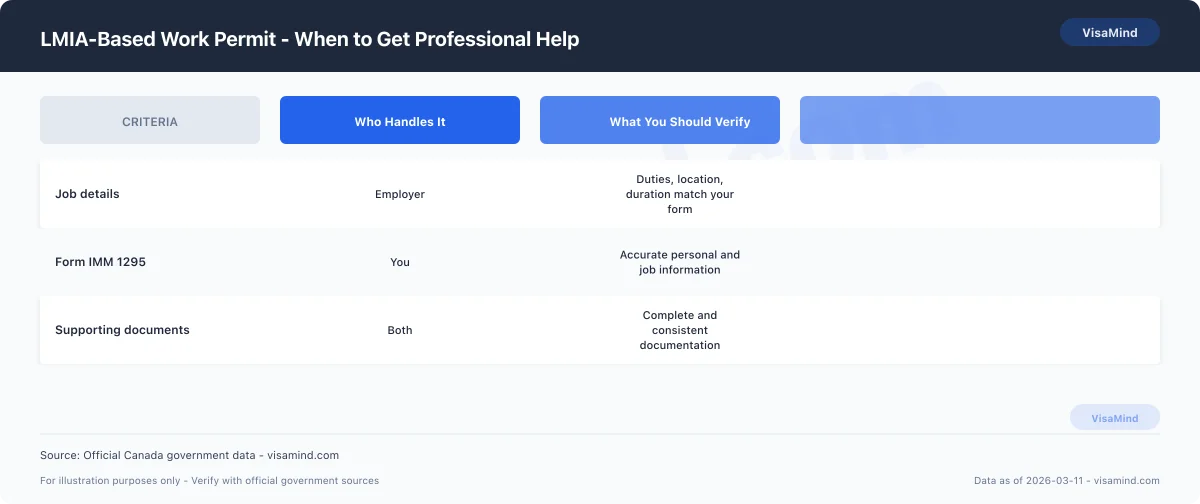
| Step | Who Handles It | What You Should Verify |
|---|---|---|
| Job details | Employer | Duties, location, duration match your form |
| Form IMM 1295 | You | Accurate personal and job information |
| Supporting documents | Both | Complete and consistent documentation |
Situations that may need an adviser
You should consider professional help if your case involves more than a straightforward employer-specific permit.
Seek advice if:
- You previously had a refusal from IRCC
- You plan to transition later to permanent residence through Express Entry (Federal Skilled Worker) or the Canadian Experience Class (CEC)
- Your job conditions or employer details changed after the LMIA
- You are unsure how to disclose past immigration history
An adviser can help you assess how your work permit strategy fits into long-term plans, especially if you intend to use Canadian work experience for future permanent residence programs.
You should also seek help if you struggle to interpret IRCC instructions or feel uncertain about document requirements.
Missing or incorrect documentation can delay processing or lead to refusal.
Practical expert advice
An experienced immigration professional focuses on accuracy and consistency.
They review your full application package, not just individual forms.
Expect structured guidance such as:
-
A document checklist tailored to your situation
-
A line-by-line review of IMM 1295
-
Cross-checking employer documents against your statements
-
Clear instructions on organizing your submission
They also help you present your employment details clearly so IRCC can assess eligibility without confusion.
Professional help does not replace your responsibility.
You must provide truthful and complete information.
However, careful review before submission reduces avoidable errors and helps you follow IRCC’s official instructions precisely.
Conditions and Portability
#An LMIA-based permit ties you to specific job terms.
You must work within the approved role, wage, and employer listed on your documents.
Job details, duties and salary
Your Work Permit (Employer-Specific) limits you to the employer, position, and location approved by Immigration, Refugees and Citizenship Canada (IRCC).
The LMIA and your permit must match on core terms.
Key details must include:
- Job title
- Main duties and responsibilities
- Offered wage or salary
- Work location
You must perform the duties described in the LMIA.
If your employer changes your role, reduces your salary, or moves you to a different location, the original approval may no longer cover your work.
When you apply for the work permit, you submit Form IMM 1295 and include the LMIA confirmation.
IRCC reviews whether the job terms align with the LMIA decision.
If you want to change employers, you generally need a new LMIA and a new employer-specific work permit before starting the new job.
Wage thresholds and provincial proof
Your employer must show that the wage offered meets the provincial or territorial wage threshold for the position.
The wage level forms part of the LMIA assessment.
You should confirm that your offer includes:
- The exact hourly wage or annual salary
- The province or territory of employment
- Evidence that the wage meets the applicable threshold
The wage must remain consistent with what the LMIA approved.
If your employer lowers your pay below the approved rate, you risk falling out of compliance with your permit conditions.
Keep copies of your job offer, LMIA confirmation, and pay records.
IRCC assesses compliance with the approved wage when reviewing future applications, including permanent residence pathways such as the Canadian Experience Class (CEC) or Express Entry (Federal Skilled Worker).
Choosing the right LMIA stream
Your employer must select the correct LMIA stream before you apply for a work permit. The stream affects how Employment and Social Development Canada reviews the position.
Common LMIA-related pathways include:
| Stream or Pathway | When It Is Used | Key Consideration |
|---|---|---|
| Standard LMIA stream | Most employer-sponsored roles | Must match job title, duties, and wage |
| Global Talent Stream (GTS) | Certain specialized positions | Faster processing framework |
| LMIA supporting Express Entry | Permanent residence under Express Entry (Federal Skilled Worker) | Must align with Express Entry profile |
The LMIA stream needs to fit your long-term plan. For example, if you want to apply under the Canadian Experience Class (CEC) later, your job duties and wage must support skilled work experience that meets program requirements.
Choosing the wrong stream can delay your work permit or affect permanent residence options.
Path to Permanent Residence
#An LMIA-based Employer-Specific Work Permit can help you qualify for permanent residence if you gain the right Canadian work experience. You must keep valid status while building eligibility and submit your PR application through the correct IRCC program.
Interim travel/document pathways
You must keep your temporary status valid while working toward permanent residence. Your Work Permit (Employer-Specific) ties you to the employer named in the LMIA, so you can't change employers without a new LMIA and permit approval from Immigration, Refugees and Citizenship Canada (IRCC).
When you apply for your work permit from outside Canada, you submit Form IMM 1295 to IRCC.
If approved, you receive documents that allow you to travel to Canada and request entry from the Canada Border Services Agency (CBSA).
- Your work permit must remain valid until you receive permanent residence.
- You must comply with the conditions printed on your permit.
- CBSA officers decide admissibility at the port of entry.
- A new job usually requires a new LMIA and work permit approval.
If you work under the Global Talent Stream (GTS), you still hold an employer-specific permit. The same status rules apply while you build Canadian work experience for PR programs managed by IRCC.
Common PR programs after work experience
Most LMIA work permit holders transition through Express Entry programs managed by IRCC.
The two most common pathways are:
| Program | Who It Targets | Key Factor |
|---|---|---|
| Canadian Experience Class (CEC) | Workers with skilled Canadian work experience | Canadian work history |
| Express Entry (Federal Skilled Worker) | Skilled workers with foreign and/or Canadian experience | Points-based selection |
You may qualify for the Canadian Experience Class (CEC) if you gain eligible skilled work experience in Canada under your LMIA-based permit. Your experience must meet IRCC’s skill and duration requirements at the time you apply.
You may also qualify under the Express Entry (Federal Skilled Worker) program if you meet selection criteria based on:
- Work experience
- Education
- Language ability
- Other ranking factors under Express Entry
You create an Express Entry profile and receive a score. If IRCC issues you an invitation to apply, you submit a complete permanent residence application within the required deadline.
Your Canadian work experience under an LMIA can strengthen your ranking profile and improve your competitiveness in Express Entry draws.
The Dual-Track Application
#You complete two separate but connected processes: the employer secures a positive Labour Market Impact Assessment (LMIA), and you apply to Immigration, Refugees and Citizenship Canada (IRCC) for your employer-specific work permit. Each track has its own forms, documents, and submission system.
Employer LMIA application
Your employer must apply for an LMIA before you can request a Work Permit (Employer-Specific). The LMIA confirms the job offer and supports your permit application.
Employers submit the LMIA through LMIA Online. They must create and use a Job Bank account to access and manage the application.
Key employer actions include:
- Creating a Job Bank account
- Completing the LMIA application in LMIA Online
- Uploading all required supporting documents
- Submitting the application electronically
If the position falls under the Global Talent Stream (GTS), the employer still follows the LMIA process, but under the specific GTS category requirements.
You can't file your work permit without the LMIA outcome. Confirm that your employer has submitted the LMIA properly before you prepare your application.
| Step | Who Completes It | Platform |
|---|---|---|
| LMIA submission | Employer | LMIA Online |
| Job Bank setup | Employer | Job Bank system |
Worker work-permit application
Once the LMIA process moves forward, you submit your work permit application to IRCC. If you apply from outside Canada, you must complete Application for Work Permit Made Outside of Canada (Form IMM 1295).
Each person who needs a work permit must complete their own IMM 1295 form.
-
Download the current IMM 1295 and its guide from IRCC.
-
Review the instructions for your eligibility category.
-
Complete every required field accurately.
-
Sign and submit the form with supporting documents to IRCC.
Your application must match the LMIA details, including the employer name and position. IRCC assesses your eligibility for the employer-specific work permit.
If you later pursue permanent residence through Express Entry (Federal Skilled Worker), Canadian Experience Class (CEC), or another pathway, this work permit may support your future profile, but it does not replace those programs.
| Form | Who Completes It | Authority |
|---|---|---|
| IMM 1295 | Worker | IRCC |
Key steps before you file
You reduce delays when you prepare both tracks carefully.
Before submitting anything:
- Confirm the employer is using the correct LMIA stream (including GTS if applicable).
- Ensure all LMIA information matches your job offer.
- Download the latest IMM 1295 from IRCC.
- Review the instruction guide for your category.
- Gather all required evidence before submission.
Do not rely on outdated forms or incomplete documentation. IRCC processes the work permit based on what you submit, and missing information can slow or interrupt your application.
What Your Employer Must Do
#Your employer must secure a valid Labour Market Impact Assessment (LMIA), choose the correct stream, and meet ongoing compliance duties under the Temporary Foreign Worker Program (TFWP). IRCC will assess these steps when you apply for an employer‑specific Work Permit.
LMIA and stream selection
Your employer must apply for a Labour Market Impact Assessment (LMIA) before you submit your Work Permit (Employer-Specific) application to IRCC. The LMIA confirms that hiring a temporary foreign worker is permitted under the appropriate stream.
The employer must determine which type of LMIA applies to the position. This includes selecting the correct stream, such as the Global Talent Stream (GTS) where applicable, based on the nature of the job and hiring needs.
The LMIA must match:
| Requirement | What It Must Reflect |
|---|---|
| Job offer | The actual position you will fill |
| Stream selection | The correct LMIA category for the role |
| Work permit type | Employer-specific conditions |
You can't use an LMIA issued for a different role or stream. IRCC will compare the LMIA details with your Form IMM 1295 work permit application to confirm consistency.
An LMIA tied to temporary work does not automatically grant permanent residence. Programs such as the Canadian Experience Class (CEC) or Express Entry (Federal Skilled Worker) operate separately.
Compliance history and obligations
Your employer’s compliance history directly affects the LMIA decision. Authorities review any past instances of non-compliance under the Temporary Foreign Worker Program.
If the employer previously failed to meet program requirements, that history can impact whether a new LMIA is approved. A clean compliance record supports the application.
Ongoing obligations continue after you receive your work permit. Your employer must:
- Follow the conditions set under the approved LMIA
- Meet all employer obligations under the TFWP
- Maintain compliance throughout your employment
IRCC assesses your work permit application, but employer compliance forms the foundation of that review.
Employer evidence requirements
Your employer must provide evidence to support the LMIA request. The documentation must show that hiring you aligns with the selected LMIA stream and program rules.
The evidence must clearly correspond to:
-
The job being offered
-
The LMIA stream selected
-
The employer’s compliance record
Inconsistent or incomplete information can delay or undermine the LMIA process.
When you apply for your Work Permit (Employer-Specific) using IMM 1295, IRCC expects the employer’s LMIA documentation to support every key detail of the job offer. If the employer does not meet these requirements, IRCC may refuse the work permit application.
Renewal and Extension
#You must apply to extend your employer-specific work permit before it expires. IRCC charges a set fee per person, and family applications follow specific limits.
Fees for renewals and group limits
IRCC charges CA$155 per person for a work permit extension, including renewals of an employer-specific work permit. This fee applies to each applicant.
If your family applies together, a maximum total of CA$500 applies when:
- All family members apply at the same time
- All applications are submitted in the same place
- Your children meet the definition of dependent children
| Application Type | Fee (CAD) |
|---|---|
| Work permit extension (per person) | CA$155 |
| Maximum family fee (if eligible) | CA$500 |
You submit your extension application to IRCC. If you apply from outside Canada, you use Form IMM 1295 as part of your work permit application package.
If you hold a permit under the Global Talent Stream (GTS) or another LMIA-based category, the same extension fee applies. The fee structure does not change based on your occupation or stream.
When to start the renewal process
You must file your extension application before your current permit expires. IRCC will not extend a permit that has already lapsed.
Start preparing early by:
-
Confirming that your employer still supports your continued employment under the same LMIA conditions.
-
Checking your current permit’s expiry date.
-
Reviewing IRCC’s current forms and document checklist.
If you plan to transition to permanent residence through programs such as the Canadian Experience Class (CEC) or Express Entry (Federal Skilled Worker), make sure your work authorization remains valid during processing. A pending permanent residence application does not automatically extend your work permit.
Submit your extension to IRCC with the required form and fee. Don’t wait until the last minute, as processing times can vary. Review IRCC’s processing times and instructions before you apply.
Eligibility Requirements
#You must provide accurate identity details and clear contact information when you apply for a Canada LMIA-based Work Permit (Employer-Specific). Immigration, Refugees and Citizenship Canada (IRCC) reviews this information to confirm who you are and how to reach you during processing.
Personal information and admissibility items
IRCC requires complete and truthful personal details in your work permit application, including Form IMM 1295. Incomplete or inconsistent information can delay processing or lead to refusal.
You must provide:
- Your full legal name, date of birth, and country of citizenship
- Passport details
- Telephone number and email address
- Employment details related to your LMIA-supported job offer
- Financial information, if requested
- Medical information, if required
You may also need to disclose your Social Insurance Number (SIN) if you have previously worked in Canada.
IRCC assesses admissibility based on the information you provide. The Canada Border Services Agency (CBSA) makes final admissibility decisions at the port of entry.
If you apply under specialized streams such as the Global Talent Stream (GTS), or if you later pursue permanent residence through programs like the Canadian Experience Class (CEC) or Express Entry (Federal Skilled Worker), your personal history must remain consistent across all applications.
| Item Category | What You Must Provide | Reviewed By |
|---|---|---|
| Identity | Legal name, DOB, passport details | IRCC |
| Employment | LMIA-supported job details | IRCC |
| Medical (if required) | Health information or exam results | IRCC |
| Admissibility | Background information | IRCC / CBSA |
Provide complete and accurate answers in every section.
Address and contact details
You must list your current residential address and mailing address in your application. If you use a Post Office Box, clearly indicate it as your mailing address.
Include:
- Full street address (or rural route, if applicable)
- City, province or state, and postal code
- Country of residence
- Valid telephone number
- Active email address
IRCC uses your email and mailing address to send correspondence, requests for documents, and decisions. If your contact details change after submission, you must update them promptly through your IRCC account.
Do not provide outdated or third-party contact details unless you have formally authorized a representative. Incorrect address information can delay your Employer-Specific Work Permit or cause you to miss important deadlines.
Common Petition Challenges
#Most LMIA work permit problems arise from missing approvals, incomplete forms, or outdated documents. You can prevent many refusals and delays by submitting a complete and accurate package to Immigration, Refugees and Citizenship Canada (IRCC) the first time.
Top reasons for refusal
IRCC will not approve a Work Permit (Employer-Specific) if the employer fails to secure a positive Labour Market Impact Assessment (LMIA) before hiring you. Submitting a work permit application without that approval leads to refusal.
Officers also refuse cases when the LMIA application itself contains errors. An incorrectly completed form can result in the LMIA being refused or not processed, which directly affects your work permit.
Insufficient job details create another problem. If the employer does not provide:
- A clear job description
- Specific employment terms
- A signed employment contract
IRCC may determine that the position lacks required detail. That gap can stop both standard LMIA applications and streams such as the Global Talent Stream (GTS).
| Issue | Result |
|---|---|
| No positive LMIA | Work permit refusal |
| Incorrect LMIA form | Refusal or return without processing |
| Missing job details | Processing delays or refusal |
| No employment contract | Application considered incomplete |
A refused work permit can disrupt your overall immigration timeline if you later plan to apply through Express Entry (Federal Skilled Worker) or the Canadian Experience Class (CEC).
How small mistakes cause delays
Minor errors often trigger major delays. Incomplete or inconsistent information forces IRCC to pause processing.
You create risk when you:
-
Leave fields blank on Form IMM 1295
-
Enter inconsistent job titles or employment terms
-
Submit documents that do not match the LMIA details
Even one missing answer can result in the application being returned. That restarts your timeline and may affect your job start date.
Small discrepancies between the LMIA approval and your work permit application also slow review. Officers compare the documents closely.
If duties, wages, or conditions do not align, IRCC may request clarification or refuse the application.
Accuracy matters more than volume. A complete and consistent file moves faster than a rushed submission.
Avoiding expired forms and omissions
Using an outdated form version is a common and avoidable mistake. IRCC updates forms such as IMM 1295, and older editions may not be accepted.
Before you submit, confirm that:
- Every form is the current version
- All required signatures appear
- The employment contract is included
- Every required document listed in the instructions is attached
Omitting the employment contract can result in refusal or return. IRCC expects clear evidence of agreed employment terms.
You should review each page line by line before submission. A final verification against the official IRCC document checklist reduces the risk of return, delay, or refusal.
What documents do I need for an LMIA work permit?
#You must submit a complete application to Immigration, Refugees and Citizenship Canada (IRCC) with the correct forms and supporting evidence. Missing signatures, barcodes, or employer documents will delay or return your file.
At minimum, you apply for an Employer-Specific Work Permit and include documents that match the details in your approved LMIA and job offer.
Core documents typically include:
- Completed Form IMM 1295 (Application for Work Permit Made Outside Canada), if you apply from outside Canada
- Copy of your positive LMIA
- Job offer or employment contract that matches the LMIA
- Proof of your identity (passport biographical page)
- Proof you meet the job requirements (education, work experience, licences if required)
- Digital photo, if requested by IRCC
| Document | Who Provides It | Why It Matters |
|---|---|---|
| Positive LMIA | Employer | Confirms the job was approved for a foreign worker |
| Job offer/contract | Employer | Sets out wages, duties, and conditions |
| IMM 1295 | You | Forms the basis of your work permit request |
| Proof of qualifications | You | Shows you meet the LMIA job requirements |
Your LMIA work permit is separate from permanent residence programs such as Express Entry (Federal Skilled Worker) or the Canadian Experience Class (CEC). Do not mix document sets unless you are applying under both processes.
Form validation and barcode tips
Complete IMM 1295 electronically. After you fill in all required fields, use the “Validate” button to generate barcode pages.
You must submit those barcode pages with your application. If the form does not validate, IRCC may return your application as incomplete.
Follow these steps:
-
Answer every required question.
-
Ensure employment details match the LMIA exactly.
-
Validate the form to create barcodes.
-
Upload or include all barcode pages as instructed.
Do not alter barcode pages. Do not scan a handwritten form unless IRCC specifically allows it.
If you apply under a stream such as the Global Talent Stream (GTS), ensure the employer information in IMM 1295 matches the LMIA issued under that stream.
Extra documents employers or IRCC may request
IRCC may request additional documents after you submit your application. Respond within the deadline shown in your online account.
You may need to provide:
- Updated employment letters
- Additional proof of work experience
- Copies of professional licences or registrations
- Clarified job duties if they differ from the LMIA
- Additional identity documents
Your employer may also need to confirm details directly with IRCC if information in the LMIA or job offer appears inconsistent.
CBSA officers assess admissibility when you enter Canada. Bring copies of your LMIA, job offer, and work permit approval letter when you travel.
Keep your documents consistent across all applications, including any future permanent residence file under Express Entry or the Canadian Experience Class. Inconsistent job titles, dates, or duties create delays.
How long will my application take?
#Your processing time depends on when IRCC receives your complete application and the category you apply under. IRCC measures time from receipt of a full file to a final decision, not from the day you start preparing forms such as Form IMM 1295.
Expect different timelines based on location, volume, and whether your case requires extra review.
How IRCC calculates processing time
IRCC calculates processing time from the date it receives your complete application to the date it makes a decision. If you submit an incomplete Employer-Specific Work Permit application, the clock does not start until you provide all required documents.
IRCC publishes estimated processing times based on:
- The month and year you applied
- The number of applications in that category
- Annual immigration levels and intake limits
These are estimates, not guarantees.
| Key Point | What It Means for You |
|---|---|
| Start date | The day IRCC receives your complete application |
| End date | The day IRCC makes a decision |
| Estimate basis | Applications submitted in the same month/year |
| Volume impact | Higher intake can increase wait times |
If application volumes exceed annual targets, processing may slow. This affects temporary permits as well as permanent residence programs such as the Canadian Experience Class (CEC) and Express Entry (Federal Skilled Worker).
Country-, province- and category-specific notes
Processing times vary depending on where you apply from and the type of work permit you request.
If you apply from outside Canada or the United States, add 3 to 4 months for mailing and document transit time. This is separate from IRCC’s published processing estimate.
Certain regions may not have reliable processing estimates. IRCC has stated that it cannot provide accurate timelines in some situations due to evolving regional conditions.
Your work permit category also matters:
- Work Permit (Employer-Specific) applications follow standard processing estimates.
- Global Talent Stream (GTS) cases may follow different service standards, but you must verify current timelines directly with IRCC.
Always select the correct country and permit type when checking processing times, as each combination produces a different estimate.
Mailing time, non-routine reviews, and exceptions
If you live outside Canada and the United States, you must factor in 3 to 4 additional months for mailing time. This applies even if IRCC’s online tool shows a shorter processing estimate.
IRCC may also take longer to finalize a non-routine application. A file becomes non-routine if it requires:
- Additional background checks
- Further document verification
- Review beyond standard processing steps
In these cases, IRCC does not commit to the standard estimate.
Processing times can also change if more people apply than Canada plans to admit in a given year. When intake exceeds annual targets, delays increase across categories.
Submit a complete and accurate application, including all required forms such as IMM 1295, to avoid preventable delays.
Fees
#| Component | Amount |
|---|---|
| Filing fee (IMM-1295)Work permit (outside Canada). | CA$155 (approx $113 USD) |
| BiometricsBiometrics: CA$85 (approx $62 USD) (as of 2026-02). Verify the current fee on the official schedule before filing. | CA$85 (approx $62 USD) |
Fees change; always verify on IRCC.
Next steps
#Use Find My Visa to build a sequenced plan with official sources and deadlines.
FAQs
Can an LMIA work permit lead to permanent residence?
It can support certain immigration pathways, depending on your profile.
- Program: Canadian Experience Class (CEC). Managed By: IRCC. Requires Express Entry Profile: Yes
- Program: Express Entry (Federal Skilled Worker). Managed By: IRCC. Requires Express Entry Profile: Yes
You must meet the eligibility criteria of the permanent residence program you choose.
Is the Global Talent Stream different?
The Global Talent Stream (GTS) is part of the LMIA process for certain high-demand roles.
Your employer applies under this stream if the position qualifies.
What fees apply?
You need to pay the required CAD (CA$) work permit processing fees.
Refer to the IRCC fee schedule for the current amounts before you submit your application.
What is a Canada LMIA work permit?
The LMIA-Based Work Permit allows employers to hire temporary foreign workers once they meet criteria set by ESDC and IRCC and ensures hiring a foreign worker will not negatively impact the Canadian job market. A positive Labour Market Impact Assessment (LMIA) is generally required. Filing does not guarantee approval.
Do I need a positive LMIA to apply?
Eligibility to hire a temporary foreign worker depends on obtaining a positive Labour Market Impact Assessment (LMIA).
Which forms do applicants use to apply for a work permit from outside Canada?
Applicants use the Application for Work Permit Made Outside of Canada (Form IMM 1295); each person who needs a work permit must fill out this form and the form is used by applicants filing with IRCC.
What fees should I expect to pay?
The filing fee (IMM-1295) is CA$155 (approx $113 USD) and the biometrics services fee is CA$85 (approx $62 USD) as of February 2026.
How long does an LMIA-based work permit application usually take?
Processing time for an LMIA-work-permit under the 'Standard' category is typically 2 to 5 months; processing times vary by category and location and should be verified with the issuing authority.
What documents and information are commonly required?
Commonly required items include validated application forms (Form IMM 1295 barcode), detailed information about the offered position (job title, duties, salary), and extra documents such as residence documents that IRCC or the employer may request.
What are frequent reasons for refusals or delays?
Frequent issues include failing to get a positive LMIA before hiring, incorrectly completing the LMIA application form, not providing detailed job descriptions and employment terms, using an expired form version, and omitting an employment contract; incomplete or incorrect information commonly causes delays.
What should the employer provide as part of their obligations?
Employers must follow LMIA-related requirements, provide their compliance history and evidence, determine the appropriate LMIA type/stream for hiring a temporary foreign worker, and ensure compliance with employer obligations under the Temporary Foreign Worker Program (TFWP).
Can this work permit lead to permanent residence?
Common next steps after this visa include applying for a Work Permit (Employer-Specific) and then pathways such as the Canadian Experience Class (CEC) or Express Entry (Federal Skilled Worker) toward permanent residence.
VisaMind provides informational guidance only and is not a government agency. This is not legal advice. Requirements can change and eligibility depends on your specific facts. If your case is complex or high-stakes, consult a licensed immigration attorney.
Next steps
Every Canada visa case depends on your nationality, purpose, and timeline. Get a personalized plan with official sources and deadlines.
Get my LMIA-Based Work Permit plan