On this page
- Who Can You Sponsor?
- What Counts as Evidence
- The Financial Bar for Sponsors
- How to Apply for Family Sponsorship
- How Long the Process Takes
- Why Family Visas Get Denied
- Your Status During Processing
- Conditions After Approval
- From Family Visa to PR
- Real Scenarios
- Visa options for this goal
- Guides for Germany
- Other goals for Germany
Who Can You Sponsor?
#To sponsor a family member for reunion in Germany, your relative must already hold legal residency in the country, ensuring adherence to Germany's immigration framework. Below is a comparison of who you can sponsor and the relationships that qualify under the family reunion category.
| Family Member | Eligibility Requirements |
|---|---|
| Spouse | A legally recognized marriage or civil partnership is required. Proof of relationship such as a marriage certificate must be provided. |
| De Facto Partner | Must demonstrate a long-term relationship akin to a marriage. Documentation proving cohabitation or a shared life is necessary. |
| Children | Minors under 18 years old qualify. Birth certificates and proof of custody, if applicable, are needed. |
| Parents | If you are a minor residing in Germany, you may sponsor your parents. Appropriate documentation, like birth certificates, is required. |
| Other Dependents | Includes family members who rely on you for financial support. Evidence of dependency is essential. |
Eligibility Criteria for Sponsorship
To sponsor a family member for a reunion in Germany, your relative must already possess a legitimate residency status in Germany. This could be through a Settlement Permit, Blue Card EU, or other legal residence permits. The sponsor must demonstrate the ability to support the family member financially and ensure adequate living conditions.
Documentation Requirements
It is critical to gather all necessary documents that verify the familial relationship and the legal status of the family member in Germany. This includes:
- Marriage or Birth Certificates: For spouses and children, respectively.
- Proof of Legal Residency: Document confirming the family member's legal status in Germany.
- Dependency Records: For other dependents, demonstrate financial dependency through bank statements or similar records.
Tip: Ensure all documents are translated into German, as the application process must be conducted in German.
Important Considerations
The application procedure for family reunification must be carried out in German. If you have received a certificate of naturalization from a German domestic authority, contact that authority to facilitate the process. Also, if you plan to apply for a Spouse Visa or other family-related permits, consult the local foreigners' authority (Ausländerbehörde) for detailed guidance on specific requirements.
For further guidance, refer to the Documents Checklist and How To Apply guide which provides comprehensive information on preparing your application.
What Counts as Evidence
#Providing strong and clear evidence of your family relationships is a critical step. The Federal Office for Migration and Refugees (BAMF) requires specific documents to verify your eligibility for a family reunion visa. Below, you’ll find a breakdown of what counts as evidence for the application process.
Marriage and Partnership
- Marriage Certificate: A certified copy of your marriage certificate is essential if you are joining a spouse in Germany. Ensure the document is translated into German by a certified translator if it wasn’t originally issued in German.
- Registered Partnership Proof: If applicable, provide documentation of a registered partnership. This should also be translated into German and notarized.
Cohabitation and Relationship Proof
- Joint Rental Agreements: Documents that show you have lived together, such as a joint rental agreement, can support your claim of an established relationship.
- Utility Bills: Joint utility bills with both names can further establish cohabitation.
- Shared Bank Accounts: Statements from shared bank accounts can be used to demonstrate financial interdependence.
Family and Dependent Children
- Birth Certificates: If you are reuniting with a child or parent, providing a birth certificate is necessary to establish the family relationship.
- Adoption Papers: In cases of adoption, provide legal documentation that verifies the adoption process and relationship.
Evidence of Communication
- Photographs: Collections of photographs showing you together with your family member over time can serve as supportive evidence.
- Communication Records: Printouts or screenshots of regular communication such as emails, messages, or call logs can help demonstrate an ongoing relationship.
Financial Interdependence
- Financial Support Documents: If you have been financially supporting each other, provide evidence like bank statements showing regular transfers or shared financial responsibilities.
- Insurance Policies: Joint insurance policies can also serve as proof of shared financial commitments.
Important: Ensure all documents not originally in German are accompanied by a certified translation. This is a requirement for the application and helps avoid unnecessary delays.
For more detailed guidance on the required documents, you can refer to the Documents Checklist. Additionally, understanding the broader application process is crucial, which you can explore in the How To Apply guide. Remember, gathering thorough and accurate evidence is key to a successful family reunion application in Germany.
The Financial Bar for Sponsors
#For family reunification in Germany, sponsors must demonstrate adequate financial resources to support their family members. The financial requirements are crucial to ensure that the sponsored family member will not become a financial burden on the German social system. Here's a breakdown of the essential components of the financial bar for sponsors:
| Requirement | Description |
|---|---|
| Income Threshold | Sponsors must have a regular income that meets or exceeds a certain threshold. This amount varies based on the size of the family and the local cost of living. As of 2023, a single person sponsoring a spouse typically needs a net monthly income of approximately €1,500. Verification with local authorities is recommended for the most current figures. |
| Savings Requirements | If the regular income does not meet the threshold, sponsors can supplement with savings. The exact amount of savings required can vary but should be sufficient to cover potential shortfalls in income. |
| Maintenance Funds | Sponsors must prove they have enough funds to cover health insurance, housing, and daily living expenses for their family members. This includes demonstrating the ability to pay rent and other essential costs without relying on public assistance. |
What Proof Do You Need?
When proving financial capacity, sponsors need to provide detailed documentation. This typically includes:
- Pay slips from the past few months
- Bank statements showing current savings
- A rental contract or proof of home ownership to demonstrate adequate housing
- Health insurance documentation covering the family member being sponsored
The exact documentation required can vary based on individual circumstances and the local Ausländerbehörde (foreigners' authority).
Tip: Always check with your local Ausländerbehörde for specific financial requirements applicable to your case, as they can vary based on location and family size.
How Does Employment Type Affect Sponsorship?
Your employment status and type can significantly impact your ability to sponsor a family member. Here are some considerations:
- Permanent Employment: This is generally seen as more stable and favorable for meeting income requirements.
- Freelance or Self-Employed: You may need to provide additional documentation, such as tax returns and business financial statements, to prove stable income.
- Part-time or Temporary Work: Sponsors in these categories may face challenges in meeting the income threshold and might need to provide additional proof of financial stability.
For those holding specific visa types like the Blue Card EU or Skilled Worker Visa, the financial requirements might be easier to meet due to the higher income levels typically associated with these categories.
Important: Be sure to review the Financial Requirements Guide for comprehensive details on how to demonstrate financial capability as a sponsor.
Understanding these financial requirements is key to successfully sponsoring your family members for reunification in Germany. Always ensure your documentation is up to date and consult with local authorities for the most accurate advice.
How to Apply for Family Sponsorship
#Determine Eligibility
Before you begin the family reunification process, ensure that you meet the eligibility criteria. You must have a family member legally residing in Germany to apply for family reunification. This could be a spouse, child, or parent, depending on your specific circumstances. Familiarize yourself with the requirements for a settlement permit if your family member holds one, as this can affect the application process. For EU Blue Card holders or international researchers, refer to the Blue Card EU and Researcher Visa pages for specific eligibility criteria.
Gather Necessary Documents
Collect all required documentation to support your application. Key documents include proof of the family relationship, such as a marriage certificate or birth certificate, and evidence of the legal status of your family member in Germany. Consult the Documents Checklist to ensure you have everything required. Remember, the entire application process must be conducted in German, so make sure any non-German documents are translated by a certified translator.
Submit Your Application
Lodge your application with the appropriate German authority. If you are applying from outside Germany, this will typically be through the German embassy or consulate in your country. If you are already in Germany, contact your local foreigners' authority (Ausländerbehörde) to submit your application. Ensure your application is complete and includes all supporting documents.
Attend an Interview
After submission, you may be required to attend an interview. This is an opportunity for the authorities to verify the information provided and to assess the genuineness of your family relationship. Prepare for this interview by reviewing your application details and understanding the key points of your case. The Interview Prep Guide can offer valuable tips.
Provide Biometrics
As part of the process, you will need to provide biometric data, such as fingerprints and photographs. This is a standard requirement for visa applications and is necessary for security and identification purposes. You will be notified when and where to provide this information.
Important: Missing key documents or failing to provide proof of the family relationship can delay your application significantly. Double-check your paperwork before submission.
Throughout this process, maintaining clear communication with the relevant authorities is crucial. If you have questions about any step, consult with the Federal Office for Migration and Refugees (BAMF) or your local foreigners' authority for guidance.
How Long the Process Takes
#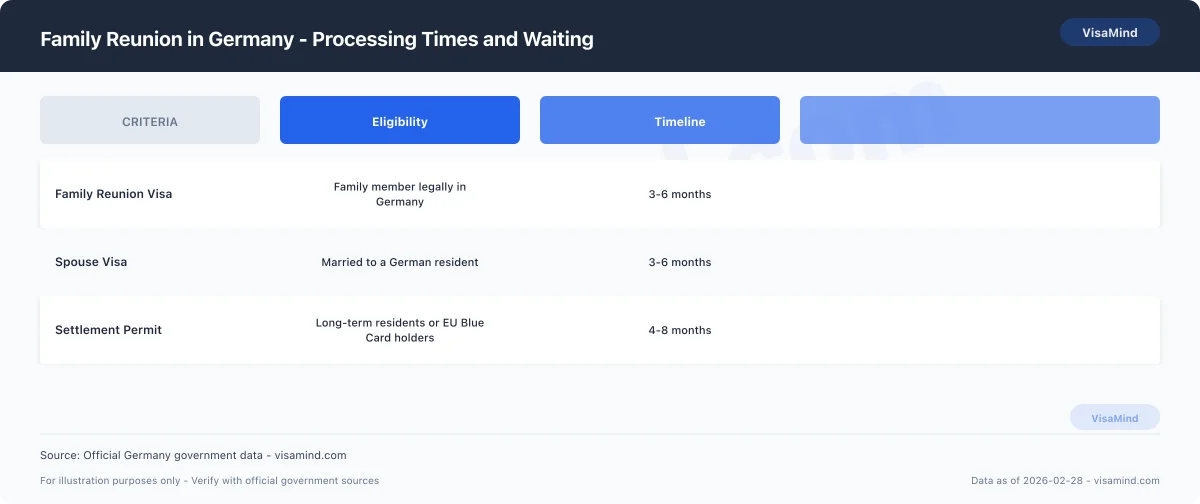
Understanding the timelines and factors affecting the process is crucial. Here is an overview of the processing times and what can influence the speed of your application.
Processing Timelines
The time it takes to process a family reunification application in Germany can vary significantly based on several factors. Below is a table that outlines typical timelines:
| Application Type | Processing Time |
|---|---|
| Family Reunion Visa | 3 to 6 months |
| Spouse Visa | 2 to 4 months |
| Child Visa | 6 weeks to 3 months |
Important: Processing times are subject to change and can vary based on individual circumstances. Always verify the current timelines on the official website.
Factors Affecting Processing Speed
Several factors can influence how quickly your application is processed:
-
Documentation Completeness: Ensure all required documents, such as marriage or birth certificates, are submitted. Missing documentation can lead to delays.
-
Eligibility Requirements: Certain categories, like EU Blue Card holders and international researchers, may have expedited processing due to specific agreements or policies.
-
Appointment Availability: Scheduling an appointment with your local foreigners' authority (Ausländerbehörde) can affect timelines. Delays in obtaining an appointment can extend the overall process.
Priority Categories
Some applicants may qualify for priority processing due to their relationship with the sponsor or their sponsor's status in Germany:
-
EU Blue Card Holders: Family members of EU Blue Card holders may experience faster processing due to streamlined procedures.
-
Skilled Workers: Those connected to family members with a Skilled Worker Visa might also benefit from quicker processing.
For those planning to apply, it's advisable to review the specific eligibility criteria and gather all necessary documentation before beginning the application process. For more information on application procedures, visit the How To Apply guide.
Tip: If you are in a high-priority category, mention this during your application to potentially expedite the process.
Keep these factors in mind to better navigate the family reunification process in Germany. Always check the most up-to-date information on the official websites of the Federal Office for Migration and Refugees (BAMF) and the local foreigners' authorities.
Why Family Visas Get Denied
#Understanding why applications might be denied is crucial. Here are some common reasons for denial:
Insufficient Evidence
- Lack of Documented Relationship: Failure to provide adequate proof of family ties, such as a marriage or birth certificate, can lead to denial. It's essential to substantiate the relationship with genuine and verifiable documents.
- Incomplete Documentation: Missing or incomplete documentation pertaining to the legal status of the family member residing in Germany can also result in refusal. Ensure all necessary documents are comprehensively gathered and submitted.
Concerns About Sham Marriages
- Suspected Fraudulent Marriage: If the authorities suspect that a marriage has been entered into solely for immigration purposes, this can lead to denial. Providing convincing evidence of a legitimate relationship is essential.
- Inconsistent Information: Discrepancies in the information provided during the application process can raise red flags and lead to further scrutiny or denial.
Financial Shortfalls
- Insufficient Financial Means: The sponsor in Germany must demonstrate adequate financial resources to support the family members intending to join. If the financial requirements are not met, the application might be denied. More details on financial requirements can be found in our Financial Requirements Guide.
- Lack of Health Insurance: Having comprehensive health insurance coverage for family members is mandatory. Failure to provide evidence of adequate health insurance can be a ground for denial.
Medical and Character Issues
- Health Concerns: If a family member has a medical condition that poses a public health risk, this can be a reason for visa denial. It's important to provide complete medical records if required.
- Character Concerns: Any criminal history or behavior that could pose a threat to public safety is scrutinized and can result in a visa being denied. Providing a clean criminal record is crucial.
Important: The application process for family reunification must be conducted in German. Ensuring accuracy and completeness in your application can significantly impact the outcome.
For more insights, you can explore our Visa Refusal Reasons Guide and understand the specific Settlement Permit requirements relevant to your situation.
Your Status During Processing
#When you apply for family reunification in Germany, your status during the processing period can impact several aspects of your life, including your work rights, travel capabilities, and more. Here’s what you need to know:
Can You Work While Your Application is Processed?
While your Family Reunion application is being processed, whether you can work depends on your current visa or residence status. If you are already in Germany on a visa or residence permit that allows you to work, you may continue to do so. However, if you are waiting for your initial entry visa from abroad, you generally cannot work in Germany until your visa is granted and you have entered the country.
Are There Travel Restrictions?
Your ability to travel while your application is pending largely depends on your current residence status. If you are in Germany and your residence permit has expired, but you have submitted your application in time, you might receive a “Fiktionsbescheinigung” from your local Ausländerbehörde. This document serves as a temporary proof of lawful residence and may allow you to travel within the Schengen Area. However, it is important to note that travel outside the Schengen Area might be restricted until your application is fully processed.
Important: Always verify the travel conditions of your temporary status with your local foreigners' authority to avoid any legal issues.
Is a Bridging Visa Available?
Germany does not have a concept of "bridging visas" as seen in some other countries. However, the Fiktionsbescheinigung acts as a temporary extension of your current status while your application is being processed. This document is particularly crucial if your current visa or residence permit is about to expire. It ensures that you can remain in Germany legally until a decision is made on your application.
Implied Status While Pending
If you have submitted your application for family reunion and are awaiting a decision, your implied status depends on your existing legal status in Germany. If you have a valid residence permit or visa, you maintain that status throughout the processing period. If your permit expires during this time, the Fiktionsbescheinigung can serve as proof of continued legal residence.
For further guidance, it may be beneficial to explore related topics such as the Spouse Visa or the Settlement Permit. Understanding these can provide additional context regarding your rights and obligations during the application process.
Conditions After Approval
#Once your family reunification application is approved by the Federal Office for Migration and Refugees (BAMF), you will be granted a residence permit. This approval is a significant step towards reuniting with your family in Germany, but it comes with specific conditions and requirements for maintaining your status.
Conditional vs Permanent Status
Initially, family reunification permits are typically granted as temporary residence permits. These permits are conditional and must be renewed periodically. The duration of your initial permit will vary depending on your specific circumstances and the status of your family member residing in Germany.
To transition to a more permanent status, such as obtaining a settlement permit, you must meet certain criteria. This typically includes demonstrating sufficient knowledge of the German language, financial stability, and integration into German society. For more information on transitioning to permanent residence, refer to the Permanent Residence section.
Residence Requirements and Restrictions
While holding a family reunification permit, it’s important to adhere to specific residence requirements:
- Residency: You must reside with your sponsoring family member in Germany. This is a core condition of maintaining your residence permit.
- Employment: Depending on the type of permit, there may be restrictions on employment. It is crucial to understand these restrictions and obtain any necessary permissions to work legally. You may want to explore options such as the Skilled Worker Visa if you plan to work.
Important: Ensure that you keep your residence permit valid and renew it before expiration. Failing to do so may result in losing your residency rights.
Maintaining Your Status
To maintain your residency status, make sure to follow these key guidelines:
- Follow Legal Obligations: Comply with all legal requirements, such as registering your residence with the local registration office (Einwohnermeldeamt) upon arrival.
- Language and Integration: Participate in integration courses if required, as these can help improve your language skills and understanding of German culture.
- Permit Renewal: Plan ahead to renew your residence permit on time by scheduling an appointment with your local foreigners' authority (Ausländerbehörde).
For more details on related visa options and requirements, you can explore the Spouse Visa and EU Long Term Residence sections. These resources offer valuable insights into alternative pathways and ensure you have the latest information to make informed decisions.
From Family Visa to PR
#Obtaining a family visa for reunification in Germany is the first step toward establishing a long-term presence in the country, potentially leading to permanent residency (PR) and eventually citizenship. Here, we outline the timeline and process from a family visa to PR and citizenship.
Transitioning from Family Visa to Permanent Residency
Once you have secured a family reunion visa, you can apply for a residence permit through your local Ausländerbehörde (foreigners' authority) in Germany. To qualify for permanent residency, you must typically hold a residence permit for at least three years. During this time, you must demonstrate:
- German language proficiency: Usually at least B1 level.
- Stable employment: Proof of financial stability and contributions to the social security system.
- Integration efforts: Participation in an integration course, if required.
Important: All application procedures must be conducted in German, so proficiency in the language is crucial.
Pathway to Citizenship
After obtaining permanent residency, you may be eligible to apply for German citizenship. Typically, this requires eight years of continuous residence in Germany. However, participation in an integration course can reduce this period to seven years.
Key requirements for citizenship include:
- Language proficiency: B1 level German.
- Legal residence: A lawful stay in Germany over the required period.
- Financial independence: No reliance on public benefits.
- Cultural integration: Successful completion of a naturalization test covering German laws, culture, and history.
Timeline Overview
| Step | Minimum Duration |
|---|---|
| Family Visa to Residence Permit | At the time of entry |
| Residence Permit to PR | 3 years |
| PR to Citizenship | 7-8 years |
For more detailed guidance, refer to our PR Pathway Guide and German Citizenship resources.
Tip: To expedite the process, ensure you maintain employment and actively improve your German language skills throughout your stay.
Real Scenarios
#Maria, a teacher from Argentina, married a German national, Thomas, last year. They decided to start their life together in Germany, so Maria needed to apply for a Family Reunion Visa. She gathered all necessary documents, including their marriage certificate and proof of Thomas’s legal residency in Germany. Maria's application was submitted to the German embassy in Buenos Aires, and the Federal Office for Migration and Refugees (BAMF) was involved in verifying the details. During the process, Maria had to attend an interview at the embassy to confirm her relationship with Thomas and her intention to reside in Germany. Four months later, her visa was approved, allowing her to join Thomas in Munich.
Scenario: Joining a Parent as a Minor
Ali, a 16-year-old from Turkey, wished to join his mother, who had moved to Germany for work and held a Blue Card EU. As a minor, Ali was eligible under the family reunification process. His mother submitted an application on his behalf to the Ausländerbehörde (local foreigners' authority) in Frankfurt. They needed to provide proof of their familial relationship, such as Ali’s birth certificate, and demonstrate that his mother had sufficient living space and financial means to support him. After a thorough review, Ali received his residence permit within three months, allowing him to move to Germany and continue his education there.
Scenario: Reuniting with an EU Blue Card Holder
Rajesh, an engineer from India, had been working in Germany for over a year on an EU Blue Card. He wanted his wife, Anika, to join him. The couple began the application process by gathering necessary documentation, including proof of Rajesh’s employment and Anika’s language proficiency in German, which is often required for spouses. Anika lodged her application at the German consulate in Mumbai, and the Federal Office for Migration and Refugees (BAMF) processed the paperwork. After six months, Anika's application was approved, and she received her visa, allowing her to relocate to Germany and reunite with Rajesh.
FAQs
Can you switch from a Family Reunion Visa to a Permanent Residence in Germany?
What is the financial requirement for sponsoring family reunion in Germany?
Are international researchers eligible for family reunion in Germany?
Can my spouse work on a Family Reunion Visa in Germany?
How does the Federal Office for Migration and Refugees (BAMF) handle Family Reunion Visa applications?
Is a language test required for a Family Reunion Visa in Germany?
What conditions must be met after approval of a Family Reunion Visa in Germany?
Sources
Last reviewed: March 1, 2026
VisaMind provides informational guidance only and is not a government agency. This is not legal advice. Requirements can change and eligibility depends on your specific facts. If your case is complex or high-stakes, consult a licensed immigration attorney.
Next steps
Requirements vary by nationality, purpose, timeline, and case details. Use Find My Visa to get a personalized checklist for Germany with official sources and deadlines.
Find my visa