Who This Is For
#To qualify for Permanent Residence in Germany, commonly known as a settlement permit, you must meet specific criteria set by the Federal Office for Migration and Refugees (BAMF). This permit is ideal for those wishing to live and work in Germany indefinitely. Here's who should consider applying:
Eligibility Criteria
-
Residence Title Duration: You should have held a residence title under Sections 18a, 18b, 18d, or 18g of the Residence Act (AufenthG) for at least three years.
-
Financial Independence: Demonstrating the ability to cover your living expenses without state assistance is crucial. This ensures you are not reliant on public funds.
-
Pension Contributions: You must have paid compulsory or voluntary contributions to the statutory pension insurance scheme for a minimum of 36 months.
-
Employment: Your current job should align with the permissions provided by your residence permit.
-
Language Proficiency: A B1 level proficiency in German, as per the Common European Framework of Reference for Languages (CEFR), is required.
-
Knowledge of Germany: You should possess a basic understanding of Germany’s legal and social systems and lifestyle.
-
Living Space: Adequate living space for yourself and any accompanying family members is mandatory.
Who Should Consider Applying?
-
Skilled Workers: If you hold a Skilled Worker Visa and meet the above criteria, this pathway allows you to transition from temporary residency to a more stable status.
-
EU Blue Card Holders: Those with an EU Blue Card can apply for permanent residency, typically after 21 months if they demonstrate a B1 language level.
-
International Researchers: Researchers in Germany under Directive (EU) 2016/801, with a focus on innovation and academia, are well-positioned to apply for permanent residency.
Special Considerations
Tip: It's essential to make an appointment with your local foreigners' authority (Ausländerbehörde) to discuss your eligibility and gather specific advice tailored to your situation.
Pathway to German Citizenship
Permanent residency can be a stepping stone to German Citizenship. After holding a settlement permit for a certain period, you may qualify for naturalization, granting you the full rights and responsibilities of a German citizen.
For those interested in long-term stability and integration into German society, the settlement permit is a vital step. Ensure you meet all requirements and consult with the local authorities to confirm your eligibility.
Requirements to Meet
#To obtain a permanent residence permit, also known as a settlement permit (Niederlassungserlaubnis), in Germany, you must meet several specific requirements. These requirements ensure that applicants are well-integrated and can sustainably live and work in Germany. Here’s a breakdown of the key criteria:
Residence Title and Duration
- You must have held a qualifying residence title under Sections 18a, 18b, 18d, or 18g of the Residence Act (AufenthG) for at least three years.
- Your current job must align with the permissions granted by your residence permit.
Financial and Employment Criteria
- Demonstrate the ability to support yourself and any family members without state assistance. This means proving financial independence, often through employment or other stable income sources.
- Show proof of having made compulsory or voluntary contributions to the statutory pension insurance scheme for a minimum of 36 months.
Language and Integration
- Prove German language proficiency at level B1 of the Common European Framework of Reference for Languages (CEFR).
- Possess a basic understanding of Germany’s legal, social, and cultural systems. This can often be demonstrated by completing an integration course.
Living Conditions
- Provide evidence of sufficient living space for yourself and any family members residing with you. This ensures that your housing situation meets German standards for living conditions.
Important: The entire application process must be conducted in German. It's advisable to seek language assistance if needed to ensure all requirements are thoroughly understood and met.
Additional Considerations
- For those holding an EU Blue Card, the process might differ slightly. Holders of this card may enjoy more streamlined processes for obtaining permanent residency.
- International researchers and skilled workers may also have specific pathways or requirements tailored to their circumstances, according to Directive (EU) 2016/801 and the relevant sections of the Residence Act (AufenthG).
To proceed with your application, it is essential to arrange an appointment with your local foreigners' authority (Ausländerbehörde). During this appointment, you will submit the necessary documents, including proof of your residence title, financial independence, and language proficiency. For further guidance on required documentation, you can refer to the Documents Checklist.
Meeting these requirements is crucial for successfully applying for permanent residence in Germany. If you are uncertain about your eligibility or need additional support, consider consulting a legal advisor or immigration expert familiar with German residency laws.
How to Apply
#-
Gather Necessary Documents
Begin by collecting all required documents for your settlement permit application. These include proof of your residence title under Sections 18a, 18b, 18d, or 18g of the Residence Act (AufenthG), evidence of your financial independence, proof of contributions to the statutory pension insurance scheme for at least 36 months, a language proficiency certificate at level B1 of the Common European Framework of Reference for Languages (CEFR), and proof of sufficient living space. Ensure all documents are current and meet the specifications outlined by the Federal Office for Migration and Refugees (BAMF).
-
Schedule an Appointment
Contact your local foreigners' authority (Ausländerbehörde) to schedule an appointment. This step is crucial as the entire application process must be conducted in German, and meeting in person will allow you to address any specific queries or issues. An appointment is also necessary for submitting your application and supporting documents.
-
Complete the Application Process
When you attend your appointment, bring all your gathered documents. You will need to lodge your application for a settlement permit and pay the applicable fee. The fee amount can vary, so it is advisable to verify the current cost on the official BAMF website or directly with your local Ausländerbehörde. During your appointment, ensure that you provide all necessary documents to avoid any delays in processing.
-
Await a Decision
After submitting your application, the waiting period for a decision can vary. It’s important to stay informed about the status of your application. You can check processing times and milestones by referring to Processing Times and contacting the relevant authorities if needed.
-
Prepare for Additional Requirements
Be prepared to provide additional documentation or attend interviews if requested by the authorities. Having a basic knowledge of the legal and social systems in Germany, as well as language proficiency, may be assessed during this phase.
Important: Ensure that all documents are translated into German by a certified translator if they are not already in the language, as the application process is conducted entirely in German.
By following these steps, you can ensure a comprehensive approach to applying for a permanent residence permit in Germany. For more detailed guidance on what to include with your application, consult the Documents Checklist.
What You Need to Submit
#To apply for permanent residence in Germany, you need to ensure that you have gathered all necessary documents and evidence required by the Federal Office for Migration and Refugees (BAMF). The application process must be conducted in German, so prepare accordingly.
Proof of Eligibility
- Residence Title: Provide proof that you have held a valid residence title under Sections 18a, 18b, 18d, or 18g of the Residence Act (AufenthG) for at least three years.
- Employment Verification: Include documentation that confirms your current employment, which should align with the conditions of your existing residence permit.
Financial and Insurance Evidence
- Financial Independence: Submit evidence demonstrating that you can support yourself without state assistance. This may include recent bank statements or a letter from your employer.
- Pension Contributions: Provide proof of at least 36 months of contributions to the statutory pension insurance scheme. This can be a statement from your pension provider.
Language and Integration
- Language Proficiency: A German language certificate at level B1 (CEFR) is required. Ensure that your certificate is from a recognized language institution.
- Integration Knowledge: Demonstrate a basic understanding of the German legal and social system. This can be shown through a passed integration course or a relevant certificate.
Living Arrangements
- Living Space: Proof of sufficient living space for yourself and any family members residing with you. This could be a rental contract or property ownership documents.
Important: Ensure that all documents not originally in German are translated by a certified translator. This will prevent any delays or issues with your application.
Additional Supporting Documents
- Application Form: Ensure that you have completed all sections of the settlement permit application.
- Identity Verification: A valid passport or national ID card is required for identity verification.
- Fee Payment: Be prepared to pay the application fee at your local foreigners' authority (Ausländerbehörde) upon submission.
For a detailed checklist of documents, you can refer to the Documents Checklist. If you're a Skilled Worker or hold a Blue Card EU, additional criteria specific to those categories might apply.
Tip: Make an appointment with your local foreigners' authority early in the process to avoid any last-minute scheduling issues.
Ensure that your application is complete and that you have addressed all requirements to improve your chances of a successful application.
Processing Times and Milestones
#Processing times for permanent residence applications in Germany can vary depending on several factors, including the applicant's specific circumstances and the completeness of the submitted documentation. As of the latest guidelines, you can generally expect the process to take between three and six months. However, certain situations might lead to longer processing times.
What Affects Processing Speed?
Several factors can influence how quickly your application is processed:
- Completeness of Documentation: Ensure that all required documents, such as proof of financial independence and language proficiency, are included. Missing documents can lead to delays.
- Local Foreigners Authority: The efficiency of the local Ausländerbehörde handling your application can vary. Some offices may have more resources and shorter waiting times than others.
- High Demand Periods: During peak times, such as summer months or the beginning of the academic year, processing times may increase due to a higher volume of applications.
Tip: To potentially expedite your application, ensure all documents are complete and double-check the requirements specific to your eligibility category, such as the Blue Card EU or Skilled Worker Visa.
Expedited Options
While there are no formal expedited processing options for permanent residence applications, certain steps can help speed up the process:
- Early Appointment Booking: Schedule your appointment with the local foreigners authority as soon as you meet the eligibility requirements.
- Thorough Preparation: Use a Documents Checklist to ensure all your paperwork is in order before your appointment.
- Language Proficiency: Demonstrating higher-than-required language skills (beyond B1 CEFR) may positively influence the processing speed.
Key Milestones
Understanding the key milestones in the application process can help manage expectations:
- Submission Confirmation: After lodging your application, you will receive confirmation from the local foreigners authority.
- Interim Communication: You may be contacted for additional information or documents, which can affect timelines.
- Decision Notification: Once a decision has been made, you will be informed by the local authority.
For more detailed guidance on timelines and potential hurdles, refer to the Processing Times Guide.
Pitfalls to Avoid
#Important: Ensure that you meet all eligibility criteria before applying for permanent residence in Germany, as failing to do so can result in application refusal.
Financial Independence
-
Demonstrating Financial Independence: One common reason for application refusal is the inability to prove financial independence. Ensure that you have stable employment and can cover your living expenses without relying on state assistance. Gather comprehensive documentation that clearly shows your financial stability, including salary slips or bank statements.
-
Pension Contributions: You must have paid contributions to the statutory pension insurance scheme for at least 36 months. Verify your payment history and have the relevant proof ready to submit with your application.
Language Proficiency
- Language Requirements: Another pitfall is failing to demonstrate the required German language proficiency at the B1 level of the Common European Framework of Reference for Languages (CEFR). Make sure to take an accredited language test and obtain the certificate before lodging your application.
Tip: If you're unsure about your current language level, consider enrolling in a language course to boost your German skills.
Documentation and Eligibility
-
Incomplete Documentation: Submitting incomplete or incorrect documentation is a frequent issue. Carefully check the list of necessary documents, such as proof of residence title and evidence of sufficient living space, and ensure everything is complete before submission. Refer to the Documents Checklist for guidance.
-
Residence Title Verification: Ensure you hold a valid residence title under the appropriate sections of the Residence Act (AufenthG) for at least three years. Misunderstanding this requirement can lead to application rejection. Check eligibility for your specific category, such as Blue Card EU or Skilled Worker Visa.
Housing Requirements
- Sufficient Living Space: You must demonstrate that you have adequate living space for yourself and any accompanying family members. Gather rental agreements or property ownership documents as proof. Failure to meet this requirement can result in a denial.
For a detailed understanding of the differences between permanent residence options, review the Settlement Permit Vs Citizenship guide. Being aware of these common pitfalls can significantly enhance your chances of a successful application.
Should You Consider Something Else?
#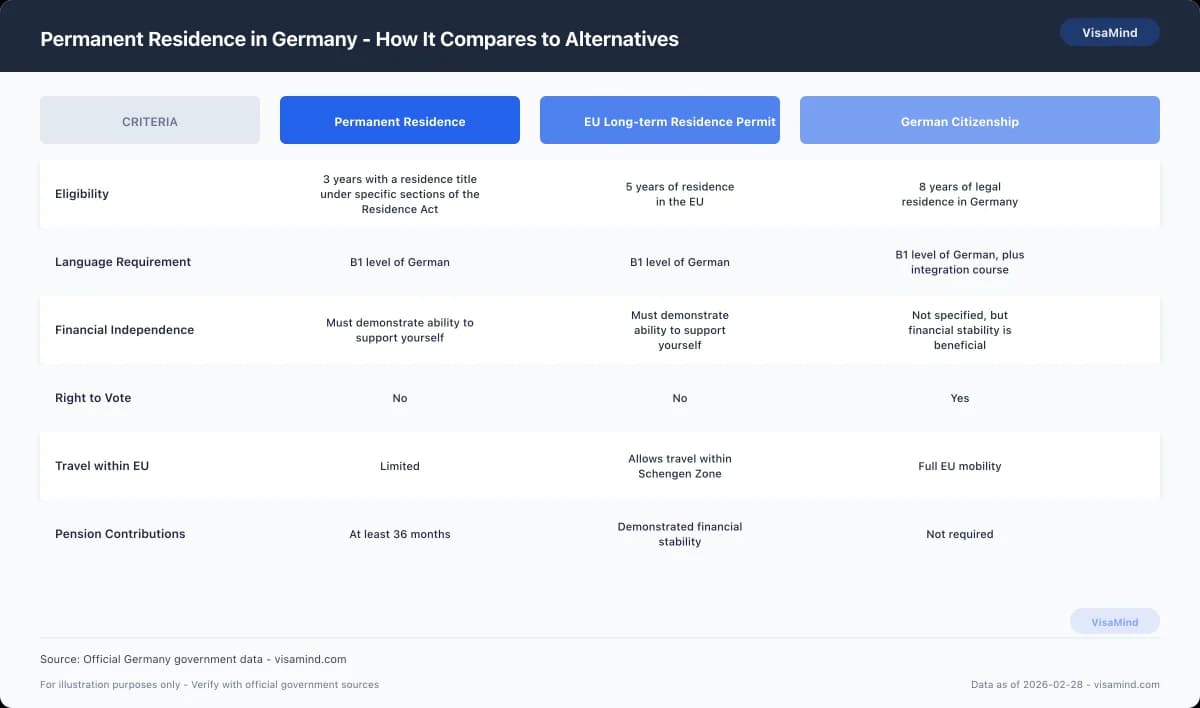
When considering options for long-term residence in Germany, it's important to understand the differences between the Permanent Residence (Settlement Permit), German Citizenship (Naturalization), and the EU Long-term Residence Permit. Each of these paths has distinct eligibility criteria and benefits. Below is a comparison to help you decide which option may be the most suitable for your situation:
| Option | Eligibility | Cost | Timeline | Key Benefits |
|---|---|---|---|---|
| Permanent Residence (Settlement Permit) | Have held a residence title under Sections 18a, 18b, 18d, or 18g of the Residence Act (AufenthG) for 3 years, financial independence, 36 months of pension contributions, German language skills at B1 | Varies by location, generally around €135 | Typically processed within 3-6 months | Permanent right to live and work in Germany, no renewal needed |
| German Citizenship (Naturalization) | 8 years of legal residence, financial independence, no criminal record, German language skills at B1 | Approximately €255 | Processing times can exceed 6 months | Full citizenship rights, including voting and EU mobility |
| EU Long-term Residence Permit | 5 years of legal residence, financial independence, integration into German society, knowledge of German language and legal system | Similar to Settlement Permit fees | Typically processed within 3-6 months | Long-term residence rights throughout the EU, similar to national permits |
What Are the Key Differences?
One of the main distinctions between these options is the duration of residence required before applying. The Permanent Residence requires a shorter period (3 years) for certain categories, while the EU Long-term Residence Permit requires 5 years, and German Citizenship generally requires 8 years.
Another key difference is in the benefits offered. While the Settlement Permit grants you the right to live and work in Germany indefinitely, German Citizenship provides the most extensive rights, including the ability to vote and move freely across the EU. The EU Long-term Residence Permit also offers the flexibility to live in other EU countries under certain conditions.
Should You Apply for Citizenship Instead?
If your long-term goal is to fully integrate into German society and enjoy all civic rights, pursuing German Citizenship might be more beneficial. However, this path requires a longer period of residence and stricter eligibility criteria, including a naturalization test and proof of integration.
Tip: Consider the Settlement Permit Vs Citizenship guide for a deeper understanding of the advantages and disadvantages of each path.
Is the EU Long-term Residence Permit a Better Fit?
For those who are considering the possibility of living in other EU countries, the EU Long-term Residence Permit could be advantageous. This permit allows for greater mobility within the EU, although it requires a slightly longer initial residence in Germany.
Ultimately, your decision should consider both your current eligibility and your future goals. Whether you aim to settle permanently in Germany, acquire full citizenship rights, or maintain flexibility within the EU, understanding these options will help you make an informed choice.
What It Costs
#Applying for permanent residence in Germany involves understanding various costs and financial requirements. Below is a comparison table outlining the key financial aspects associated with the process.
| Item | Details |
|---|---|
| Application Fee | The fee for a settlement permit application is approximately €113 for adults and €55 for minors. Specific fees might vary slightly by location, so verify with your local foreigners' authority. |
| Salary Threshold | To qualify, you must demonstrate financial independence. While no fixed salary is mandated, your income should cover living costs without state assistance, as outlined in the Settlement Permit requirements. |
| Investment Minimums | There are no specific investment minimums required for the settlement permit. However, you must show financial stability and sufficient resources to support yourself and your family. |
| Pension Contributions | You must have made compulsory or voluntary contributions to Germany's statutory pension insurance for at least 36 months. |
| Proof of Financial Independence | Evidence of financial independence is crucial. This can include salary slips, employment contracts, or bank statements demonstrating consistent and adequate income. |
Are There Additional Costs?
Beyond the application fee, consider potential costs for language proficiency tests, document translations, or legal advice, which might be necessary to ensure all requirements are met.
Tip: Consult the Financial Requirements guide for detailed information on what constitutes financial independence and how to prepare your financial documentation.
How to Prepare Financially
- Review Income: Ensure your monthly income meets the living costs in Germany without state support.
- Document Pension Contributions: Gather evidence of your contributions to the statutory pension scheme over the past three years.
- Plan for Fees: Factor in the application fee and any additional expenses related to document preparation and language certification.
Understanding these financial aspects will help you prepare effectively for your settlement permit application in Germany.
Rights and Conditions
#With a permanent residence permit in Germany, you enjoy unrestricted work rights, meaning you can pursue employment opportunities without the need for a separate work permit. Whether you are a skilled worker or transitioning from an EU Blue Card, your employment options are vast. This flexibility is particularly beneficial for those already integrated into the German job market and looking to expand their career horizons.
Travel
As a permanent resident, you have the privilege to travel freely within the Schengen Area for up to 90 days within any 180-day period. This facilitates easy movement across European countries for both personal and professional reasons. However, it's essential to ensure your German residence permit remains valid, especially if planning extended stays abroad.
Important: If you plan to stay outside Germany for more than six months, you must obtain permission from your local foreigners’ authority to avoid losing your permanent residence status.
Family Members
Your permanent residence status can significantly benefit your family. Eligible family members, such as spouses and minor children, may apply for residence permits to join you in Germany under the Family Reunion provisions. It's crucial to demonstrate sufficient living space and financial stability to support your family members without state assistance.
Restrictions
While permanent residence grants extensive rights, certain restrictions still apply. For instance, you are required to maintain your primary residence in Germany and continue contributing to the statutory pension insurance scheme. Also, the entire application and communication process are expected to be conducted in German, which underscores the importance of language proficiency.
Tip: Consider attending integration courses to enhance your understanding of the German legal and social systems, further securing your status in the country.
For further guidance on maintaining your permanent residency or navigating related situations, you can explore resources like the PR Pathway Guide or consult with your local Ausländerbehörde.
Real Scenarios
#A skilled IT professional named Alex has been living and working in Germany on a Skilled Worker Visa for over three years. Having fulfilled the requirement of holding a residence title under Section 18b of the Residence Act (AufenthG), Alex is eligible to apply for a settlement permit. To proceed, Alex arranged an appointment with the local Ausländerbehörde (foreigners' authority) to discuss the Permanent Residence application process. Alex gathered all necessary documents, including proof of financial independence and evidence of statutory pension contributions for the last 36 months. After submitting the application, Alex received the settlement permit within a few months, enabling him to live and work in Germany permanently.
Scenario: Blue Card Holder Transitioning to Permanent Residence
Maria, an engineer holding an EU Blue Card, has been residing in Germany for over 33 months. She has consistently met the income threshold required for Blue Card holders and has also achieved B1-level proficiency in German. Maria contacted the Federal Office for Migration and Refugees (BAMF) to verify her eligibility for a settlement permit. After confirming her compliance with all conditions, Maria booked an appointment with her local foreigners' authority. She presented her documents, including proof of her Blue Card status, financial stability, and language proficiency. Following the submission, Maria successfully transitioned to permanent residency in about three months, securing her future in Germany.
Scenario: Researcher Applying for Permanent Residence
Dr. Erik, an international researcher working in Germany under Section 18d of the Residence Act, aims to obtain permanent residence after contributing to the German academic community for several years. Erik ensured that he met the eligibility criteria, such as having sufficient living space and understanding of the German legal and social systems. He consulted with the BAMF to confirm his application requirements and then scheduled a meeting with the local Ausländerbehörde. Erik prepared his application, which included his residence title, financial records, and proof of pension contributions. Within a few months, Erik was granted a settlement permit, allowing him to continue his research with greater stability.
FAQs
Can I switch from an EU Blue Card to Permanent Residence in Germany?
What documents are needed for a Permanent Residence application in Germany?
Is language proficiency required for Permanent Residence in Germany?
Can Permanent Residence in Germany lead to German citizenship?
Are there any pitfalls to avoid when applying for Permanent Residence in Germany?
Can I apply for Permanent Residence in Germany if I've only been on a temporary visa?
What happens if I don't meet the German language requirement for Permanent Residence?
Sources
Last reviewed: March 1, 2026
VisaMind provides informational guidance only and is not a government agency. This is not legal advice. Requirements can change and eligibility depends on your specific facts. If your case is complex or high-stakes, consult a licensed immigration attorney.
Next steps
Requirements vary by nationality, purpose, timeline, and case details. Use Find My Visa to get a personalized checklist for Germany with official sources and deadlines.
Find my visa