
Germany child visa — What the Child Visa Covers
#
This visa allows a minor child to join a parent who is legally residing in Germany.
It falls under family reunification and focuses on keeping parents and children together in one household.
Who the visa covers
The Germany child visa covers minor children who want to live with a parent who already has the right to reside in Germany.
You qualify if:
- You are under 18 years old.
- Your parent is legally entitled to stay in Germany.
- You apply for the purpose of family reunification.
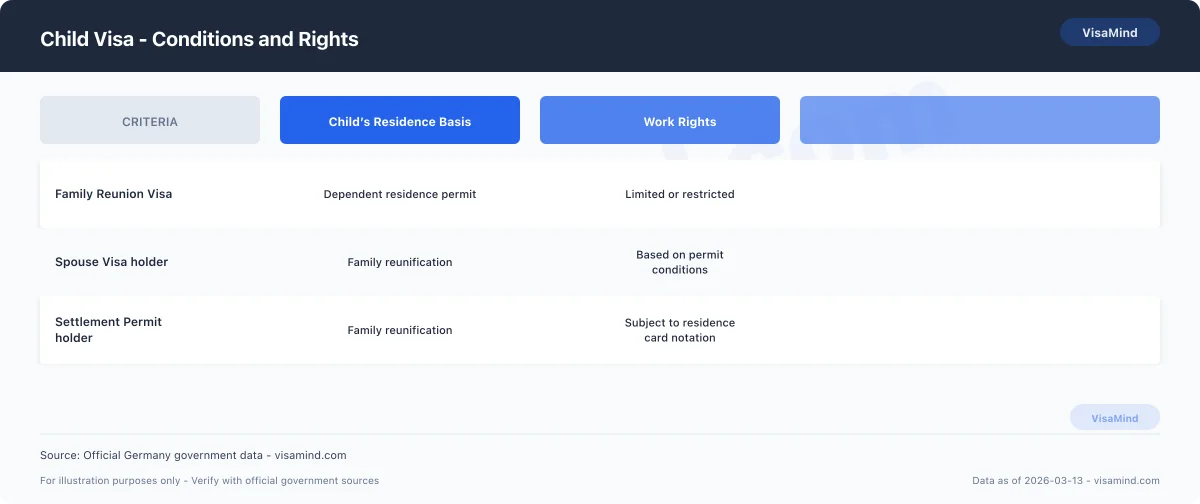
This visa forms part of the broader Family Reunion Visa framework.
It differs from other categories such as the Spouse Visa, Au Pair Visa, or Voluntary Service Visa, which serve different family or work-based purposes.
| Visa Type | Who It Is For | Main Purpose |
|---|---|---|
| Child Visa | Minor children | Join a parent in Germany |
| Spouse Visa | Married partners | Join a spouse in Germany |
| Au Pair Visa | Young adults | Cultural exchange and childcare |
| Voluntary Service Visa | Volunteers | Participate in approved service programs |
You submit your application through the Federal Foreign Office abroad.
If you are already in Germany, the local Ausländerbehörde handles residence matters.
The Federal Office for Migration and Refugees (BAMF) oversees asylum matters but does not process standard family reunification visas.
Purpose and scope
This visa allows you to live with your parent in Germany as part of family reunification.
It does not serve employment, study, or cultural exchange purposes.
Your stay links directly to your parent’s legal residence status.
If your parent holds a residence permit or a Settlement Permit (Niederlassungserlaubnis), your right to remain depends on that status.
The application typically requires:
- A completed Form VIDEX application form.
- A Form Residence Declaration, if applicable.
- A Form Verpflichtungserklärung (formal obligation letter), where required.
The child visa does not replace other residence pathways.
It strictly supports family unity between a minor child and a legally resident parent in Germany.
When to Get Help
#Some child visa cases move smoothly.
Others involve status changes, prior visa issues, or complex family situations that require professional review before you apply.
Situations that need expert advice
You should seek legal advice if your child’s application involves more than a standard Family Reunion Visa scenario.
Common risk situations include:
- You hold a temporary status (such as an Au Pair Visa or Voluntary Service Visa) and want to sponsor your child.
- You recently applied for or received a Settlement Permit (Niederlassungserlaubnis).
- You previously filed a Spouse Visa or other family-based application that is still pending.
- Your child will apply from abroad through the Federal Foreign Office, but you live in Germany and must coordinate with the local Ausländerbehörde.
- You are unsure whether a Form Verpflichtungserklärung (formal obligation letter) is required.
You should also get advice if:
- Your child was previously refused a visa.
- You submitted incorrect information in Form VIDEX.
- You received conflicting guidance from the Ausländerbehörde or the Federal Office for Migration and Refugees (Bundesamt für Migration und Flüchtlinge) (BAMF).
Filing an application does not guarantee approval.
Errors often lead to delays or refusals that are harder to fix later.
What a lawyer or adviser can help with
An immigration lawyer or qualified adviser can review your full immigration history before you apply.
They can:
-
Confirm whether the Family Reunion Visa is the correct route for your child.
-
Check if your current residence status allows sponsorship.
-
Review your Form Residence Declaration and supporting documents for consistency.
-
Identify whether a Verpflichtungserklärung strengthens your case.
They also coordinate between authorities when responsibilities overlap.
| Authority | Role in Child Visa Cases |
|---|---|
| Federal Foreign Office | Processes visa applications abroad |
| Local Ausländerbehörde | Issues residence permits inside Germany |
| BAMF | Handles asylum-related matters |
If your case involves prior refusals, status changes, or complex custody arrangements, professional review reduces procedural errors.
You should seek help before submitting VIDEX and booking the visa appointment, not after a refusal.
Application Process
#You apply through the correct German authority, complete the official form, and submit it with supporting evidence.
Accuracy and complete documentation determine whether your child’s visa application proceeds without delays.
Where to apply
You submit a child visa application either online through the Consular Services Portal or directly at the German embassy or consulate responsible for your place of residence.
The Federal Foreign Office manages visa applications filed abroad.
If your child is already in Germany and applying for a residence permit, the local Ausländerbehörde handles the process.
If the application relates to a broader category such as a Family Reunion Visa, Spouse Visa, Au Pair Visa, or Voluntary Service Visa, you must ensure the child is listed correctly under that eligibility category before filing.
Use the correct authority based on location:
| Situation | Responsible Authority |
|---|---|
| Applying from outside Germany | German embassy or consulate (Federal Foreign Office) |
| Online submission | Consular Services Portal |
| Residence permit inside Germany | Local Ausländerbehörde |
| Asylum-related matters | Federal Office for Migration and Refugees (BAMF) |
Always confirm procedural details through the Federal Foreign Office or BAMF, depending on your case type.
Step-by-step filing
Start by downloading the current child visa application form and instructions from the Federal Office for Migration and Refugees (Bundesamt für Migration und Flüchtlinge) (BAMF) website if your category requires it.
Review the instructions carefully.
Pay close attention to the eligibility category, especially if the application connects to a parent’s Settlement Permit (Niederlassungserlaubnis) or another residence status.
Follow these steps:
-
Select the correct visa category (for example, Family Reunion Visa).
-
Complete all required sections of the form.
-
Prepare the required supporting documents.
-
Sign the form where indicated.
-
Submit through the appropriate authority.
If the process requires digital entry, use the official online system such as Form VIDEX where instructed.
Do not leave mandatory fields blank.
Submitting the form and evidence
Submit the signed application form together with all required evidence.
Incomplete submissions delay processing.
Your document package typically includes:
- Completed and signed application form
- Supporting identity and status documents
- Any required Form Residence Declaration
- A Form Verpflichtungserklärung (formal obligation letter), if applicable
- Evidence tied to the parent’s residence status
Ensure every document matches the eligibility category under which you apply.
If the child’s application depends on a parent’s residence permit, the parent’s documentation must be clear and valid.
Before submission, verify that all forms are current versions from official sources.
Outdated forms or missing signatures can result in rejection or return of the application.
Fees and Processing Times
#You must pay a fixed application fee and plan for a processing period that can last several months.
Timelines depend on where you apply and which residence category your family member holds in Germany.
Application fees
You pay a €37.50 visa fee for a child application (as of February 2026).
This fee applies when you submit the application through the German mission abroad responsible for your place of residence.
| Item | Amount (EUR) | Notes |
|---|---|---|
| Child visa application fee | €37.50 | Payable at time of application |
You usually pay the fee when you lodge your application and submit documents such as:
- Completed Form VIDEX application form
- Child’s passport
- Birth certificate
- Residence documents of the parent in Germany (for example, a Family Reunion Visa, Spouse Visa, Settlement Permit (Niederlassungserlaubnis), Au Pair Visa, or Voluntary Service Visa)
- Any required Form Residence Declaration or Form Verpflichtungserklärung, if applicable
Confirm accepted payment methods with the German mission where you apply.
The Federal Foreign Office manages visa applications abroad.
Standard processing window
You should expect a processing time of 2 to 6 months for a child visa under the standard procedure (as of March 2026).
| Processing type | Estimated time |
|---|---|
| Standard child visa | 2–6 months |
The timeline begins once you submit a complete application.
Missing documents, unclear custody status, or incomplete forms can extend the review.
The German mission abroad reviews your file and may coordinate with the local Ausländerbehörde in Germany, which assesses the sponsoring parent’s residence status.
In cases involving protection status, the Federal Office for Migration and Refugees (Bundesamt für Migration und Flüchtlinge – BAMF) may also be relevant.
Always verify current timelines with the issuing authority handling your case.
Variations by category or location
Processing times vary based on both visa category and application location.
A child joining a parent with a Family Reunion Visa or Settlement Permit (Niederlassungserlaubnis) may follow a different internal review path than a child joining a parent on an Au Pair Visa or Voluntary Service Visa.
Applications filed in different countries can move at different speeds.
Workload at the specific German mission abroad affects how quickly staff forward the case to the responsible Ausländerbehörde in Germany.
Additional factors that may affect timing include:
- Whether custody is shared or disputed
- Whether a Verpflichtungserklärung is required
- Whether documents need verification
- Whether the parent’s residence status is temporary or permanent
You should confirm expected processing times directly with the German mission where you apply, as they control intake and initial review.
Path to Permanent Residence
#A child’s status in Germany depends on the parent’s residence rights.
You must understand whether your child receives a temporary permit or can qualify for a permanent title such as the Settlement Permit (Niederlassungserlaubnis).
Temporary vs permanent permits
Most children enter Germany under a Family Reunion Visa linked to a parent’s residence status.
If you applied through the Federal Foreign Office abroad, your child receives a national visa first and then a residence permit from the local Ausländerbehörde after arrival.
A temporary residence permit ties your child’s status to:
- Your valid residence permit (for example, under a Spouse Visa, Au Pair Visa, or Voluntary Service Visa)
- Your lawful residence in Germany
- Ongoing eligibility for family reunification
If you hold a temporary title, your child generally receives a temporary permit as well.
If you hold a Settlement Permit (Niederlassungserlaubnis) or another permanent right of residence, your child may qualify for a more secure residence status.
The local Ausländerbehörde decides the type and duration of the permit.
| Parent’s Status | Child’s Likely Permit Type | Authority Involved |
|---|---|---|
| Temporary residence permit | Temporary residence permit | Local Ausländerbehörde |
| Settlement Permit (Niederlassungserlaubnis) | More secure or permanent status possible | Local Ausländerbehörde |
| Visa issued abroad | National visa before residence permit | Federal Foreign Office |
For official guidance on residence categories, consult the Federal Office for Migration and Refugees (BAMF).
When a child may need a separate title
Your child must hold an independent residence permit, even though it is based on family reunification.
A visa placed in the passport does not replace the residence permit issued after entry.
You must complete the required steps:
-
Submit the visa application through the Federal Foreign Office using the Form VIDEX system, if applying abroad.
-
Enter Germany with the correct national visa.
-
Register the child’s address and file for a residence permit with the local Ausländerbehörde.
Authorities may require supporting documents such as:
- Proof of your residence status
- The child’s birth certificate
- A completed Form Residence Declaration
- A Form Verpflichtungserklärung (formal obligation letter), if applicable
Each child receives their own residence title.
Even minor children do not remain covered automatically under a parent’s permit without formal issuance by the local authority.
Required Documents — child visa Germany
#You must prove your child’s identity, confirm marital status, and document legal custody. If only one parent applies, you’ll need to show clear consent from the other parent.
Accurate paperwork helps avoid delays at the German consulate and later with the local Ausländerbehörde.
Identity and marital-status details
Provide official documents confirming your child’s identity and current civil status. The visa form, including the Form VIDEX application, requires you to state the child’s marital status clearly and consistently with the supporting records.
Prepare:
- Valid passport for the child
- Birth certificate showing parentage
- Details confirming the child’s marital status (as declared in the application)
- Completed VIDEX application form
The information in the VIDEX form, passport, and birth certificate must match exactly. Inconsistent names, dates of birth, or status declarations often trigger additional review by the Federal Foreign Office.
If your residence in Germany connects to a Family Reunion Visa, Spouse Visa, Settlement Permit (Niederlassungserlaubnis), Au Pair Visa, or Voluntary Service Visa, make sure the child’s documents align with your residence records.
| Document | Purpose | Must Match |
|---|---|---|
| Passport | Confirms identity and nationality | Name, date of birth |
| Birth certificate | Confirms parent-child relationship | Parent details |
| VIDEX form | Formal visa application record | All identity data |
| Marital-status entry | Confirms civil status | Supporting records |
Custody and parental consent
If you apply as a single parent, you must prove you have the legal right to relocate the child. German authorities require clear evidence of custody or written consent from the other parent.
Provide one of the following:
- Proof of sole custody, or
- A signed consent declaration from the non-applying parent
The consent must explicitly allow the child to move to Germany. Vague or informal statements cause delays.
If the other parent can’t provide consent, you must show documentation explaining why. The consulate reviews these documents carefully before issuing a visa.
Make sure the custody documents align with the information declared in your application. Any contradiction between your custody claim and official records will result in additional scrutiny.
Assembling supporting evidence
Organize your documents in a clear and logical order before submission. Incomplete files slow down processing at the Federal Foreign Office and later with the local Ausländerbehörde.
Follow this sequence:
-
Complete the VIDEX form.
-
Gather identity and marital-status records.
-
Add custody or consent documents.
-
Include any required Form Residence Declaration or Form Verpflichtungserklärung, if applicable to your case.
Check that every document contains consistent names, dates, and signatures. If you submit documents that relate to a sponsor in Germany, ensure the sponsor’s details match across all forms.
Authorities such as the Federal Office for Migration and Refugees (Bundesamt für Migration und Flüchtlinge) (BAMF) may review status information in certain contexts, so accuracy across all records is essential.
Submit copies exactly as requested by the consulate handling your application. If you’re unsure about formatting or certification requirements, consult the Federal Foreign Office guidance before filing.
Conditions and Rights
#Your child must meet strict age and civil status rules, and you must respect specific validity periods tied to the visa. German authorities assess these points before issuing or extending a residence permit.
Minimum age and marital status rules
A child applying under a Family Reunion Visa must qualify as a minor under German immigration law at the time of application and decision. If your child is married, German authorities may treat the case differently than for an unmarried minor.
You must prove your child’s:
- Age at the time of application
- Unmarried status, where required
- Legal parent‑child relationship
The Federal Foreign Office reviews these conditions during the visa process abroad. After entry, your local Ausländerbehörde confirms them when issuing the residence permit.
If your status in Germany is based on a Settlement Permit (Niederlassungserlaubnis), a Spouse Visa, or another residence title, the authorities will assess how your status affects your child’s eligibility. For binding rules and documentation standards, refer to the Federal Foreign Office and the Federal Office for Migration and Refugees (BAMF).
| Factor | What Authorities Check |
|---|---|
| Age | Whether your child qualifies as a minor under German law |
| Marital status | Whether your child is unmarried, if required |
| Parent’s status | Type and validity of your residence permit |
Special time limits and periods
Strict time calculations are tied to entry and residence. One key rule involves a 180‑day period, which German authorities use to assess lawful stay in specific situations.
This period affects how long your child may remain in Germany under certain conditions before additional authorization becomes necessary. If your child exceeds the permitted timeframe within the defined 180‑day window, the stay may become unlawful.
You should track:
-
Date of entry into Germany
-
Any exit and re‑entry dates
-
Expiry date of the visa sticker
-
Validity of the issued residence permit
If you applied using Form VIDEX through the Federal Foreign Office, keep copies of your submission and appointment confirmation. After arrival, complete any required local registration and, where applicable, submit a Form Residence Declaration.
For calculations of permitted stay within the 180‑day framework, confirm details directly with your local Ausländerbehörde.
Eligibility Requirements
#Germany applies strict age, marital, and nationality rules to child reunification cases. You must confirm your child’s age, civil status, passport type, and your own residence status before filing through the Federal Foreign Office abroad or the local Ausländerbehörde in Germany.
Who qualifies as a dependent child
Your child qualifies for a Germany Family Reunion Visa if all of the following apply:
- Under 18 years old
- Unmarried
- Not divorced or widowed
German authorities treat only minor, unmarried children as dependents under family reunification rules.
If your child is already 18, they generally must apply for an independent residence title instead of joining you as a dependent. Different rules may apply depending on the purpose of stay.
Children joining a parent who holds a temporary residence permit will typically receive a temporary residence permit as well. If you hold a Settlement Permit (Niederlassungserlaubnis), your child still must meet the same age and marital status conditions.
These rules apply whether you reside in Germany under a Spouse Visa, Au Pair Visa, Voluntary Service Visa, or another residence category.
Visa-waiver and nationality rules
Visa requirements depend on your child’s nationality and passport type.
Children who are nationals of:
- EU Member States
- EEA countries
- Switzerland
do not need a visa to enter Germany.
Nationals of certain countries, such as Andorra and Australia, may also enter Germany without a visa for family reunification purposes. The visa waiver applies only to holders of biometric passports.
Important limitations apply:
| Condition | Rule |
|---|---|
| Serbian passports issued by the Coordination Directorate | No visa waiver |
| Taiwanese passports | Must include an identity card number |
| Non-biometric passports | Visa required |
If your child does not qualify for visa-free entry, you must apply for a national visa through the Federal Foreign Office before travel. You typically complete the application using the Form VIDEX system and submit supporting documents at the German mission abroad.
Age and parental-residence conditions
Age determines both visa eligibility and the type of residence permit your child receives.
- Under 16 years old: If you hold a temporary residence permit, your child will receive a temporary residence permit.
- Under 18 years old: Eligible for a Family Reunion Visa if unmarried.
- 18 years or older: Must generally apply for a separate residence title.
German authorities assess your residence status at the time of application. If you live in Germany with lawful temporary residence, your child’s permit will match that status.
After arrival, your child must register their address and may need to complete a Form Residence Declaration with the local Ausländerbehörde.
If a third party sponsors the stay, authorities may require a Form Verpflichtungserklärung (formal obligation letter). The local immigration office decides whether this document is necessary based on your case.
Relationship Scrutiny Red Flags
#German authorities closely examine custody rights and the consistency of your paperwork. Missing parental consent or mismatched information across forms often leads to refusal of a Germany child visa.
Missing custody or consent
If one parent remains outside Germany, you must prove that you have the legal right to relocate the child. When required, you need clear consent from the other parent.
Applications often fail because the non-accompanying parent’s approval is absent, unclear, or unsigned. This issue affects cases under the Family Reunion Visa, and it can also surface when a parent holds a Spouse Visa, Settlement Permit (Niederlassungserlaubnis), or another residence status.
Pay close attention to:
- Written consent from the other parent, when custody is shared
- Matching parent names and signatures as shown in passports
- Consistent details in the Form VIDEX application and supporting documents
If you submit a Form Residence Declaration or a Form Verpflichtungserklärung, ensure the child’s details align exactly with custody documents. The Federal Foreign Office reviews visa applications abroad, and discrepancies can trigger delays or refusal.
| Risk Factor | Why It Causes Problems |
|---|---|
| No written consent | Authorities cannot confirm legal relocation rights |
| Different signature formats | Raises authenticity concerns |
| Missing custody evidence | Leaves parental authority unclear |
Inconsistent or incomplete information
Inconsistent answers across forms create immediate credibility concerns. Even small differences can undermine your application.
Use the exact spelling, passport numbers, and dates as shown in official documents. Enter identical information in VIDEX, paper forms, and any declarations.
Common problem areas include:
-
Child’s full name order
-
Date of birth format
-
Passport number digits
-
Parent’s residence status description (e.g., Spouse Visa vs. Settlement Permit (Niederlassungserlaubnis))
If your sponsor previously applied under an Au Pair Visa or Voluntary Service Visa, ensure past visa history matches current statements. Authorities compare records.
| Document | What Must Match Exactly |
|---|---|
| Passport | Name, number, date of birth |
| VIDEX form | All biographical details |
| Residence Declaration | Parent and child identity data |
Review every entry before submission. Incomplete fields or conflicting answers are a common reason for rejection.
Avoid These Common Mistakes
#Small errors delay a Germany child visa application and can lead to rejection. Focus on accuracy, consistency, and complete documentation when filing under the Family Reunion Visa framework.
Checklist to prevent form rejection
Submit a fully completed application through Form VIDEX and review every field before you sign.
Use this checklist to reduce the risk of refusal:
- Complete all sections of the visa form without leaving blanks.
- Ensure names, dates of birth, and passport numbers match across every document.
- Confirm that your child’s details align with the sponsoring parent’s status (e.g., Spouse Visa, Settlement Permit (Niederlassungserlaubnis)).
- Attach any required Form Residence Declaration exactly as issued.
- If financial sponsorship applies, ensure the Form Verpflichtungserklärung reflects correct personal data.
- Sign every required page.
| Area to Review | What to Check | Common Error |
|---|---|---|
| Personal Data | Spelling, date format, passport number | Typos or inconsistent spellings |
| Sponsor Status | Visa or residence title listed correctly | Selecting wrong category (e.g., Au Pair Visa instead of Family Reunion Visa) |
| Declarations | All signatures present | Missing signature or undated form |
If you apply abroad, the Federal Foreign Office processes the visa. If you apply inside Germany, your local Ausländerbehörde handles residence matters.
Expert tips for accurate filing
Enter information exactly as it appears on official documents. Don’t shorten names or translate details unless the form specifically requires it.
Keep your visa category consistent across all paperwork. If the parent holds a Settlement Permit (Niederlassungserlaubnis), state that clearly instead of listing a previous status such as Voluntary Service Visa or Au Pair Visa.
Follow these steps before submission:
-
Review every answer for accuracy.
-
Cross-check all dates across passports, certificates, and declarations.
-
Confirm that the purpose aligns with a Family Reunion Visa, not a Spouse Visa.
If your case involves protection status, the Federal Office for Migration and Refugees (Bundesamt für Migration und Flüchtlinge) (BAMF) handles asylum matters, not standard family visa processing.
Careful review prevents avoidable delays and repeat appointments.
Fees
#| Component | Amount |
|---|---|
| Application feeChild visa (reduced national visa fee) | €37.50 (approx $41 USD) |
Fees change; always verify on AA.