
Overview — Germany spouse visa
#
The Germany spouse visa allows a non-EU spouse to join a partner who already lives in Germany. Eligibility and procedure depend on your spouse’s nationality and residence status.
Who this covers
The Germany spouse visa applies to you if you’re a non-EU national married to someone who legally resides in Germany.
Your sponsoring spouse may be:
- A German citizen
- An EU citizen residing in Germany
- A third-country national holding a valid German residence status, such as:
The exact rules depend on your spouse’s legal status in Germany. Different residence titles can change how your application is assessed and which authority reviews it.
If your spouse later applies for German Citizenship (Naturalization), your residence status may also change. You must apply under the correct category based on your spouse’s current legal position at the time of filing.
| Sponsor’s Status | Visa Type You Apply For | Main Authority Involved |
|---|---|---|
| German citizen | Family Reunion Visa | Federal Foreign Office / local Ausländerbehörde |
| EU citizen in Germany | Family reunification pathway | Local Ausländerbehörde |
| Non-EU resident (e.g., EU Blue Card holder) | Family Reunion Visa | Federal Foreign Office / local Ausländerbehörde |
Scope of family reunification
This visa falls under Germany’s family reunification framework. It allows you to live in Germany with your spouse as part of lawful family unity.
You apply for a Family Reunion Visa from abroad through the Federal Foreign Office. After entering Germany, you convert your visa into a residence permit through your local Ausländerbehörde.
Family reunification focuses strictly on the marital relationship. It does not automatically grant permanent residence.
Long-term status, such as a Settlement Permit (Niederlassungserlaubnis) or EU Long-term Residence Permit, requires a separate process.
The Federal Office for Migration and Refugees (Bundesamt für Migration und Flüchtlinge – BAMF) oversees broader migration policy. Residence permits inside Germany are issued locally.
You must follow the procedure that matches your spouse’s residence category. Authorities review your case within that legal framework.
Form and legal context
You start by submitting a visa application to the German mission abroad. Many applicants complete the electronic pre-application through Form VIDEX before attending their appointment.
Your application falls under Germany’s residence law governing family reunification. The decision considers your spouse’s lawful residence in Germany and your marital relationship.
After arrival, you register your address and apply for your residence permit at the local Ausländerbehörde. In some cases, authorities may require supporting declarations, such as a Form Residence Declaration or a Form Verpflichtungserklärung, depending on the specific situation.
For current forms, procedural details, and fees in EUR (€), consult the Federal Foreign Office and your local Ausländerbehörde.
Required Documents
#You’ll need to submit clear evidence of your identity, your marriage or registered partnership, and your living situation in Germany. Incomplete or inconsistent documents delay a Family Reunion Visa decision and can lead to refusal.
Identity and civil documents
Provide valid passports for both you and your spouse. The passport must clearly show your biographical details and validity period.
Submit these civil status documents:
- Marriage certificate or registered partnership certificate
- Birth certificates for both spouses
- Any prior civil status documents if applicable
If you apply from abroad, complete the required visa application process through the Federal Foreign Office. You must also complete the Form VIDEX application form and ensure all personal data matches your passports and certificates exactly.
If your spouse already lives in Germany under a residence title such as an EU Blue Card, Settlement Permit (Niederlassungserlaubnis), EU Long-term Residence Permit, or German Citizenship (Naturalization), include proof of that status.
All documents must be consistent in names, dates, and places of birth. Discrepancies raise credibility concerns and may require additional clarification.
| Document | Who Provides It | Purpose |
|---|---|---|
| Passport | Both spouses | Identity verification |
| Birth certificate | Both spouses | Civil status confirmation |
| Marriage certificate | Married couple | Proof of legal relationship |
| German residence title | Spouse in Germany | Proof of lawful stay |
Proof of relationship
You must prove that your marriage or registered partnership is legally valid. The primary evidence is your official marriage or partnership certificate.
Authorities check whether the relationship forms the legal basis for a Family Reunion Visa. Your certificate must clearly identify both spouses and the date and place of registration.
If applicable, your marriage details should align with:
- Passport information
- Birth certificate data
- Any residence records in Germany
Inconsistent spelling, different name formats, or conflicting dates often trigger requests for clarification. All submitted documents should match exactly.
If your spouse resides in Germany, include proof of their registered address. This confirms the location where you intend to live after arrival.
Additional supporting evidence
You also need to show practical conditions for family reunification. This includes proof of residence in Germany and financial documentation.
Prepare the following:
- Recent pay slips or tax statements of your spouse
- Rental agreement or housing confirmation in Germany
- Completed Form Residence Declaration, if required
- A Form Verpflichtungserklärung (formal obligation letter), if applicable
You must provide a recognized language certificate based on a standardized test aligned with the standards of the Association of Language Testers in Europe (ALTE).
Submit copies that are clear and legible. The local Ausländerbehörde reviews residence-related documents inside Germany, while visa issuance abroad is handled through the Federal Foreign Office.
Fees and Processing Times
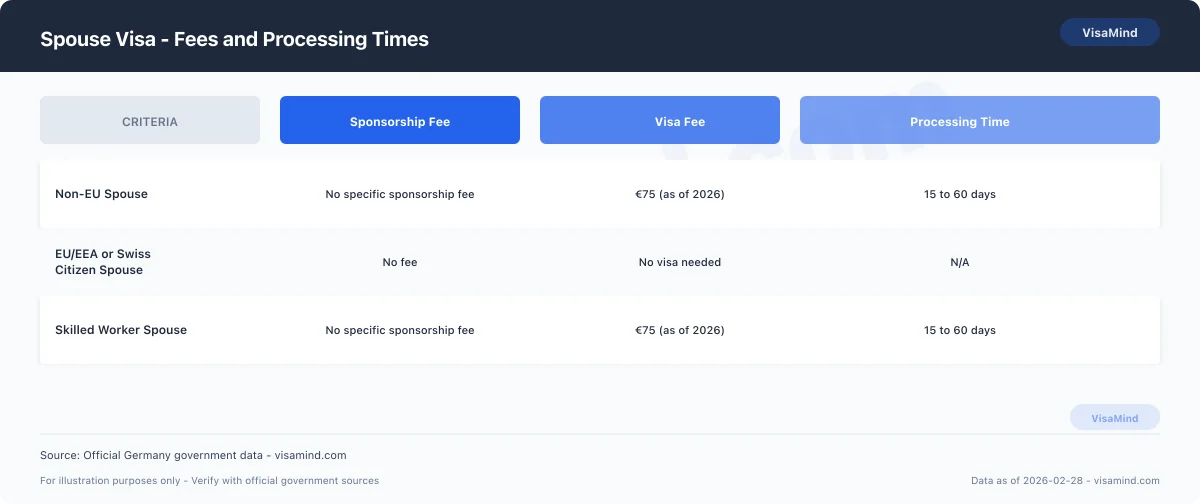
#You must pay a fixed government fee and prepare for a multi-month review period. Processing length depends on your case type and where you apply, and different authorities handle different stages.
Application fees
You pay a €75 application fee for a Germany spouse visa (Family Reunion Visa).
| Item | Amount (EUR) | Notes |
|---|---|---|
| Spouse visa application fee | €75 | Payable when you submit your application |
You usually pay this fee at the German embassy or consulate when you lodge your application abroad through the Federal Foreign Office. If you later apply for a residence permit inside Germany, your local Ausländerbehörde manages that stage.
Keep proof of payment with your records. You complete the visa application form, often through Form VIDEX, before your appointment.
If your sponsoring spouse holds an EU Blue Card, Settlement Permit (Niederlassungserlaubnis), or EU Long-term Residence Permit, the visa category remains family reunification. The stated €75 fee applies to the spouse visa application itself.
For the most current fee information, confirm directly with the Federal Foreign Office before you file.
Typical processing windows
Standard processing for a spouse visa takes 2 to 6 months.
| Application Type | Standard Processing Time |
|---|---|
| Spouse (Family Reunion Visa) | 2–6 months |
Processing times vary based on:
- The visa category
- The German mission handling your case
- The workload of the responsible Ausländerbehörde in Germany
The embassy or consulate forwards your file to the local immigration office where your spouse lives. That office reviews residence status, such as an EU Blue Card or Settlement Permit (Niederlassungserlaubnis), before approval.
The Federal Office for Migration and Refugees (Bundesamt für Migration und Flüchtlinge, BAMF) does not process standard spouse visa applications. The Federal Foreign Office manages consular processing abroad.
Always verify current timelines with the German mission where you apply.
Timing considerations
Apply well before your intended travel date. A 2-month approval is possible, but a 6-month timeline is within the standard range.
Delays often relate to document checks and coordination with the local Ausländerbehörde. Incomplete forms, missing civil records, or unsigned declarations can slow review.
If your spouse must provide a Form Residence Declaration or a Form Verpflichtungserklärung, submit it promptly when requested. Late submission extends processing.
Don’t book non-refundable travel until you receive your visa. After arrival in Germany, you must schedule your residence permit appointment with the local Ausländerbehörde, which operates on its own timeline separate from the visa decision.
Application Process
#You must file the correct application with the appropriate authority and complete every section accurately. Careful preparation reduces delays and prevents requests for additional documents.
Where to file
Where you submit your application depends on your location and status.
If you apply from abroad for a Family Reunion Visa, you file your visa application with the Federal Foreign Office through the German consulate responsible for your place of residence.
If you are already in Germany and applying for a residence permit as the spouse of a German citizen or a holder of an EU Blue Card, Settlement Permit (Niederlassungserlaubnis), or EU Long-term Residence Permit, you submit your application to your local Ausländerbehörde.
The Federal Office for Migration and Refugees (Bundesamt für Migration und Flüchtlinge) (BAMF) provides official application forms and instructions. BAMF primarily handles asylum matters, but its published forms and guidance may apply to certain residence procedures.
Always verify the competent authority before filing. Submitting to the wrong office causes delays.
| Your Situation | Where You File |
|---|---|
| Outside Germany | Federal Foreign Office (German consulate) |
| Inside Germany | Local Ausländerbehörde |
| Form and guidance | BAMF website |
Preparing and completing the form
Use only the most recent version.
Read the instructions for your eligibility category before you start. Requirements may differ depending on whether your spouse holds German Citizenship (Naturalization), an EU Blue Card, or another qualifying residence status.
Complete every required field clearly and accurately. If you use the Form VIDEX system to prepare your visa application, ensure that the printed version matches your entries exactly.
Review your answers before signing. Inconsistent information can lead to additional scrutiny or delays.
Sign the form where required. If a Form Residence Declaration or Form Verpflichtungserklärung applies to your case, prepare it according to the official instructions.
Submission checklist
Prepare your documents in an organized file. Missing documents can stop processing.
Basic submission checklist:
- Completed and signed application form
- Valid passport
- Marriage certificate
- Proof of your spouse’s legal status in Germany (e.g., EU Blue Card, Settlement Permit, EU Long-term Residence Permit, or German Citizenship)
- Supporting documents listed in the official instructions
- Any required Residence Declaration or Verpflichtungserklärung
Confirm document format requirements before submission. Some authorities require originals, copies, or certified translations.
Before filing, review everything once more. Accurate forms and complete evidence reduce the risk of delays and follow-up requests.
Renewal and Extension
#You must plan your renewal early and track official processing timelines. Late filing can disrupt your legal stay and delay future steps such as a Settlement Permit (Niederlassungserlaubnis) or German Citizenship (Naturalization).
When to renew or extend
Apply for renewal or extension well before your current residence document expires. Waiting too long can prevent the authority from issuing your renewed permit before your intended travel date.
If you originally entered Germany with a Family Reunion Visa issued by the Federal Foreign Office, you will handle your residence permit renewal inside Germany through your local Ausländerbehörde.
You may generally submit applications up to a 180-day period before your planned travel or status deadline, depending on your situation. Confirm exact timing rules directly with the competent authority.
Your long-term plans also matter. If you aim to move from a spouse residence permit to:
- EU Blue Card
- Settlement Permit (Niederlassungserlaubnis)
- EU Long-term Residence Permit
- German Citizenship (Naturalization)
you must maintain continuous lawful residence. Gaps caused by late renewal can affect eligibility.
Deadlines and timing risks
Late applications can cause real legal problems. Authorities might not issue your renewed permit before your current one expires or before you need to travel.
Use this timing framework:
| Action | Why It Matters |
|---|---|
| Apply well in advance | Allows processing within official timelines |
| Avoid last-minute filing | Reduces risk of travel disruption |
| Track the 180-day window | Ensures you apply within accepted advance period |
If your status lapses, future permanent residence applications may get complicated.
The Federal Office for Migration and Refugees (Bundesamt für Migration und Flüchtlinge – BAMF) sets migration policy, but your local Ausländerbehörde decides residence permit extensions. Always follow instructions from the authority handling your case.
Practical renewal tips
Get your documents ready early and check current requirements with your local Ausländerbehörde. Requirements differ by city.
Focus on these steps:
-
Check your permit’s expiration date.
-
Confirm the earliest filing date (up to 180 days in advance, where permitted).
-
Book your appointment as soon as slots open.
-
Review whether updated documents such as a Form Residence Declaration or financial proof (for example, a prior Form Verpflichtungserklärung, if applicable) are required.
If you used Form VIDEX for a consular visa, renewals inside Germany follow local authority procedures.
Keep copies of all submissions and appointment confirmations. Organized filing protects your legal stay and keeps you eligible for future residence options.
Path to Permanent Residence
#After entering Germany on a Family Reunion Visa and receiving your residence permit from the local Ausländerbehörde, you can work toward permanent status. Most spouses apply for a Settlement Permit (Niederlassungserlaubnis) first and may later consider German Citizenship (Naturalization) if they meet the requirements.
Your progress depends on maintaining lawful residence, meeting integration expectations, and complying with local rules.
Settlement permit (Niederlassungserlaubnis)
The Settlement Permit (Niederlassungserlaubnis) grants permanent residence in Germany. It removes time limits from your stay and gives unrestricted access to the labor market.
Apply through your local Ausländerbehörde. BAMF doesn’t issue residence permits but oversees integration programs that may affect eligibility.
Common eligibility factors include:
- Holding a valid residence permit (such as one issued after a Family Reunion Visa)
- Securing your livelihood without relying on public funds
- Adequate living space for you and your family
- Sufficient German language skills
- Compliance with registration requirements, including your Form Residence Declaration (Anmeldung)
If your spouse holds an EU Blue Card, different pathways may apply. Eligibility criteria vary based on your residence history; confirm details with your local Ausländerbehörde.
You may also qualify for the EU Long-term Residence Permit, which can provide additional mobility rights within the EU.
| Permit Type | Validity | Issuing Authority | Key Benefit |
|---|---|---|---|
| Settlement Permit (Niederlassungserlaubnis) | Permanent | Local Ausländerbehörde | No time limit on stay |
| EU Long-term Residence Permit | Permanent | Local Ausländerbehörde | Broader EU mobility rights |
Naturalization (German citizenship)
German Citizenship (Naturalization) allows you to become a German national. You apply through the competent local citizenship authority.
You must generally show:
- Lawful residence in Germany
- Financial self-sufficiency
- Adequate German language proficiency
- Knowledge of Germany’s legal and social order
- No serious criminal convictions
Integration courses coordinated by BAMF can support your application, especially if language or civic knowledge requirements apply.
Naturalization differs from permanent residence. Citizenship grants full political rights, including voting and a German passport.
Check with the Federal Foreign Office and your local authority for procedural steps and documentation.
Typical next steps
Once you hold a spouse-based residence permit, take these steps:
-
Register your address and keep your Residence Declaration updated.
-
Maintain continuous lawful residence.
-
Attend integration or language courses if required.
-
Track your permit’s expiration date and apply for renewal on time.
If your initial visa involved financial sponsorship through a Form Verpflichtungserklärung, confirm when that obligation ends.
Keep copies of all approvals, including your original Family Reunion Visa, residence card, and registration records. These will be needed when applying for permanent residence or citizenship.
When to Consult a Professional
#Some spouse visa cases involve technical exceptions, prior refusals, or document inconsistencies that increase the risk of denial. In these situations, legal review protects your status and helps avoid delays.
Complex or exceptional visa-exemption cases
Seek legal advice if you plan to enter Germany without a visa based on passport exemptions. Visa-free entry applies only to certain biometric passports, and some passports are excluded even if they’re biometric.
For example:
| Situation | Risk Factor |
|---|---|
| Biometric passport from a visa-exempt country | Must meet all exemption conditions |
| Serbian passport issued by the Coordination Directorate | Not eligible for visa-free entry |
| Taiwanese passport | Must include an identity card number |
If you enter incorrectly, you may not qualify to apply for a Family Reunion Visa or residence permit from inside Germany. The local Ausländerbehörde can refuse to process your case.
This gets more complex if your spouse holds an EU Blue Card, Settlement Permit (Niederlassungserlaubnis), or EU Long-term Residence Permit and you intend to pursue German Citizenship (Naturalization) later. Legal advice can confirm whether your entry method aligns with your long-term residence plan and avoids status violations.
After application denials or high-risk issues
A prior refusal increases scrutiny on your next application. Get professional advice before reapplying.
Common high-risk issues include:
- Inconsistent personal data across forms
- Conflicting statements between your application and supporting documents
- Errors in passport numbers or identity details
- Unclear financial documentation, including a Form Verpflichtungserklärung
Even small discrepancies can cause credibility concerns. The Federal Foreign Office reviews visa applications abroad, and mistakes remain in your record.
If your case involves prior immigration history reviewed by the Federal Office for Migration and Refugees (Bundesamt für Migration und Flüchtlinge) (BAMF), professional analysis is essential. You need a response that addresses the exact refusal grounds rather than just resubmitting the same documents.
Fixing inconsistent or incomplete filings
Incomplete or mismatched information is a common reason for rejection. Filing a spouse visa doesn’t guarantee approval.
You must ensure that:
- Your name matches your passport exactly
- Passport numbers are identical across all forms
- Dates of birth and marriage are consistent
- Information entered into Form VIDEX matches your paper documents
- Any required Form Residence Declaration reflects accurate and current data
Use this checklist before submission:
| Document Area | What to Verify |
|---|---|
| Application form | No blank required fields |
| Passport details | Exact character match |
| Supporting documents | Same spelling and dates throughout |
If you already submitted inconsistent information, don’t ignore it. A professional can assess whether to correct the record proactively or wait for a request from the consulate or Ausländerbehörde. Early correction reduces suspicion and strengthens credibility.
Conditions and Rights
#Your Germany spouse visa grants residence rights tied to your sponsoring partner’s status. You must meet language rules, follow residence regulations, and understand how your status can lead to permanent residence or citizenship.
Language expectations
In most cases, you must show basic German language skills before receiving a Family Reunion Visa. The required level and accepted proof depend on your individual case and the rules applied by the Federal Foreign Office during visa processing.
You typically submit language evidence with your visa application through the consulate. You complete the national visa application using Form VIDEX and include supporting documents.
After arrival, you may need to attend an integration course administered under the framework of the Federal Office for Migration and Refugees (Bundesamt für Migration und Flüchtlinge – BAMF).
Key points:
- Provide recognized proof of German language ability when required
- Submit documentation during your Family Reunion Visa process
- Follow any integration course instructions issued by local authorities
Your local Ausländerbehörde may impose additional participation requirements after you register your residence.
Special conditions for joining skilled workers
If you join a spouse who holds an EU Blue Card or another skilled worker residence permit, your residence status remains linked to that permit.
Your eligibility depends on:
- A legally valid marriage
- Your spouse’s valid residence title (e.g., EU Blue Card)
- Sufficient living space and financial stability, if required
- A completed visa application submitted through the Federal Foreign Office
If a third party provides financial support, authorities may request a Form Verpflichtungserklärung (formal obligation letter).
Your rights depend on your spouse’s status. When your spouse qualifies for a Settlement Permit (Niederlassungserlaubnis) or an EU Long-term Residence Permit, you may also become eligible for a more secure residence status, provided you meet the legal criteria in force at that time.
Confirm current eligibility rules with the Federal Foreign Office or your local Ausländerbehörde, as they assess each case individually.
Residence-related rules
After entering Germany with a Family Reunion Visa, you must:
-
Register your address with the local registration office.
-
Attend your appointment at the Ausländerbehörde.
-
Apply for your residence permit card.
Your residence permit remains valid only while:
- Your marriage continues to exist
- Your spouse maintains lawful residence
- You comply with German residence laws
You must report changes in address and personal status. Some municipalities require a Form Residence Declaration as part of local registration procedures.
Over time, you may qualify for:
| Status | Authority Involved | What It Means for You |
|---|---|---|
| Settlement Permit (Niederlassungserlaubnis) | Ausländerbehörde | Permanent residence in Germany |
| EU Long-term Residence Permit | Ausländerbehörde | Long-term residence with broader EU-related rights |
| German Citizenship (Naturalization) | Competent citizenship authority | Full German nationality if you meet statutory requirements |
Each step requires a formal application and proof that you meet the legal conditions in effect at the time of filing.
Eligibility Requirements — spouse visa Germany
#You qualify for a spouse visa if your partner holds a valid German residence status and your marriage or civil partnership meets strict legal standards. Authorities check who sponsors you, whether your relationship is legally valid, and when the marriage took place in relation to relocation to Germany.
Who can sponsor
Your sponsor must be a third-country national who already holds a valid German residence status.
Eligible sponsors include holders of:
- A residence permit
- A Settlement Permit (Niederlassungserlaubnis)
- An EU Blue Card
- An EU Long-term Residence Permit
If your spouse has one of these permits, you may apply for a Family Reunion Visa through the Federal Foreign Office abroad. After you enter Germany, the local Ausländerbehörde issues your residence permit.
The Federal Office for Migration and Refugees (BAMF) oversees migration policy, but local immigration offices decide individual residence permits inside Germany.
| Sponsor’s Status | Can Sponsor a Spouse? |
|---|---|
| Residence Permit | Yes |
| EU Blue Card | Yes |
| Settlement Permit (Niederlassungserlaubnis) | Yes |
| EU Long-term Residence Permit | Yes |
Your sponsor must already hold the permit at the time you apply.
Valid partnership or marriage
Germany recognizes only legally valid marriages or registered civil partnerships.
Your relationship must meet all of the following:
- The marriage or partnership is officially registered in the country where it took place.
- The registration appears in official records or civil registers.
- The relationship creates legal rights and obligations under the law of that country.
Informal, religious-only, or unregistered unions do not qualify.
The authorities examine whether the partnership has full legal effect. You must provide official documentation when submitting your visa application, typically through the Form VIDEX system used for consular processing.
If your documents do not clearly prove legal validity, the Federal Foreign Office may request additional records before issuing the visa.
Timing and residence status rules
The timing of your marriage is critical.
You must have been legally married before one spouse moved their usual place of residence to Germany. If the marriage took place after relocation, you do not meet this core requirement under the standard spouse visa framework described here.
This rule applies when your sponsor relocates to Germany as a permit holder and later seeks family reunification.
After you enter Germany with the Family Reunion Visa, you must:
-
Register your address (Form Residence Declaration) with the local authorities.
-
Apply for your residence permit at the local Ausländerbehörde.
Your eligibility depends on both the sponsor’s valid residence status and the pre-existing legal marriage. If you later pursue German Citizenship (Naturalization), different legal requirements apply, and you should review the rules published by the competent German authorities.
Relationship Scrutiny Red Flags
#German authorities closely examine the authenticity and documentation of your marriage when you apply for a Family Reunion Visa. Missing records, invalid certificates, or conflicting details can lead to refusal.
Missing or invalid marriage evidence
You need to submit a valid marriage certificate or a registered partnership certificate with your application. Without this, the authorities may reject your application.
If you provide a document that’s incomplete, improperly issued, or not legally recognized, you’re facing the same risk. The reviewing authority expects official, valid paperwork.
| Document Issue | Likely Outcome |
|---|---|
| No marriage certificate submitted | Application may be rejected |
| No registered partnership certificate (if applicable) | Application may be rejected |
| Certificate is invalid or not properly issued | Application may be rejected |
Applying through the Federal Foreign Office abroad means a consular officer checks your documents before sending your case onward. Inside Germany, the local Ausländerbehörde reviews your residence application.
Even if your spouse holds an EU Blue Card, a Settlement Permit (Niederlassungserlaubnis), or an EU Long-term Residence Permit, you still need to prove your marriage is legally valid. The sponsor’s status doesn’t replace the need for documentary proof.
Inconsistent application information
The details in your forms must match your marriage documents exactly. This includes names, dates, and marital status.
When using Form VIDEX, double-check every entry before submitting. Any mismatch between your form and your certificate can raise concerns.
For example:
- Spelling differences in names
- Different marriage dates
- Declaring single status while submitting a marriage certificate
Such inconsistencies can lead the reviewing authority to doubt whether your relationship qualifies under Family Reunion Visa requirements.
Accuracy matters for supporting documents too, like a Form Residence Declaration or a Form Verpflichtungserklärung. All details need to line up.
Common causes of rejection
The most direct reason for refusal is not submitting a legally valid marriage or partnership certificate. Authorities won’t approve a spouse visa without formal proof.
Rejection often results from:
-
Missing marriage certificate.
-
Submitting a certificate that isn’t legally valid.
-
Providing conflicting marital information on official forms.
The Federal Office for Migration and Refugees (BAMF) doesn’t handle routine spouse visa approvals, but German immigration offices are strict about documents. You have to show clear, valid proof of your marriage when applying.
Consistent, accurate records from the start also help if you later apply for a Settlement Permit or German Citizenship (Naturalization).
Fees
#| Component | Amount |
|---|---|
| Application feeExtracted from guide content — verify against official source | €75 (approx $81 USD) |
Fees change; always verify on AA.