
Germany EU long-term residence: Overview
#The EU long-term residence permit gives you permanent residence in Germany and the right to move to other EU countries. You qualify after five years of lawful residence and apply using the official form issued by the Federal Office for Migration and Refugees (Bundesamt für Migration und Flüchtlinge) (BAMF).
Program summary
The EU Long-term Residence Permit is a permanent residence status available after five years of residence in Germany. It’s distinct from temporary residence permits issued for work, study, or family reasons.
You’ll need to use the official form titled “EU Long-term Residence Permit”. BAMF issues the form, but your local Ausländerbehörde processes residence permits inside Germany.
Key features:
- Permanent residence status
- Eligibility after 5 years of residence
- Right to move to other EU countries under EU rules
- Formal application using the BAMF-issued form
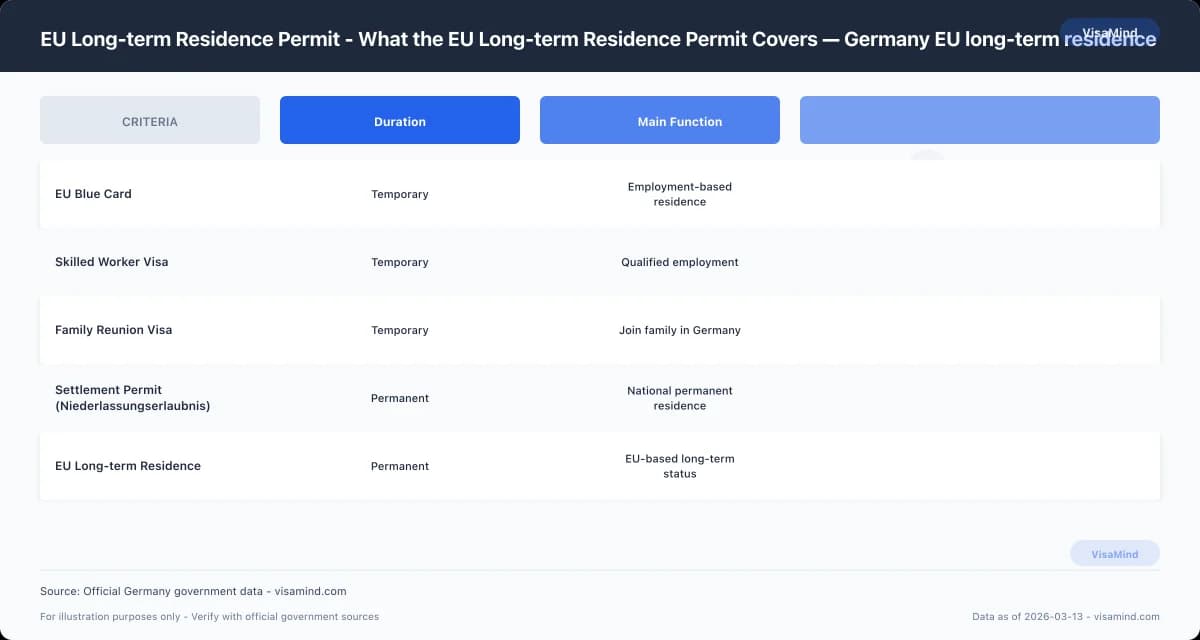
This status differs from a Settlement Permit (Niederlassungserlaubnis) because it specifically includes mobility rights within the European Union framework.
If you currently hold a residence title such as an EU Blue Card, Skilled Worker Visa, Family Reunion Visa, or another Aufenthaltstitel, those years may count toward the five-year residence period. Confirm how your time is calculated with your local Ausländerbehörde.
For official form details and procedural guidance, refer to BAMF and your local immigration office.
Who it's for
The EU long-term residence permit is for those who have lived in Germany for at least five years and want both permanence and mobility within the EU.
You may consider this status if you:
- Have maintained lawful residence in Germany for 5 years
- Hold or previously held a valid Aufenthaltstitel
- Want long-term security beyond temporary visas
- Plan to move to another EU country in the future
It’s relevant if you first entered Germany on a:
- EU Blue Card
- Skilled Worker Visa
- Family Reunion Visa
- Other residence-based permits
If you are still on a short-term or transitional status, such as a Opportunity Card, you must first accumulate the required five years of residence before qualifying.
Your eligibility depends on how your residence periods are recognized. The local Ausländerbehörde will assess your individual record, including your Form Residence Declaration history and issued permits.
Key outcomes
The EU long-term residence permit gives you two core outcomes: permanent residence in Germany and the right to move to other EU countries under EU provisions.
| Feature | What it means for you |
|---|---|
| Permanent residence | You no longer rely on a temporary visa category |
| EU mobility rights | You may move to other EU countries under EU rules |
Unlike temporary residence permits, this status does not tie you to a specific visa purpose such as employment or family reunification.
You still interact with German authorities for administrative matters. The Ausländerbehörde manages your residence status, while BAMF provides the official application framework.
For procedural steps, documentation requirements, and processing details, consult BAMF and your local Ausländerbehörde directly.
Residency Obligations (EU long-term resident Germany)
#
You must keep your status valid by maintaining accurate records and complying with all residence conditions issued by your local Ausländerbehörde. Careful documentation and consistent communication with the correct authority protect your EU long-term residence in Germany.
Keeping records and documents
You must retain every document connected to your Form Aufenthaltstitel Application and residence history. This includes approval notices, residence cards, renewal confirmations, and any correspondence from your local Ausländerbehörde or the Federal Office for Migration and Refugees (Bundesamt für Migration und Flüchtlinge) (BAMF), where applicable.
Keep both physical and digital copies.
Maintain organized records for related permits, especially if you previously held a:
- EU Blue Card
- Skilled Worker Visa
- Opportunity Card
- Family Reunion Visa
- Settlement Permit (Niederlassungserlaubnis)
If you submit a Form Residence Declaration or update your registered address, store confirmation receipts. Missing paperwork can delay renewals or status confirmations.
Before filing any new request, review the official instructions from the responsible authority and confirm that you include all required documents. Incomplete submissions often lead to processing delays.
| Document Type | Why It Matters | Where to Verify Requirements |
|---|---|---|
| Residence permit card | Proof of legal stay | Local Ausländerbehörde |
| Application confirmations | Evidence of timely filing | Local Ausländerbehörde |
| Consular visa records | Entry basis documentation | Federal Foreign Office |
Common compliance tips
You must follow the conditions attached to your residence title at all times. The authority that issued your permit defines those conditions.
Use this checklist to stay compliant:
- Ensure your address registration remains current.
- Respond promptly to written requests from the Ausländerbehörde.
- Keep copies of every submission.
- Verify document requirements before each renewal.
- Track expiration dates well in advance.
If your status changes from another permit, such as an EU Blue Card or Skilled Worker Visa, confirm that your new rights and obligations are reflected correctly in your records.
For procedural rules or timelines not stated in your approval notice, consult the official guidance issued by your local Ausländerbehörde or, for matters abroad, the Federal Foreign Office.
Your Rights as a Permanent Resident
#With a valid EU long-term residence permit or a Settlement Permit (Niederlassungserlaubnis), you gain secure residence in Germany and defined mobility rights within the European Union. These rights affect where you can live, work, and apply for a new residence status.
Freedom of movement in the EU
The EU long-term residence permit allows you to move to almost any other EU country and apply for a residence permit there under facilitated conditions. You do not start from the same position as a first-time applicant without EU long-term status.
When you relocate, you must:
-
Apply for a new national residence permit in the destination EU country.
-
Comply with that country’s immigration rules.
-
Submit the required Form Residence Declaration and supporting documents.
This mobility right differs from national permits such as the EU Blue Card, Skilled Worker Visa, or Opportunity Card, which tie you more closely to the issuing state.
| Status | Move to another EU country | Conditions |
|---|---|---|
| EU long-term residence | Yes | Apply under facilitated national rules |
| Settlement Permit (Germany only) | Not automatically | Subject to the other country’s standard law |
| EU Blue Card | Limited mobility | Based on EU and national Blue Card rules |
You still apply through the competent authority in the new country. In Germany, local Ausländerbehörde offices handle residence permits, while the Federal Foreign Office manages visa applications abroad.
Access and limitations
Your permanent status gives you stable residence in Germany. You no longer depend on the original purpose of stay, such as employment under a Skilled Worker Visa or studies.
You may:
- Live in Germany without time limits.
- Change employers without reapplying for a new Aufenthaltstitel.
- Apply for Family Reunion Visas for eligible family members under the applicable rules.
However, your rights are not unlimited.
You must:
- Maintain valid identification and registration.
- Comply with German law and residence regulations.
- Keep your residence information current with the local registration authority.
The Federal Office for Migration and Refugees (BAMF) oversees migration policy and asylum matters, but your residence permit remains under the authority of your local Ausländerbehörde.
If you move to another EU country, your German status does not automatically replace that country’s national permit requirements. You must complete a new Form Aufenthaltstitel Application there under its legal framework.
From PR to Citizen
#After you secure permanent residence in Germany, you can move toward full German citizenship if you meet the legal requirements. Your pathway depends on the residence permit you held before receiving your Settlement Permit (Niederlassungserlaubnis) and how consistently you maintained lawful status.
Typical pathways
Most applicants reach permanent residence first, then apply for naturalization.
Common routes to a Settlement Permit (Niederlassungserlaubnis) include:
- EU Blue Card
- Skilled Worker Visa
- Family Reunion Visa
- Other long-term Aufenthaltstitel issued by your local Ausländerbehörde
You must hold a valid residence title and comply with its conditions before qualifying for permanent residence. Your application is filed with the local Ausländerbehörde, not with the Federal Office for Migration and Refugees (BAMF).
If you first entered Germany on a national visa issued by the Federal Foreign Office, you converted it into a residence permit through an Form Aufenthaltstitel Application after arrival.
| Stage | Authority Responsible | Where You Apply |
|---|---|---|
| National visa (if required) | Federal Foreign Office | German mission abroad |
| Temporary residence permit | Local Ausländerbehörde | Inside Germany |
| Settlement Permit (Niederlassungserlaubnis) | Local Ausländerbehörde | Inside Germany |
| Citizenship (naturalization) | Local naturalization authority | Inside Germany |
BAMF primarily handles asylum and integration matters, not standard residence permits.
Timing and next steps
You must maintain uninterrupted lawful residence before moving from permanent residence to citizenship. The exact residence period and eligibility rules depend on your status and personal circumstances.
Before applying for citizenship, make sure you:
- Hold a valid Settlement Permit (Niederlassungserlaubnis)
- Have completed any required local registration or Form Residence Declaration (Anmeldung)
- Can document your lawful stay from your initial Aufenthaltstitel onward
- Meet integration and legal compliance requirements under German law
Follow this sequence:
-
Confirm eligibility with your local naturalization authority.
-
Prepare documentation covering your residence history.
-
Submit your application within your district of residence.
Your path from EU long-term residence to citizenship depends on consistent legal status and proper filings at each stage.
Renewing Your PR Card
#You must renew your permanent residence card to keep valid proof of your right to live in Germany. Renewal focuses on timing and meeting the administrative steps set by your local Ausländerbehörde.
When to renew
You should apply for renewal before your current permanent residence card expires. Your status under a Settlement Permit (Niederlassungserlaubnis) or EU long-term residence does not automatically extend the physical card.
The card serves as official proof of your residence title (Aufenthaltstitel). Employers, public offices, and border authorities may request a valid card, even if your underlying status remains valid.
If you previously held an EU Blue Card, Skilled Worker Visa, Family Reunion Visa, or Opportunity Card and later obtained permanent residence, only the permanent residence card requires renewal—not your prior visa category.
You submit the renewal request to your local Ausländerbehörde, not to the Federal Office for Migration and Refugees (BAMF). BAMF handles asylum matters, while residence permits inside Germany fall under local immigration authorities.
If you’re unsure about your card’s validity date, check the expiration printed on the card itself or confirm directly with your Ausländerbehörde.
Administrative requirements
You must file a renewal application with your local Ausländerbehörde. Authorities may refer to this as an Form Aufenthaltstitel Application for card reissuance.
Expect the following administrative elements:
- Completed renewal form (as required by your Ausländerbehörde)
- Valid passport
- Current permanent residence card
- Updated Form Residence Declaration if requested
The standard administrative fee is:
Processing times vary by city and workload. You must verify current timelines directly with your local Ausländerbehörde before applying.
The Federal Foreign Office handles visa applications abroad, not PR card renewals inside Germany. Always confirm local procedural details with your issuing authority to avoid delays.
How to Apply
#You apply by using the official form issued by the Federal Office for Migration and Refugees (Bundesamt für Migration und Flüchtlinge) (BAMF), completing it fully, and filing it with all required evidence. Accuracy and complete documentation determine whether your application proceeds without delays.
Download the form and instructions
Get the current EU long-term residence application form and its official instructions from the Federal Office for Migration and Refugees (BAMF). Use only the latest version to avoid problems with outdated forms.
Review the instructions before you start. They explain how to complete each section and clarify what supporting evidence you need to attach.
If you currently hold a Settlement Permit (Niederlassungserlaubnis), EU Blue Card, Skilled Worker Visa, Family Reunion Visa, or Opportunity Card, make sure your Aufenthaltstitel (residence title) details match your records. You'll need to report this information accurately in the form.
Pay attention to any references to a Form Residence Declaration or similar registration documents. The instructions specify if you have to include them.
| Step | What You Must Do | Why It Matters |
|---|---|---|
| 1 | Download the current form | Outdated forms may not be accepted |
| 2 | Read official instructions | Prevents errors and omissions |
| 3 | Verify residence title details | Ensures consistency with your immigration record |
Complete, sign and file
Fill out every required section of the application clearly and truthfully. Don't leave mandatory fields blank.
Provide full details about your identity, current residence status, and previous permits issued in Germany. If you previously held an EU Blue Card, Skilled Worker Visa, Family Reunion Visa, or another Aufenthaltstitel, list it exactly as issued.
Use consistent information across all documents. Names, dates of birth, and residence history should match your passport and prior approvals.
Sign the form where required. An unsigned application can cause delays or rejection.
File the completed form as instructed by BAMF. Follow the submission method stated in the official guidance.
Before filing, confirm that you have:
- Completed all mandatory fields
- Used accurate residence permit information
- Signed where required
- Prepared all supporting documents
Submit supporting evidence
Attach all documents listed in the official instructions. Missing evidence can stop your application from moving forward.
Organize your documents in the order requested. Clear organization helps the reviewing authority verify your eligibility more efficiently.
Supporting evidence usually relates to your identity and your current lawful residence in Germany. This includes documentation connected to your existing Aufenthaltstitel, such as a Settlement Permit (Niederlassungserlaubnis) or EU Blue Card, if applicable.
If the instructions require a Residence Declaration or proof of registration, include it in the specified format.
Use this checklist to confirm completeness:
- Valid passport copy
- Copy of your current residence permit
- Any required Residence Declaration
- Additional documents listed in the official BAMF instructions
Submit only copies unless originals are specifically required. Always follow the document format and certification rules stated by BAMF.
PR Fees and Timeline
#You must pay a government fee when you submit your EU long-term residence permit application. Processing usually takes several months, and timelines depend on your residence category and the local authority handling your file.
Application and admin fees
You pay the fee at the time you file your Form Aufenthaltstitel Application with your local Ausländerbehörde. The exact amount appears on your fee notice.
| Fee Type | Amount (EUR) | When You Pay |
|---|---|---|
| Possible maximum administrative cost | Up to approx. Your local Ausländerbehörde collects the fee. If you applied from abroad, the Federal Foreign Office processes the consular side of your case. |
Fee structures can change, and the exact amount appears on your notice.
Typical processing times
After entering Germany, you must apply for a residence permit at the foreigners authority in Germany in good time before your visa expires.
The clock generally starts once you submit a complete application, including your Form Residence Declaration and supporting documents. Incomplete files delay review.
Your local Ausländerbehörde handles residence permits inside Germany. The Federal Office for Migration and Refugees (BAMF) oversees migration policy and asylum matters but doesn't issue regular residence permits.
You should not make travel or employment changes until you receive a formal decision.
Variations by category/location
processing times vary depending on:
- Your current status (e.g., EU Blue Card, Skilled Worker Visa, Family Reunion Visa, Opportunity Card)
- Whether you already hold a Settlement Permit (Niederlassungserlaubnis)
- The workload of your local Ausländerbehörde
- The completeness of your application
Urban offices with high application volumes often take longer than smaller districts. Category-based reviews may also require additional checks.
Each local office manages its own caseload and scheduling system.
When to Get Help
#Approval is not automatic, even if you believe you meet the requirements. Seek professional guidance if your history, status type, or prior applications create legal risk.
High-risk or complex cases
Legal help is important if your immigration history includes status changes, gaps, or overlapping permits. Moving between a EU Blue Card, Skilled Worker Visa, Family Reunion Visa, or Opportunity Card can complicate how the local Ausländerbehörde reviews your Form Aufenthaltstitel Application.
Issues often arise when your records with different authorities don't align. The local Ausländerbehörde decides residence permits inside Germany, while the Federal Office for Migration and Refugees (BAMF) handles asylum matters. Confusion between agencies can delay or weaken your file.
Seek help if you have:
- Filed multiple residence applications
- Changed employers under a work-based permit
- Switched from temporary to long-term status
- Submitted a Form Residence Declaration with inconsistent details
| Risk Factor | Why It Matters |
|---|---|
| Status changes | Authorities reassess eligibility history |
| Incomplete records | Delays or negative decisions |
| Prior asylum contact with BAMF | Separate legal track may affect review |
Professional review reduces preventable errors before you submit.
Borderline eligibility or prior refusals
If you narrowly meet the requirements for Germany EU long-term residence, don't rely on assumptions. Filing doesn't guarantee approval.
Borderline cases often involve timing. You may believe your years under a Settlement Permit (Niederlassungserlaubnis) or another Aufenthaltstitel qualify, but documentation gaps can undermine your claim.
Seek help if you:
- Received a previous refusal
- Withdrew an earlier application
- Disagree with how the authority calculated your residence period
- Submitted incomplete documents in the past
| Situation | Why Legal Review Helps |
|---|---|
| Prior refusal | Identifies weaknesses before refiling |
| Disputed residence period | Clarifies how time is counted |
| Incomplete file | Ensures corrected submission |
A structured review of your full immigration history strengthens your position before you reapply.
Who Qualifies
#You qualify for a Germany EU long-term residence permit only if you hold a valid German residence status and meet the rules tied to that status. Your current Aufenthaltstitel determines how your time in Germany counts and what conditions apply.
Eligibility categories
Your eligibility depends on the type of residence permit you currently hold and how it was issued by your local Ausländerbehörde.
Common categories include:
- EU Blue Card
- Skilled Worker Visa
- Family Reunion Visa
- Existing Settlement Permit (Niederlassungserlaubnis)
- Other residence permits issued as an Aufenthaltstitel
If you applied from abroad, the Federal Foreign Office handled your entry visa. Once in Germany, your residence permit and any change of status fall under the local Ausländerbehörde.
If you previously held protection-related status, the Federal Office for Migration and Refugees (Bundesamt für Migration und Flüchtlinge – BAMF) may have been involved in your procedure.
| Residence Status | Issuing Authority | Relevance for EU Long-Term Residence |
|---|---|---|
| EU Blue Card | Local Ausländerbehörde | Counts as qualifying legal residence |
| Skilled Worker Visa | Local Ausländerbehörde | Counts if converted into a residence permit |
| Family Reunion Visa | Local Ausländerbehörde | Counts if valid and continuous |
| Settlement Permit (Niederlassungserlaubnis) | Local Ausländerbehörde | May affect which long-term option suits you |
You must hold a valid residence title at the time you submit your application.
Check category-specific instructions
Before filing your Form Aufenthaltstitel Application for EU long-term residence, review the rules tied to your current permit type. Each category can have different documentation and procedural steps.
Focus on:
- Whether your current permit qualifies toward long-term status
- Whether you must first convert your status
- Which authority processes your request
- Whether you must submit a new Form Residence Declaration
Time spent under a Opportunity Card or another temporary status doesn't automatically qualify. Confirm how your specific permit is treated.
Your local Ausländerbehörde provides binding instructions for applicants already living in Germany. If your case involves asylum or protection matters, verify any prior BAMF decisions before applying.
Follow the official category guidance to avoid delays or rejection.
Why PR Applications Fail
#Most permanent residence refusals stem from preventable filing mistakes. You control the accuracy, completeness, and organization of your application, whether you apply for a Settlement Permit (Niederlassungserlaubnis) or EU long-term residence.
Top application errors
Forms with missing fields, inconsistent dates, or unsigned declarations are a problem. The local Ausländerbehörde will not process an incomplete Form Aufenthaltstitel Application.
Required documents listed in the official instructions must be included. This applies across residence categories, including:
- EU Blue Card
- Skilled Worker Visa
- Family Reunion Visa
- Opportunity Card
- Applications transitioning to a Settlement Permit (Niederlassungserlaubnis)
If you omit supporting records such as a Form Residence Declaration or required identity documents, the authority must pause or return your file.
The most common issues include:
| Error Type | How It Affects Your Case |
|---|---|
| Missing signatures | Application considered incomplete |
| Blank form fields | Processing delay or rejection |
| Inconsistent personal data | Additional verification required |
| Missing required documents | File returned or decision delayed |
Even small inconsistencies can slow review. Officers must verify your information before moving forward.
How to avoid delays
Most problems can be avoided by reviewing every field before submission. Don't leave sections blank unless the form clearly allows it.
Use this checklist before filing:
- Confirm all personal details match your passport and current residence permit
- Sign every required section
- Attach all documents listed in the official instructions
- Include your Residence Declaration if required
- Organize documents in the order requested
Prepare your file as if the officer has no prior access to your records. Don't assume the Federal Office for Migration and Refugees (BAMF) or your local Ausländerbehörde will retrieve missing information for you.
Submit a complete and clearly organized application the first time. That step alone reduces most avoidable delays.
Fees
#| Component | Amount |
|---|---|
| Application feeExtracted from guide content — verify against official source | See official schedule |
| Administrative feeProcessing — verify against Ausländerbehörde | See official schedule |
Fees change; always verify on AA.