On this page
- Overview — Germany Job Seeker visa
- Sponsor Requirements
- Fees and Processing Times
- When to Get Professional Help
- Path to Permanent Residence
- Renewal and Extension
- Conditions and Portability
- Dependents
- Eligibility Requirements — job seeker visa Germany
- How to Apply
- Prepare Required Documents
- Common Petition Challenges
- Fees
- Required forms
- Related visa types
- Related guides
- Related goals
- Next steps
Overview — Germany Job Seeker visa
#The Germany Job Seeker visa allows you to enter Germany to look for work if you meet certain professional or educational standards. It grants a temporary residence permit and can be a stepping stone to options like the Skilled Worker Visa or EU Blue Card.
What it is
The Germany Job Seeker visa—also called the Opportunity Card (Chancenkarte)—lets you stay in Germany temporarily while you look for employment.
You don't get work authorization with this visa alone. The main purpose is to give you legal residence while you seek a qualifying job offer.
If you secure employment, you must apply for a different residence title, such as:
- Skilled Worker Visa
- EU Blue Card
- Self-Employment Visa
- Freelance Visa
You submit your visa application abroad through the Federal Foreign Office using the Form VIDEX system. After entering Germany and getting a job offer, you file an Form Aufenthaltstitel Application with your local Ausländerbehörde to switch to the right work-based permit.
| Feature | Germany Job Seeker Visa |
|---|---|
| Purpose | Search for employment in Germany |
| Work rights | No direct work authorization |
| Type | Temporary residence permit |
| Next step after job offer | Apply for Skilled Worker Visa or EU Blue Card |
Who manages it
Different German authorities handle various stages.
If you apply from outside Germany, the Federal Foreign Office processes your national visa application through German embassies or consulates. You use VIDEX to complete and submit your application before your appointment.
Once you're in Germany, your local Ausländerbehörde manages your residence status. This office handles your Aufenthaltstitel Application if you transition to a Skilled Worker Visa or EU Blue Card.
The Federal Office for Migration and Refugees (Bundesamt für Migration und Flüchtlinge — BAMF) oversees broader migration policy and legal frameworks, including residence regulations for this visa category.
| Authority | Role |
|---|---|
| Federal Foreign Office | Processes visa applications abroad |
| Local Ausländerbehörde | Issues and converts residence permits inside Germany |
| BAMF | Oversees migration regulations and legal structure |
Sponsor Requirements
#The Germany Job Seeker Visa doesn't require a sponsoring employer. Your eligibility depends on your passport status and compliance with German entry rules, not on a job offer.
Does an employer sponsor this visa?
You don't need an employer to sponsor your Germany Job Seeker Visa application.
This visa allows you to enter Germany to search for work independently. You apply through the Federal Foreign Office if you're outside Germany, and you later file an Form Aufenthaltstitel Application with your local Ausländerbehörde if you qualify for a residence permit after securing employment.
Your passport type affects whether you need a visa before travel. The visa exemption applies only in these cases:
| Passport Type | Visa Exemption Condition |
|---|---|
| Biometric passport | Eligible for visa-free entry (except certain Serbian passports) |
| Serbian passport issued by the Coordination Directorate | Not eligible for visa-free entry |
| Taiwan passport | Must include an identity card number to qualify for exemption |
If you don't meet these conditions, you must apply for a visa before entering Germany.
After you find employment, you may transition to a Skilled Worker Visa, EU Blue Card, Opportunity Card (Chancenkarte), Self-Employment Visa, or Freelance Visa, depending on your situation.
Employer compliance notes
No employer sponsors this visa, so no company files documents on your behalf during the job-seeking phase.
You're responsible for:
- Submitting your visa application through the Federal Foreign Office
- Completing the Form VIDEX form if required
- Filing your Aufenthaltstitel Application after securing employment
- Applying for an EU Blue Card if you meet its criteria
An employer gets involved only after you have a formal job offer and apply to change your status.
At that point, your future residence permit application—such as a Form Blue Card Application—will depend on meeting the legal requirements for that specific permit. BAMF doesn't handle employer sponsorship for this visa category.
Fees and Processing Times
#A fixed national visa fee applies, and you can expect a processing period of one to three months. The exact timeline depends on the consulate handling your file and how complete your application is.
Application and visa fees
You pay the national visa fee of €75 when you apply for the Germany Job Seeker Visa. This fee applies to long-stay visas issued by German missions abroad under the Federal Foreign Office.
There's also a visa processing fee of €25. Check the current total with the German mission where you submit your application, as fees can change.
| Fee type | Amount (EUR) | When you pay |
|---|---|---|
| National visa fee | €75 | At application submission |
| Visa processing fee | €25 | During visa processing |
You submit your application through the appropriate consulate, usually using the Form VIDEX online form system before your appointment.
If you later switch to a residence permit in Germany—like a Skilled Worker Visa, EU Blue Card, Opportunity Card (Chancenkarte), Self-Employment Visa, or Freelance Visa—you'll file a separate Form Aufenthaltstitel Application with the local Ausländerbehörde and pay new fees. Refer to the Federal Foreign Office or BAMF for current regulations.
Typical processing timelines
Standard processing for the Germany Job Seeker Visa takes 1 to 3 months as of March 2026. Your timeline depends on the consulate, application volume, and the completeness of your documents.
| Processing type | Estimated time |
|---|---|
| Standard processing | 1–3 months |
You can't speed up the process unless the consulate offers a specific expedited option. Most applicants should plan for the full three months.
processing times vary by location and visa category. A Form Blue Card Application or another long-stay visa may have a different timeline.
The Federal Foreign Office publishes general guidance, but your specific consulate controls your file.
When to Get Professional Help
#A lawyer isn't required for every Germany Job Seeker Visa application. However, targeted help is valuable when your case involves a change to another residence title like the EU Blue Card or Skilled Worker Visa.
Professional guidance can reduce errors in your Form VIDEX form, your Form Blue Card Application, or any Form Aufenthaltstitel Application filed with the local Ausländerbehörde.
When employers handle applications
Some employers help coordinate your transition from a Job Seeker Visa to a Skilled Worker Visa or EU Blue Card. They might assist with documentation or communicate with the local Ausländerbehörde.
You're still responsible for accuracy. Mistakes or incomplete information in your application can delay or affect your residence status.
Before submission, make sure you:
- Complete every section of the application form fully
- Review all answers for accuracy
- Follow the official instructions issued by the Federal Foreign Office or the Ausländerbehörde
- Include every required supporting document
If your employer prepares documents on your behalf, review them carefully. Double-check that your personal details, qualifications, and intended residence purpose match your records.
| Authority | Role in the Process |
|---|---|
| Federal Foreign Office | Processes visa applications abroad |
| Local Ausländerbehörde | Issues residence permits inside Germany |
| Federal Office for Migration and Refugees (BAMF) | Handles asylum matters |
If your case shifts from a Job Seeker Visa to an EU Blue Card, Opportunity Card (Chancenkarte), Self-Employment Visa, or Freelance Visa, legal review before filing a new Aufenthaltstitel Application may be worth considering.
Situations that benefit from a lawyer
Consult an immigration lawyer if your situation involves a change of legal basis or multiple residence options. Moving from a Job Seeker Visa to a Self-Employment Visa, Freelance Visa, or EU Blue Card requires precise documentation and correct classification.
Legal help is useful if:
- You're unsure which residence title fits your job offer
- You plan to switch from employment to self-employment
- Your documents were previously incomplete or inconsistent
- You need to correct or amend a submitted application
A lawyer can review your VIDEX submission, confirm that you follow official instructions, and check that you included all required documents before filing with the appropriate authority.
For asylum matters, only BAMF has jurisdiction. In those cases, legal representation is especially important due to the complexity of asylum procedures.
If you're uncertain about eligibility requirements or documentation standards, verify details with the Federal Foreign Office or your local Ausländerbehörde before submitting any Blue Card Application or Aufenthaltstitel Application.
Path to Permanent Residence
#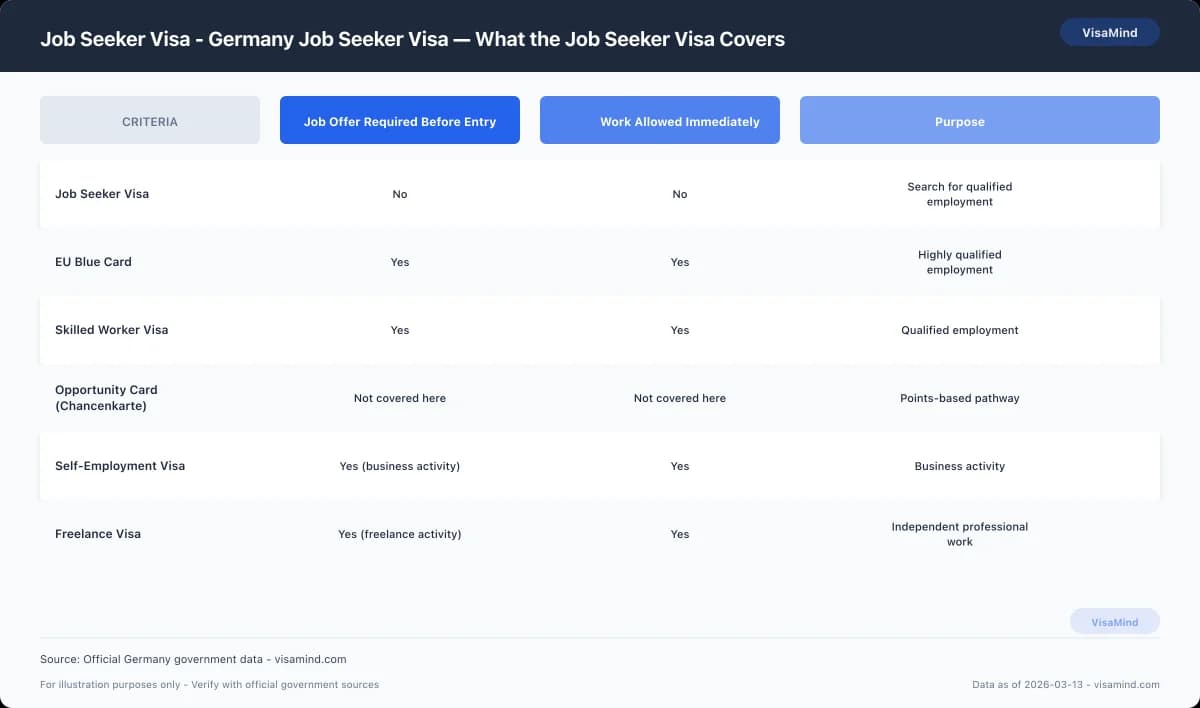
Your Job Seeker Visa doesn't lead directly to permanent residence. You need to switch to a qualifying residence permit and build lawful residence time in Germany.
Common next steps after job search
After you secure a job offer, you apply for a residence permit at your local Ausländerbehörde. You can't start long-term employment without converting your status to an appropriate Aufenthaltstitel.
Most applicants move to one of these:
- Skilled Worker Visa
- EU Blue Card
- Opportunity Card (Chancenkarte)
- Self-Employment Visa
- Freelance Visa
You submit your Form Aufenthaltstitel Application to the Ausländerbehörde in Germany. If you applied from abroad, you likely used the Form VIDEX system through the Federal Foreign Office.
If you qualify for the EU Blue Card, you complete a separate Form Blue Card Application after receiving a binding job offer that meets the criteria. Check the Federal Foreign Office and your local Ausländerbehörde for current requirements and fees in EUR (€).
| Situation | Likely Next Step | Where You Apply |
|---|---|---|
| Job offer in qualified employment | Skilled Worker Visa | Local Ausländerbehörde |
| High-skilled job meeting Blue Card criteria | EU Blue Card | Local Ausländerbehörde |
| Plan to start a business | Self-Employment Visa | Local Ausländerbehörde |
| Independent professional services | Freelance Visa | Local Ausländerbehörde |
Routes to skilled immigration
Permanent residence generally comes after a period of lawful stay under a qualifying residence permit. The most common path is through skilled employment.
You typically qualify for long-term residence after holding:
- A Skilled Worker Visa
- An EU Blue Card
- A residence permit for self-employment or freelance activity
Each route requires that you:
- Maintain valid residence status
- Meet employment conditions tied to your permit
- Comply with German immigration law
The EU Blue Card provides a structured path within Germany’s skilled immigration framework. The Skilled Worker Visa is also a standard route if your qualifications align with your employment.
The Federal Office for Migration and Refugees (Bundesamt für Migration und Flüchtlinge – BAMF) oversees broader migration policy. Your local Ausländerbehörde processes residence permits and long-term status applications.
For exact residence periods, documentation requirements, and current fees in EUR (€), consult your local Ausländerbehörde or the Federal Foreign Office.
Renewal and Extension
#The Germany Job Seeker Visa allows you to stay for a fixed period of 180 days. Plan your job search and any follow‑up application within this timeframe.
Visa duration and timeline
The Job Seeker Visa is valid for a maximum stay of 180 days. Your period starts on the date shown on your visa sticker or residence document.
There’s no grace period. When 180 days are up, your legal stay ends.
Here’s a basic timeline:
| Stage | What You Should Do | Authority Involved |
|---|---|---|
| Day 1–30 | Arrive in Germany and begin your job search | — |
| During 180 days | Secure a qualifying job offer | — |
| Before Day 180 | Prepare and file the appropriate Form Aufenthaltstitel Application if eligible | Local Ausländerbehörde |
If you receive a job offer, you need to apply for the relevant residence permit before your 180-day period ends. This could be a Skilled Worker Visa, EU Blue Card, Opportunity Card (Chancenkarte), Self-Employment Visa, or Freelance Visa.
Visa issuance abroad is handled by the Federal Foreign Office. Inside Germany, your local Ausländerbehörde issues residence permits.
When to re-file
The Job Seeker Visa can’t be extended past 180 days unless German authorities specifically allow it under current rules. Extension policies are determined by your local Ausländerbehörde.
Consider switching status or re-filing if:
- You get a qualifying employment contract
- You’re eligible for an EU Form Blue Card Application
- You meet the requirements for a Self-Employment Visa or Freelance Visa
- You qualify for the Opportunity Card (Chancenkarte)
If your 180 days run out without a new residence status, you must leave Germany. Overstaying can impact your future immigration options.
For policy updates, refer to the Federal Foreign Office or the Federal Office for Migration and Refugees (BAMF).
Conditions and Portability
#The Job Seeker Visa lets you stay in Germany temporarily to find qualified employment. Your rights are limited, and you must switch to the correct residence title once you have a job offer.
Length of stay while job seeking
Your visa is valid for the period printed on the visa sticker issued by the Federal Foreign Office. You’re only allowed to remain in Germany during that time.
You can’t extend this visa unless German law allows a status change. If you find qualified work, apply for the appropriate residence permit at your local Ausländerbehörde before your visa expires.
Once you have a job offer that meets the requirements, you may apply for:
- Skilled Worker Visa (residence permit for qualified professionals)
- EU Blue Card
- Opportunity Card (Chancenkarte), if eligible
- Self-Employment Visa
- Freelance Visa
File your Form Aufenthaltstitel Application with the Ausländerbehörde. For the EU Blue Card, submit the formal Form Blue Card Application.
| Situation | What You Must Do |
|---|---|
| No job offer before expiry | Leave Germany before your visa expires |
| Job offer received | Apply for the correct residence permit at the Ausländerbehörde |
| Change to EU Blue Card | Submit a Blue Card Application with employment documentation |
The Federal Office for Migration and Refugees (BAMF) doesn’t handle work residence permits. Local immigration offices process these applications inside Germany.
Work restrictions during the search
The Job Seeker Visa doesn’t authorize regular employment. You can’t start full-time or long-term paid work while searching.
You’re limited to job search activities: attending interviews, contacting employers, negotiating contracts.
If you want to work independently, you’ll need a:
- Self-Employment Visa
- Freelance Visa
You can’t start self-employment or freelance work until the new permit is approved.
| Activity | Allowed on Job Seeker Visa? |
|---|---|
| Attend interviews | ✅ Yes |
| Sign employment contract | ✅ Yes |
| Start full-time employment | ❌ No (requires residence permit) |
| Begin freelance/self-employment | ❌ No (requires proper visa) |
Once you secure employment, apply for the correct residence permit. Don’t start working until the Ausländerbehörde grants permission.
For procedural details, refer to the Federal Foreign Office for visa issuance abroad and your local Ausländerbehörde for residence permits.
Dependents
#Family members can’t automatically accompany you on a Job Seeker Visa. Their eligibility depends on your status and financial resources.
Bringing family members
The Job Seeker Visa is a temporary permit for finding work. It doesn’t grant an immediate right to family reunification.
If your spouse or children wish to join you, they typically need to apply for their own visa through the Federal Foreign Office at the German consulate. Approval depends on your legal status and ability to support them.
Family reunification usually becomes possible only after you switch to a long-term residence permit such as:
- Skilled Worker Visa
- EU Blue Card
- Opportunity Card (Chancenkarte)
- Self-Employment Visa
- Freelance Visa
Once you hold one of these permits, you can apply for family reunification through your local Ausländerbehörde as part of your Form Aufenthaltstitel Application. German residence law governs these policies; asylum matters fall to the Federal Office for Migration and Refugees (BAMF).
Use the Form VIDEX system for national visa applications abroad.
| Your Status in Germany | Can Family Join Immediately? | Authority Involved |
|---|---|---|
| Job Seeker Visa | Generally no automatic right | Federal Foreign Office (abroad) |
| Skilled Worker / EU Blue Card | Possible, subject to approval | Ausländerbehörde |
| Asylum Procedure | Separate legal process | BAMF |
Financial proof for family
You need to show you can support yourself and any dependents without public funds. This requirement is stricter when family members apply.
Prepare to provide:
- Proof of stable and sufficient income
- Evidence of adequate housing
- Valid health insurance for all family members
For applications from abroad, the German consulate reviews your financial documentation. If you’re already in Germany, your Ausländerbehörde checks your ability to cover living expenses during the residence permit process.
If you later submit a Form Blue Card Application or another Aufenthaltstitel Application, update your financial evidence to match your household size. Insufficient funds can result in refusal of the family’s visa.
Check current financial thresholds with the Federal Foreign Office or your Ausländerbehörde before your family applies.
Eligibility Requirements — job seeker visa Germany
#You must meet specific legal conditions before Germany issues a residence title for job seeking. Authorities review your qualifications, financial security, identity, and immigration history under the Residence Act (AufenthG).
Who can apply
You’re eligible if you’re a non‑EU/EEA/Swiss national and meet one of these paths:
- Hold a foreign academic or vocational qualification recognized in Germany, or
- Qualify under the points system with at least six points and a qualification not formally recognized in Germany.
You must also fulfill general residence title requirements:
- Proof of a secure livelihood (enough funds to cover living expenses)
- Clear proof of identity and nationality
- No circumstances that create a public interest in your expulsion
If applying from abroad, the Federal Foreign Office processes your visa. After arrival, your local Ausländerbehörde handles your residence permit (Aufenthaltstitel).
Qualification and points rules
There are two eligibility routes. Your qualification status determines which applies.
| Pathway | Key Requirement | Who It Fits |
|---|---|---|
| Recognized Qualification | Foreign academic/vocational qualification recognized in Germany | Applicants with completed recognition |
| Points-Based Route | At least six points under the official points system | Applicants with non-recognized qualifications |
You need to prove either formal recognition or that you meet the six-point threshold. Without one of these, the visa won’t be issued.
This structure is different from residence titles like the EU Blue Card, Skilled Worker Visa, or Opportunity Card (Chancenkarte), which have separate eligibility rules. The job seeker visa focuses on qualification recognition or points—not a job offer.
Passport/waiver conditions
You must prove your identity and nationality without doubt. A valid passport is required.
Authorities check:
- Authenticity of your passport
- Consistency of your personal data
- No identity discrepancies
You must also show there’s no legal ground for removal or expulsion.
During the visa process, submit your application through the relevant authority. Applicants abroad use the Federal Foreign Office, often via the Form VIDEX system for forms. After arrival, convert your entry visa into a residence permit through the local Ausländerbehörde.
The Federal Office for Migration and Refugees (BAMF) deals with asylum, not job seeker visa processing.
How to Apply
#You must apply through the correct authority using the right forms. Where you live determines where you file, and your documents must prove eligibility.
Where to submit your application
Apply for the Job Seeker Visa at the German mission responsible for your country of residence. The Federal Foreign Office manages applications abroad.
For the Opportunity Card (Chancenkarte), apply online through the Consular Services Portal. Follow the portal’s instructions and upload all required documents.
Refer to this table:
| Situation | Responsible Authority |
|---|---|
| Visa application abroad (Job Seeker, Opportunity Card) | Federal Foreign Office (mission abroad) |
| Asylum matters | Federal Office for Migration and Refugees (BAMF) |
| Residence permit inside Germany (after entry) | Local Ausländerbehörde |
If you later switch to another status (e.g., EU Blue Card, Skilled Worker Visa, Self-Employment Visa, Freelance Visa), file the appropriate Form Aufenthaltstitel Application or Form Blue Card Application with your local Ausländerbehörde.
Steps and forms
Complete the correct visa application form before your appointment or online submission. Some applicants use a form required for filings with BAMF, depending on the procedure.
Core steps:
-
Confirm you meet all visa requirements.
-
Complete the required application form.
-
Prepare supporting documents.
-
Submit the application in your country of residence.
Supporting documents include:
- Valid passport
- Previous passports
- Copies of old visas and entry stamps
Provide clear copies and keep everything organized. Missing documents can delay or derail your application.
For the Opportunity Card via the Consular Services Portal, upload all required documents digitally and follow instructions closely.
Prepare Required Documents
#You need to prove your qualifications, language ability, identity, and financial position with clear, verifiable documents. Unsupported claims or incomplete files delay or block your application.
Proofs of qualification and language
Submit formal evidence of your professional or academic qualifications. Informal experience isn’t enough.
Typical documents:
- Degree certificates or diplomas
- Official transcripts (if available)
- Professional qualification certificates
- Documents showing your field of study or training
Your documents must clearly identify you and the issuing institution. If you later apply for a Skilled Worker Visa, EU Blue Card, Opportunity Card (Chancenkarte), Self-Employment Visa, or Freelance Visa, these same qualifications will be needed.
You also need proof of required language skills, supported by recognized certificates. The certificate must match the language level required for your intended profession.
Use the Form VIDEX system carefully and make sure the information matches your certificates. Inconsistent details can slow down both your Job Seeker Visa and any later Form Aufenthaltstitel Application or Form Blue Card Application.
| Requirement Type | What You Must Provide | Key Rule |
|---|---|---|
| Academic degree | Official certificate | Must clearly show your name and qualification |
| Professional training | Recognized certificate | Must relate to your stated occupation |
| Language skills | Valid language certificate | Must match required level |
Identity, travel and financial evidence
You need to prove your identity and lawful travel status. Submit clear copies of your passport and any prior visas or residence permits.
Passport details must match what you enter in VIDEX. Any mismatch may require clarification.
You also have to provide evidence that you can support yourself during your job search in Germany. Follow the official instructions from the Federal Foreign Office and include every document listed for your nationality.
If you later apply for a residence permit inside Germany, your local Ausländerbehörde will use the same identity and financial evidence during your Aufenthaltstitel Application.
Supporting certificates and originals
Every claim in your application needs documentary proof. Unsupported statements aren’t considered.
Provide:
- Original documents, where required
- Certified copies, if originals are not submitted
- Translations, if your documents are not in German
Check the official document checklist before you submit. Missing certificates can delay processing and sometimes force you to book a new appointment.
The Federal Office for Migration and Refugees (Bundesamt für Migration und Flüchtlinge) (BAMF) handles migration policy. The Federal Foreign Office processes visa applications abroad.
Send in a complete file from the start. Incomplete or inconsistent submissions can lead to complications in future visa categories.
Common Petition Challenges
#Most issues come from missing documents, unrecognized qualifications, or inconsistencies in your application. You’re expected to show you meet eligibility requirements and that your forms match your supporting records.
Frequent causes of rejection
Rejections often happen when qualifications aren’t recognized or validated. If your degree or professional credential doesn’t meet eligibility standards, the Federal Foreign Office can refuse your visa.
You also need to prove sufficient financial means with proper documentation. If there’s no clear evidence, the application may be denied.
Inconsistent information is a major risk. If details on your Form VIDEX form don’t match your passport or supporting documents, the authority may reject your case.
Common rejection triggers
| Issue | Why It Leads to Refusal | How to Reduce Risk |
|---|---|---|
| Unrecognized qualifications | You do not meet eligibility criteria | Confirm recognition status before applying |
| Insufficient financial proof | You cannot demonstrate ability to support yourself | Provide complete, verifiable documentation |
| Inconsistent application details | Authorities question credibility | Match passport and document data exactly |
The Job Seeker Visa doesn’t guarantee approval for other categories. It doesn’t convert automatically into a Skilled Worker Visa, EU Blue Card, Opportunity Card (Chancenkarte), Self-Employment Visa, or Freelance Visa.
Common causes of delay
Delays usually come from incomplete or incorrect information. Even small omissions in your VIDEX or Form Aufenthaltstitel Application can slow things down.
Missing documents force the authority to request more information before continuing.
Review every field and attachment before you submit.
Frequent delay factors
- Blank or partially completed form fields
- Incorrect passport numbers or personal data
- Missing required supporting documents
- Documents that don’t align with information in the form
If you later apply for a Form Blue Card Application or another residence title after entering Germany, you’ll face similar documentation standards. The local Ausländerbehörde expects complete and consistent records.
Fees
#| Component | Amount |
|---|---|
| Application feeExtracted from guide content — verify against official source | €75 (approx $81 USD) |
| Visa processing feeNational visa — verify against Auswärtiges Amt | €25 (approx $27 USD) |
Fees change; always verify on AA.
Next steps
#Use Find My Visa to build a sequenced plan with official sources and deadlines.
FAQs
How long can I stay in Germany to look for work on this visa?
The visa generally allows up to six months (180 days) to find qualified employment.
Can I work while holding the Job Seeker Visa?
No; the Job Seeker Visa does not permit work while you are searching for employment.
What documents should I include with my application?
You must provide evidence of formal qualifications and necessary language skills, proof of recognized qualification or eligibility under the points system, evidence of sufficient financial resources to cover living costs, old passports and entry stamps where applicable, and supporting certificates as required.
How and where do I apply for the Job Seeker Visa?
Apply online via the Consular Services Portal and submit your visa application in your country of residence; applicants filing with BAMF use the designated form.
How long does a Job Seeker Visa application typically take?
Standard processing for the job‑seeker category typically takes 1 to 3 months, though times vary by category and processing location.
What are the fees for applying?
The application fee is €75 and there is a visa processing fee of €25 (amounts as of 2026-02).
Does filing a job‑seeker application guarantee approval?
No: filing a job‑seeker application does not guarantee approval.
What common mistakes cause rejections or delays?
Common issues include applying without validated or recognized qualifications, failing to demonstrate sufficient financial means with proper documentation, and incomplete or inconsistent information across the form which can cause rejections or delays.
Official sources referenced
Last reviewed: 2026-03-13
VisaMind provides informational guidance only and is not a government agency. This is not legal advice. Requirements can change and eligibility depends on your specific facts. If your case is complex or high-stakes, consult a licensed immigration attorney.
Next steps
Every Germany visa case depends on your nationality, purpose, and timeline. Get a personalized plan with official sources and deadlines.
Get my Job Seeker Visa plan