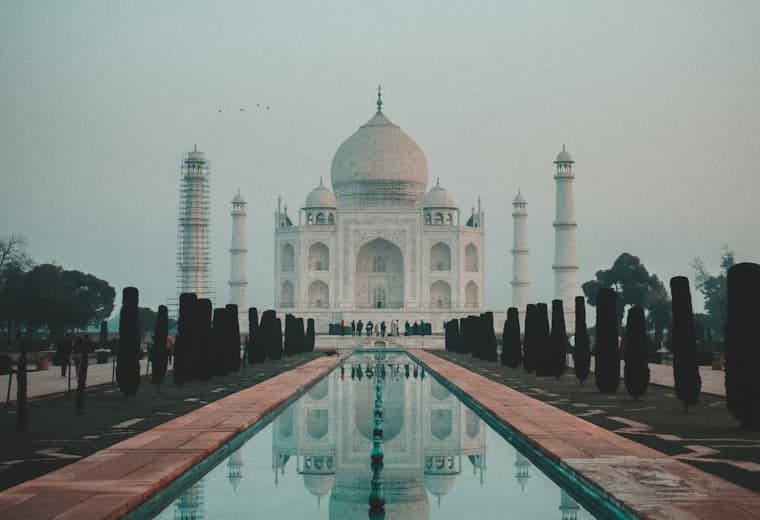
What the Research Visa Covers (India research visa)
#The India Research Visa allows entry and stay in India to conduct approved research with a specific institution. Formal clearance and ongoing compliance with immigration rules are required.
Purpose and scope
The Research Visa is issued for conducting research in India under sponsorship from a recognized Indian institution. Your research activity must match the approved purpose stated in your application.
This visa is not a substitute for a Student Visa, Intern Visa, Employment Visa, Project Visa, or Journalist Visa. If you plan to work, study, intern, or report, apply under the correct category.
Clearance from the Ministry of Home Affairs (MHA) is required before the visa is granted. Without this, the Research Visa will not be issued.
You must use the designated Form Online Visa Application form for research and follow Bureau of Immigration instructions.
| Requirement | Applies to Research Visa |
|---|---|
| Conduct academic or institutional research | Yes |
| Institutional sponsorship required | Yes |
| MHA clearance required | Yes |
| Paid employment allowed | No (unless separately authorized) |
| Media reporting allowed | No |
Who it's for
Apply for the Research Visa if your primary purpose in India is structured research under supervision or sponsorship of a specific Indian institution.
Typically, you qualify if you:
- Have formal sponsorship from an Indian research institution
- Intend to conduct research in India
- Can obtain required MHA clearance
- Apply using the designated Research Visa form
If you plan to enroll in a degree program, a Student Visa is likely required. Employment activities require an Employment Visa. For field assignments related to infrastructure or industrial projects, the Project Visa may apply.
Your visa category must match your actual activity. Immigration authorities may refuse entry if your stated purpose does not align with your visa type.
After arrival, you may need to complete registration formalities with the FRRO, depending on your stay. Your host institution may also have reporting obligations.
Governing authority
Several authorities oversee the Research Visa process.
The Bureau of Immigration (BOI) manages entry and exit at ports of entry and publishes the official Research Visa form and instructions. Use the correct version of the form.
The Ministry of Home Affairs (MHA) grants the required research clearance. Without MHA approval, your visa cannot proceed.
The Foreigners Regional Registration Office (FRRO) handles in-country compliance, including registration and extensions where permitted. If you stay beyond the prescribed period or require changes, work through FRRO.
Visa application centers such as BLS or VFS may accept and forward your application, but they do not decide your case.
| Authority | Role in Research Visa |
|---|---|
| Ministry of Home Affairs (MHA) | Research clearance approval |
| Bureau of Immigration (BOI) | Form issuance; entry/exit control |
| FRRO | Registration and extensions inside India |
| BLS / VFS centers | Application submission only |
You are responsible for ensuring your visa conditions, research activity, and institutional sponsorship remain consistent during your stay.
How to Apply Step by Step
#The India Research Visa process is completed online. You submit the required details, pay the fee in INR (₹), and follow the instructions for submission or appointment.
Fill out the online form
Begin with the Form Online Visa Application form for a Research Visa. Select the correct visa category—do not choose Student Visa, Intern Visa, Employment Visa, Project Visa, or Journalist Visa unless they match your actual purpose.
Complete every required field. Enter your personal details exactly as they appear on your passport.
Before submission, review the form for errors. You must:
- Complete all mandatory sections
- Provide accurate passport details
- Enter a valid email address
- Sign the application as required
An incomplete or inconsistent form can delay processing or lead to refusal. Use consistent information throughout.
Pay, submit and get confirmation
After completing the form, pay the visa fee in INR (₹) through the application portal. For current fee amounts, refer to the Bureau of Immigration source.
Once payment is successful, submit your application electronically. The system will generate a confirmation of submission.
A confirmation message is sent to the email address you entered. Keep this confirmation for your records.
Submission confirms receipt, not approval.
In-person submission or appointment
After submitting online, follow the instructions in your confirmation regarding in-person submission or scheduling an appointment.
Applications are typically handled through authorized visa application centers such as BLS or VFS, which accept and forward your file. These centers do not make visa decisions.
| Authority | Role |
|---|---|
| BLS/VFS | Accept and forward applications |
| Bureau of Immigration (BOI) | Manages entry and exit at Indian borders |
| Foreigners Regional Registration Office (FRRO) | Handles registration and visa extensions inside India |
If your stay requires registration after arrival, FRRO manages that process. In some cases, accommodation providers may submit Form Form C, which is separate from your visa application.
Follow the instructions given in your confirmation notice and attend any required appointment on time.
What It Costs and How Long
#You pay a government fee and should expect a multi‑week review period. Processing times depend on visa category and location, and authorities may adjust them without notice.
Application fees
The fee for a Research Visa depends on the type and duration of visa applied for. The exact INR amount depends on the exchange rate at the time of payment through the Form Online Visa Application system or the authorized submission center.
| Item | Amount (as of 2026) | Paid To |
|---|---|---|
| Research Visa application fee | Depends on visa type and duration | Through Online Visa Application / authorized center |
You pay this fee when you submit your application. Submission centers such as BLS or VFS accept documents, but do not make visa decisions.
If you extend your stay inside India, you will deal with the FRRO. Confirm any additional fees directly with FRRO before filing.
Authorities can revise amounts, so verify the current fee with the Government of India visa portal before you pay.
Standard processing window
Upon receipt of the application, the Indian Mission or Post requires a minimum of three working days to process and issue a visa, depending on nationality and excluding special cases.
| Processing Type | Typical Timeframe |
|---|---|
| Standard | Minimum three working days (depending on nationality; special cases excluded) |
Count this period from the date the issuing authority receives a complete application. Missing documents delay review.
Plan your travel around this window. Do not book non‑refundable tickets until you receive visa approval.
If you are already in India and need an extension, FRRO handles the request. Processing times for extensions can differ from initial entry visas, so confirm timelines directly with FRRO.
Variations by category/location
The processing times vary by visa category and application location. A Research Visa may move at a different pace than a Student Visa, Intern Visa, Employment Visa, Project Visa, or Journalist Visa.
Applications submitted from different countries can follow different review schedules. Local workload and clearance requirements affect timing.
Inside India, FRRO manages registration and extensions. Hotels and host institutions may also complete compliance steps such as Form Form C registration, but that process is separate from visa issuance.
Confirm current processing times with the issuing authority before you apply. Use Government of India visa portal and FRRO communications for updates.
Official sources: https://indianvisaonline.gov.in/visa/visa-fee.html · https://indianvisaonline.gov.in/visa/visa-processing.html
Tips and Common Mistakes
#
Accuracy and consistency determine whether your Research Visa application moves forward or stalls. Careful form completion and documentation prevent most refusals and delays.
Expert tips
Complete every section of the Form Online Visa Application with details from your passport and supporting documents.
Do not estimate dates, abbreviate names, or leave fields blank unless the form allows it. Even small differences in spelling or numbering create inconsistencies.
Before you submit:
- Review each answer against your passport.
- Confirm all required documents match the information in the form.
- Read the instructions carefully and follow them line by line.
If you register with the FRRO inside India, your details must match your visa record. Inconsistent information can complicate registration, extensions, or Form Form C filings.
If you previously held another Indian visa, ensure your prior visa details are entered exactly as issued. Use the same document numbers and dates shown on official records.
Common causes of rejection
Most refusals stem from incomplete or inconsistent information.
Common problems include:
- Mismatched passport numbers
- Different spellings of your name across documents
- Missing required documents
- Conflicting dates in travel or research history
The decision-making authority reviews your application as a complete record. If one section contradicts another, officers may treat the entire application as unreliable.
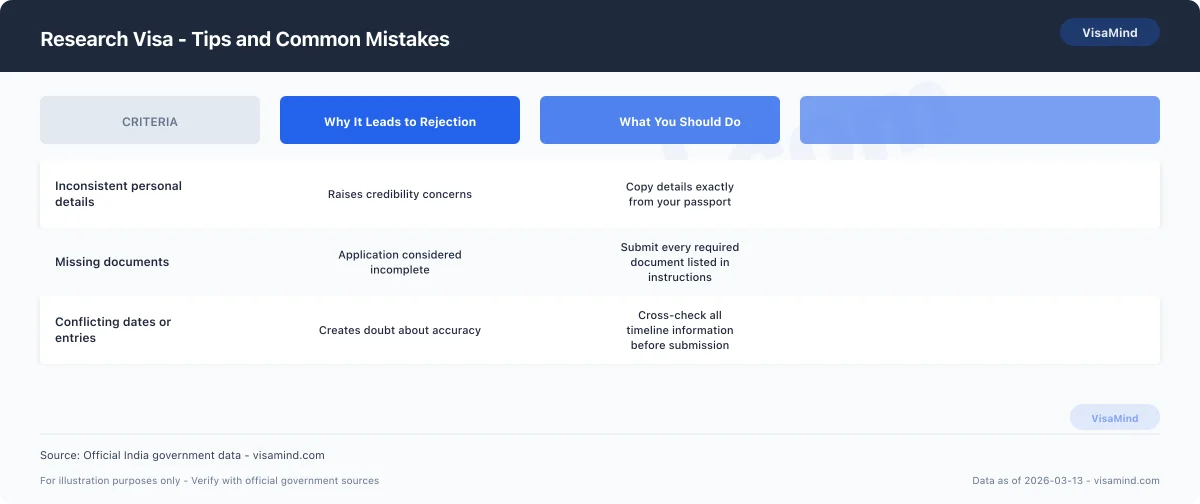
| Issue | Why It Leads to Rejection | What You Should Do |
|---|---|---|
| Inconsistent personal details | Raises credibility concerns | Copy details exactly from your passport |
| Missing documents | Application considered incomplete | Submit every required document listed in instructions |
| Conflicting dates or entries | Creates doubt about accuracy | Cross-check all timeline information before submission |
Review the full application in one sitting before final submission.
How to avoid processing delays
Delays usually result from incomplete or incorrect information rather than complex eligibility questions.
Check every field carefully. Confirm you answered all mandatory sections and uploaded each required document.
Use this checklist before you submit:
-
Verify passport number, issue date, and expiry date.
-
Ensure names match exactly across all documents.
-
Confirm that no required document is missing.
-
Re-read the instructions to confirm compliance.
If you interact with the FRRO for registration or extensions, consistent and accurate initial information reduces follow-up queries.
Accuracy at the start prevents avoidable back-and-forth and keeps your Research Visa process on track.
Conditions of Stay
#Your India Research Visa allows a defined period of stay and may require registration with the FRRO. You must track your time in India and complete registration if your stay crosses specific limits.
Maximum stay rules
Your permitted stay depends on the validity granted on your visa. A key threshold is 180 days.
If you remain in India for less than 180 days, you do not need to register with the FRRO. Once your stay reaches 180 days, registration requirements apply.
For visas issued with longer validity, such as one-year or five-year categories, the 180-day rule still controls registration obligations. The same 180-day threshold applies across multiple visa types, including Student Visa, Intern Visa, Employment Visa, Project Visa, and Journalist Visa.
| Length of Stay in India | Registration with FRRO Required |
|---|---|
| Less than 180 days | No |
| 180 days or more | Yes |
Count your stay from the date of arrival in India. The Bureau of Immigration (BOI) records your entry and exit, so your calculation must match official travel records.
Registration requirements
If your stay reaches 180 days, you must register with the FRRO or the local Foreigners Registration Office (FRO).
You must complete registration:
- With the FRRO/FRO that has jurisdiction over your place of stay
- Through the official FRRO system
- Based on the date of your arrival in India
If your visa category requires registration, you must comply even if you applied through the Form Online Visa Application process before travel. Visa issuance and FRRO registration are separate steps.
Registration obligations apply regardless of whether you hold a Research Visa or another long-term visa type such as a Student Visa or Employment Visa.
If you change your residential address, the accommodation provider may have separate reporting duties through Form Form C, but your personal registration responsibility remains your own.
FRRO handles registration and extensions inside India. The BOI manages entry and exit at the border.
Timing for registration
Register with the FRRO within 180 days of your arrival in India if your stay will reach or exceed that period.
If you complete 180 days in India, register within two weeks after the 180-day period.
Follow this timeline:
-
Enter India (Day 1).
-
Count 180 days from arrival.
-
If you remain in India beyond Day 180, register within the next 14 days.
| Event | Deadline |
|---|---|
| Arrival in India | Day 1 |
| Completion of 180 days | Registration trigger |
| Registration deadline | Within 14 days after Day 180 |
Missing this window can affect your legal status.
Track your dates precisely and act before the deadline passes.
Who Can Apply
#Apply for an India Research Visa if you meet the nationality and category requirements set by the Government of India.
Eligibility depends on your citizenship, the type of research you’ll conduct, and whether you qualify under the e Visa framework or require a regular visa application.
Nationality and eligibility categories
Your nationality determines whether you may use the e Visa system or must submit a regular visa application through an authorized center.
If you’re from a country eligible for an e Visa, you may begin with the Form Online Visa Application.
You must:
- Hold a passport from an eligible country
- Apply under the correct category (Research)
- Follow the instructions for your eligibility group
Not all visa types allow research. A Student Visa, Intern Visa, Employment Visa, Project Visa, or Journalist Visa does not automatically permit research unless specifically authorized.
| Factor | What You Must Confirm |
|---|---|
| Nationality | Whether your country qualifies for e Visa |
| Visa Category | That “Research” matches your purpose |
| Entry Type | That you enter only through authorized immigration check posts |
| Registration | Whether you must report to the FRRO after arrival |
The Bureau of Immigration (BOI) controls entry and exit at authorized check posts.
Check specific eligibility rules
Review the instructions for your nationality and research purpose before applying.
You must verify:
- Whether you qualify for an e Visa or need a regular visa
- The document list for your nationality
- Payment instructions in INR (₹)
- Approved immigration check posts for arrival and departure
BLS or VFS centers can collect your application, but they do not decide your case.
If your research falls under another structured activity, such as employment on a funded project, consider whether an Employment Visa or Project Visa fits your role.
Select the correct visa at the start. Changing categories after arrival may require FRRO approval.
Document exceptions for special cases
Some applicants face extra documentation requirements or procedural differences based on nationality or category.
Check whether you must provide:
- Additional supporting letters
- Category‑specific forms
- Proof linked to your eligibility group
- Special declarations tied to your nationality
If you stay in registered accommodation in India, the property manager may need to complete Form Form C.
If you must register after arrival, do so with the Foreigners Regional Registration Office (FRRO).
Special visa types, including the Journalist Visa, follow separate rules and are not substitutes for a Research Visa.
Confirm every document requirement before submitting your Online Visa Application.
When to Consult a Professional
#You can complete many India Research Visa steps on your own.
Some situations justify professional guidance, especially if your facts don’t clearly fit one visa category or if you face compliance issues with FRRO.
Start with the official form and guidance
Begin with the Form Online Visa Application system used by the Bureau of Immigration.
Read the instructions carefully and complete every field exactly as shown in your passport and supporting documents.
You should review:
- The visa category you select (Research Visa vs. Student Visa, Intern Visa, Employment Visa, Project Visa, Journalist Visa)
- The purpose of your research and hosting institution details
- Any registration steps required after arrival with the Foreigners Regional Registration Office (FRRO)
If you will stay in India beyond the permitted period or require registration, comply with FRRO rules inside India.
Your host institution may need to complete Form Form C for your stay details.
Use a professional only if you cannot understand the official instructions or your documents do not match the application fields.
When your case is unclear
Consult a professional if you’re unsure which visa category fits your work.
A Research Visa differs from other categories, and choosing the wrong one can delay entry or create compliance issues.
| Activity Type | Common Visa Category to Review |
|---|---|
| Academic research with an Indian host institution | Research Visa |
| Enrolled in a degree program | Student Visa |
| Structured internship or training placement | Intern Visa |
| Paid employment by an Indian entity | Employment Visa |
| Work tied to a specific infrastructure or industrial project | Project Visa |
| Media reporting or documentary work | Journalist Visa |
If your research includes paid services, field reporting, or industrial project work, your activities may overlap with another category.
Seek advice if:
- Your previous Indian visa status changed
- You overstayed or missed FRRO registration
- You plan to extend your stay through FRRO
Errors in category selection or registration can affect future travel.
Authority to consult
Choose advisors who understand Indian immigration structure and authority roles.
Decisions on entry and exit fall under the Bureau of Immigration, while registration and extensions inside India are handled by the Foreigners Regional Registration Office (FRRO).
| Function | Authority |
|---|---|
| Entry and exit control | Bureau of Immigration |
| Registration and visa extensions inside India | FRRO |
| Application intake support | BLS/VFS centers (no decision-making power) |
Do not rely on third-party submission centers for legal advice.
They forward applications but do not approve visas.
If your issue involves FRRO compliance, visa extension, or correction of records such as Form C reporting, consult a professional familiar with FRRO procedures.
Document Checklist (research visa India)
#Prepare complete civil records, passport evidence, and proof of status before your appointment.
Submit physical documents along with your passport at the Indian Visa Application Center (IVAC) or the Indian Mission on your scheduled date.
Incomplete files delay processing and may require a new appointment.
Identity and civil documents
Provide official civil records that confirm your identity and personal status.
These documents must match the details in your Form Online Visa Application.
Provide:
- Birth certificate
- Marriage certificate (if applicable)
- Any document supporting a change in name or marital status
If you are a Person of Indian Origin, include documents that establish that connection.
Your records must be clear and legible.
Ensure all names, dates of birth, and places of birth are consistent across your:
- Passport
- Visa application form
- Civil certificates
Discrepancies create avoidable delays.
If you previously held another long-term Indian visa such as a Student Visa, Intern Visa, Employment Visa, Project Visa, or Journalist Visa, keep copies available in case the Mission requests them.
Passport and surrender documents (if applicable)
Submit your current valid passport in original form.
The Indian Visa Application Center or Indian Mission will not process your research visa without the physical passport.
If you surrendered an Indian passport in or after 2010, provide:
- The cancelled Indian passport, and
- The official surrender certificate
These documents are mandatory for former Indian passport holders.
Failure to submit them can result in refusal or suspension of your application.
| Your Status | Required Documents |
|---|---|
| First-time foreign passport holder | Current valid passport |
| Person of Indian Origin | Current passport + civil proof of origin |
| Surrendered Indian passport (after 2010) | Cancelled passport + surrender certificate |
Bring originals and required copies as instructed by the IVAC or Mission.
Submitting supporting evidence
Submit your completed Online Visa Application and attend your appointment on the scheduled date.
Bring:
- Printed visa application form
- Required supporting documents
- Original passport
Submit the full physical file to the Indian Visa Application Center (IVAC) or directly to the Indian Mission, as instructed.
The IVAC or BLS/VFS center accepts and forwards applications but does not make decisions.
The Indian Mission reviews and decides your case.
If you later register in India, the Foreigners Regional Registration Office (FRRO) handles registration and visa extensions.
Keep copies of all documents for FRRO or Form Form C compliance if required during your stay.
What Consular Officers Evaluate
#Consular officers assess whether your research plans are credible, consistent, and supported by clear documentation.
You must show that your purpose aligns with a Research Visa and not another visa category.
They review your application details, supporting documents, and how your case fits within India’s visa framework, including post-arrival compliance with the Foreigners Regional Registration Office (FRRO).
Approval is not automatic
Submitting a research proposal does not guarantee approval.
An officer decides your case based on the full record, not just your academic intent.
You must demonstrate that your primary purpose in India is research.
If your activities resemble employment, journalism, coursework, or an internship, the officer may determine that a different category—such as an Employment Visa, Journalist Visa, Student Visa, Intern Visa, or Project Visa—is more appropriate.
The officer also considers whether your planned activities match the visa you selected in the Form Online Visa Application.
A mismatch between your stated purpose and your supporting documents raises concerns.
| Visa Type | Primary Purpose | Risk if Activities Overlap |
|---|---|---|
| Research Visa | Academic or institutional research | Refusal if duties resemble paid employment |
| Student Visa | Formal academic study | Refusal if no enrollment evidence |
| Intern Visa | Structured internship | Refusal if no host confirmation |
| Employment Visa | Paid employment | Refusal if no employment basis |
| Journalist Visa | Media-related work | Refusal if research involves reporting |
You must define your role and limit your activities to what your visa permits.
Information consistency
Officers compare every part of your file for internal consistency.
This includes your Online Visa Application, invitation letters, research summary, and any institutional correspondence.
Your research topic, host institution, duration of stay, and location in India must match across all documents.
Even minor discrepancies can delay a decision or lead to refusal.
You should ensure consistency between your stated length of stay and any registration obligations with the FRRO after arrival.
If you indicate a long-term project but provide short-term documentation, the officer will question your credibility.
Pay attention to:
- Dates of research activity
- Name and address of the host institution
- Your academic or professional title
- Funding source (if mentioned in your documents)
If you previously applied under another category, such as a Student Visa or Employment Visa, your current application must clearly explain the change in purpose.
Officers look for logical progression, not abrupt shifts without explanation.
Consistency shows preparation and reduces avoidable scrutiny.
Supporting evidence matters
Officers rely on documentation, not assumptions.
Your statements alone carry little weight without written proof.
Provide clear evidence of:
- A formal association with an Indian institution
- The defined scope of your research
- The expected duration of your work
- Your intent to comply with Indian immigration rules
If your stay requires local registration, be prepared to comply with FRRO requirements after entry.
Accommodation providers may complete Form Form C for your stay, and officers expect you to understand these compliance steps.
Weak or vague documentation creates doubt.
Strong documentation directly supports each claim you make in your application.
Every document should answer a specific question about who you are, what you will do, where you will do it, and how long you will remain in India.
Fees
#| Component | Amount |
|---|---|
| Application feeThe fee depends on the type of visa applied for and its duration. Verify the current fee on the official schedule before filing. | Varies by visa type and duration |
Fees change; always verify on FRRO.