
India OCI card: Overview
#The OCI card allows certain Persons of Indian Origin to register for lifelong, multiple-entry visa privileges.
You apply through the designated submission center. Authorities process and issue the card under the OCI scheme.
Quick summary
The OCI scheme registers eligible Persons of Indian Origin as OCI cardholders. Once approved, you receive a lifelong, multiple-entry visa facility for travel to India.
You submit your Form OCI Application through the authorized service provider (such as BLS or VFS, where applicable). These centers accept and forward applications but do not make decisions.
Indian authorities review and decide your case. Inside India, the Foreigners Regional Registration Office (FRRO) handles registration-related matters and visa extensions where applicable.
The Bureau of Immigration (BOI) manages entry and exit at ports of entry.
Eligibility (high-level):
- You must qualify as a Person of Indian Origin under the OCI scheme.
For full eligibility criteria and document requirements, refer to the Government of India OCI guidelines.
Key benefits
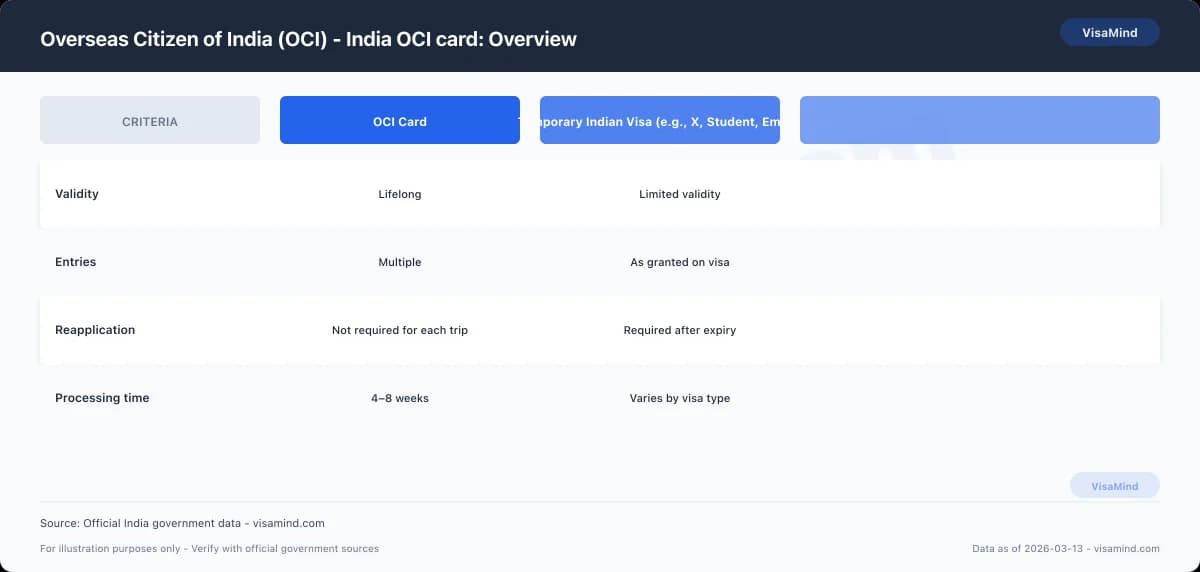
The main benefit of the OCI card is a lifelong, multiple-entry visa to India.
You do not need to apply for a separate visa each time you travel.
This sets the OCI card apart from time-limited visa categories such as:
Those visas are issued for specific purposes and validity periods. The OCI card provides long-term travel authorization under one status.
You must still comply with Indian immigration laws during each stay. FRRO oversees in-country immigration compliance where required.
At-a-glance processing time
Processing times depend on government review and verification.
| Stage | Estimated Time |
|---|---|
| OCI Application processing | 4–8 weeks |
Plan travel accordingly and avoid booking non-refundable tickets until you receive approval.
Delays can occur if your application is incomplete or requires additional verification. Submit complete and accurate documents to reduce processing issues.
Application Process (OCI India)
#You apply for an OCI card through an online system followed by in-person document submission.
You must complete the digital Form OCI Application, upload supporting records, and then submit physical documents and your passport at the designated center.
Before you start
Read the instructions that apply to your specific eligibility category.
Confirm that you are applying for an OCI card, not a visa such as an Entry Visa (X Visa), Student Visa, Employment Visa, Business Visa, or Research Visa. Those visas follow a separate process.
Prepare clear digital and physical copies of all required supporting documents.
You will need to:
- Review eligibility details carefully
- Gather required personal documents
- Ensure your passport is valid
- Prepare documents for upload and physical submission
Use personal details that match your passport exactly. Inconsistent information can delay processing.
| Step | What You Must Do |
|---|---|
| Review eligibility | Confirm your OCI category |
| Collect documents | Prepare digital and paper copies |
| Check passport | Ensure details match your application |
| Read instructions | Follow BOI guidance for your category |
Complete the online form
Complete the OCI Application at the official OCI services portal.
Enter your personal details exactly as shown in your passport.
Fill in all required sections. Do not leave mandatory fields blank.
Upload supporting documents for verification.
You must:
-
Enter eligibility information
-
Provide personal and passport details
-
Upload required supporting documents
-
Review all entries carefully before submission
After completing the form, sign where required and submit it through the portal. Keep a copy of your completed application for your records.
The Bureau of Immigration manages entry and exit matters. If you are already in India on a visa, the Foreigners Regional Registration Office (FRRO) handles registration and visa extensions.
The OCI application itself proceeds through the designated OCI system and submission centers.
Submit physical documents and appointment
After submitting the online form, schedule an appointment at the appropriate Indian Visa Application Center (IVAC) or directly at the Indian Mission, as instructed.
On your appointment date, submit:
- Printed copy of your completed OCI Application
- Supporting documents
- Your original passport
Bring the same documents you uploaded online. The center will forward your application for processing; it does not make the final decision.
Follow the appointment instructions carefully. Missing documents or incorrect paperwork can require you to reschedule and submit again.
Path to Citizenship
#
An OCI card does not make you an Indian citizen.
You do not receive political rights or eligibility for government employment, and you must understand these limits before planning any long-term move.
OCI vs. citizenship
Treat the OCI card as a distinct status, not as dual citizenship. It does not grant full constitutional rights in India.
The key differences affect your legal rights and public participation.
| Issue | OCI Cardholder | Indian Citizen |
|---|---|---|
| Citizenship status | Not an Indian citizen | Indian citizen |
| Voting rights | Not permitted | Permitted |
| Public employment | Not eligible | Eligible |
You cannot vote in Indian elections. You also cannot apply for public sector or government positions that require Indian citizenship.
If your long-term goal involves political participation or government service, the OCI card does not meet that objective.
You must evaluate formal citizenship options under Indian law and review the official guidance from the Government of India before making decisions.
Residency and eligibility implications
Your OCI status does not convert into citizenship automatically.
Holding an OCI card does not remove the legal distinction between you and an Indian citizen.
If you live in India on another status—such as an Entry Visa (X Visa), Student Visa, Employment Visa, Business Visa, or Research Visa—you must follow the conditions attached to that visa.
The Foreigners Regional Registration Office (FRRO) manages registration and in-country immigration compliance.
You should consider:
- Whether your current visa category limits your activities
- Whether you must register or update your status with FRRO
- Whether your long-term plans require citizenship rather than OCI status
When filing an Form OCI Application, understand that approval does not grant voting rights or eligibility for public employment.
If you need clarity on citizenship pathways, consult the Government of India sources for current legal requirements and procedures.
What PR Gives You
#An Overseas Citizen of India status gives you long-term entry and residence rights in India without repeated visa applications.
You can work in most sectors, avoid routine FRRO registration, and hold property in your own name.
Work and professional permissions
You can work in India without applying for an Employment Visa, Business Visa, or Research Visa for most activities.
The lifetime visa attached to your status allows multiple entries and ongoing residence for professional purposes.
You must meet the requirements set by the relevant professional councils if you plan to practice in regulated fields. Indian law controls these professions directly.
You may practice in India as a:
| Profession | Governing Law Applies |
|---|---|
| Doctors, dentists, nurses, pharmacists | Yes |
| Advocates | Yes |
| Architects | Yes |
| Chartered Accountants | Yes |
You must satisfy the standards under the applicable Indian Acts before you begin practice.
You may also appear for the All India Pre-Medical Test or similar entrance examinations if you seek admission under the rules that govern those exams.
You do not need to convert to an Entry Visa (X Visa), Student Visa, or Employment Visa to carry out these permitted activities.
Your OCI status covers lawful work and professional engagement, subject to regulatory compliance.
Travel and residency privileges
You receive a lifetime visa linked to your OCI status. This visa allows multiple entries into India.
You can enter and leave India without applying for a separate visa each time.
The Bureau of Immigration (BOI) manages entry and exit at ports of entry.
You do not need to complete routine registration with the Foreigners Regional Registration Office (FRRO) for your stay.
This removes the recurring reporting requirement that applies to many long-term visa holders.
Because your visa does not expire in the same way as a Student Visa or Employment Visa, you avoid repeated extensions through the FRRO.
Your residency remains valid as long as your OCI status remains valid.
You apply for this status through the formal Form OCI Application process.
BLS or VFS centers may accept your documents, but authorities in India make the final decision.
Property ownership and registrations
You can purchase and hold property in India in your own name. This right flows directly from your OCI status.
You do not need to obtain a separate visa category to register property.
Your lifetime visa and legal status allow you to complete ownership formalities under Indian law.
Property transactions must follow standard registration procedures under Indian regulations.
Your OCI card serves as proof of your status when completing documentation.
You remain subject to all applicable Indian property laws and registration rules.
When to Get Help
#You increase your approval chances when you understand your eligibility and submit a complete Form OCI Application.
Seek guidance if your situation is unclear or if you risk delays due to documentation errors.
Complex eligibility and borderline cases
Get help if your eligibility is not straightforward. Filing an OCI Application does not guarantee approval, especially in cases that fall near the edges of the rules.
Common situations that require closer review include:
- Prior or current Entry Visa (X Visa)
- Previous Student Visa, Employment Visa, Business Visa, or Research Visa
- Past registration with the Foreigners Regional Registration Office (FRRO)
- Changes in nationality or immigration history
If you previously interacted with the FRRO for registration or visa extensions, confirm that your records are consistent before you apply.
Discrepancies between past visa records and your OCI Application can raise questions.
Use this quick reference:
| Situation | Why Professional Review Helps |
|---|---|
| Mixed visa history | Confirms records align with your application |
| Prior FRRO registration | Verifies compliance history |
| Unclear eligibility category | Reduces risk of refusal |
Review the government instructions carefully before you file.
Avoiding delays and documentation mistakes
Most OCI delays result from incomplete or incorrect information.
You must complete every field accurately and submit all required documents exactly as instructed.
Before submitting your OCI Application, confirm that you:
- Double-check spelling of names and passport details
- Match all dates across forms and supporting documents
- Include every required document listed in the official instructions
- Ensure uploaded or submitted copies are clear and legible
BLS or VFS centers accept applications, but they do not make decisions. The final decision rests with the competent authorities.
Use this checklist to reduce risk:
| Risk Factor | How You Prevent It |
|---|---|
| Missing documents | Follow the official document list line by line |
| Incorrect data entries | Review each field before submission |
| Assumptions about approval | Prepare a complete, well-documented file |
Careful preparation prevents avoidable delays.
Renewal and Card Replacement
#India has relaxed the rules for re-issuing an OCI card after passport changes.
Your age determines whether you must obtain a new OCI card or simply update your passport details.
Passport re-issuance rules
You do not need a new OCI card every time you receive a new passport.
The Government of India removed the earlier requirement for repeated re-issuance. The current rules depend on your age at the time your passport is renewed.
| Age Group | OCI Re-issuance Requirement |
|---|---|
| Up to 20 years | No new OCI card required each time; follow updated document submission rules when a new passport is issued |
| After 50 years | One re-issuance required after obtaining a new passport following your 50th birthday |
| Between 21 and 49 years | No repeated re-issuance required under the relaxed guidelines |
If you are under 20, you must provide your new passport details and a recent photograph each time you receive a new passport.
After you turn 50, you must obtain one OCI re-issuance following the issue of a new passport.
Further passport renewals after that do not require repeated OCI re-issuance under the relaxed framework.
Submit updates through the official Form OCI Application process.
For current procedural steps, refer to the Government of India’s OCI portal.
When to replace or update the card
You’ll need to replace or update your OCI card if your situation matches the mandatory re-issuance categories.
Here’s a quick checklist:
- You got a new passport before turning 20
- You received a new passport after age 50
- Your photo needs updating under the age-based rules
If any of these apply, you’ll have to fill out the OCI Application for re-issuance.
Living in India? The Foreigners Regional Registration Office (FRRO) handles immigration compliance like registration and visa extensions. OCI issuance and re-issuance, though, run through the OCI application system.
OCI status isn’t the same as holding an Entry Visa (X Visa), Student Visa, Employment Visa, Business Visa, or Research Visa. Those visas need separate applications and renewals, typically through FRRO. Updating your OCI card doesn’t convert or replace those visas.
Fees and Processing Times
#There’s a government application fee, plus a card issuance fee. Processing typically takes 4 to 8 weeks, but it can vary by category and where you apply.
Application and card fees
For your Form OCI Application, you pay two charges: the application fee and the OCI card issuance fee.
| Fee Type | Amount (₹) | Notes |
|---|---|---|
| Application fee | ₹275 | Paid at the time of submission |
| OCI card issuance fee | ₹15 | Charged for card printing and issuance |
You pay these at the designated service center when you submit your application. The center accepts your documents but doesn’t decide your case.
If you’re in India on an Entry Visa (X Visa), Student Visa, Employment Visa, Business Visa, or Research Visa, check with the FRRO to see if any extra registration steps apply. FRRO manages registration and visa matters in India, but not OCI fees.
Standard processing timeline
Standard processing for an OCI Application runs about 4 to 8 weeks.
This period begins after your complete application and all supporting documents are accepted. If your submission’s incomplete, expect delays.
processing times can shift based on your application category, where you file, and any internal verification requirements.
Applying from outside India? Your timeline may differ from those filing within India. If you’re in India on a valid visa and switching to OCI status, keep your underlying visa valid until OCI approval.
Variable processing factors
Several things can affect how long your case takes.
Category of application:
New OCI registrations, re-issuance, and passport-based updates all move at different speeds.
Location of submission:
Each jurisdiction has its own workflow.
Document verification:
Sometimes authorities check your background or documents before approving. Any inconsistency can pause the process.
If you’re in India during processing, you have to maintain lawful status under your current visa. FRRO manages registration and visa extensions, while entry and exit are controlled by the Bureau of Immigration.
Maintaining PR Status
#You’ll need to follow residency requirements for any in-country process and keep your records up to date with the right authority. Missing these basics can disrupt your stay or your future applications.
Residency obligations
If you file an Form OCI Application or related request from within India, you must meet the residency requirement tied to that filing.
Not meeting the required period of stay before or during the process can cause delays or even refusal.
Common issues come up when applicants:
- Enter India on an Entry Visa (X Visa), Student Visa, Employment Visa, Business Visa, or Research Visa
- File in-country without completing the required period of residence
- Leave India before satisfying the residency condition
FRRO oversees registration and compliance inside India. If your application depends on your physical presence, your stay must match that requirement.
| Situation | Risk if Residency Rule Is Not Met |
|---|---|
| In-country OCI Application | Delay or rejection |
| Visa-based stay tied to residence | Non-compliance record |
| Early departure from India | Disruption of processing |
Check that your time in India meets the eligibility condition before filing.
Required notifications (address changes, etc.)
While living in India, you need to keep your residential details current with the FRRO if your visa category or registration status requires it.
Not reporting a change of address can create compliance issues. Even moving within the same city should be reported if your status requires notification.
Notify FRRO if you:
- Change your residential address
- Move to another city or state
- Update your local contact details
Accurate records help during OCI processing, visa extensions, and any future immigration review.
Keeping your registration info updated keeps your stay in India properly documented and avoids unnecessary issues.
Eligibility Requirements
#You’re eligible for an Overseas Citizen of India (OCI) card if you meet certain citizenship, ancestry, or family-based criteria under Indian law.
Eligibility depends on your past Indian citizenship, descent from an Indian citizen, or relationship to a current Indian citizen or OCI cardholder.
Primary eligibility categories
You can apply if you’re a foreign national and fit into one of these categories:
- You were an Indian citizen on or after 26 January 1950
- You were eligible to become an Indian citizen on 26 January 1950
- You belonged to a territory that became part of India after 15 August 1947
You need full legal capacity to apply for yourself if you’re an adult.
| Category | Key Requirement | Citizenship Status Now |
|---|---|---|
| Former Indian citizen | Held Indian citizenship on/after 26 Jan 1950 | Citizen of another country |
| Eligible in 1950 | Qualified for Indian citizenship at Constitution commencement | Citizen of another country |
| Territory integration | Originated from territory merged with India after 15 Aug 1947 | Citizen of another country |
If you don’t qualify under these, you’ll need to look at an Entry Visa (X Visa), Student Visa, Employment Visa, Business Visa, or Research Visa. FRRO manages registration and extensions for those visas inside India.
OCI India: Family and descent rules
You might qualify through lineage if you’re the child, grandchild, or great-grandchild of someone in a primary eligibility category.
Your claim must connect directly to a person who was an Indian citizen on or after 26 January 1950, was eligible at that time, or came from a territory that became part of India.
You’ll need to prove:
-
The ancestor’s qualifying Indian status
-
Each parent-child relationship linking you to that ancestor
-
Your current foreign citizenship
If you can’t document this chain, you won’t qualify under descent rules. In that case, apply for a visa and complete FRRO registration if needed.
Spouse and minors
You can apply as a minor child if both parents are Indian citizens, or just one parent is.
A foreign-origin spouse may qualify if you’re married to an Indian citizen or a registered OCI cardholder under section 7A of the Citizenship Act, 1955, your marriage is legally registered, and it’s lasted at least two years before submitting your application.
| Applicant Type | Core Condition | Additional Requirement |
|---|---|---|
| Minor child | Parent(s) are Indian citizen(s) | Proof of parentage |
| Foreign-origin spouse | Married to Indian citizen or OCI cardholder | Registered marriage of at least 2 continuous years |
If you don’t meet these conditions, apply under the correct visa category and follow FRRO rules during your stay.
Why PR Applications Fail
#Most refusals happen because of mistakes in paperwork or visa status. You need to submit all required evidence and apply from an eligible visa category, or your Form OCI Application will be rejected.
Common documentation errors
Incomplete or inaccurate documents are a frequent reason for denial. If you don’t prove eligibility with clear and correct records, your application won’t proceed.
Check every page and signature before you submit. Missing pages, unsigned declarations, or inconsistent details cause immediate problems.
Common document issues:
- Missing supporting evidence
- Forms with blank fields
- Missing signatures
- Incomplete document sets
| Error Type | How It Affects Your OCI Application |
|---|---|
| Missing eligibility proof | Application cannot be verified |
| Unsigned form sections | Considered invalid submission |
| Incomplete pages | Processing stops or file is returned |
| Inconsistent information | Raises credibility concerns |
You’re responsible for accuracy, even if a BLS or VFS center accepts your file. These centers collect applications, but don’t decide cases.
If you’re unsure about document standards, check with FRRO for matters inside India.
Ineligible visa or application situations
Your current visa status must allow you to apply. Applying while on a Tourist Visa or another non-eligible visa leads to refusal.
You need to apply from a qualifying status. A Tourist Visa isn’t eligible.
The following visa categories require careful review before you file:
- Entry Visa (X Visa)
- Student Visa
- Employment Visa
- Business Visa
- Research Visa
If your visa type doesn’t permit an OCI Application, authorities will reject it. The Bureau of Immigration manages entry and exit; FRRO handles registration and extensions inside India.
Check that your current visa allows you to apply before submitting anything.
Other refusal reasons
Administrative inconsistencies can block your application. Even small differences between your visa records and submitted forms can cause delays or rejection.
If you don’t follow procedural requirements, refusal is likely. Every section of the OCI Application must match your passport and visa records.
If FRRO can’t verify your status or documentation, your request won’t be approved. Accuracy and eligibility are the deciding factors.
Required Documents
#You must prove your Indian origin or qualifying relationship with clear, verifiable records. Without the right evidence, your Form OCI Application won’t move forward.
Proof of Indian origin or prior citizenship
You’ll need to show you previously held Indian citizenship or were eligible at the time the Constitution took effect. Your documents must clearly identify you and connect you to India.
Provide copies of:
- Previous Indian passport, if you have it
- Citizenship certificate or official record confirming prior Indian citizenship
- Official proof showing eligibility at the time the Constitution took effect
Your name and personal details must match across all records. If they don’t, include supporting identity documents explaining the difference.
If you currently hold an Entry Visa (X Visa), Student Visa, Employment Visa, Business Visa, or Research Visa, include a copy of your valid visa and passport bio page. If registered in India, add your FRRO registration certificate.
BLS or VFS centers collect your documents, but authorities decide eligibility.
Family and descent documents
Applying based on descent? You need to prove the family link to the qualifying Indian citizen or person of Indian origin.
Provide:
- Your birth certificate showing your parents’ names
- Parent’s or grandparent’s proof of Indian citizenship or eligibility
- Marriage certificates, if needed to explain surname or lineage changes
Each document must connect one generation to the next, with no gaps. If your parent or grandparent held Indian citizenship, include proof.
| Relationship Basis | Key Documents Required |
|---|---|
| Parent | Your birth certificate + parent’s Indian citizenship proof |
| Grandparent | Your birth certificate + parent’s birth certificate + grandparent’s Indian citizenship proof |
If you live in India on a valid visa and have registered, include your FRRO documentation.
Evidence for spouse-based claims
For spouse-based claims, you must prove both the marriage and your spouse’s eligibility.
Provide:
- Registered marriage certificate
- Proof of your spouse’s Indian citizenship or OCI eligibility
- Copies of your spouse’s passport or citizenship record
The marriage certificate must be officially registered. Informal or religious-only records aren’t enough.
If you’re in India on an Entry Visa (X Visa) or another long-term visa, include your current visa copy and any FRRO registration certificate. This supports your identity and residence history but doesn’t replace proof of eligibility.
Your eligibility depends on the strength and consistency of your documents. Incomplete or inconsistent records will delay your OCI Application.
Fees
#| Component | Amount |
|---|---|
| Application feeExtracted from guide content — verify against official source | $275 |
| OCI card issuance feeCard production and delivery — verify against MEA/OCIServices | $15 |
Fees change; always verify on FRRO.