What Reviewers Look For
#Over 10 million foreign tourists visit India annually, with many opting for the e-Visa due to its convenience and accessibility. The e-Visa is available for various purposes, including tourism, business, and medical treatment, making it a versatile option for travelers. Understanding the philosophy behind document requirements is essential when preparing your application. The Foreigners Regional Registration Office (FRRO) evaluates each submission to ensure adherence to guidelines, emphasizing accuracy and authenticity in documentation.
Cultural Sensitivity in Documentation
When applying for an Indian visa, documents should reflect an understanding of India's cultural expectations. This includes providing a recent photograph with appropriate attire, avoiding overly casual or culturally inappropriate clothing. India's diverse cultural landscape encourages applicants to be mindful of religious and traditional norms. This sensitivity extends to any documentation that might include references to local customs or interactions with Indian citizens.
Tip: Ensure your documents, such as invitation letters or business references, are respectful and considerate of Indian cultural values.
Consistency in Provided Information
Consistency in your application is necessary. The information on your passport, photographs, and other documents should exactly match the details provided in your visa application. Discrepancies can lead to delays or rejections. Cross-check all entries, including names, birth dates, and passport numbers, across documents to prevent errors. The FRRO places significant importance on precision and uniformity in submitted information.
Important: Double-check your passport's validity; it should be valid for at least six months from your planned arrival in India.
Clarity and Legibility Standards
Documents submitted for an Indian visa should be clear and legible. Blurred or obscured copies can lead to processing issues. Ensure that all scanned documents are of high quality and free from obstructions. The FRRO requires that text on documents be easily readable, with no smudges or misprints. This applies to both physical copies and digital uploads.
Tip: Use a high-quality scanner or smartphone app to capture documents, ensuring clarity and legibility.
Health and Character Requirements
#In India, health and character checks are integral to the visa application process. The Foreigners Regional Registration Office (FRRO) requires applicants to fulfill specific requirements to ensure public safety and health standards.
TB Screening and Certification
Tuberculosis (TB) screening is mandatory for certain categories of visa applicants who plan to stay in India for more than six months. This requirement is in place to prevent the spread of TB within the country.
-
Consult an authorized medical practitioner for a TB test.
-
Undergo a chest X-ray and additional tests if needed.
-
Obtain a TB clearance certificate from the medical facility.
Tip: Ensure the medical practitioner is approved by Indian authorities to avoid delays in your application process.
Obtaining Police Clearance Certificates
A police clearance certificate (PCC) is essential to demonstrate the applicant's good character. It verifies that the individual has no criminal record in their home country.
-
Contact your local police department or relevant authority for a PCC.
-
Submit any required identification documents and fees.
-
Receive the PCC, which should be dated within six months of your visa application.
Important: For Indian visa applications, the PCC must be translated into English if issued in another language.
Approved Medical Facilities for Exams
Medical examinations for visas must be conducted at facilities approved by the Indian government. These facilities are equipped to perform necessary tests and issue valid certificates. - Check the list of approved medical centers on the Bureau of Immigration website. - Schedule an appointment at a nearby approved facility. - Bring all necessary documentation and identification to the appointment.
Warning: Certificates from non-approved medical centers will not be accepted, leading to application delays.
Category-Specific Requirements
#In India, obtaining a visa involves presenting specific documents tailored to the type of visa you are applying for. The Foreigners Regional Registration Office (FRRO) oversees these processes within India, ensuring all necessary documentation is in place for various visa categories. Whether you're coming for work, study, or family reasons, understanding the unique document requirements for each visa category is necessary. Each category has its own set of documents that must be gathered before lodging your application.
Work Visa Contract Essentials -
A signed employment contract from the Indian employer. - Company registration documents proving legal operation in India. - An official letter from the employer detailing the terms of employment, such as job position, salary, and duration.
Tip: Ensure your employment contract is stamped by the relevant authorities to avoid delays in processing.
Important: Work visas require proof of the applicant's professional qualifications and experience in the field they are being hired for.
Student Visa Admission Letters -
A formal admission letter from a recognized Indian educational institution. - Proof of tuition fee payment or financial capability to support educational expenses. - A detailed course curriculum or syllabus from the institution.
Tip: Check if the institution is approved by the relevant Indian government bodies to avoid any issues with your student visa.
Warning: Ensure that the admission letter clearly states the duration of the course, as this will affect the length of your visa.
Family Visa Relationship Proof -
Official marriage certificate for spouse visas. - Birth certificates for dependent children. - Legal adoption papers if applicable.
Important: All relationship documents must be translated into English or Hindi and notarized if they are in another language.
Tip: Have extra copies of all relationship documents as the FRRO might require them for verification purposes.
Photo Requirements
#Meeting specific photo requirements is key to avoid application delays. The Foreigners Regional Registration Office (FRRO) mandates these criteria to ensure uniformity in documentation. Let's explore the precise specifications needed for your photo submission.
Photo Size and Dimension Criteria
Your photograph should be 2 inches by 2 inches (51 mm x 51 mm). It must clearly show your full face and shoulders, with your face occupying 70-80% of the frame.
Important: Ensure your photograph is neither too close nor too far from the camera to meet the size requirements accurately. This helps avoid rejection by the FRRO.
Approved Background Colors
For e-Visa applications, a white background is mandatory as per the FRRO guidelines. This helps in maintaining clarity and contrast in the photograph.
Tip: Using a plain white wall or backdrop will help you meet the background requirements effectively.
Digital Format and Submission Guidelines
The digital photograph should be in JPEG format with a minimum size of 10 KB and a maximum size of 1 MB. It must be uploaded at the time of your e-Visa application.
| Specification | Details |
|---|---|
| Format | JPEG |
| Minimum Size | 10 KB |
| Maximum Size | 1 MB |
Tip: Before uploading, double-check that your file size and format meet these specifications to prevent technical issues during submission.
Passport and ID Requirements
#For any Indian visa application, your passport must be valid for at least six months beyond your intended stay in India. This requirement ensures that you have sufficient time left on your passport for your visa to be granted and used effectively. When planning your trip to India, it is vital to have the correct identification documents prepared. This includes not only a valid passport but also additional identification as required by Indian authorities.
Passport Validity for Indian Visa -
Your passport must be valid for at least six months from your expected date of arrival in India. - Ensure that your passport has at least two blank pages for stamping by the immigration officer. - The passport should be in good condition, with no significant damage that could hinder identification.
Important: If your passport is expiring within six months, renew it before applying for an Indian visa to avoid any potential travel disruptions.
Required ID for Indian Entry -
A valid visa for India, such as an e-Tourist Visa or e-Business Visa depending on the purpose of your visit. - A recent front-facing photograph with a white background, as specified by the Indian visa requirements. - A copy of the photo page of your passport, which includes personal details and photograph.
Warning: Ensure all your documents match the details provided in your visa application to prevent issues at the border.
Supporting Identity Documentation -
Additional identification such as a national ID card or driver’s license may be required for certain visa categories. - For minors, a birth certificate might be required to establish identity and relationship with accompanying adults. - In some cases, additional documentation such as marriage certificates may be needed to verify family relationships.
Tip: Check the Bureau of Immigration for any updates on specific documentation requirements for your visa type.
Proof of Funds
#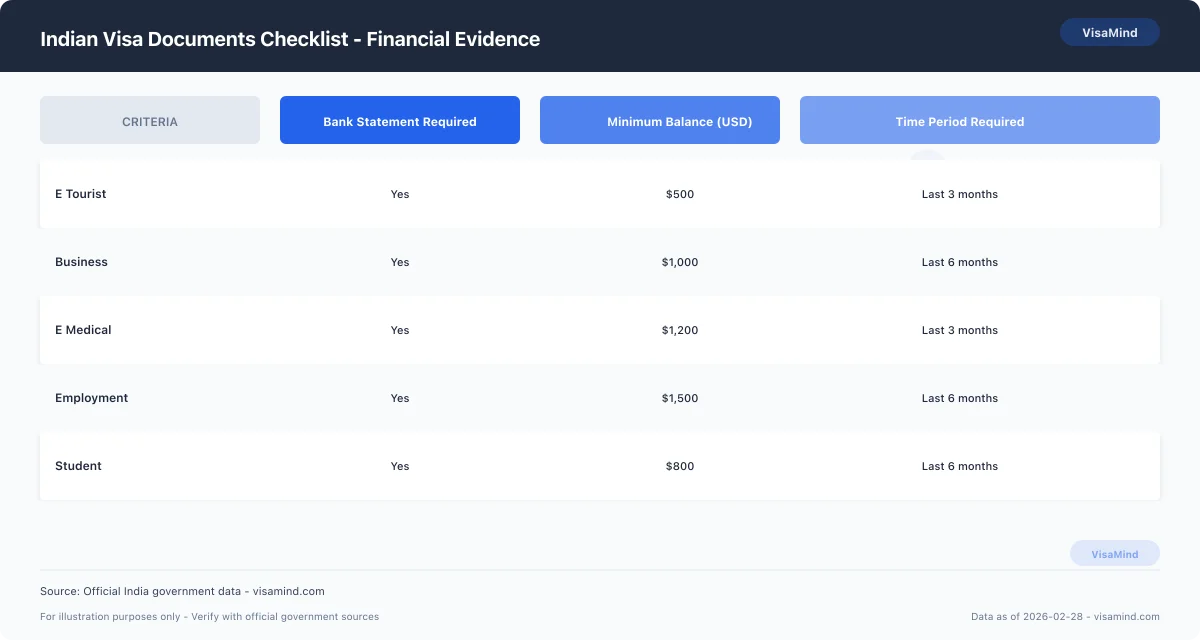
For an Indian e-Visa, applicants must demonstrate sufficient financial stability. This includes meeting specific bank balance requirements, which vary depending on the type of visa you apply for. Understanding the financial documentation necessary for an Indian visa is critical to ensure your application is not rejected. Below, we detail the requirements for proof of funds, including minimum balances and the duration funds need to be maintained.
Minimum Bank Balance Requirements
The amount you need to demonstrate in your bank account can vary based on the type of e-Visa you are applying for. While there is no fixed rule applicable to all, here is a general guideline.
| Visa Type | Minimum Balance (INR) |
|---|---|
| e-Tourist Visa | ₹50,000 |
| e-Business Visa | ₹100,000 |
| e-Medical Visa | ₹75,000 |
Important: Ensure the funds are in your account at least 30 days prior to application to demonstrate financial stability.
Recent Financial Statement Guidelines
Applicants must provide recent financial statements as a part of their visa applications. Typically, the last three months of bank statements are required. - Statements must be stamped and signed by your bank. - Ensure all transactions are legible and clearly show the account holder's name.
Tip: Consider submitting statements with consistent transactions and avoid sudden large deposits, as these may raise queries.
Duration of Fund Availability
Funds must be maintained in your account for a specific period before you apply for the visa. Typically, this duration is at least three months. Consistent account activity and a stable balance over this period provide stronger evidence of financial reliability.
Warning: Ensure your balance does not drop below the required minimum at any point during this period, as this could jeopardize your application.
Common Document Mistakes
#Nearly 10 million e-Visas are issued annually by India for a range of purposes such as tourism, business, and medical treatment. However, common document mistakes can delay your visa approval. Ensuring you have the correct documents in order is necessary to avoid such pitfalls.
Incorrect Photograph Specifications
Photographs submitted with your visa application must meet specific criteria to be accepted. A recent front-facing photograph with a white background is required. The photo should clearly show your full face without any shadows or reflections. - Ensure the photograph is in color and of high quality. - The size should be 2 inches by 2 inches. - Your face should occupy 70-80% of the photo.
Tip: Verify the photograph requirements on the Bureau of Immigration website to avoid rejections.
Using Expired Financial Documents
Providing valid financial documentation is essential when applying for an Indian visa. Expired bank statements or financial guarantees can lead to application delays or denials. - Submit recent bank statements, not older than 3 months. - Ensure all financial documents are in your name or accompanied by an affidavit.
Important: Always double-check the validity period of your financial documents before submission to the FRRO.
Failure to Provide Certified Translations
All documents not in English must be accompanied by a certified translation. This is vital for documents such as birth certificates or marriage licenses. - Use a certified translator recognized by Indian authorities. - Attach the original document with its certified translation.
Warning: Failure to provide certified translations can result in application rejection. Ensure all translations are accurate and complete.
Additional Local Requirements
#India's diverse states and territories mean that additional documentation may be needed depending on your destination. The Foreigners Regional Registration Office (FRRO) is responsible for registration and visa extensions in India and can provide guidance on specific local requirements.
Local Documentation Variations
India's states and union territories may require different documents for visa applications. These variations are based on regional laws and practices. - Some regions may ask for proof of accommodation, such as a hotel booking or rental agreement. - In areas with security concerns, additional identification or background checks may be required. - Certain states may request a local contact or sponsor.
Tip: Check with the local FRRO office for any specific documentation needed for your intended state of stay.
Region-Specific Certification Needs
Certification requirements can also differ by region. You might need additional legalizations or attestations, especially for business or medical visas.
| Region | Certification Required |
|---|---|
| Delhi | Medical certificates must be attested |
| Maharashtra | Business documents require notarization |
| Karnataka | Educational certificates need state attestation |
Important: Ensure all certifications are completed before arrival to avoid delays in processing at the FRRO.
Unique Provincial Requirements
Certain provinces have unique requirements that could affect your visa application process. These are often linked to local laws and regulations.
-
Contact the local authorities in your destination for specific information.
-
Prepare any additional documents as advised by the local FRRO.
-
Submit any required documents promptly to avoid processing delays.
Warning: Failure to comply with unique provincial requirements could result in delayed entry or inability to register with the FRRO.