
Who This Helps
#Indonesia offers two primary options for tourists wishing to visit: the e-Visa Tourist and the Visa on Arrival (VOA). The VOA can be obtained upon arrival at select Indonesian airports and seaports, while the e-Visa must be applied for online before travel. Each option has its own benefits, depending on your travel needs and circumstances.
Frequent Travelers to Indonesia
For travelers who visit Indonesia often, the e-Visa Tourist might be more convenient. It allows you to complete the process online before your trip, reducing the time spent at the airport. This can be especially beneficial if you frequently enter the country and wish to bypass lengthy queues at visa counters.
Tip: Consider using the e-Visa to streamline your entry process if you frequently travel to Indonesia and want to minimize airport wait times.
First-Time Visitors Needing Guidance
First-time visitors might find the Visa on Arrival (VOA) a routine choice. Available at major entry points, it allows you to secure your visa upon arrival. This can be ideal if you prefer handling visa matters in-person or if your trip was planned on short notice.
Important: Ensure you have all required documents ready as per Directorate General of Immigration guidelines to avoid any issues at the immigration desk.
Budget-Conscious Tourists
Budget-conscious travelers should consider the costs associated with both options. The Visa on Arrival may be more cost-effective if you are traveling on short notice, as it allows you to pay the fee at the airport. Conversely, the e-Visa might incur additional charges for online processing.
Tip: Check the Visa On Arrival and E Visa Tourist pages for the latest fee structures to align with your budget considerations.
Changing Your Mind After Applying
#Indonesia offers travelers the flexibility to choose between an e-Visa Tourist and a Visa on Arrival (VOA). Each option comes with its own set of processes and fees, and it's possible to change your mind after applying. If you find yourself needing to switch your visa type, understanding the conversion procedures can help ensure a smooth transition. The Directorate General of Immigration (Ditjen Imigrasi) manages these processes. If you've entered Indonesia with a Visa on Arrival and wish to switch to an e-Visa Tourist, the process involves a few key steps. This is generally done for longer stays or when planning multiple entries into Indonesia. Converting to an e-Visa requires approval from the Directorate General of Immigration. Ensure your documents are complete and accurate. Switching from an e-Visa to a Visa on Arrival is less common but possible if you decide to enter Indonesia flexibly or for a shorter stay. For the latest VOA fees and processes, check the Visa On Arrival section on the official website.
Option B Is Better When...
#In 2026, Indonesia's Visa on Arrival (VOA) option became increasingly popular for tourists seeking flexibility. With the VOA, travelers can enter Indonesia without prior visa application, making it ideal for spontaneous trips. This option is particularly beneficial for those planning short stays or for nationals not eligible for an e-Visa. Let's explore specific scenarios where opting for a Visa on Arrival is more advantageous.
Visa on Arrival for Last-Minute Trips
The Visa on Arrival is perfect for those who decide to visit Indonesia at the last minute. It allows travelers to enter the country without the need to apply for a visa in advance. - Quick entry process at Indonesian airports. - No need for pre-trip visa application or approval. - Available at major entry points such as Ngurah Rai International Airport in Bali and Soekarno-Hatta International Airport in Jakarta.
Tip: Ensure you have a valid passport and the visa fee in Indonesian Rupiah (Rp) upon arrival.
Short Stays Under 30 Days
If your travel plans involve a short stay of less than 30 days, a Visa on Arrival simplifies the process. It provides flexibility and is valid for a range of nationalities. - 30-day validity with the option to extend once for another 30 days. - Ideal for tourists planning brief vacations or business trips. - Streamlined documentation requirements compared to longer-stay visas.
Important: Verify current visa extension policies on the Visa On Arrival page to avoid overstaying.
Access for Non-Eligible e-Visa Nationals
Certain nationalities may not be eligible for an e-Visa due to diplomatic or administrative reasons. For these travelers, the Visa on Arrival provides a viable alternative. - Open to a wider range of nationalities compared to the e-Visa. - Immediate access upon arrival without pre-approval requirements. - Facilitates travel for those facing e-Visa eligibility restrictions.
Warning: Check with the Directorate General of Immigration for the latest nationality eligibility updates before traveling.
The Critical Differences
#Indonesia offers tourists the option to enter the country using an e-Visa Tourist or a Visa on Arrival (VOA). Each visa type has unique processes and requirements that travelers must understand to ensure a smooth entry.
Application Process and Requirements
The application process for an e-Visa Tourist is entirely online, which allows you to apply from anywhere in the world. You must gather the necessary documents and complete the application through the official Directorate General of Immigration website. - Valid passport with at least 6 months of remaining validity
- Recent passport-sized photograph
- Proof of travel itinerary In contrast, the Visa on Arrival is obtained at designated entry points in Indonesia. This option requires you to present your passport and pay the visa fee upon arrival.
Important: Ensure payment methods are prepared in advance; Visa on Arrival fees can be paid in cash or by credit card at the entry point.
Validity and Duration of Stay Both the
e-Visa Tourist and Visa on Arrival allow for an initial stay of up to 30 days in Indonesia. However, the e-Visa can be applied for and approved before your travel, adding convenience and peace of mind. If you wish to extend your stay, both visas allow for a one-time extension of 30 days. Extensions require visiting the local immigration office in Indonesia.
Entry Points and Restrictions
The e-Visa Tourist offers flexibility with entry, as it can be used at any international airport in Indonesia. This makes it a convenient choice for travelers who plan their itinerary in advance. - Soekarno-Hatta International Airport, Jakarta
- Ngurah Rai International Airport, Bali
- Juanda International Airport, Surabaya The Visa on Arrival is only available at select entry points, primarily major airports and seaports. This limits your entry options and might require additional travel arrangements.
Quick Comparison Table
#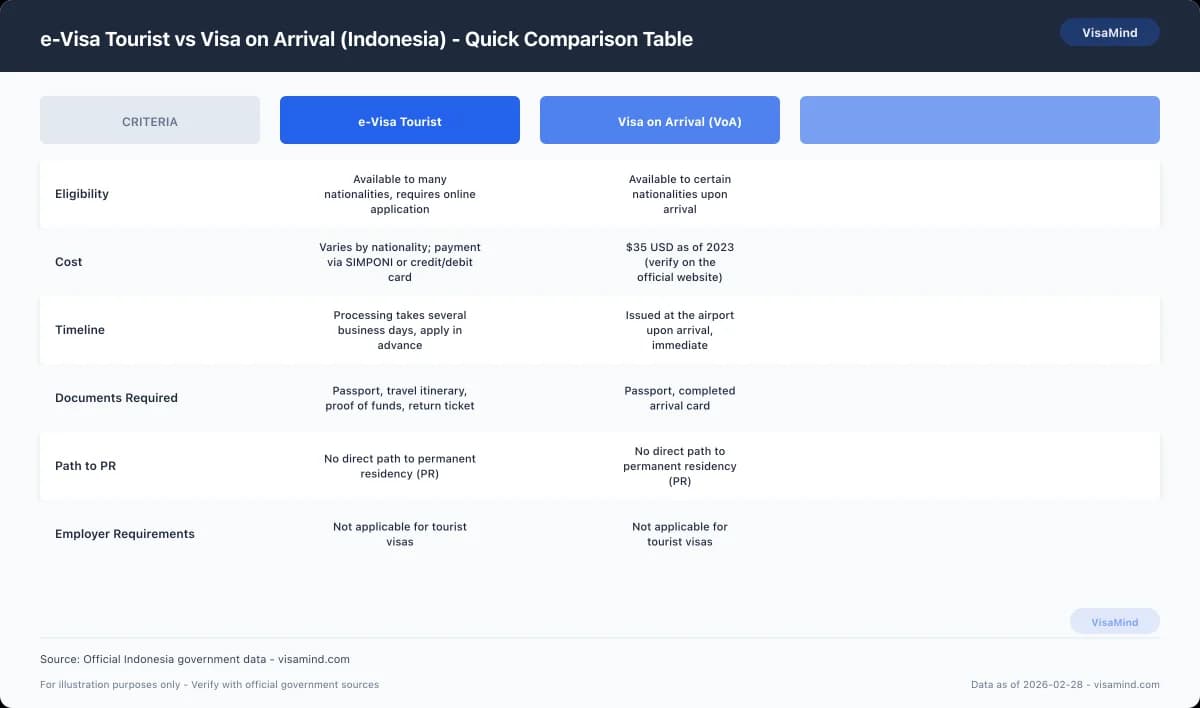
In 2026, Indonesia offers travelers two main visa options: the e-Visa Tourist and the Visa on Arrival (VOA). Each option caters to different needs and circumstances, allowing visitors to choose the best fit for their travel plans. The Directorate General of Immigration (Ditjen Imigrasi) oversees these visas, ensuring a smooth entry process for international visitors. Understanding the differences between these options can help you plan your trip effectively.
Eligibility Criteria for Each Visa
| Visa Type | Eligibility Criteria |
|---|---|
| e-Visa Tourist | Available to travelers from eligible countries who apply online before arrival. |
| Visa on Arrival | Available to travelers from 86 countries upon arrival at select Indonesian entry points. |
Failure to do so may result in entry delays.
Cost Comparison: e-Visa vs. Visa on Arrival
| Visa Type | Cost (IDR) |
|---|---|
| e-Visa Tourist | Rp 2,000,000 |
| Visa on Arrival | Rp 500,000 |
Tip: Consider applying for the e-Visa Tourist if you prefer handling visa matters before your trip and want to avoid queues at the airport.
Processing Timeline Differences
| Visa Type | Processing Time |
|---|---|
| e-Visa Tourist | Approximately 3-5 business days |
| Visa on Arrival | Immediate upon arrival |
Employer Sponsorship Requirements
Neither the e-Visa Tourist nor the Visa on Arrival requires employer sponsorship. These visas are strictly for tourism purposes and do not permit employment in Indonesia.
Important: Ensure you are traveling for tourism purposes only, as neither visa allows you to engage in any form of work-related activity.
Choose Option A If...
#Indonesia offers both an electronic visa, known as the e-Visa Tourist, and a Visa on Arrival for travelers wishing to explore its diverse landscapes. These options cater to different needs, providing flexibility for various travel plans.
e-Visa for Digital
Nomads looking to work remotely while experiencing Indonesia, the e-Visa Tourist offers a convenient solution. This type of visa can be applied for online, making it accessible from anywhere in the world. - Allows for remote work during your stay
- Apply before traveling to Indonesia, saving time at the airport
- Access to longer stay options compared to Visa on Arrival
Tip: Check the Digital Nomad Guide for more detailed information on remote work opportunities in Indonesia.
Longer Stay and Multiple Entries
Travelers planning to stay longer or make multiple entries into Indonesia should consider the e-Visa Tourist. Unlike the Visa on Arrival, which is limited to a single entry, the e-Visa offers more flexibility for extended travel plans. - Ideal for travelers planning visits to neighboring countries
- Allows for a longer duration of stay in Indonesia
- Reduces the need for frequent reapplication
Important: Ensure your itinerary aligns with the e-Visa's validity period to avoid overstaying.
Planning Ahead with Fixed Itinerary
For those with a fixed itinerary, applying for an e-Visa in advance can streamline your travel experience. This ensures your entry into Indonesia is hassle-free, without the need to manage paperwork upon arrival. - Secure your visa before departure
- Avoid delays at immigration checkpoints
- Peace of mind with pre-approved travel authorization
Tip: Visit the E Visa Tourist page for detailed application requirements and instructions.
Myths and Misunderstandings
#In 2026, Indonesia's e-Visa system processed over 1 million tourist applications, highlighting its growing popularity. However, many travelers still opt for the Visa on Arrival option, which caters to spontaneous trips. Despite their popularity, both the e-Visa and Visa on Arrival have common misconceptions that can affect travelers' experiences. Understanding these myths can help you make an informed decision about which visa option suits your travel needs.
e-Visa Instant Approval Myth
Many travelers believe that applying for an e-Visa guarantees immediate approval, but this is not the case. The Indonesian Directorate General of Immigration reviews each application before issuing a visa. - Processing time may vary, and approvals are not instantaneous. - Applicants must wait for a confirmation email with a download link for the visa once approved.
Important: Always apply for your e-Visa well in advance of your travel dates to avoid any last-minute issues.
Visa on Arrival Availability at All Airports
A common myth is that Visa on Arrival is available at all Indonesian airports. In reality, it is only available at designated international airports and seaports. - Check the latest list of airports offering Visa on Arrival services on the official immigration website. - Consider alternative entry points if your preferred airport does not offer this service.
Warning: Arriving at an airport without Visa on Arrival facilities could result in denied entry.
Misunderstanding Visa Validity Periods
There is often confusion regarding the validity periods of e-Visas and Visas on Arrival. Both visas typically allow for a 30-day stay, but extensions and specific rules apply. - Both e-Visas and Visas on Arrival are valid for 30 days from entry, not the application date. - Extensions may be possible, but they require additional processing and fees.
Tip: For extended stays, consider applying for a visa extension or a different visa type, such as the E Visa Tourist or Visa On Arrival.
Decision Scenarios
#Indonesia offers two convenient options for tourists entering the country: an e-Visa Tourist and a Visa on Arrival (VOA). Each option provides flexibility depending on your travel needs and itinerary. The choice between these visas often depends on factors like travel schedule, ease of access to the internet, and the proximity to an Indonesian embassy or consulate. Understanding which option best suits your travel scenario can save you time and hassle upon arrival.
Family Vacation with Young Children
A family of four planning a two-week vacation to Bali might find the e-Visa Tourist option most suitable. This digital application can be completed well in advance, allowing the family to focus on preparing their children for the trip rather than airport procedures. Since the e-Visa Tourist can be processed online and the confirmation sent via email, it eliminates the need for standing in long queues with restless children. The family can complete the application from home, ensuring that everything is in place before departure.
Tip: Ensure that all necessary documents for the e-Visa are prepared and submitted accurately to avoid any delays. Check the E Visa Tourist page for detailed requirements.
Business Trip with Tight Schedule
An executive from Singapore scheduled for a short business meeting in Jakarta might opt for the Visa on Arrival. Given the proximity and frequency of flights, the VOA allows the traveler to be flexible and make last-minute travel decisions. Arriving at Soekarno-Hatta International Airport, the executive can quickly obtain the VOA by paying the fee at the counter, which eliminates the need for pre-application and is ideal for a busy schedule. This option provides the flexibility needed for unplanned extensions or changes in travel plans.
Important: The Visa on Arrival requires payment in IDR (Rp) upon arrival. Ensure you have the correct amount or a credit card that can be used at the airport.
Backpacker Traveling Through Southeast Asia
A backpacker traveling through Southeast Asia may prefer the Visa on Arrival for its flexibility. With plans often changing, the VOA allows for spontaneous travel without the need for prior arrangements. The backpacker can enter Indonesia through various entry points that offer VOA services, making it convenient as they move from one country to another. This removes the need for online application processes during travel, which can be cumbersome without stable internet access.
Warning: Make sure to verify on the Visa On Arrival page that your entry point supports VOA services to avoid any last-minute inconveniences.