
Overview of Financial Requirements
#Similarly, for the Global Citizen of Indonesia (GCI) visa, applicants must demonstrate a minimum income of USD 1,500 per month or USD 15,000 per year. These financial requirements are necessary in assessing a candidate's eligibility for these visa categories by the Directorate General of Immigration (Ditjen Imigrasi).
Understanding Indonesia's Financial Criteria
Indonesia requires applicants for various visa types to demonstrate financial stability as part of the application process. This ensures that applicants can support themselves while in the country without relying on Indonesian resources. The financial criteria vary depending on the visa type.On the other hand, the GCI visa focuses on former Indonesian citizens and their families, who must prove a stable income.
Important: Applicants should verify the latest financial requirements for their specific visa type on the official Ditjen Imigrasi website.
Evaluating Financial Stability for Visas
The evaluation of financial stability is a key part of the visa application process in Indonesia. The Ditjen Imigrasi assesses the applicant’s financial documents to ensure they meet the necessary criteria for the visa they are applying for. - Minimum income proof for GCI visa applicants: USD 1,500/month or USD 15,000/year.
Tip: Ensure all financial documents are up-to-date and translated into Bahasa Indonesia if required.
Indonesia's Approach to Financial Proof
Indonesia's approach to financial proof involves verifying the authenticity and sufficiency of the documents submitted by applicants. This process helps ensure that the applicant's financial situation aligns with the requirements of their desired visa.Failure to provide adequate financial proof can lead to application rejection.
Warning: Ensure all financial proofs are legally verified and recognized by Indonesian authorities to avoid delays in processing.
Bank Statement Rules
#This requirement ensures that applicants can support themselves during their stay in Indonesia. The Directorate General of Immigration (Ditjen Imigrasi) mandates specific bank statement criteria, including duration and balance standards. Understanding these requirements is necessary for a successful application.
Required Bank Statement Duration
Applicants must provide bank statements covering a specific period to demonstrate financial stability. The standard requirement is usually the last three months of bank statements. However, it's advisable to verify the exact duration on the official Ditjen Imigrasi website as this may vary based on the visa type.
Important: Ensure your bank statements are recent and clearly show your financial transactions. Statements older than three months may not be accepted.
Minimum vs Average Balance Standards
The financial criteria for Indonesian visas often involve both minimum and average balance standards. It's generally required to maintain a minimum balance over the specified period, with some visas also requiring an average balance to demonstrate consistent financial status. - Minimum Balance: A set amount that should be present in your account at all times. - Average Balance: Calculated over the statement period to show financial consistency.
Tip: For a smoother process, ensure your account maintains the required balance continuously over the statement period.
Eligible Accounts and Joint Holdings
Not all bank accounts are eligible for the visa financial requirements. Generally, personal savings or checking accounts are considered valid. Joint accounts can also be used, provided you are listed as one of the account holders. - Personal Savings Accounts: Must be in the applicant's name. - Checking Accounts: Accepted if they demonstrate financial activity. - Joint Accounts: Valid if the applicant is a named account holder.
Warning: Business accounts are typically not accepted unless you can prove the funds are personal.
Money Mistakes That Sink Applications
#Mistakes in financial documentation are a common reason for visa rejections by the Directorate General of Immigration (Ditjen Imigrasi). To prevent these issues, applicants should focus on providing clear and consistent financial evidence that meets the requirements set by the DGIM. Understanding the common financial pitfalls can help you prepare a successful application.
Avoiding Last-Minute Deposits
Depositing large sums into your account shortly before applying for a visa can raise red flags. The Directorate General of Immigration is likely to scrutinize such transactions, questioning their source and purpose. - Ensure your account has a steady balance over several months. - Avoid sudden large deposits close to your application date. - Provide documentation for any significant deposits, explaining their source.
Warning: Last-minute deposits can lead to delays or rejections if not properly explained.
Importance of Currency Consistency
Financial documents must be presented in a currency that is consistently recognized by the DGIM. Using various currencies without clear conversion can complicate the assessment of your financial stability. - Convert all foreign currency amounts to IDR (Rp) where possible. - Use a credible source for currency conversion rates. - Document any currency conversions clearly in your application.
Tip: Using IDR (Rp) for all financial documents simplifies the review process for the immigration authorities.
Pitfalls of Insufficient Account History
An insufficient account history can be a significant barrier. The DGIM typically requires several months of bank statements to assess financial stability. - Provide at least six months of bank statements. - Ensure your account history demonstrates consistent income. - Avoid large fluctuations in your account balance.
Important: A consistent account history is essential for demonstrating financial stability to the DGIM.
What Qualifies as Proof
#The Directorate General of Immigration outlines strict criteria to ensure applicants can support themselves financially while in Indonesia.
Recognized Cash and Investment Assets
Applicants must provide documents showing their financial capacity. This can include savings, investments, or other liquid assets. - Bank statements showing consistent savings. - Certificates of deposit in Indonesian banks. - Investment portfolios, such as stocks or bonds.
Property and Loan Considerations
Property ownership can also serve as financial proof, but it must meet specific criteria. Loans are generally not considered unless they demonstrate a capacity to handle financial commitments responsibly. - Title deeds for property owned in Indonesia. - Mortgage statements showing positive equity. - Documentation of rental income from properties.
Important: Ensure all property documents are legally verified and translated into Bahasa Indonesia.
Non-Eligible Financial Proofs
Certain financial proofs are not accepted by the Directorate General of Immigration. These include unverified assets or non-liquid forms of wealth. - Informal loans from friends or family. - Cryptocurrency holdings without proper documentation. - Undocumented sources of income.
Warning: Relying on unverified financial sources can lead to application denial.
Sponsor Financial Evidence
#Indonesia requires sponsors or guarantors to prove financial capability when supporting a visa application. This includes demonstrating income levels, submitting affidavits, and providing tax returns.
Sponsor's Income Documentation
Sponsors must present clear proof of their income to back a visa application. Acceptable documents include salary slips, bank statements, and employment contracts showing consistent earnings. - Recent bank statements indicating regular income
- Salary slips for the past six months
- Employment contract or letter from employer
Affidavit and Tax Return Necessities
In addition to income proof, an affidavit confirming financial support is often necessary. This document should outline the sponsor's commitment to cover the applicant's expenses. Tax returns from the past two years may also be required to verify the sponsor's financial standing. These returns help establish the reliability of the income sources.
Important: Ensure that tax returns are complete and accurately reflect all income sources to avoid application delays.
Guarantor's Financial Responsibilities
A guarantor holds a significant role in financial sponsorship. Their responsibilities include covering any unforeseen costs during the applicant's stay in Indonesia.
-
Review the financial requirements based on visa type, such as the Kitas Investor or E Visa Business.
-
Calculate the estimated expenses for the duration of the stay.
-
Ensure availability of funds to cover these expenses.
Warning: Failure to meet financial responsibilities may result in complications for both the applicant and the guarantor.
Proof of Funds by Visa Type
#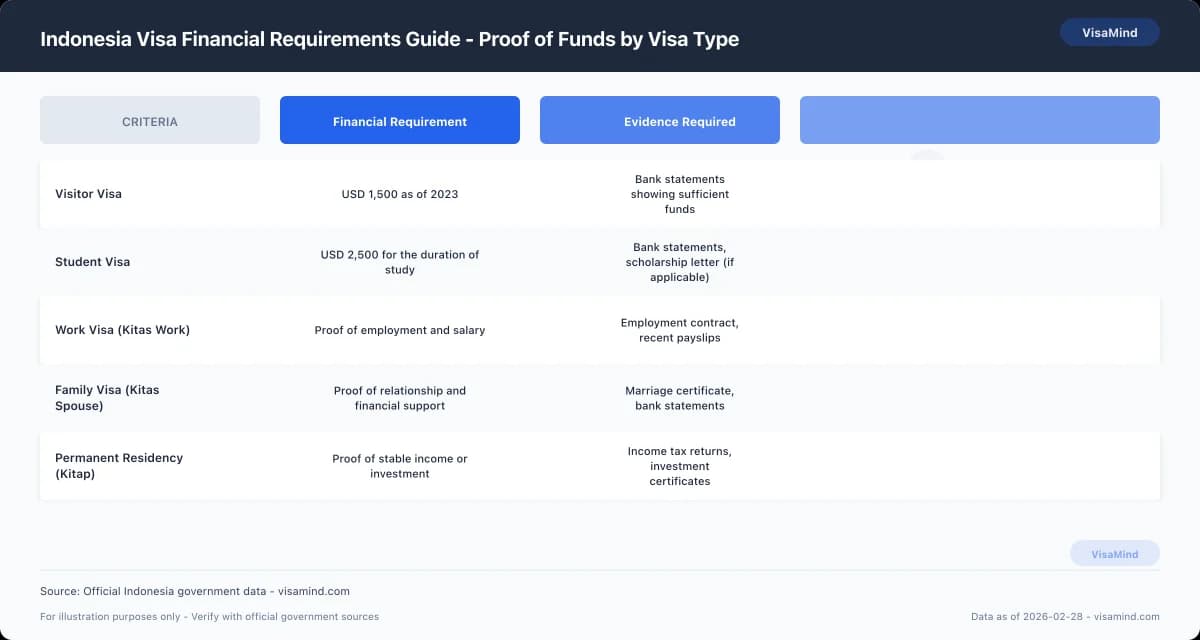
Indonesia's Directorate General of Immigration requires specific financial evidence depending on the type of visa you are applying for. These requirements help ensure that applicants can support themselves financially during their stay in Indonesia.
Tip: Ensure your bank statements clearly show your name and account number to avoid delays in the verification process.
Student Visa Financial Essentials
Students must provide evidence of adequate financial resources to cover tuition fees and living expenses. The minimum annual amount required is Rp 60,000,000. Acceptable documents include scholarship letters or bank guarantees. - Scholarship award letters or financial aid documents
- Bank statements showing sufficient funds
- Proof of tuition payment
Important: Students may also need a sponsor's financial statement if they are being supported by a family member or guardian.
Work and Family Visa Proofs
For work and family visas, applicants must show proof of income to support themselves and any dependents. The financial requirement varies between Rp 50,000,000 and Rp 100,000,000, depending on the applicant's role or family size.
| Visa Type | Financial Requirement | Proof Needed |
|---|---|---|
| Work Visa | Rp 100,000,000 | Employment contract, salary slips |
| Family Visa | Rp 50,000,000 | Sponsor's income statement, bank statements |
| Spouse Visa | Rp 75,000,000 | Joint bank statements, marriage certificate |
Warning: Failing to provide adequate proof of funds can result in visa refusal. Always verify the most recent requirements on the Directorate General of Immigration's website.
Getting Your Finances Application-Ready
#Ensuring your finances are ready for application is critical for a successful visa process with the Directorate General of Immigration (Ditjen Imigrasi).
Early Financial Preparation Strategies
Starting your financial preparations early can significantly streamline the visa application process. For instance, prospective applicants for the Global Citizen of Indonesia (GCI) visa should plan for a minimum income of USD 1,500 per month, which translates to approximately Rp 22,500,000 as of 2026. Verify on the official website for the most current exchange rates. - Assess your current financial status and identify any gaps in meeting the visa requirements. - Begin maintaining detailed records of income and investments well in advance of your application. - Regularly review your financial documentation to ensure compliance with Indonesia's immigration criteria.
Tip: Consider consulting with a financial advisor familiar with Indonesian immigration requirements to optimize your preparation strategies.
Maintaining Consistent Financial
Records is essential when applying for Indonesian visas. Regular updates and accurate documentation can help you avoid potential pitfalls during the application process. - Keep monthly bank statements and proof of income readily available. - Ensure all records are detailed, accurate, and reflect consistent inflow and outflow of funds. - Use digital tools to track and organize your financial documents.
Warning: Failing to provide sufficient proof of income or investment could jeopardize your visa application. Make sure all necessary documents are complete and up-to-date.
Explaining Unusual Financial Patterns
If your financial records show unusual patterns, such as large deposits or fluctuations, you should be prepared to explain these to the Directorate General of Immigration. Clear explanations can prevent misunderstandings and potential application delays. - Prepare a cover letter to explain any irregular financial activity, detailing reasons and supporting documents. - Include documentation, such as sales contracts or loan agreements, to justify large transactions. - Ensure all explanations are concise and factual, providing a clear narrative of your financial situation.
Important: Providing thorough explanations for financial anomalies demonstrates transparency and can strengthen your application.