
Can You Extend Your Visa?
#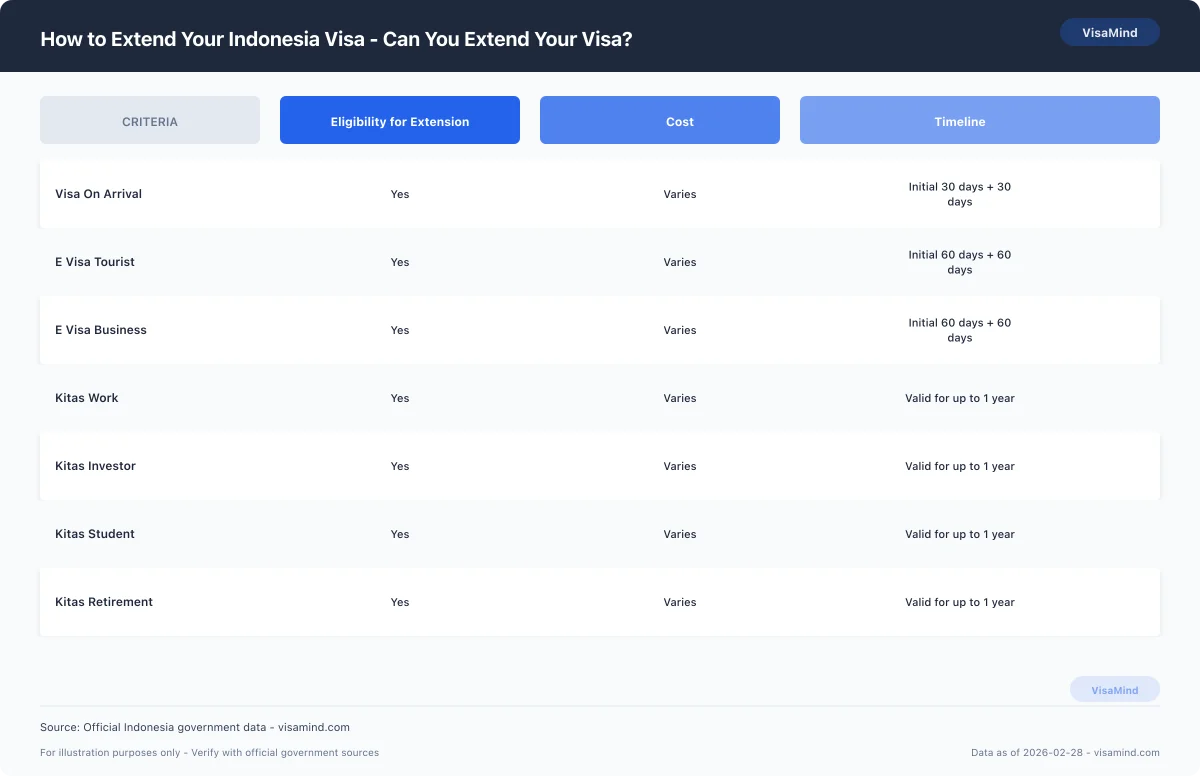
In Indonesia, certain visa types, such as the Visa on Arrival and Limited Stay Permits (KITAS), can be extended. This flexibility allows travelers and residents more time to enjoy or accomplish their objectives in the country. However, not all visas offer this option. Understanding which visas are extendable is essential for planning your stay in Indonesia. The Directorate General of Immigration (Ditjen Imigrasi) manages these processes.
Visa Types Eligible for Extension
Several visas in Indonesia can be extended, providing options for those who wish to prolong their stay. Here's a look at some of the extendable visas:
| Visa Type | Extension Availability |
|---|---|
| Visa on Arrival (VOA) | Can be extended once for 30 days |
| Limited Stay Permit - Work (KITAS) | Extendable based on employment contract |
| Limited Stay Permit - Investor (KITAS) | Extendable for ongoing investment activities |
| Limited Stay Permit - Student (KITAS) | Extendable for the duration of the study program |
| Limited Stay Permit - Spouse/Family (KITAS) | Extendable depending on family ties |
Tip: For more details on extending the Visa on Arrival, visit the Visa On Arrival page.
Non-Extendable Visa Categories
Not all visa categories in Indonesia allow for extensions. Travelers need to be aware of these restrictions to avoid overstaying, which can result in fines or deportation.
| Visa Type | Extension Restrictions |
|---|---|
| Tourist E-Visa | No extension allowed |
| Business E-Visa | No extension allowed |
| Digital Nomad Visa | No extension allowed |
Warning: Ensure you check the specific terms of your visa as overstaying is subject to penalties. For more information, consult the Visa Refusal Reasons guide.
Fees and Processing Times
#In Indonesia, extending your visa involves specific fees and processing times that are determined by the Directorate General of Immigration (Ditjen Imigrasi). Understanding these requirements is essential for a smooth extension process.
Current Extension Fees for Indonesia
The fee for extending a visa in Indonesia varies depending on the type of visa you hold. The payment can be made using SIMPONI or international credit/debit cards like Mastercard, Visa, or JCB.
| Visa Type | Extension Fee (IDR) |
|---|---|
| Visa on Arrival | Rp 500,000 |
| KITAS Work | Rp 1,500,000 |
| KITAS Investor | Rp 1,500,000 |
| KITAS Spouse | Rp 1,500,000 |
| KITAS Student | Rp 1,500,000 |
Tip: Check the official Directorate General of Immigration website for the most up-to-date fee information.
Typical Processing Times for Visa Extensions
Visa extension processing times can vary, but typically they take around 7 to 14 working days. Delays may occur if documents are incomplete or during peak travel seasons.
Important: Ensure all required documents are complete and submitted correctly to avoid processing delays. For more details, you can refer to Processing Times.
Expedited Processing Options Currently,
Indonesia does not officially provide expedited processing options for visa extensions. Applications are processed in the order they are received by the Directorate General of Immigration.
Warning: Attempting to expedite your application through unofficial channels may lead to legal complications. Always follow the official processes set by Ditjen Imigrasi.
What If You Overstay
#Overstaying your visa in Indonesia can result in a fine of Rp 1,000,000 per day. This regulation is enforced by the Directorate General of Immigration (Ditjen Imigrasi) and applies to all types of visas. It's important to address any overstays immediately to avoid further complications, including potential bans on future travel to Indonesia.
Fines Imposed for Overstaying
Indonesia imposes a significant daily fine for overstaying your visa. The current penalty is Rp 1,000,000 per day. These fines accumulate quickly and must be settled before you are allowed to leave the country.
Important: Ensure you pay any fines in full to avoid being detained at the airport when attempting to exit Indonesia.
Impact on Future Visa Applications
An overstay in Indonesia can have serious implications for future visa applications. The Directorate General of Immigration may scrutinize subsequent applications more closely if you have overstayed previously. - Potential delays in processing future applications
- Increased likelihood of visa denial
- Requirement to provide additional documentation
Tip: If you have overstayed, consider consulting an immigration lawyer to improve your chances on future applications.
Overstay-related Travel Bans
In some cases, overstaying in Indonesia can lead to a travel ban. This ban can prevent you from re-entering Indonesia for a specified period. - Short-term travel bans for minor overstays
- Long-term bans for significant or repeated overstays
- Permanent bans in extreme cases
Warning: Consult the Visa Refusal Reasons guide to understand how overstays may affect your eligibility for other visas, like the Visa On Arrival.
Extension Document Checklist
#When extending your visa in Indonesia, preparing the correct documentation is a critical step. The Directorate General of Immigration (Ditjen Imigrasi) requires specific materials to process your extension application efficiently. Understanding which documents to gather can save you time and ensure your application is successful. Below is a detailed checklist of essential items you need for a visa extension in Indonesia.
Essential Documents for Visa Extension -
Current passport with a minimum of six months validity. - Recent passport-sized photographs. - Proof of financial means, such as bank statements showing income equivalent to at least Rp 21,750,000 per month. - Completed visa extension application form, available at immigration offices.
Important: Ensure all documents are in English or Indonesian. Non-English documents must be accompanied by a certified translation.
Additional Papers for Special Cases -
For - For GCI Visa applicants: Proof of your status as a former Indonesian citizen or descendant, and documentation of any special skills if applicable.
Tip: Additional documents may be required depending on your specific visa category.
Document Submission Guidelines
Once your documents are ready, you must lodge them at the nearest immigration office. It is advisable to make an appointment ahead of time to avoid long waiting periods. You can pay the visa extension fee using SIMPONI or major credit/debit cards such as Mastercard, Visa, or JCB. Ensure that you receive a receipt for your payment as it will be needed during the application process.
Warning: Failure to submit the complete set of documents can result in delays or denial of your extension application.
Which Visas Are Extendable
#In Indonesia, extending your visa is a common procedure managed by the Directorate General of Immigration (Ditjen Imigrasi). Whether you're here for tourism, work, study, or family, knowing which visas are extendable can save you time and avoid potential issues.
Tourist Visa Extension Details
Tourist visas in Indonesia, such as the Visa on Arrival (VOA)
are extendable for an additional 30 days. This extension is applicable only once, and you must apply before your current visa expires. - Fee: Rp 500,000 per extension
- Application must be submitted to a local immigration office
- Extension process takes approximately 3-5 business days
Tip: Ensure you apply for your extension well before your visa expiration to avoid overstaying penalties.
Important: The Visa on Arrival is not extendable online. You must visit the immigration office in person.
Student Visa Extension Process
Students holding a Limited Stay Permit (KITAS) for study can extend their visa through their educational institution. The extension aligns with the duration of your study program.
-
Gather necessary documents including proof of enrollment and financial support.
-
Submit an application through your educational institution.
-
Pay the extension fee via SIMPONI or a recognized credit/debit card.
Tip: Check with your institution for specific deadlines to submit your application.
Work Visa Extension Eligibility
Work visas, such as the KITAS for employment, are extendable in Indonesia. Extensions depend on the terms of your work contract and sponsorship by your employer.
| Visa Type | Initial Validity | Extension Possible | Maximum Duration |
|---|---|---|---|
| KITAS Work | 6-12 months | Yes | Up to 5 years |
| KITAS Investor | 1-2 years | Yes | Up to 5 years |
Important: Ensure your employer is aware of and complies with the sponsorship requirements for your visa extension.
Family Visa Extension Information
Family visas, or the KITAS for spouses and dependents, are extendable in line with the primary visa holder's status. This ensures families can reside together legally in Indonesia. - Application must include proof of relationship and primary visa holder's status. - Submit to the local immigration office where you reside. - Fees are similar to other KITAS extensions.
Tip: Coordinate with the primary visa holder to align the extension timing for all family members.
Submitting Your Extension Request
#In Indonesia, extending your visa involves following specific procedures set by the Directorate General of Immigration (Ditjen Imigrasi). Whether you choose to submit your extension request online or in person, understanding the steps and required documents can streamline the process.
Online Application Procedure
For a convenient way to extend your visa, the Directorate General of Immigration offers an online application process. This option is ideal for those who prefer to handle their paperwork digitally.
-
Visit the official Directorate General of Immigration website.
-
Create an account or log in to your existing account.
-
Select the option for visa extension and complete the necessary details.
-
Upload the required documents as specified on the website.
-
Pay the extension fee through SIMPONI or using a Mastercard, Visa, or JCB credit/debit card.
-
Submit your application and await confirmation.
Tip: Ensure that all documents are scanned clearly and meet the file size requirements outlined on the website.
In-Person Application Steps
If you prefer in-person interaction, you can visit a local immigration office to apply for a visa extension. This method allows you to directly engage with immigration officials, which can be helpful for clarifying any doubts.
-
Visit the nearest immigration office with the required documents.
-
Collect the application form for a visa extension at the office.
3.4. Submit your completed application to the immigration officer.
-
Pay the required fee at the office.
-
Obtain a receipt and wait for notification regarding your application status.
Important: Ensure you arrive early at the immigration office as there might be queues, especially during peak times.
Forms Required for Submission
When extending your visa, certain forms and documents are essential for a smooth process. These documents help verify your identity and eligibility for the extension. - A valid passport with at least six months' validity. - Current visa and proof of entry into Indonesia. - Proof of financial means, such as bank statements or income proof. - A recent passport-sized photograph. - Any additional documents specific to your visa type, if required.
Warning: Failure to provide accurate and complete documents may result in delays or rejection of your application.
Alternatives to Extension
#Indonesia offers various alternatives if extending your visa is not an option. In 2026, the Directorate General of Immigration introduced several pathways to accommodate different needs and situations. Whether you're considering a status change or a new visa type, understanding these alternatives can help you make informed decisions.
Changing Visa Status
Changing your visa status can be a viable option if your circumstances have changed since your initial application. For instance, if you have secured employment, you might consider switching to a Kitas Work or Kitas Investor permit. - Gather all necessary documents as per your new visa category requirements. - Ensure your current visa is valid and you have not violated any immigration rules. - Submit your application through the official Directorate General of Immigration website.
Important: Changing your visa status must be done before your current visa expires to avoid penalties.
Leaving and Re-entering Indonesia
Leaving and re-entering Indonesia is another option if you need to refresh your visa status. This approach often involves returning on a Visa on Arrival or another short-term visa type.
-
Exit Indonesia before your current visa expires.
-
Apply for a suitable visa for re-entry, such as the Visa on Arrival.
-
Re-enter Indonesia with your new visa.
Warning: This option can be costly and time-consuming, as it involves travel expenses and the risk of being denied entry if requirements are not met.
Switching to a Different Visa Type
Switching to a different visa type can be beneficial if your long-term plans have changed.| Visa Type | Purpose | Requirements | | Golden Visa | Investment | Investment commitment | | Kitas Work | Employment | Job offer and employment contract | | Kitas Student | Study | Enrollment in an Indonesian institution |
Considering Voluntary Departure
If none of the above options are feasible, voluntary departure may be the most practical solution. This involves leaving Indonesia before your visa expires to avoid overstaying penalties. - Confirm your departure date and ensure it is before your visa expiration. - Settle any outstanding obligations, such as taxes or bills. - Plan your return strategy if you intend to revisit Indonesia in the future.
Important: Voluntary departure helps maintain a clean immigration record, which is required for future visa applications.