Do You Need a Visa?
#Visa-Free Travel to Japan: Are You Eligible?
Did you know that travelers from 68 countries and regions can visit Japan without a visa for short-term stays? The Immigration Services Agency of Japan has arrangements that allow tourists, business visitors, and those visiting friends or relatives to enter the country without the need for a traditional visa, provided they meet specific conditions.
Who Qualifies for Visa Exemption?
Many nationalities can enjoy a visa-free entry into Japan under the following conditions:
- Indonesia: Nationals must register an ICAO-compliant ePassport with Japanese diplomatic missions.
- Malaysia: Travelers need an ICAO-compliant ePassport.
- Taiwan: Passport holders must have a personal ID number.
- Uruguay: Only holders of the old version of Uruguayan passports are exempt.
It's crucial to ensure your documents meet these requirements to avoid any issues at the port of entry. Failure to do so might result in refusal of entry.
When Do You Need a Visa?
If your country is not listed among those with visa-free arrangements, or if you plan to stay in Japan longer than the permitted short-term period (usually up to 90 days), you will need to apply for an appropriate visa. Common types for extended stays or specific activities include the Short-Term Stay Visa, Highly Skilled Professional Visa, and others depending on your purpose of visit.
What About Special Cases?
Even if you are eligible for visa-free entry, immigration officers at the port of entry in Japan have the authority to grant or deny "landing permission." This means having a visa or being visa-exempt does not automatically guarantee entry into Japan. If you're planning to engage in activities not covered by a short-term stay or require an extended stay, be sure to explore other visa options or consult the How To Apply Guide for more detailed processes.
Keep in mind that for many travelers, registering information necessary for immigration procedures in advance and presenting a 2D code at the time of entry using a smartphone or tablet can streamline the process. However, always check the latest requirements and procedures on the official website before your trip.
Types of Visitor Visas
#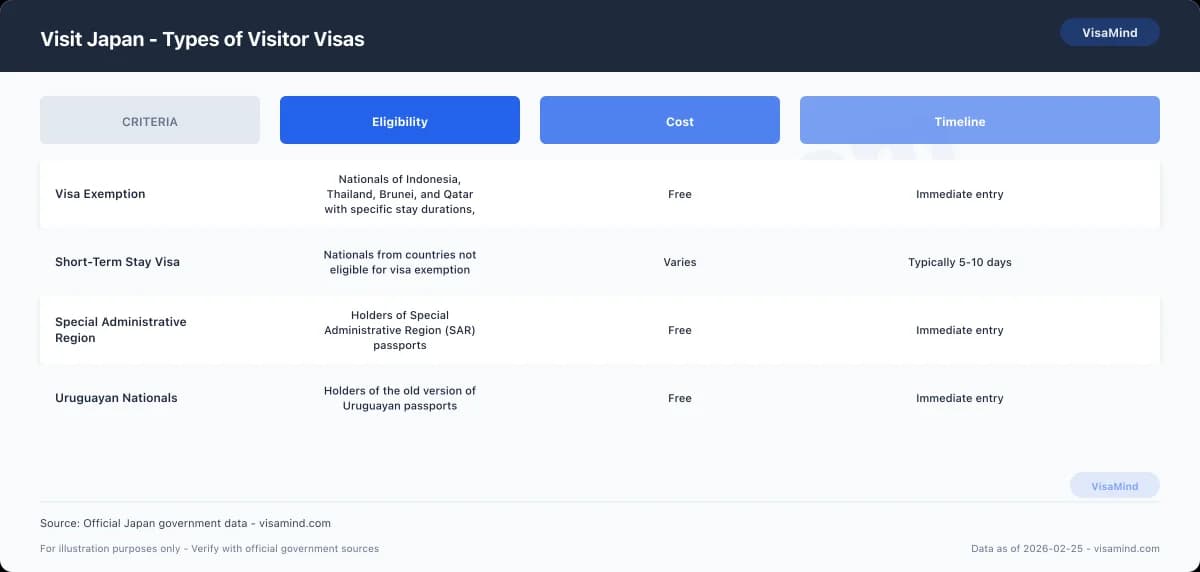
Types of Visitor Visas for Japan
When planning a visit to Japan, understanding the different types of visitor visas available is crucial. Below is a comparison of the main visitor visa types, including their eligibility criteria, costs, and timelines.
| Visa Type | Eligibility | Cost (as of 2023) | Timeline (Approximate) |
|---|---|---|---|
| Visa Exemption | - Nationals of Indonesia, Malaysia, Taiwan, Uruguay, and others meeting specific passport conditions | No cost | Immediate entry |
| Short-Term Stay | - Generally for tourism, business, short-term family visits<br>- Requires a valid passport and sufficient funds | Varies by nationality | 5-10 business days |
| Business Visa | - For short-term business activities<br>- Requires invitation from a Japanese company | ¥3,000-¥6,000 | 5-10 business days |
| Transit Visa | - For travelers passing through Japan to another destination<br>- Requires evidence of onward travel | ¥3,000 | 5-7 business days |
Visa Exemption Program
Japan has established visa exemption arrangements with several countries, allowing for short-term visits without a visa. This often applies to nationals from countries such as Indonesia, Malaysia, Taiwan, and Uruguay, provided they meet specific passport requirements. For instance, Indonesian and Malaysian nationals need an ICAO-compliant e Passport, while Taiwanese nationals must have a passport with a personal ID number. It’s important to verify the specific requirements for your nationality and ensure all conditions are met to take advantage of this program.
Short-Term Stay Visa
The Short-Term Stay Visa is ideal for those planning to visit Japan for tourism, business, or family visits. Applicants must demonstrate sufficient funds for their stay and provide a valid passport. The processing time typically ranges from 5 to 10 business days, so plan accordingly. It is crucial to prepare all necessary documentation and evidence before lodging your application.
Business Visa
If you are traveling to Japan for business purposes, you may need a Business Visa. This visa requires an invitation from a Japanese company and is suitable for short-term business activities such as meetings or conferences. The cost ranges from ¥3,000 to ¥6,000 depending on the specifics of your visit. Ensure you have all relevant documents, including the invitation letter, to support your application.
Transit Visa
For travelers who need to pass through Japan en route to another destination, a Transit Visa is available. This type of visa requires evidence of onward travel, such as a confirmed plane ticket. The cost is approximately ¥3,000, and the processing time can be around 5 to 7 business days. This visa is necessary if you plan to leave the airport during your layover.
For more detailed guidance on application processes and requirements, you can refer to the How To Apply and Documents Checklist guides.
What You Need to Apply
#Required Documents for Applying
When planning to visit Japan under the visa exemption program, it is important to ensure you have all necessary documentation prepared. Below is a detailed list of what you may need to gather:
Passport Requirements
- ICAO-compliant e Passport: This is mandatory for certain nationalities to qualify for visa exemption. Specifically:
- Nationals of Indonesia must register their e Passport with a Japanese diplomatic mission.
- Nationals of Malaysia must possess an ICAO-compliant e Passport.
- Nationals of Taiwan require a passport that includes a personal ID number.
- Nationals of Uruguay can only use the old version of their passports for visa exemption.
Financial Proof and Supporting Documents
- Proof of Financial Capability: You may need to demonstrate sufficient financial means to cover your stay in Japan. This could include bank statements or a letter from your employer.
- Invitation Letter (if applicable): If you are visiting friends, relatives, or an organization, an invitation letter may be required. The inviting party or guarantor should send this directly to you, not to the Japanese authorities.
Photographs
- Recent Passport-Size Photos: While not always required for visa-exempt travelers, having a recent photo can be useful if additional documentation is requested upon entry.
How to Prepare for Entry
Once you have gathered the necessary documents, it's crucial to prepare for the immigration process:
- Register Information in Advance: Before your travel, register your information for immigration procedures. This can streamline your entry process.
- 2D Code Presentation: Ensure you have access to your 2D code on a smartphone or tablet, as it will be needed during immigration procedures.
For more detailed guidance on document preparation and the application process, you can refer to the Documents Checklist and How To Apply guides.
Understanding Visa Exemptions
For travelers who do not meet the visa exemption requirements, a Short-Term Stay Visa may be necessary. Note that possessing a visa is just one aspect of entry requirements as defined by the "Immigration Control and Refugee Recognition Act". Final entry permission, known as "landing permission," is granted at the port of entry when all conditions are met. If you are considering longer stays or different visa categories, explore options such as the Highly Skilled Professional Visa.
By ensuring you have all the required documents and understanding the process, you can enjoy a smooth entry into Japan and fully experience the country's rich culture and attractions.
The Application Process
#How to Apply for the Visit Japan Program
-
Determine Your Eligibility
Before beginning the application process, ensure you meet the eligibility criteria for the Visit Japan program. Nationals from specific countries, like Indonesia, Malaysia, Taiwan, and Uruguay, may qualify for visa exemption under certain conditions. For example, Indonesian nationals must register their ICAO-compliant e Passport with Japanese diplomatic missions. Verify your eligibility based on your nationality and passport type.
-
Choose Your Application Method
You have two primary ways to apply for the Visit Japan program:
-
Online Application: This is the most convenient method. You can register the necessary information for immigration procedures in advance through the official Immigration Services Agency of Japan website. Make sure to review instructions for your specific eligibility category before starting the process.
-
Embassy or VFS Centers: If you prefer or are required to apply in person, you may visit the nearest Japanese embassy, consulate, or a Visa Facilitation Services (VFS) center. This might be necessary if you're registering an e Passport or if you need assistance with the application process.
-
-
Gather Required Documents
Prepare the necessary documents depending on your application method and eligibility. Common requirements include:
- A valid ICAO-compliant e Passport (for certain nationalities)
- Any other documents specified by the Immigration Services Agency, which may include proof of travel plans or an invitation from a guarantor.
Refer to the Documents Checklist for a detailed list of what you may need.
-
Schedule an Appointment (if applicable)
If you are applying through an embassy or VFS center, you may need to schedule an appointment. This is particularly important if you require personalized assistance or need to register an ICAO-compliant e Passport.
-
Complete the Application Process
-
Online: After gathering your documents, complete the online application by submitting the required information and documents. Follow the instructions provided on the website to ensure all sections are completed accurately.
-
In Person: Attend your appointment with all necessary documents. An official will guide you through the process. Ensure your documents are complete to avoid delays.
-
-
Present the 2D Code Upon Arrival
If you have applied online, you will receive a 2D code that you must present at the port of entry in Japan. This can be displayed using a smartphone or tablet. This step is crucial as it facilitates the immigration process upon your arrival.
What Happens After Submission?
After submitting your application, either online or at an embassy/VFS center, you will wait for confirmation of your eligibility for visa exemption. Keep in mind that the "landing permission" is ultimately granted by an immigration officer when you arrive in Japan, based on your compliance with entry requirements.
For additional information on related visa types, such as the Short-Term Stay Visa or Highly Skilled Professional Visa, explore our comprehensive guides. Be sure to check the official website of the Immigration Services Agency of Japan for the most up-to-date information.
At the Border
#What to Expect at the Border
Upon arrival in Japan, you'll be greeted by the Immigration Services Agency of Japan (ISA) at the port of entry. Here, you will need to pass through several procedures to gain entry into the country. Understanding these steps can help ease the process.
Fingerprinting and Photographing
As part of the entry procedures, you will be required to undergo fingerprinting and photographing. This is a standard procedure for all foreign nationals, except for certain exemptions like diplomats and children under the age of 16. This biometric data is collected to ensure security and manage immigration control effectively.
Interviews and Landing Permission
Interview Process
In some cases, you may be asked to participate in a brief interview with an immigration officer. This could involve questions about the purpose of your visit, duration of stay, and accommodation arrangements. Ensure you have all relevant documents, such as your return ticket and hotel reservation, readily available to facilitate this process.
Landing Permission
The final step at the border is obtaining landing permission. An immigration officer will grant this once they verify that all entry requirements are met. Remember, while a visa or visa exemption allows you to travel to Japan, it does not guarantee entry. The landing permission is your official entry approval.
E-Gates and Registration
Using E-Gates
Japan offers e-gate services for expedited immigration clearance. If you are eligible, you can register your information in advance and use a 2D code on your smartphone or tablet during entry procedures. This can significantly reduce wait times at immigration.
Eligibility for E-Gates
To use the e-gates, ensure that your passport is ICAO-compliant, especially if you are from countries like Malaysia or Indonesia. Failure to have the correct passport type may result in delays or entry refusal. If you have questions about your eligibility, consider reviewing the Documents Checklist or consulting with the Immigration Services Agency.
Possible Pitfalls
It's crucial to be aware of potential pitfalls that could lead to complications at the border:
- Not registering an ICAO-compliant e Passport for eligible countries can result in refusal of entry.
- Using an updated Uruguayan passport without a 'place of birth' may affect your visa exemption eligibility.
For more detailed guidance, explore the Visa Refusal Reasons to understand more about potential issues you might face at the border.
Extending Your Stay
#Can You Extend Your Stay in Japan?
If you're visiting Japan under the Visit Japan visa exemption, you might be wondering if you can extend your stay beyond the initial period granted upon entry. Generally, the visa exemption allows travelers from eligible countries to enter Japan for short stays, usually up to 90 days, depending on nationality. However, extending your stay beyond this period is not straightforward and requires careful planning.
How to Apply for an Extension
To pursue an extension, you need to lodge an application with the Immigration Services Agency of Japan (ISA). It's crucial to begin this process well before your current period of stay expires. The application must be justified by a legitimate reason, such as unforeseen circumstances preventing departure. However, extensions are rarely granted for reasons like extending a holiday or visiting friends longer.
Required Documents and Procedures
When applying for an extension, prepare to provide several documents, including:
- A valid passport showing your current entry status
- A completed application form for extension of stay
- Evidence supporting your reason for extension (such as medical certificates if applicable)
- Financial proof showing you can support yourself during the extended period
The process involves submitting these documents at a regional immigration office in Japan. As procedures can vary, it's advisable to consult with the Visa Extension Guide for detailed instructions tailored to your specific situation.
Alternatives to Extending Your Stay
If extending your stay is not feasible, consider exploring other visa options that might align with your longer-term plans in Japan. For instance, if your intent is to work or study, you might look into visas like the Specified Skilled Worker 1 or the Student visa. Each visa type has specific eligibility criteria and application procedures, which you can explore through the Visa Refusal Reasons guide to understand common pitfalls and ensure a successful application.
In conclusion, while the Visit Japan exemption offers a convenient entry for short-term stays, extending beyond the initial period requires navigating a formal application process. Always ensure your stay in Japan remains compliant with immigration policies to avoid potential issues.
Common Mistakes Visitors Make
#Overstaying Your Visa
- Understanding Your Stay Duration: It's important to note that the "landing permission" granted by an immigration officer at the port of entry determines the length of your stay in Japan. This duration might be less than the maximum allowable time for your visa exemption category.
- Consequences of Overstaying: Overstaying your visa can lead to serious consequences including fines, detention, and a potential ban on re-entry. Always monitor your departure date and plan ahead to avoid these issues. For those needing a longer stay, consider applying for a Visa Extension Guide before your permitted period ends.
Engaging in Unauthorized Work
- Tourist Visa Limitations: Visitors entering Japan under a visa exemption for tourism, business, or visiting friends and relatives are not permitted to engage in any paid work. Unauthorized work can result in penalties, deportation, and future entry bans.
- Permitted Activities: Ensure that your activities align with the purpose of your visit. If you wish to work in Japan, you must apply for an appropriate visa, such as the Engineer Specialist or Specified Skilled Worker 1.
Insufficient Financial Resources
- Proof of Funds Requirement: When entering Japan, you may be required to demonstrate sufficient financial resources to support your stay. This is crucial for proving you can cover all expenses without illegal employment.
- Plan Your Finances: It’s advisable to prepare evidence of funds, such as bank statements, to present at the port of entry if requested. Refer to the Financial Requirements for more detailed guidance.
By avoiding these common mistakes, you can ensure a smooth and enjoyable visit to Japan. Always verify the most current requirements on the official Immigration Services Agency of Japan website.
Real Scenarios
#Understanding Visa Exemptions for Visiting Japan
Visiting Japan under a visa exemption can seem straightforward, but it's essential to understand the specific requirements that apply to your nationality. For instance, nationals of Indonesia and Malaysia can enjoy visa-free travel to Japan if they possess an ICAO-compliant e Passport. Indonesians must also register their e Passport with Japanese diplomatic missions to qualify. Meanwhile, Taiwanese travelers are eligible only if their passports include a personal ID number.
Potential Pitfalls and How to Avoid Them
Travelers should be aware of some common pitfalls associated with the visa exemption process for Japan. For example, Uruguayan nationals can only benefit from visa-free entry with the old version of their passports, which includes a 'place of birth'. Using the newer version without this detail could lead to ineligibility. Furthermore, failing to register an ICAO-compliant e Passport might result in refusal of entry at the border. It's advisable to review the detailed Visa Refusal Reasons to avoid such issues.
What Happens at the Port of Entry?
Even with a visa exemption, entry into Japan is not guaranteed until you receive a landing permission from an immigration officer upon arrival. The officer will verify if you meet all the entry requirements. This underscores the importance of preparing all necessary documents and ensuring that all your information is correctly registered in advance. Having your 2D code ready on a smartphone or tablet can streamline your process when you arrive.
Additional Resources
For those planning a longer stay or different purposes, Japan offers various visas like the Specified Skilled Worker 1 or Engineer Specialist, which cater to specific needs and qualifications. You might also find the Visa Extension Guide helpful if you're considering a longer stay beyond the visa exemption limits.
Understanding your eligibility and preparing adequately can make your visit to Japan smooth and enjoyable. Always verify the latest requirements on the official website to ensure compliance with all immigration protocols.
FAQs
What happens if I overstay my visa in Japan?
How much does a Japan visa cost?
Can I extend my short-term stay visa in Japan?
What documents are needed to apply for a Japan tourist visa?
Can I work in Japan with a tourist visa?
How can I avoid common mistakes when applying for a Japan visa?
Can I bring my family with me on a Japan tourist visa?
VisaMind provides informational guidance only and is not a government agency. This is not legal advice. Requirements can change and eligibility depends on your specific facts. If your case is complex or high-stakes, consult a licensed immigration attorney.
Next steps
Requirements vary by nationality, purpose, timeline, and case details. VisaMind turns uncertainty into a sequenced checklist with official source citations.
Find my visa