Pre-Application Checklist
#Japan requires a visa for most foreign visitors, with processing overseen by the Immigration Services Agency of Japan (ISA). The type of visa and specific documents required can vary significantly depending on your purpose of visit. Before you start your visa application, it's necessary to identify the correct visa category, ensure you meet the eligibility requirements, and gather all necessary documents to avoid any delays or rejections.
Choosing Your Visa Category
Selecting the correct visa category is the first step. Japan offers various visas tailored to different purposes of stay, such as tourism, work, or study. - Short-Term Stay Visa: For visits up to 90 days, such as tourism or business. See more about Short-Term Stay Visa.
- Work Visa: For those planning to work in Japan, including categories like Engineer/Specialist in Humanities/International Services and Highly Skilled Professional.
- Student Visa: For individuals intending to study at a Japanese institution. Learn more about the Student Visa.
Tip: Consider consulting the official Immigration Services Agency of Japan website for detailed descriptions of each visa type.
Eligibility Requirements for Japanese Visas
Each visa category has specific eligibility criteria. Short-term visas generally allow stays up to 90 days for non-remunerative activities like tourism. Work and long-term visas require a Certificate of Eligibility issued in Japan. - Short-Term Stay: Must be for non-remunerative activities and not exceed 90 days.
- Work or Long-Term Stay: Requires a Certificate of Eligibility before applying.
- Japan eVISA: Available for short-term tourism from certain countries.
Important: A visa does not guarantee entry to Japan. Final permission is granted by an immigration officer upon arrival.
Essential Documents to Gather
Before you lodge your visa application, ensure you have all the required documents ready. The specific documents needed can vary based on the visa type and local conditions. - Valid passport
- Completed visa application form
- Certificate of Eligibility (for work and long-term stays)
- Recent passport-sized photographs
- Proof of financial stability
- Itinerary and accommodation details (for short-term stays)
Warning: Submitting incomplete or incorrect documents can delay processing or result in denial.
Application Costs
#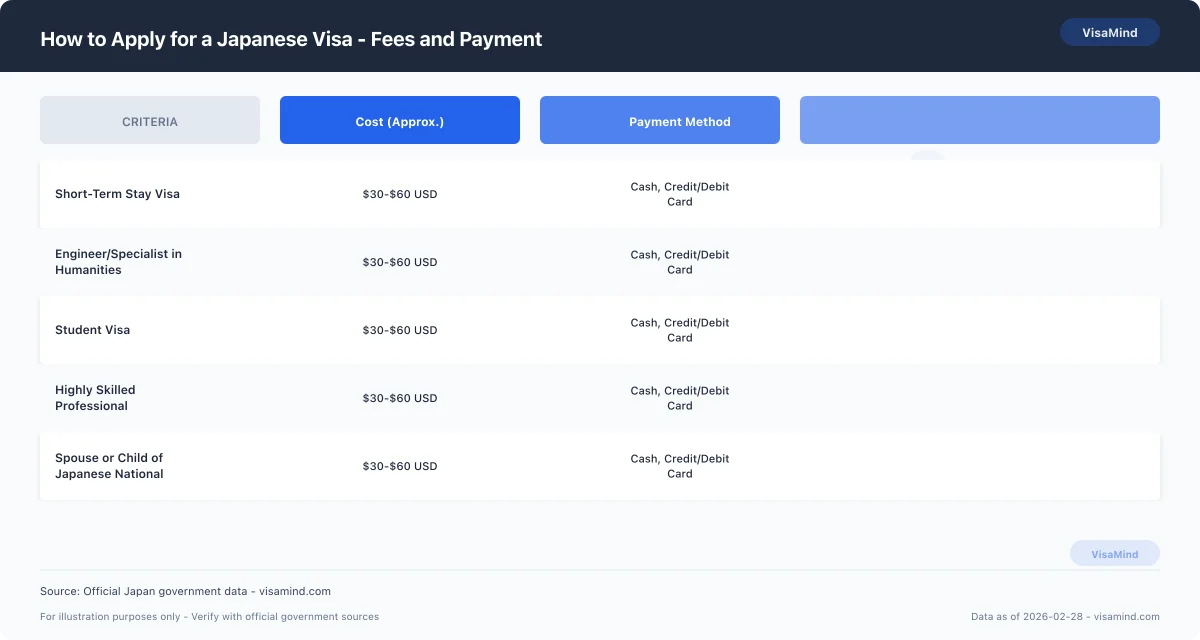
Applying for a Japanese visa involves specific fees that vary by visa type. Understanding these costs is required to ensure a smooth application process.
Visa Application Fee Structure
Visa application fees depend on the type of visa you are applying for. For instance, a Short-Term Stay Visa usually costs around ¥3,000 for a single entry, while a Multiple Entry Visa can cost up to ¥6,000. Fees may vary slightly depending on your nationality and the specific visa category.
| Visa Type | Fee (JPY) |
|---|---|
| Short-Term Stay | ¥3,000 |
| Multiple Entry | ¥6,000 |
| Transit Visa | ¥700 |
Tip: Always check the Immigration Services Agency of Japan website for the most current fee structure.
Accepted Payment Methods in Japan
Visa application fees in Japan can typically be paid in cash or by credit card at Japanese consulates or embassies. It's advisable to confirm the accepted payment methods at the specific location where you intend to apply. - Cash: Payable in Japanese yen at most locations. - Credit Card: Accepted at many consular offices. - Bank Transfer: Some offices may allow payment via bank transfer; confirm this option in advance.
Warning: Ensure that your payment method is accepted at the location where you plan to lodge your application.
Refund Policy for Visa Fees
Visa application fees are generally non-refundable, even if your application is denied. It's important to submit complete and accurate documents to avoid unnecessary costs.
Important: If you withdraw your application before processing begins, some embassies may offer partial refunds; inquire directly with the consulate.
Tracking Your Application
#As of 2026, visa applications for Japan are processed by the Immigration Services Agency of Japan (ISA). Utilizing available tools can help you track your application status efficiently.
How to Track Your Visa Status
Once you have lodged your application through the appropriate Japanese Diplomatic Mission, you can track its status. Some embassies and consulates provide online tracking services, so check their official websites for specific procedures.
Tip: Keep the receipt number from your application handy, as it may be required to access tracking services.
Typical Processing Times in Japan
The processing times for Japanese visas vary depending on the visa type and the specific circumstances of your application. On average, short-term visas such as the Short-Term Stay Visa take around 5 to 10 working days.
| Visa Type | Typical Processing Time |
|---|---|
| Short-Term Stay | 5-10 working days |
| Work or Long-Term | 1-3 months |
| Student | 2-3 months |
Important: Processing times can be longer if additional documents are needed or during peak application periods. Verify current timelines on the official Processing Times page.
Activities While Awaiting Decision -
Prepare for your potential move by researching accommodation, especially if applying for a long-term visa like the Engineer/Specialist in Humanities/International Services.
- Gather any additional documentation that may support your case or might be requested later. - Stay informed about Japan's entry requirements and updates through the Immigration Services Agency of Japan.
Warning: Do not make non-refundable travel plans until your visa has been approved and issued.
If Something Goes Wrong
#In 2026, over 2 million people applied for a Japanese visa. Despite thorough preparation, not all applications result in approval. Understanding your options if your application is denied can help you plan your next steps effectively.
Appealing a Visa Denial
If your Japanese visa application is denied, the Immigration Services Agency of Japan does not typically provide an appeal process. Instead, you have the option to reapply with additional documentation or correct previous errors. It's required to carefully review the reasons for denial, as outlined in the notification you receive.
Important: Carefully analyze any errors or omissions in your initial application to avoid repeated denials.
Reapplying After Rejection
Reapplying for a Japanese visa requires addressing the issues that led to the initial rejection. Gather all required documents, ensuring completeness and accuracy to meet the specific visa requirements. Depending on the visa type, you might need a Certificate of Eligibility if applying for work or long-term stay.
-
Review the denial reasons carefully.
-
Collect any additional documents required.
-
Ensure all information is accurate and complete.
-
Submit a new application with corrected details.
Tip: Consider consulting an immigration specialist for guidance on strengthening your reapplication.
Administrative Review Procedures
In some cases, an administrative review may be available. This process involves the Immigration Services Agency of Japan reassessing your application to ensure all procedures were correctly followed. However, this is not a common practice for visa applications and is usually reserved for specific circumstances. - Check if your situation qualifies for an administrative review. - Contact the nearest Japanese embassy or consulate for guidance. - Prepare to demonstrate how your application meets all requirements.
Warning: Do not use fraudulent websites or intermediaries when dealing with visa applications. Always verify information through official channels.

Which System to Use
#Japan's visa application process includes accessing specific online systems to manage and track your application. The Immigration Services Agency of Japan (ISA) provides these systems to facilitate the application process.
Japan Visa
Portal is your primary online resource for managing your visa application. This portal is designed to help applicants understand which documents and steps are necessary for different visa types.
-
Visit the official website of the Immigration Services Agency of Japan.
-
Select the visa type you are applying for, such as Short-Term Stay or Work.
-
Review the specific requirements and conditions applicable to your visa type.
Tip: Ensure you are accessing the official portal to avoid fraudulent websites. Always check that the URL corresponds to the official Immigration Services Agency of Japan website.
Accessing Japan's Online Visa System
Japan offers an online visa system to streamline the application process. This system is particularly useful for eVISA applications, which are available for nationals from specific countries.
-
Go to the JAPAN eVISA website if eligible.
-
Create an account using your email address.
-
Follow the prompts to complete your visa application.
Important: Only ordinary passport holders can apply through the JAPAN eVISA website. Verify your eligibility before proceeding. - Short-Term Stay Visa
- Highly Skilled Professional
- Engineer/Specialist in Humanities/International Services
How to Submit Your Application
#Applying for a Japanese visa involves several detailed steps, from gathering documents to lodging your application. The Immigration Services Agency of Japan oversees this process, ensuring all applicants meet specific requirements. Whether you're visiting Japan for tourism, work, or study, it's required to understand the submission process to avoid any delays. Here, we outline how to complete and submit your visa application to Japanese authorities.
Completing the Visa Application Form
-
Visit the official Immigration Services Agency of Japan website to access the visa application form.
-
Select the visa type that corresponds to your intended activity in Japan, such as a Student Visa or Highly Skilled Professional.
-
Carefully fill in your personal details, passport information, and purpose of visit, ensuring all information is accurate.
-
Review the form to confirm that there are no errors or omissions.
Important: Ensure all information on the application form matches your supporting documents. Discrepancies can lead to delays or rejections.
Submitting Documents to Japanese Authorities
-
Prepare all necessary documents, such as a valid passport, photographs, and any specific documents related to your visa type, like a Certificate of Eligibility for work or long-term stay visas.
-
Verify document requirements on the official ISA website or the nearest Japanese diplomatic mission, as they can vary based on local conditions.
-
Submit your application and documents through the specified method by the Diplomatic Mission of Japan. This may involve submitting them in person or through an accredited travel agency in some countries.
Tip: Check with the Japanese diplomatic mission in your country for specific submission guidelines and whether an appointment is required.
Finalizing Your Visa Submission
-
Pay the applicable visa fee, which is typically around ¥3,000 for a single-entry visa, but verify the current fees on the official website.
-
Receive a receipt for your application submission, which is essential for tracking your application status.
-
Wait for notification from the Japanese authorities regarding any further steps, such as an interview, which is sometimes required.
Warning: Be wary of fraudulent websites claiming to offer visa services. Only use official channels for your application.

Expected Timeline
#Applying for a Japanese visa typically requires several weeks, depending on the visa type and country of application. The process involves multiple steps, including document preparation and submission to the Immigration Services Agency of Japan.
Visa Processing Timeline Overview
The processing time for a Japanese visa can vary greatly based on the visa category and the applicant's nationality. On average, short-term visas may take approximately 5 to 10 business days from submission, while long-term visas may take longer.
| Visa Type | Average Processing Time | Fee (JPY) |
|---|---|---|
| Short-Term Stay | 5-10 business days | ¥3,000 |
| Work Visa | 2-3 weeks | ¥3,000 |
| Student Visa | 2-3 weeks | ¥3,000 |
Warning: Ensure you apply well in advance of your planned travel date, as processing times can be longer during peak seasons or due to additional scrutiny.
Milestones in the Visa Application Process
-
Gather necessary documents as required by the Immigration Services Agency of Japan.
-
Submit your visa application through the appropriate Japanese diplomatic mission in your area.
-
Pay the visa application fee, which is typically ¥3,000 for most visa types.
-
Attend an interview if requested by the consulate or embassy.
-
Receive your visa decision and collect your passport with the visa, if approved.
Tip: For work or long-term stay visas, make sure to obtain a Certificate of Eligibility before applying, as this is a required document for these visa types. - Student Visa
- Spouse or Child of Japanese National
- Visa Refusal Reasons
Your Biometrics Appointment
#Biometric data collection is a critical step for visa applications to Japan, where fingerprints and photographs are typically required. This process ensures identity verification and is part of Japan's security measures for foreign visitors. Applicants are often required to book an appointment at a VFS center or the Japanese Embassy for biometric capture. It's important to understand the specific procedures for your visa type to avoid any delays in your application process.
Booking a Biometric Appointment in Japan
-
Visit the official website of the Japanese Embassy or Consulate in your country to find the correct VFS center or embassy for your biometric appointment.
-
Select an available date and time for your appointment that fits your schedule.
-
Receive a confirmation email with details of your appointment, including what documents to bring.
Tip: Ensure that your documents are complete and correct to avoid delays or having to reschedule your appointment. Incomplete documents are a common reason for application delays.
Visiting VFS Centers for Biometrics
VFS centers are the primary locations for biometric data collection for Japanese visa applications. These centers are equipped to handle fingerprinting and photography in a secure environment. - Bring your appointment confirmation and ID. - Arrive at least 15 minutes early to your scheduled appointment. - Follow all instructions provided by the VFS staff during the biometric process.
Important: If you are applying for a visa such as the Spouse or Child of Japanese National or Specified Skilled Worker 1, ensure you check for any additional biometrics requirements specific to these categories.
What to
Expect at the Embassy If your biometric appointment is at a Japanese Embassy, expect a slightly different process from VFS centers. Embassies may conduct additional interviews or require further documentation. - Bring all required documents, including your passport and appointment letter. - Be prepared to answer questions about your purpose of visit and stay. - Follow the embassy's security protocols and respect any additional instructions.
Warning: Failing to appear for your biometric appointment can significantly delay your visa application process. Reschedule in advance if you cannot attend.
The COE Step
#For those seeking to work or reside in Japan for more than 90 days, obtaining a Certificate of Eligibility (COE) is a key step. This document, issued by the Immigration Services Agency of Japan, serves as a prerequisite for long-term stay visas. Applicants must secure the COE before proceeding with their visa applications. This certificate confirms that the applicant meets the entry requirements under Japan's immigration laws.
Understanding the Certificate of Eligibility
The Certificate of Eligibility is an essential document for those planning to stay in Japan for work or longer than 90 days. It is not a visa but a preliminary requirement that simplifies the visa issuance process by confirming that the applicant has met certain entry conditions. The COE must be obtained before applying for a visa at a Japanese embassy or consulate. It is typically requested by a sponsor in Japan, such as an employer or educational institution.
Important: Without a COE, your visa application for a long-term stay may be denied. Make sure your sponsoring organization in Japan initiates this process early.
Steps to Obtain Your COE
-
Ensure your sponsor in Japan is ready to assist with the COE application.
-
Gather all required documents, including proof of intended activities and identification.
-
Your sponsor submits the application to the local immigration office in Japan.
-
Wait for the Immigration Services Agency of Japan to process the application (usually 1 to 3 months).
-
Once issued, have your sponsor send you the original COE. The processing time for a COE can vary, but it generally takes between one and three months. It is advisable to start this process well in advance of your planned travel date.
Tip: Check the status of your application regularly through your sponsor to avoid any delays, especially if you have a specific entry date in mind. - Proof of sponsorship
- Identification documents
- Details of intended activities in Japan For more information about visa types related to the COE, consider visiting the pages for Highly Skilled Professional, Spouse or Child of Japanese National, and Engineer/Specialist in Humanities/International Services.