
What the Intra-company Transferee Covers — Japan intra-company transferee
#
The Intra-company Transferee status — often called the intra-company transferee visa — is a Japanese work visa that lets you work in Japan when your overseas employer sends you to a related entity in Japan. It covers an intra-company transfer, where a company moves you from an overseas office to an office in Japan within the same corporate group. It applies to specific professional activities and is distinct from other work statuses.
Unlike a general work permit tied to a single employer, this work visa is anchored to your corporate group: your permission to work follows the transfer relationship between the sending office abroad and the host office in Japan.
Who this visa is for
You qualify if your company transfers you from an overseas office to a Japanese head office, branch, or affiliated company. This status typically applies if you already work for the sending company and will continue similar duties in Japan.
Your activities must fall within professional fields comparable to Engineer/Specialist in Humanities/International Services. You generally fit this category if:
- You work for a foreign office of a company with a presence in Japan
- Your employer assigns you to a Japanese branch or subsidiary
- Your duties involve specialized knowledge, technology, or international services
- You remain employed by the same corporate group
Business owners who are setting up or managing a company in Japan need to look at the Business Manager status instead.
It also differs from:
- Highly Skilled Professional, which uses a points-based system
- Specified Skilled Worker (i), which targets specific labor sectors
- Long-term Resident, which is based on personal status rather than employment
The Immigration Services Agency (ISA) reviews your status of residence and any change or extension applications.
Key features
The Intra-company Transferee status ties your permission to:
- Your sponsoring corporate group
- The specific professional activities described in your application
- The Japanese host entity
You can’t freely change employers outside the related corporate structure without applying for a change of status with the ISA.
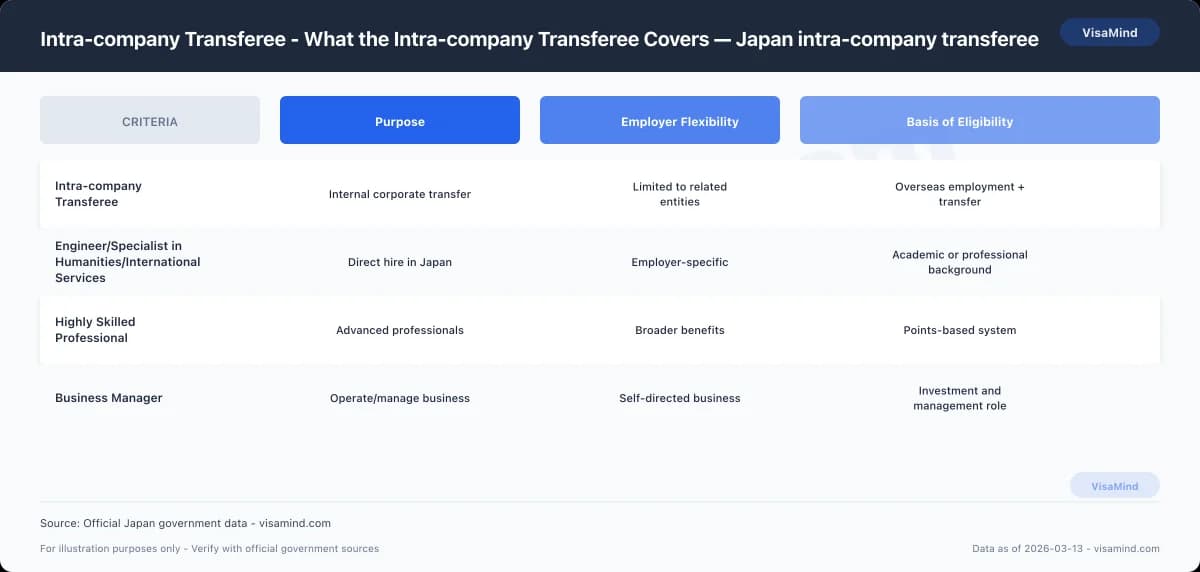
Below is a comparison of related statuses:
| Status | Purpose | Employer Flexibility | Basis of Eligibility |
|---|---|---|---|
| Intra-company Transferee | Internal corporate transfer | Limited to related entities | Overseas employment + transfer |
| Engineer/Specialist in Humanities/International Services | Direct hire in Japan | Employer-specific | Academic or professional background |
| Highly Skilled Professional | Advanced professionals | Broader benefits | Points-based system |
| Business Manager | Operate/manage business | Self-directed business | Investment and management role |
You must submit a Form Visa Application and supporting corporate documents to the ISA. The ISA checks whether your duties match the permitted scope.
Quick processing note
Processing times depend on your case and location.
If you apply from abroad, you usually need a Certificate of Eligibility from the Japanese host entity before applying for your visa at a Japanese embassy or consulate. If you already live in Japan under another status, you apply for a change of status through the ISA.
For current timelines and application steps, refer to the Immigration Services Agency (ISA).
Wording you’ll see: intracompany transferee vs intra-company transferee
Japanese immigration material uses the hyphenated spelling intra-company transferee, while corporate mobility teams often write intracompany transferee or shorten the route to ICT visa. All three describe the same status of residence, so an intracompany transferee visa and an intra-company transferee visa are the same work visa, not two separate immigration categories.
Japan also doesn’t issue a stand-alone document called a work permit. Your status of residence is your work authorization: once ISA grants Intra-company Transferee status, that status defines the activities you may perform at the office in Japan that receives you. So when people ask about an intra-company transfer work permit, the practical answer is this work visa plus the residence status behind it.
Where the route sits in Japan’s visa system: the Ministry of Foreign Affairs lists the intra-company transferee visa among its long-term stay visa categories, and ISA lists Intra-company Transferee among the work-related statuses of residence. Both references are linked in the official sources for this page.
What this work visa does not cover
The scope limits matter as much as the eligibility rules, because immigration officers assess what you actually do at the office in Japan rather than what your contract is called:
- Work for an unrelated Japanese employer. The status is anchored to the corporate group named in your visa application. Moving to a company outside that group means a change of status through ISA, not just a new job.
- Activities outside the permitted professional scope. Paid work beyond your approved activities needs separate permission from ISA, not simply your employer’s agreement.
- Locally hired roles. If the Japanese entity recruits you directly instead of receiving you on an intra-company transfer, Engineer/Specialist in Humanities/International Services is normally the correct work visa.
- Running your own company. Establishing or managing a business points to Business Manager instead.
If the assignment drifts away from the intra-company transfer described in your application, treat it as an immigration matter to raise with ISA rather than an internal HR change — mismatches between declared and actual activities are a recurring theme in our guide to Japanese visa refusal reasons.
Conditions and Portability
#Your visa status lets you request entry to Japan, but admission isn’t guaranteed. Immigration officers at the port of entry have the final say after checking your documents and circumstances.
Entry and inspection
When you arrive in Japan, an immigration officer from the Immigration Services Agency of Japan (ISA) will inspect your documents and decide whether to admit you.
A visa alone doesn’t secure entry. You need to show the officer that you meet the conditions of your approved status, such as Intra-Company Transferee, and that your stay matches that purpose.
Bring supporting documents in your carry-on:
- Return or onward ticket
- Accommodation details in Japan
- Proof of sufficient funds
- Valid passport with appropriate visa
Officers may compare your stated activities with your visa category. If your activities resemble those under Engineer/Specialist in Humanities/International Services, Business Manager, Highly Skilled Professional, Specified Skilled Worker (i), or another status, you must have the right classification.
ISA makes the final decision at the airport or seaport.
Passport & travel document rules
Your passport must be valid for your entire stay in Japan. If it expires during your assignment, you could face issues at entry or while living in Japan.
Renew your passport before travel if its validity is short. Make sure there are enough blank pages for visa placement and entry stamps.
Before filing a Form Visa Application or traveling, check:
- Passport validity covers your full assignment
- There’s at least one blank visa page
- The passport is undamaged and machine-readable
Applying for Intra-Company Transferee status doesn’t guarantee approval. ISA reviews each application individually and can deny it if requirements aren’t met.
Visa issuance vs entry
A Japanese visa and permission to land are separate steps.
A consulate may issue your visa based on your documents. ISA officers at the port of entry decide whether to grant landing permission after reviewing your case.
This distinction matters if your situation changes between visa issuance and arrival.
| Stage | Authority | What It Means |
|---|---|---|
| Visa issuance | Japanese consulate or embassy | You may travel to Japan and request entry |
| Landing inspection | Immigration Services Agency (ISA) | Officer grants or denies entry at the port |
If the officer decides your purpose doesn’t fit the Intra-Company Transferee category, you may be refused entry even with a valid visa.
Carry documentation that clearly supports your assignment and employer relationship to avoid problems during inspection.
After landing: residence card and keeping your status valid
Clearing immigration is where your status begins, not where the process ends. When an officer grants landing permission for a mid- to long-term stay, you are issued a residence card (在留カード) recording your status of residence, your authorized period of stay, and your permission to work. That card — not a separate work permit — is what evidences your right to work at the office in Japan that received you.
Where you get the card depends on where you land. Only the designated ports of entry issue residence cards at the counter; if you arrive anywhere else, your passport is endorsed on the spot and the card is mailed to you after you register your address with the municipal office. Check which ports currently issue cards on arrival with the Immigration Services Agency before you book the flight, because the difference decides whether you walk out of the airport already holding the card.
After arrival you generally need to:
- Register your address at the municipal office where you live, and update it whenever you move
- Carry the residence card, since immigration officers and police may ask to see it
- Notify ISA when the receiving organization changes name, merges, or ends your assignment
- Apply to renew your period of stay before it lapses if the intra-company transfer continues — see our Japanese visa extension guide
If you travel out of Japan mid-assignment, check the re-entry rules attached to your status before you go, so that returning does not turn into a fresh visa application.

When to Get Professional Help
#Many intra-company transferee applications can be handled internally if you follow ISA requirements closely. Mistakes in documents, eligibility classification, or supporting evidence can lead to rejection or delay.
When employer can manage
Your company can usually prepare and file the Form Visa Application if your HR team has handled similar cases before and understands ISA documentation standards.
You should double-check:
- Personal details match the passport exactly.
- Every form answer is consistent across documents.
- The Certificate of Eligibility (CoE) is obtained before applying for long-term work status.
- The photograph meets ISA specifications:
4.5cm × 4.5cm
- White background
- Taken within 6 months
- No accessories
Many established companies already handle transfers under categories such as:
- Intra-Company Transferee
- Engineer/Specialist in Humanities/International Services
- Highly Skilled Professional
- Business Manager
If your case is a standard transfer and the job duties fit the status of residence, internal handling is usually enough. The Immigration Services Agency of Japan (ISA) checks whether your documents match your declared activity, so accuracy is more important than the number of documents.
When to consult a lawyer
You should consult an immigration lawyer if your case doesn’t clearly fit one status category.
For example, if you’re unsure between:
| Situation | Risk |
|---|---|
| Intra-company transfer vs. Engineer/Specialist in Humanities/International Services | Misclassification |
| Transfer with management authority | May require Business Manager review |
| Considering Highly Skilled Professional instead | Different documentation structure |
You also need legal help if:
- ISA previously rejected your application.
- Your answers differ across prior filings.
- You plan to change from another status such as Long-term Resident or Specified Skilled Worker (i).
- Your company isn’t experienced with CoE applications.
A lawyer checks for consistency across forms and supporting materials before submission. That helps avoid refusals based on conflicting information.
Complex document issues
Document problems cause many rejections and delays.
Common risk areas include:
| Issue | Likely Result |
|---|---|
| Missing CoE for long-term work status | Automatic refusal |
| Inconsistent information across forms | Rejection |
| Incorrect photo size or format | Processing delay |
Every document must show identical names, dates, and passport details. Even small discrepancies can cause trouble.
You should get professional help if your corporate documents are incomplete, translated inconsistently, or don’t match ISA expectations. A lawyer can check formatting, photo rules, and make sure your package supports your activities without contradictions.
What Your Employer Must Do
#Your employer in Japan leads the immigration process. They secure approval from the Immigration Services Agency (ISA) and prepare the official forms supporting your Form Visa Application.
Sponsor obtains CoE
For long-term work, your employer in Japan must get a Certificate of Eligibility (CoE) from the Immigration Services Agency of Japan (出入国在留管理庁) (ISA) before you apply for your visa.
This covers work statuses such as:
- Intra-company Transferee
- Engineer/Specialist in Humanities/International Services
- Highly Skilled Professional
- Business Manager
- Specified Skilled Worker (i)
- Certain other long-term statuses, including Long-term Resident
Your employer files the CoE application with ISA in Japan. You can’t file this application yourself from overseas.
Processing usually takes 1–3 months, so your employer should start early.
| Step | Responsible Party | Where Filed | Typical Processing Time |
|---|---|---|---|
| CoE application | Your sponsoring employer | Immigration Services Agency (Japan) | 1–3 months |
| Visa Application (after CoE issued) | You | Japanese embassy/consulate | Check official instructions |
ISA reviews whether your transfer fits the Intra-company Transferee status. If approved, ISA issues the CoE, which you use to apply for your visa abroad.
Employer paperwork & forms
Your employer must complete the official “Intra-company Transferee” application form issued by ISA.
They need to:
-
Use the current version of the ISA form.
-
Complete all required sections accurately.
-
Submit the form to ISA in Japan.
-
Coordinate with you so your Visa Application matches the approved CoE details.
The form title must match the status: “Intra-company Transferee.” Don’t use forms for Engineer/Specialist in Humanities/International Services or Highly Skilled Professional unless your role fits those categories.
Your employer must ensure consistency across:
- Your job title
- Your duties
- Your Japanese entity details
- The transferee relationship within the company
Any mismatch between the CoE and your Visa Application can cause delays or problems.
Download official instructions
Your employer should download both the Intra-company Transferee form and its instructions directly from the Immigration Services Agency of Japan.
ISA updates forms and instructions periodically. Using an outdated version can result in rejection or correction requests.
You and your employer should check:
- The correct status category (Intra-company Transferee)
- The latest application form version
- Current procedural guidance from ISA
Refer only to the Immigration Services Agency (ISA) for the most current forms and instructions.
Bringing Your Spouse and Children
#Your spouse and children need their own status to live with you in Japan. They can’t enter based solely on your Intra-company Transferee status, or other categories like Highly Skilled Professional, Engineer/Specialist in Humanities/International Services, Business Manager, Long-term Resident, or Specified Skilled Worker (i).
Each family member files a separate Form Visa Application and must meet document requirements set by the Immigration Services Agency of Japan (ISA).
Dependent visa basics
Your spouse and unmarried children apply for a dependent status tied to your authorized stay in Japan.
Before they apply for a visa at a Japanese consulate, you must get a Certificate of Eligibility (COE) for each family member. ISA issues the COE in Japan. Without it, the visa application won’t move forward.
Each applicant needs:
- A valid passport
- The required visa application form
- The required photograph
- The issued Certificate of Eligibility
If you later change your status—for example, to Highly Skilled Professional or Business Manager—your family’s status must remain consistent with your own. ISA handles status changes and extensions inside Japan.
| Applicant | COE Required | Visa Application Required | Issuing Authority |
|---|---|---|---|
| Spouse | Yes | Yes | ISA (COE) |
| Child | Yes | Yes | ISA (COE) |
Family documents for Chinese nationals
If your spouse or child is a Chinese national, you’ll need to submit extra civil documents.
Required documents include:
- A copy of the Chinese Family Register
- A Temporary Residence Permit or Residence Certificate
These confirm family relationships and legal residence. Provide clear, complete copies to avoid delays.
Each family member must still get an individual Certificate of Eligibility before applying for the visa. ISA reviews the COE application in Japan, and the Japanese consulate reviews the visa application abroad.
Don’t substitute other household registration records unless the consulate specifically tells you to.
Photo & form requirements
Every family member must submit their own visa application form and photograph.
Standard requirements are:
- One visa application form
- One photograph
Nationals of Russia, CIS countries, or Georgia submit:
- Two visa application forms
- Two photographs
Make sure the form is fully completed and matches your passport details exactly.
Inconsistent names, passport numbers, or dates of birth will delay processing.
Submit all documents together with the issued Certificate of Eligibility and your passport at the time of the visa application.
ISA oversees residence status in Japan, while the consulate is responsible for visa issuance abroad.
The Dual-Track Application (ICT visa Japan)
#You coordinate two parallel steps: your employer’s Certificate of Eligibility (CoE) filing and your own Form Visa Application paperwork.
The Immigration Services Agency of Japan (ISA) reviews both parts, and errors in either track can slow approval.
Employer petition (CoE)
Your sponsoring entity in Japan files the Certificate of Eligibility with the Immigration Services Agency (ISA).
This employer-led filing confirms that your role fits the Intra-Company Transferee category, not another status such as Engineer/Specialist in Humanities/International Services, Business Manager, Highly Skilled Professional, Specified Skilled Worker (i), or Long-term Resident.
You need to confirm the company uses the correct status classification before submission.
A mismatch between your job duties and the selected status can result in rejection or requests for correction.
Your employer prepares and submits the required documentation directly to ISA.
You don't file the CoE yourself, but you're responsible for providing accurate personal and employment details.
Review all information carefully before your company submits it.
For current processing procedures or status-specific guidance, check with the Immigration Services Agency (ISA).
Completing the application form
You must complete the official Visa Application form for filings with the Immigration Services Agency (ISA).
Fill in every required field clearly and accurately.
Do not leave mandatory sections blank.
Follow these steps:
-
Enter your personal details exactly as shown in your passport.
-
Provide your intended status as Intra-Company Transferee.
-
Review all entries for spelling and consistency.
-
Sign the form where required.
Unsigned forms or incomplete sections frequently delay processing.
ISA expects the information in your Visa Application to match the details in the employer’s CoE filing.
Small inconsistencies can trigger additional review.
If you consider another status such as Highly Skilled Professional or Engineer/Specialist in Humanities/International Services, confirm eligibility before submitting the form under the ICT category.
Photo and evidence submission
ISA enforces strict photo standards.
Non-compliant photos often cause delays.
Your photograph must meet the following specifications:
| Requirement | Standard |
|---|---|
| Size | 4.5 cm × 4.5 cm |
| Recency | Taken within the last 6 months |
| Background | Plain white |
| Appearance | No hats or sunglasses |
Submit a clear image that meets all measurements exactly.
Photos that fail size or background rules may result in a request for resubmission.
Attach all required supporting evidence when you submit your signed Visa Application.
Missing documents prevent ISA from reviewing your case efficiently.
Before filing, confirm that:
- Your form is fully completed
- Your signature appears where required
- Your photo meets all specifications
- Your supporting documents are included
ISA handles both status certifications and Visa Applications, so accuracy at this stage directly affects your approval timeline.

Eligibility Requirements
#You must meet the specific criteria set by the Immigration Services Agency of Japan (ISA) for the Japan intra-company transferee status.
ISA evaluates your employment background, service period, and whether your role fits the correct status category before approving your Form Visa Application.
Carefully match your situation to the correct status and follow the published category instructions.
Employment history
ISA reviews your employment history to confirm that your transfer qualifies under the intra-company transferee framework.
You must document your current position, past roles within the same corporate group, and the nature of your work.
Prepare clear evidence that shows:
- Your employer abroad and the entity in Japan are related within the same corporate group
- Your job duties before and after transfer
- The continuity of your employment
Your responsibilities in Japan must align with the authorized activities under the applicable status.
If your duties resemble those under Engineer/Specialist in Humanities/International Services, Highly Skilled Professional, or Business Manager, you must ensure your application reflects the correct classification.
Use accurate job titles and detailed descriptions.
Inconsistent or vague employment records can delay review by ISA.
Minimum service requirement
ISA requires you to satisfy the service conditions set for your specific category.
The required period of prior employment depends on the status instructions that apply to you.
You must confirm:
- The length of time you have worked for the overseas entity
- Whether your employment was continuous
- That your service falls within the qualifying corporate relationship
Do not assume that time worked in a different role or location automatically qualifies.
ISA examines whether your service directly supports the transfer purpose.
If you cannot meet the intra-company transferee requirements, you may need to review other statuses such as Specified Skilled Worker (i) or Long-term Resident, depending on your circumstances.
Check category instructions
Before filing your Visa Application, review the official instructions for your exact status category.
ISA evaluates each application against the criteria published for that classification.
Use this checklist:
- Confirm the correct status name
- Verify required employment history
- Confirm minimum service conditions
- Ensure your job duties match authorized activities
The table below shows how category alignment affects eligibility:
| Status Category | Must Match Job Duties? | Requires Category-Specific Review? |
|---|---|---|
| Intra-Company Transferee | Yes | Yes |
| Engineer/Specialist in Humanities/International Services | Yes | Yes |
| Highly Skilled Professional | Yes | Yes |
| Business Manager | Yes | Yes |
If your role does not clearly fit one category, ISA may reject or require correction of your application.
Always rely on the official category guidance before submission.
Who is eligible for an intra-company transfer work permit
Eligibility for this work visa rests on the corporate relationship rather than on a local job offer. ISA looks for a genuine intra-company transfer: a sending office abroad, a receiving office in Japan inside the same corporate group, and an existing employment relationship between you and that group.
In practice, an eligible intra-company transferee usually shows:
- A documented corporate link between the overseas entity and the office in Japan (head office, branch, subsidiary, or affiliate)
- Continuous employment with the sending entity before the transfer, for the service period published for this category
- Duties in Japan that involve specialized knowledge, technology, or international services rather than unskilled work
- A transfer that is temporary in purpose and assigned by the employer, not a self-arranged move onto the open labor market
What does not create eligibility: a job advertisement from an unrelated Japanese company, a group relationship you cannot document, or duties that sit outside the permitted professional scope. In those cases the correct route is usually a different work visa, such as Engineer/Specialist in Humanities/International Services, or Business Manager if you will run the office in Japan yourself.
Fees and Processing Times
#You must pay a visa issuance fee and plan for two separate timelines: status eligibility review and visa stamping.
processing times depend on where you apply and which status category applies to your transfer.
Visa issuance fees
Japan charges a fee when it issues your visa.
As of February 2026, the visa issuance fee is ¥6,000 for a multiple-entry visa.
| Item | Amount (JPY) | When You Pay |
|---|---|---|
| Visa issuance fee (multiple-entry) | ¥6,000 | Upon visa issuance |
You do not pay this fee when you submit initial documents for status review.
You pay it when the visa is approved and issued by the Japanese Embassy or Consulate.
If you apply under a different status, such as Engineer/Specialist in Humanities/International Services, Highly Skilled Professional, Business Manager, Specified Skilled Worker (i), or Long-term Resident, confirm the applicable issuance fee with the Japanese Embassy, Consulate, or the Immigration Services Agency of Japan (ISA).
Fee structures can differ by visa type and entry category.
Always verify the current amount directly with the issuing authority before you apply.
Standard processing times
For an Intra-Company Transferee under standard processing, the typical timeline is 1 to 3 months as of March 2026.
This timeframe refers to the main immigration review handled by the Immigration Services Agency of Japan (ISA).
The processing times vary by:
- Status category
- Work location in Japan
- Volume at the processing office
After approval, the embassy or consulate generally processes the visa stamp in about 5 business days.
This step can take longer during peak travel seasons.
Use the table below as a general guide:
| Stage | Typical Timeframe |
|---|---|
| ISA review (Intra-Company Transferee – standard) | 1–3 months |
| Visa issuance at embassy/consulate | ~5 business days |
Always confirm current timelines with the issuing authority before you schedule travel.
Processing variations & tips
The processing times differ depending on your status classification.
An application filed as Highly Skilled Professional may follow a different internal review track than one filed as Engineer/Specialist in Humanities/International Services or Business Manager.
Location also matters.
Applications handled in different jurisdictions can move at different speeds.
Follow these practical steps to reduce delays:
-
Apply at the Japanese Embassy or Consulate in your country of residence.
-
Submit your application at least 2–3 weeks before your intended travel date.
-
Confirm current processing times with the embassy or ISA before booking flights.
Peak seasons increase wait times.
Incomplete or inconsistent documents slow review and may push your case beyond the standard 1–3 month window.
How long does it take to get a Japanese intra-company transferee visa?
Plan around two clocks rather than one. The first is the ISA review of the Certificate of Eligibility your employer files in Japan, which is where most of the elapsed time sits. The second is visa issuance at the Japanese embassy or consulate with jurisdiction over your residence, which starts only after the CoE exists.
Several factors move the total: the immigration office handling your case, how complete the corporate evidence for the intra-company transfer is, whether ISA asks for clarification, and seasonal demand at the consulate. Requesting an extension or change of status once you are in Japan runs on its own timeline.
Because both clocks are published and revised by the authorities themselves, confirm current figures against the Ministry of Foreign Affairs visa processing page and the ISA guidance for your status category, and see our processing times guide, before you commit to a start date at the office in Japan.
Common Petition Challenges
#Most denials stem from avoidable filing errors, poor document preparation, or choosing the wrong consular post.
You reduce risk by matching your status to your actual duties, preparing compliant photos and documents, and filing only where you have jurisdiction.
Common reasons for rejection
You face rejection when your job duties do not match the Intra-Company Transferee status.
If your role fits Engineer/Specialist in Humanities/International Services, Business Manager, Highly Skilled Professional, or Specified Skilled Worker (i) instead, the Immigration Services Agency of Japan (ISA) will not treat it as an intra-company transfer.
Review your eligibility before filing a Form Visa Application.
Confirm that:
- You transfer from a foreign office to a related office in Japan.
- Your duties in Japan align with the approved status.
- Your employer’s corporate relationship supports the transfer.
Do not rely on titles alone.
ISA examines your actual activities in Japan, not your business card.
Misclassification often occurs when applicants previously held Long-term Resident status or another category and assume it covers corporate transfers.
Each status has distinct criteria.
You must meet the specific requirements of the Intra-Company Transferee category.
| Issue | Result |
|---|---|
| Duties inconsistent with status | Rejection or request for clarification |
| Applying under wrong status | Denial and need to refile |
| Inadequate proof of corporate relationship | Application not approved |
Photo & document errors
ISA expects complete and accurate documents.
Missing pages, inconsistent information, or incorrect photographs delay or derail your Visa Application.
Check your file carefully:
- Ensure all forms are fully completed and signed where required.
- Confirm names, dates of birth, and employment details match across documents.
- Submit photographs that meet the specified format requirements.
Small inconsistencies raise credibility concerns.
For example, mismatched job descriptions between the overseas entity and the Japanese entity may suggest that the transfer is not genuine.
You also risk confusion if you submit documents prepared for another status, such as Highly Skilled Professional or Engineer/Specialist in Humanities/International Services, without tailoring them to the Intra-Company Transferee criteria.
Align every document with the status you request.
Create a simple internal checklist before submission:
-
Confirm status category.
-
Verify consistency across all documents.
-
Review photo specifications.
-
Reconfirm signatures and dates.
Applying at the correct post
You must apply at the Japanese Embassy or Consulate that has jurisdiction over your place of residence.
Filing at the wrong location leads to refusal to accept or process your application.
Jurisdiction depends on where you legally reside, not where your employer is located.
If you live in one country but your company headquarters is in another, you still apply where you reside.
| Scenario | Correct Action |
|---|---|
| You reside in Country A | Apply at the Japanese Embassy/Consulate serving Country A |
| Employer headquartered in Country B | Do not apply in Country B unless you reside there |
Confirm jurisdiction directly with the relevant Japanese Embassy or Consulate before submitting your Visa Application.
This step prevents immediate procedural rejection and unnecessary delays.
Fees
#| Component | Amount |
|---|---|
| Visa issuance feeVisa issuance fee: ¥6,000 (approx $40 USD) (as of 2026-02). Verify the current fee on the official schedule before filing. | ¥6,000 (approx $40 USD) |
Fees change; always verify on ISA.