Japan long-term resident: Overview
#The Long-term Resident is a status managed by the Immigration Services Agency of Japan (出入国在留管理庁) (ISA). Use this form when you apply for or manage matters related to this specific residence status with ISA.
This status is separate from Permanent Residence, Spouse or Child of Permanent Resident, Highly Skilled Professional, Intra-company Transferee, and Specified Skilled Worker (i). Pick the right category before you file.
Japan long-term resident: quick summary
The Long-term Resident form is an official document from the Immigration Services Agency of Japan (ISA). Submit it to ISA when applying under this status.
This form is only for the Long-term Resident category. It doesn’t replace applications for:
- Permanent Residence
- Spouse or Child of Permanent Resident
- Highly Skilled Professional
- Intra-company Transferee
- Specified Skilled Worker (i)
| Item | Details |
|---|---|
| Issuing authority | Immigration Services Agency of Japan (ISA) |
| Form title | Long-term Resident |
| Used for | Applications under Long-term Resident status |
| Country | Japan only |
You file this form directly with ISA as part of your immigration process.
Who this form is for
Use this form if you’re applying for residence in Japan under the Long-term Resident status. ISA determines eligibility and reviews your application.
This form isn’t for you if you qualify under another residence category. For example, use the correct process if you’re applying as:
- A Spouse or Child of Permanent Resident
- A Highly Skilled Professional
- An Intra-company Transferee
- A Specified Skilled Worker (i)
- An applicant for Permanent Residence
You may file this form as part of a Certificate of Eligibility (CoE) Application or other procedures handled by ISA, depending on your situation. Double-check that “Long-term Resident” is the exact status on your intended application before preparing documents.
Submitting the wrong category can delay your case. ISA processes your request strictly under the status you select.
Where to get the form and instructions
Don’t use outdated copies or third-party versions. ISA provides the official version, and requirements can change.
Follow these steps:
-
Go to the Immigration Services Agency (ISA) website.
-
Find the residence status forms section.
-
Select Long-term Resident.
-
Download both the form and the instructions.
| Source | What to Download |
|---|---|
| Immigration Services Agency (ISA) website | Long-term Resident form |
| Immigration Services Agency (ISA) website | Official instructions |
Check the ISA website for any updates before filing your Form Visa Application or Form CoE Application. Use only the most recent version available on the ISA site.
Fees and Processing Times (long-term resident Japan)
#You pay a government fee when your long-term resident visa is issued. Processing usually takes several weeks to a few months. Timelines and handling differ by status category and where you apply, so confirm details with the Immigration Services Agency of Japan (ISA) or the Japanese embassy or consulate handling your case.
Visa issuance fee and payment
Japan charges a visa issuance fee of ¥6,000 for a long-term resident visa, including a multiple-entry visa (as of February 2026). This fee is paid when the visa is issued, not when you first submit your application.
If you apply outside Japan, you submit your application at a Japanese embassy or consulate in your country of residence. The embassy or consulate collects the issuance fee after approving your visa.
If you apply inside Japan through a Form CoE Application or status change at ISA, follow payment instructions from the regional office. Always verify the current fee and payment method directly with:
- The Immigration Services Agency of Japan (ISA) for in-country procedures
- The relevant Japanese embassy or consulate for overseas applications
| Item | Amount (JPY) | When Paid |
|---|---|---|
| Long-Term Resident visa (multiple-entry) | ¥6,000 | Upon visa issuance |
Typical processing windows
Processing for long-term resident status under the standard track usually takes 1 to 3 months (as of March 2026). This applies to many CoE Applications and in-country status changes handled by ISA.
If you apply at a Japanese embassy or consulate after your Certificate of Eligibility (CoE) is issued, visa processing often takes about 5 business days. It can take longer during busy seasons or if your file needs more review.
You should:
-
Submit your CoE Application as early as possible.
-
Apply at the embassy or consulate at least 2–3 weeks before your planned travel date.
-
Confirm current timelines directly with the issuing authority, as workloads vary by region.
Priority categories such as Highly Skilled Professional may get faster CoE handling than standard cases.
Category and location differences
Processing times and administrative handling vary by both status category and application location. ISA manages applications inside Japan, while embassies and consulates handle overseas Visa Applications.
Some categories move faster due to internal prioritization. For example:
- Highly Skilled Professional applications often get expedited CoE processing.
- Statuses like Spouse or Child of Permanent Resident, Intra-company Transferee, or Specified Skilled Worker (i) follow standard review timelines unless ISA notifies otherwise.
Location matters. A regional ISA office with a heavy caseload may take closer to the upper end of the 1–3 month range.
If you plan to transition later to Permanent Residence, factor in these timelines when organizing your long-term immigration plans. Always verify current processing expectations with ISA before you file.

Maintaining PR Status
#
You must protect your status at every stage: application, visa issuance, and entry. Approval, visa issuance, and landing are separate decisions made by different authorities, and each can result in refusal.
Approval is not guaranteed
Submitting a Form Visa Application or Form CoE Application does not secure status in Japan. The Immigration Services Agency of Japan (ISA) reviews eligibility, but the outcome depends on compliance with all requirements and your background.
A Certificate of Eligibility (CoE) supports your visa request, but it doesn’t bind the Japanese consulate. The consulate evaluates your case independently before issuing a visa.
You face higher risk of refusal if you:
- Have a criminal record
- Previously violated visa conditions
- Overstayed or breached immigration rules
These principles apply across statuses, including:
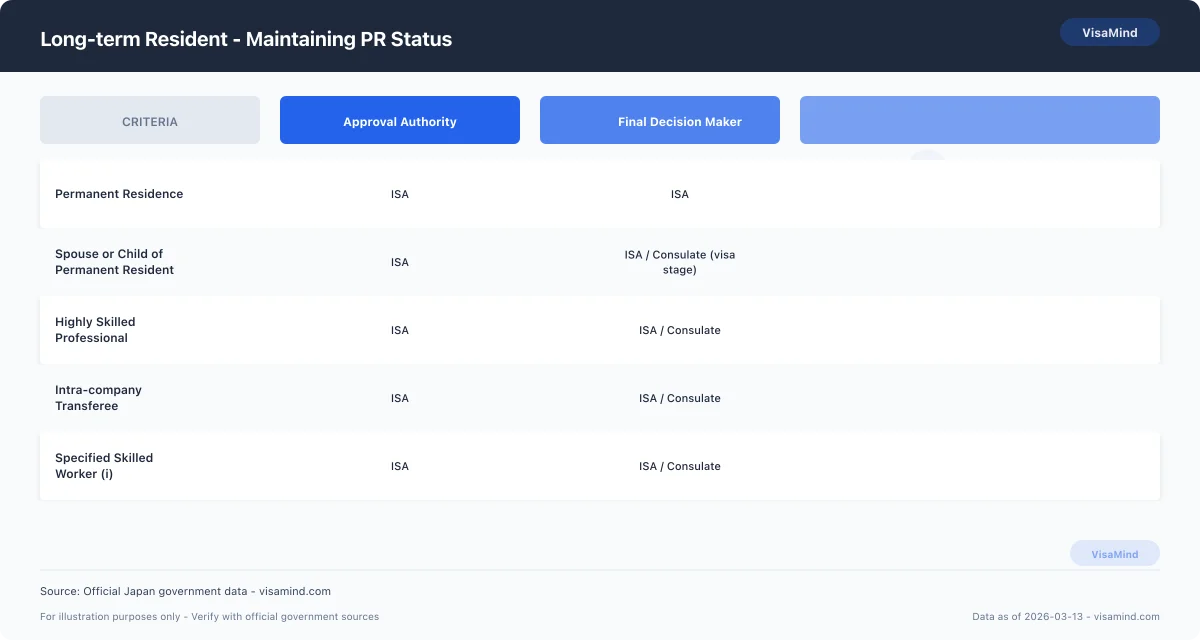
| Status Type | Approval Authority | Final Decision Maker |
|---|---|---|
| Permanent Residence | ISA | ISA |
| Spouse or Child of Permanent Resident | ISA | ISA / Consulate (visa stage) |
| Highly Skilled Professional | ISA | ISA / Consulate |
| Intra-company Transferee | ISA | ISA / Consulate |
| Specified Skilled Worker (i) | ISA | ISA / Consulate |
Past approvals don’t guarantee future ones. Each application stands on its own record.
Entry and immigration check tips
A valid visa does not guarantee admission at the airport. Immigration officers at the port of entry make the final determination.
Arrive prepared for inspection. Officers may ask for documents confirming the purpose and conditions of your stay.
Carry:
- Your return or onward ticket
- Accommodation details in Japan
- Proof of sufficient funds
Present documents clearly and answer questions directly. Inconsistent answers or missing documents can delay processing or lead to denial of entry.
Even if you hold Permanent Residence or a status like Highly Skilled Professional, officers still verify your eligibility to land. Entry screening is a separate legal step from visa issuance.
Passport validity and visa space
Your passport must remain valid for the entire period of your intended stay. Insufficient validity can result in refusal, even if your status category is approved.
Make sure your passport contains blank pages for visa attachment. Lack of space can delay or block issuance.
Before submitting a Visa Application or attending a consular appointment, confirm:
- Passport validity covers your planned stay
- At least one blank visa page is available
- Your passport is undamaged and readable
Renew your passport in advance if needed. Don’t wait until after ISA approves your status or issues a CoE, as the consulate may refuse to place a visa in an invalid or full passport.
Application Process
#You can’t apply for a Japan long-term resident visa without a Certificate of Eligibility (CoE). Your sponsor in Japan files first, then you complete the Form Visa Application with the required documents and photo that meet strict standards.
Certificate of Eligibility: sponsor steps
You need a Certificate of Eligibility (CoE) before you submit your Visa Application. The Immigration Services Agency of Japan (ISA) issues the CoE.
Your sponsor in Japan must file the Form CoE Application at the regional ISA office. You can’t apply for the CoE yourself if you’re outside Japan.
Your sponsor may be:
- An employer
- A school
- A family member
This requirement applies to long-term stays, including work and study. It also affects applicants connected to statuses such as Spouse or Child of Permanent Resident, Highly Skilled Professional, Intra-company Transferee, or Specified Skilled Worker (i) where sponsorship is needed.
Start early. CoE processing usually takes 1–3 months.
| Step | Who Handles It | Where Filed | Typical Processing Time |
|---|---|---|---|
| CoE Application | Sponsor in Japan | Regional ISA office | 1–3 months |
Your sponsor must submit complete and accurate documents. Missing evidence causes delays.
Filling, signing, and submitting the form
After ISA issues the CoE, you prepare your Visa Application.
Complete all required sections of the form. Don’t leave fields blank unless the form instructs you to do so. Sign the form where required.
Submit:
-
Your completed and signed application form
-
Your passport
-
The issued Certificate of Eligibility
-
Supporting documents relevant to your status
If you apply based on employment, include detailed company documentation and proof of your qualifications. Incomplete corporate records or missing diplomas often delay review.
| Document Type | Examples |
|---|---|
| Company documents | Registered company copy, financial statements |
| Applicant qualifications | Diplomas, employment history |
ISA reviews your materials for consistency with the CoE. Any discrepancy can slow processing.
Document checklist and photo rules
Prepare your documents carefully. ISA applies strict technical standards, especially for photos.
Basic checklist:
- Valid passport
- Certificate of Eligibility
- Completed and signed Visa Application form
- Status-specific supporting documents
For work-related categories, include:
- Company registration documents
- Recent financial statements
- Your academic diplomas
- Your employment history
Your photo must meet all of the following:
- Size: 4.5 cm x 4.5 cm
- Taken within the last 6 months
- Plain white background
- No hats
- No sunglasses
Non-compliant photos are a common reason for delays. Confirm measurements and background before submission to avoid resubmitting your application.
Renewing Your PR Card
#Your renewal process depends on the validity of your Certificate of Eligibility (CoE) and strict timing rules. Missing the deadline can force your sponsor to restart the process with a new Form CoE Application through the Immigration Services Agency of Japan (ISA).
CoE validity and timing
A Certificate of Eligibility is valid for 3 months from the date of issuance. You must submit your Form Visa Application at the Japanese embassy or consulate within that period.
If you apply after the 3‑month window, the CoE is no longer valid. The embassy will not accept it.
Key timing rules
| Item | Requirement |
|---|---|
| CoE validity period | 3 months from issuance |
| Where to apply | Japanese embassy or consulate |
| Deadline | Before the 3‑month validity expires |
| Authority issuing CoE | Immigration Services Agency of Japan (ISA) |
This rule applies regardless of your status category, including:
- Permanent Residence
- Spouse or Child of Permanent Resident
- Highly Skilled Professional
- Intra-company Transferee
- Specified Skilled Worker (i)
Act immediately once you receive your CoE. Delays between issuance and your Visa Application create avoidable risk.
What to do if your CoE expires
If your CoE expires before you submit your visa application, you can't use it. The document becomes invalid after the 3‑month period.
Your sponsor in Japan must file a new CoE Application with the Immigration Services Agency (ISA). There's no way to extend or reactivate an expired CoE.
Follow these steps:
-
Confirm the expiration date on your CoE.
-
Notify your sponsor immediately.
-
Have the sponsor submit a new CoE application to ISA.
-
Wait for the new CoE before applying at the embassy.
Don't try to file your Visa Application with an expired CoE. The embassy will reject it, costing you extra time.
Track issuance dates closely to avoid unnecessary repeat filings and delays.
Your Rights as a Permanent Resident
#Permanent Residence gives you a distinct status under Japan’s immigration system. The Immigration Services Agency of Japan (ISA) manages this status and any related applications or changes.
This status is different from work‑specific or family‑based categories. That distinction affects how you approach employment, family sponsorship, and future Form Visa Application procedures.
Work and activities allowed
Permanent Residence stands apart from employer‑linked categories such as Highly Skilled Professional, Intra-company Transferee, and Specified Skilled Worker (i). Those statuses are granted for defined activities, while Permanent Residence is issued as its own category by the ISA.
You don't apply under a predefined activity label like “engineer” or “intra-company transferee” when you hold Permanent Residence. Your status itself is the basis of stay.
If you later submit a Visa Application or a status-related filing with the ISA, you apply as a Permanent Resident rather than under a work-restricted category. This changes how your status appears in official records.
| Status Category | Tied to Specific Activities | Issued by ISA | Separate Status Label |
|---|---|---|---|
| Permanent Residence | Not defined by a single activity category | Yes | Yes |
| Highly Skilled Professional | Yes | Yes | Yes |
| Intra-company Transferee | Yes | Yes | Yes |
| Specified Skilled Worker (i) | Yes | Yes | Yes |
The ISA handles all status changes and extensions. You need to follow its procedures for any update to your residence record.
Special categories and examples
Japan’s immigration system includes family‑based categories such as Spouse or Child of Permanent Resident. This status isn't the same as Permanent Residence and has its own eligibility requirements under ISA rules.
A family member doesn't automatically get Permanent Residence. They must qualify under the appropriate category and complete a Visa Application or Form CoE Application (Certificate of Eligibility) when required by the ISA.
Other professional categories, including Highly Skilled Professional and Intra-company Transferee, also remain separate from Permanent Residence. Each requires its own application and review process.
When comparing categories, focus on:
- The exact status name granted by the ISA
- Whether a CoE Application is required
- Whether the status is activity-based or independently classified
Your rights and procedures depend on the specific status printed on your residence record. Always confirm the correct category before submitting any application to the ISA.
When to Get Help
#Seek professional guidance if your filing route, sponsor structure, or personal history creates legal risk. Errors in a Form Visa Application or Form CoE Application can delay or jeopardize your status with the Immigration Services Agency of Japan (ISA).
long-term resident Japan: eVISA and embassy options
You need to choose the correct filing channel from the start. Japan’s online visa system currently supports short-term tourism for eligible nationalities, not long-term resident categories.
If you are applying for a long-term resident status, you will generally proceed through a Certificate of Eligibility (CoE) Application handled in Japan before submitting your Visa Application through an embassy or consulate.
Use this comparison to avoid filing mistakes:
| Purpose | eVISA | Embassy/Consulate |
|---|---|---|
| Short-term tourism | Available for some nationalities | Yes |
| Long-term resident status | Not typical | Yes |
| CoE-based applications | No | Yes (after CoE issuance) |
Get help if:
- You aren't sure whether your nationality qualifies for online processing.
- You hold or are switching from Highly Skilled Professional, Intra-company Transferee, or Specified Skilled Worker (i) status.
- You are applying under Spouse or Child of Permanent Resident or transitioning toward Permanent Residence.
Filing through the wrong channel can result in refusal or delay.
Complex sponsor or company documentation
Get assistance when your sponsor structure is not straightforward. ISA reviews the legal relationship between you and your sponsor carefully.
High-risk documentation issues include:
- Multiple related companies sponsoring one position
- Recent company formation with limited financial history
- Parent-subsidiary transfers under Intra-company Transferee
- Status changes between work categories and long-term resident
If your employer supports your CoE Application, you'll need to submit consistent corporate records, employment terms, and activity descriptions. Inconsistencies between your job duties and your current status (such as Highly Skilled Professional) can trigger additional scrutiny.
Use this checklist before filing:
- Clear employment contract
- Defined job duties
- Sponsor registration documents
- Matching information across all forms
Professional review helps reduce the risk of document mismatches that can delay ISA processing.
High-risk situations (criminal record, prior violations)
Never file without legal review if you have prior immigration or criminal issues. ISA examines overstay history, unauthorized work, and status violations closely.
High-risk factors include:
- Previous overstay in Japan
- Work outside your authorized status
- Denied Visa Application or CoE Application
- Criminal record in Japan or abroad
If you plan to move toward Permanent Residence, past violations can affect eligibility. Even minor discrepancies in prior applications may surface during review.
Address issues directly. Provide full disclosure and supporting records. Trying to minimize or omit past problems can result in refusal or long-term consequences for future applications.
Path to Citizenship
#Japan Long-Term Resident status can be a stepping stone toward Permanent Residence and, eventually, Japanese nationality. Your strategy depends on your family ties, employment category, and how long you have maintained lawful residence under the Immigration Services Agency of Japan (ISA).
Typical next steps after this visa
Many long-term residents first stabilize their status before pursuing permanent residence or naturalization. You must keep your residence status valid and file any Form Visa Application or extension with the ISA before your period of stay expires.
Common progression routes include:
- Change of Status of Residence to a work-based category such as:
Highly Skilled Professional
-
Intra-company Transferee
-
Specified Skilled Worker (i)
-
Family-based status changes, such as:
Spouse or Child of Permanent Resident
If you plan to change status, you submit a Change of Status application to the ISA. If you apply from outside Japan, you typically need a Certificate of Eligibility (CoE) Application before obtaining the visa at a Japanese consulate.
| Path | When It Applies | Key Authority |
|---|---|---|
| Change of Status | You are already in Japan | ISA |
| Form CoE Application | You apply from abroad | ISA |
| Extension of Period of Stay | You keep same status | ISA |
You must continue meeting the conditions of your current status until any change is approved.
Permanent residence and longer-term options
Permanent Residence removes the need to renew your period of stay. The ISA reviews your residence history, stability, and compliance with immigration law.
You generally must show:
- Continuous lawful residence in Japan
- Good conduct and compliance with Japanese law
- Stable income or financial support
- Proper tax and social insurance payments
If you qualify under another category, such as Highly Skilled Professional or Spouse or Child of Permanent Resident, that status may support a future Permanent Residence application. You apply directly to the ISA for Permanent Residence while living in Japan.
After obtaining Permanent Residence, you may later consider naturalization as a Japanese citizen. Naturalization follows a separate legal process and requires a formal application to the appropriate authority, with final approval granted under Japanese nationality law.
Eligibility Requirements
#You must match your qualifications to the exact status of residence you plan to apply for. Most rejections happen because applicants choose the wrong category or fail to meet the stated education or experience standards.
The Immigration Services Agency of Japan (ISA) reviews both your Certificate of Eligibility (CoE) Application and your Form Visa Application against the requirements of the specific status you select.
Review eligibility category before you start
Start by confirming the precise status of residence that fits your background and activities in Japan. Each category has its own qualification standards.
For example, work-related statuses may require:
- A relevant university degree, or
- 10 or more years of professional experience in the related field
If you apply under a category such as Engineer/Specialist in Humanities without meeting one of these thresholds, ISA can deny your application even if you have a job offer.
Use this basic comparison approach before filing:
| Status of Residence | Key Qualification Focus |
|---|---|
| Engineer/Specialist in Humanities | Relevant degree or 10+ years of experience |
| Highly Skilled Professional | Must meet the criteria of the underlying professional field |
| Intra-company Transferee | Must satisfy category-specific professional background |
| Specified Skilled Worker (i) | Must meet the requirements set for that classification |
| Spouse or Child of Permanent Resident | Must qualify under that family-based status |
| Permanent Residence | Must meet the criteria defined for that status |
Always review the official criteria issued by ISA for your exact category before submitting a Form CoE Application.
Common qualification mismatches
ISA often rejects applications where the applicant’s background doesn't align with the selected status.
Typical problems include:
- Applying under a professional category without the required degree
- Claiming experience that doesn't total 10 or more years where required
- Selecting a status based on job title rather than formal eligibility standards
- Confusing work-based categories with family-based statuses such as Spouse or Child of Permanent Resident
You must document your qualifications clearly and ensure they directly support the category you choose. ISA evaluates whether your education and work history match the legal definition of the status—not whether your situation seems similar.
Before filing, confirm that your credentials meet the exact educational or experience threshold tied to your selected status of residence.
Common Refusal Reasons
#Most refusals for Japan long-term resident–related statuses result from preventable filing errors. The Immigration Services Agency of Japan (ISA) checks your forms, supporting documents, and jurisdiction carefully, and inconsistencies often lead to rejection rather than a simple correction request.
Incomplete or inconsistent information
ISA frequently refuses applications when details don't match across forms and documents. Even small differences in spelling, dates, salary, or employment terms can cause rejection.
This issue often arises between the Certificate of Eligibility (CoE) Application and the later Form Visa Application. If your job title, compensation, contract dates, or personal information differ, ISA may treat the application as unreliable.
Common problem areas include:
- Name format not matching your passport exactly
- Different employment terms between CoE and visa filings
- Mismatched dates of birth or marital status
- Salary figures that change without explanation
This applies across categories such as Highly Skilled Professional, Intra-company Transferee, Specified Skilled Worker (i), and Spouse or Child of Permanent Resident.
Before submission, make sure every detail matches your passport and previously filed documents exactly. Review both applications side by side if you are filing after CoE approval.
| Error Type | Result |
|---|---|
| Inconsistent CoE and visa details | Likely refusal |
| Missing required information | Likely refusal |
| Minor typographical differences | Possible refusal or delay |
Photo, passport, and filing-location mistakes
ISA may delay or reject your application if your photograph doesn't meet strict specifications. You must submit a 4.5 cm × 4.5 cm photo taken within the last six months, with a white background and no accessories.
Photos that are the wrong size, too old, or taken against colored backgrounds often cause processing delays.
Filing at the wrong location leads to rejection. You must:
-
Apply at the Japanese Embassy or Consulate that has jurisdiction over your place of residence.
-
File CoE-related documents at the regional immigration office that has jurisdiction over your sponsor’s location in Japan.
Applicants sometimes file based on intended residence in Japan rather than the sponsor’s registered address. ISA doesn't accept that approach.
For long-term categories requiring a CoE, including work-based statuses and dependent categories, you must obtain CoE approval before submitting the visa application.
Sponsor/company documentation errors
Your sponsor plays a central role in work-based and dependent applications. If the company submits incomplete documentation, ISA often pauses or rejects the case.
Common missing documents include:
- Company registration certificate (登記事項証明書)
- Most recent financial statements
- A written business overview
These documents support applications under statuses such as Highly Skilled Professional, Intra-company Transferee, and Specified Skilled Worker (i).
If the sponsor files the CoE at the wrong regional office, ISA may reject the filing outright. The correct office is determined by the sponsor’s registered location, not your planned address in Japan.
Confirm that your sponsor reviews all corporate documents for completeness and consistency before submission. Incomplete sponsor documentation typically results in delay, but serious discrepancies can lead to refusal.
Fees
#| Component | Amount |
|---|---|
| Visa issuance feeVisa issuance fee: ¥6,000 (approx $40 USD) (as of 2026-02). Verify the current fee on the official schedule before filing. | ¥6,000 (approx $40 USD) |
Fees change; always verify on ISA.