
What the Highly Skilled Professional Covers — Japan Highly Skilled Professional visa
#The Highly Skilled Professional is a residence status administered by the Immigration Services Agency of Japan (出入国在留管理庁), or ISA.
You use a specific ISA form titled “Highly Skilled Professional” as part of your immigration process.
This status operates within Japan’s residence status system and is tied directly to your Certificate of Eligibility (CoE) Application and Form Visa Application.
What this status is
The Highly Skilled Professional is a formal residence status recognized by the Immigration Services Agency (ISA).
You apply using the designated “Highly Skilled Professional” form issued by the ISA.
Always use the most recent form and instructions.
This status is distinct from other residence categories, such as:
| Residence Status Name | Separate ISA Category |
|---|---|
| Engineer/Specialist in Humanities/International Services | Yes |
| Intra-company Transferee | Yes |
| Skilled Labor | Yes |
| Business Manager | Yes |
| Long-term Resident | Yes |
You must select the correct status before filing your Form CoE Application or Visa Application.
The ISA reviews and processes applications for this status.
Who it's for
This status is for applicants who meet the eligibility standards set by the Immigration Services Agency for the Highly Skilled Professional category.
You must confirm your qualifications match the ISA’s criteria before submitting:
- A Certificate of Eligibility (CoE) Application, or
- A Visa Application at a Japanese embassy or consulate
If your activities align more closely with another residence status—such as Engineer/Specialist in Humanities/International Services, Intra-company Transferee, Skilled Labor, Business Manager, or Long-term Resident—review that category instead.
You remain responsible for filing under the correct residence status and using the proper ISA form.
When to Get Professional Help (highly skilled Japan)
#You can often rely on your employer for routine filings, but certain risk factors justify legal support.
Key issues are document consistency, prior immigration history, and the difference between status approval and visa issuance.
When employer handling may be enough
Many employers in Japan regularly file applications with the Immigration Services Agency (ISA), especially when they already sponsor foreign staff under statuses such as Engineer/Specialist in Humanities/International Services, Intra-company Transferee, Skilled Labor, or Business Manager.
Your employer’s HR team may be able to manage:
- Preparation and submission of the Certificate of Eligibility (CoE) application
- Coordination of supporting employment documents
- Internal verification of salary, job duties, and contract terms
- Guidance for your Form Visa Application at the consulate
This approach works best when:
- You have no criminal record
- You have no prior visa overstays or violations
- Your employment terms are straightforward and clearly documented
- All details remain consistent from CoE filing to visa issuance
| Factor | Low Risk Scenario |
|---|---|
| Immigration history | No violations |
| Employment terms | Clear and stable |
| Status type | Standard employment-based category |
| Documentation | Consistent across all filings |
Even in routine cases, every personal detail, salary figure, job title, and date must match exactly between the Form CoE Application and the visa application.
Situations that often need a lawyer
Professional help is advisable if any part of your background creates risk.
Approval of a CoE does not guarantee that a consulate will issue your visa.
Legal guidance becomes important when:
- You have a criminal record
- You previously overstayed or violated visa conditions
- You are changing from Long-term Resident or another status with complex history
- Your case involves prior denials
- Your employment structure does not fit neatly into standard categories
A lawyer can:
-
Review inconsistencies before submission.
-
Identify red flags that may trigger scrutiny by ISA or the consulate.
-
Align the CoE application and visa application to prevent contradictions.
| Risk Issue | Why It Matters |
|---|---|
| Criminal history | May lead to visa refusal despite CoE |
| Prior violations | Raises credibility concerns |
| Inconsistent information | Common cause of rejection |
When your case includes any of these elements, a professional review reduces avoidable risk before submission.

Conditions and Portability — HSP visa
#Your Highly Skilled Professional (HSP) status depends on document validity and inspection at entry.
You must manage timing carefully and understand that a visa does not guarantee admission.
Entry and port-of-entry limits
A visa issued after your Form Visa Application allows you to travel to Japan, but it does not guarantee entry.
Immigration officers at the port of entry make the final decision under the authority of the Immigration Services Agency of Japan (ISA).
Carry supporting documents in your hand luggage.
Officers may request evidence that matches the purpose stated in your Form CoE Application and visa.
Bring:
- Your passport with the visa attached
- Certificate of Eligibility (CoE)
- Return or onward ticket
- Accommodation details in Japan
- Proof of available funds
If your stated activities differ from what appears on your CoE—such as work similar to Engineer/Specialist in Humanities/International Services, Intra-company Transferee, Skilled Labor, or Business Manager—officers may question your eligibility.
Your HSP status does not override inspection authority at arrival.
You must satisfy the officer that you meet the conditions of stay on the day you enter Japan.
Document validity requirements
Your Certificate of Eligibility (CoE) remains valid for three months from the date of issuance.
You must submit your Visa Application at a Japanese embassy or consulate within that period.
If the CoE expires, you cannot use it for visa issuance.
Your passport must remain valid for the full period of your intended stay and contain blank pages for visa attachment.
Insufficient validity or lack of blank space can lead to refusal at the visa stage.
Use this checklist before applying:
| Document | Key Requirement |
|---|---|
| Passport | Valid for entire stay; blank visa pages available |
| Certificate of Eligibility | Used within 3 months of issuance |
| Visa | Properly affixed to passport before travel |
The ISA handles status changes and extensions after arrival.
Keep all documents consistent with your approved HSP activities to avoid compliance issues.
What Your Employer Must Do
#Your employer drives the process from inside Japan.
They file the required application with the Immigration Services Agency of Japan (ISA) and submit detailed company records to support your Highly Skilled Professional status.
Certificate of Eligibility (sponsor filing)
Your employer must apply for your Certificate of Eligibility (CoE) at the regional office of the Immigration Services Agency (ISA) that has jurisdiction over the company’s location in Japan.
You cannot file the CoE yourself if you are outside Japan.
The sponsor—typically your employer—submits the Form CoE Application on your behalf.
Key filing rules:
-
File at the ISA office that covers the sponsor’s registered address.
-
Submit the application before you start your Form Visa Application at a Japanese embassy or consulate.
-
Include documents proving both the company’s activities and your qualifications.
Filing at the wrong regional office causes delays.
The ISA will not process a case submitted outside the sponsor’s jurisdiction.
The CoE supports your later Visa Application and confirms that your planned activities align with an approved work category.
These may include classifications such as:
- Engineer/Specialist in Humanities/International Services
- Intra-company Transferee
- Skilled Labor
- Business Manager

Dependents
#Your spouse and other eligible family members must obtain their own immigration status to live with you in Japan.
Each family member requires a separate application and review by the Immigration Services Agency of Japan (ISA).
Certificate of Eligibility for family members
Your dependents must obtain a Certificate of Eligibility (CoE) before applying for a visa.
ISA issues a CoE for each family member after you submit a separate application on their behalf.
You cannot include your family members under your Highly Skilled Professional status.
Each person receives an individual CoE.
Key points:
- A separate Form CoE Application is required for each dependent.
- ISA reviews and issues the CoE.
- The CoE supports the subsequent Form Visa Application at a Japanese embassy or consulate.
| Step | Who Applies | Authority | Purpose |
|---|---|---|---|
| CoE Application | You (for each family member) | Immigration Services Agency (ISA) | Confirm eligibility for entry |
| Visa Application | Each family member | Japanese embassy/consulate | Obtain entry visa |
ISA determines eligibility and required documentation.
Timing and common pitfalls for dependents
Apply for your family members’ CoEs as early as possible.
ISA will not issue status automatically based on your approval.
Delays often occur when applicants:
- Submit incomplete CoE applications
- Fail to file a separate application for each family member
- Assume dependents can enter Japan without a CoE
You must complete the CoE process first, then proceed with the Visa Application.
Do not book travel until the visa is issued.
If you previously held another status such as Engineer/Specialist in Humanities/International Services, Intra-company Transferee, Skilled Labor, Business Manager, or Long-term Resident, ensure your current status is clearly reflected in the CoE Application.
ISA evaluates the application based on your approved Highly Skilled Professional status at the time of review.
Fees and Processing Times
#You pay government fees at the visa issuance stage.
Plan for separate timelines for the Certificate of Eligibility (CoE) and the visa stamp.
Processing speed depends on your category and where you apply.
Consular fees and multiple-entry visas
You pay the visa issuance fee after the Japanese embassy or consulate approves your Form Visa Application.
| Item | Amount (JPY) | Notes |
|---|---|---|
| Visa issuance fee | ¥6,000 | As of February 2026 |
This fee applies to the Highly Skilled Professional visa, including multiple-entry visas.
You pay it at the time of visa issuance, not when you submit your documents.
You submit your Visa Application at the Japanese embassy or consulate in your country of residence.
Apply at least 2–3 weeks before your planned travel date.
Standard processing at overseas posts typically takes about 5 business days, but it can take longer during peak seasons.
The Immigration Services Agency (ISA) sets immigration policy, while embassies and consulates handle visa issuance abroad.
CoE and visa processing timelines
Most Highly Skilled Professional applicants first obtain a Certificate of Eligibility (CoE) from the Immigration Services Agency (ISA) in Japan.
Your employer or sponsoring organization usually files the Form CoE Application on your behalf.
Processing under the Highly Skilled Professional “Standard” track generally takes 10 to 14 business days.
This category often receives priority handling compared to statuses such as:
- Engineer/Specialist in Humanities/International Services
- Intra-company Transferee
- Skilled Labor
- Business Manager
- Long-term Resident
As a practical range, immigration processing can take 1 to 3 months, depending on the visa category and the workload at the regional immigration office.
After the CoE is issued, you submit it with your Visa Application at the embassy or consulate for final visa issuance.
How timelines vary by location and category
Processing times vary for two main reasons: your visa category and the office handling your case.
Within Japan, different regional offices of the Immigration Services Agency (ISA) manage CoE applications.
Workload levels affect how quickly officers review your file.
A busy metropolitan office may take longer than a smaller regional office.
Overseas, each embassy or consulate sets its own internal schedule for visa issuance.
While many posts complete processing in about 5 business days, peak travel seasons can extend that timeframe.
Category also matters.
Highly Skilled Professional applications often move faster than categories such as Engineer/Specialist in Humanities/International Services or Business Manager.
If you switch status inside Japan, confirm current processing times directly with the Immigration Services Agency (ISA) before filing.
From Work Visa to PR
#
The Highly Skilled Professional (HSP) status creates a path to Permanent Resident (PR) status through a points-based system managed by the Immigration Services Agency of Japan (ISA).
Your eligibility and timing depend on your points score and how long you maintain qualifying activities in Japan.
Points-based pathway overview
The HSP system gives points for things like:
- Academic background
- Professional experience
- Annual salary
- Research achievements
- Japanese language ability
You need to keep up qualifying activities under your HSP status and hit the required point threshold set by the Immigration Services Agency (ISA).
Many applicants start with statuses such as:
- Engineer/Specialist in Humanities/International Services
- Intra-company Transferee
- Skilled Labor
- Business Manager
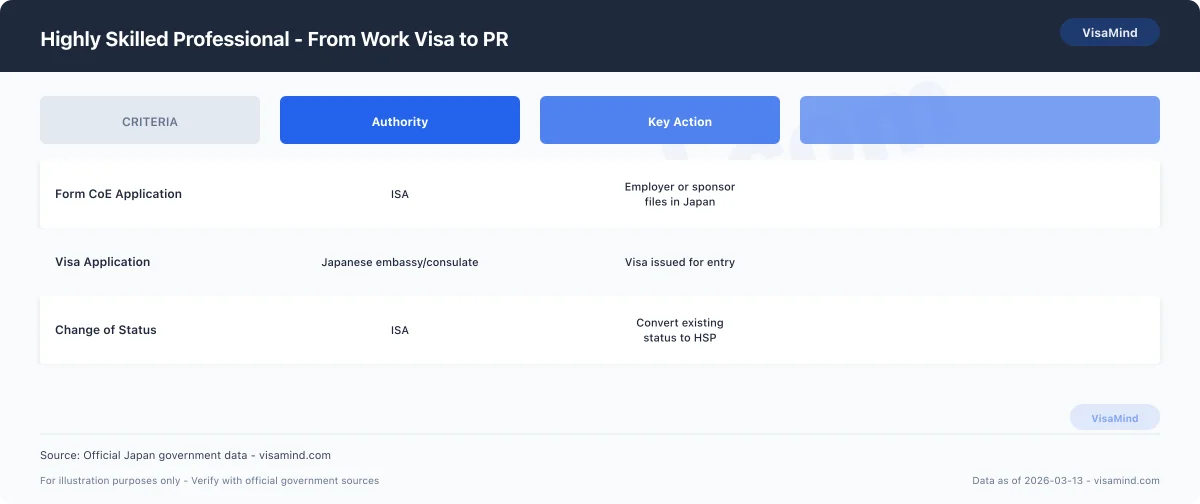
Switching to HSP usually involves a Change of Status of Residence application with ISA. If you’re applying from abroad, you’ll typically get a Certificate of Eligibility (CoE) first, then submit a Form Visa Application at a Japanese embassy or consulate.
| Stage | Authority | Key Action |
|---|---|---|
| Form CoE Application | ISA | Employer or sponsor files in Japan |
| Visa Application | Japanese embassy/consulate | Visa issued for entry |
| Change of Status | ISA | Convert existing status to HSP |
ISA checks your points when you apply. You’ll need to show clear evidence of salary, education, and professional history.
Typical PR timeline after HSP
PR eligibility depends on your HSP points and how long you keep up qualifying activities in Japan. ISA ties specific residence periods to your score.
You need to:
- Maintain HSP status without interruptions
- Keep working in your authorized field
- Stay compliant with tax and residency rules
- Avoid immigration violations
ISA looks at whether you’ve consistently engaged in your designated activities and if your residence has been stable.
If you’ve held other statuses—like Long-term Resident or a different work category—ISA reviews your overall residence history during PR review.
The Dual-Track Application
#To get Highly Skilled Professional status, you’ll go through two main steps: your sponsor in Japan gets a Certificate of Eligibility (CoE), and then you apply for the visa at a Japanese embassy or consulate. Both steps require careful documentation and strict photo compliance to avoid delays.
Sponsor applies for the CoE
For long-term work statuses, your sponsor in Japan must secure a Certificate of Eligibility (CoE) from the Immigration Services Agency of Japan (ISA) before you can apply for a visa.
This isn’t just for Highly Skilled Professional status—other work categories need it too:
| Work Status Examples | CoE Required |
|---|---|
| Engineer/Specialist in Humanities/International Services | Yes |
| Intra-company Transferee | Yes |
| Skilled Labor | Yes |
| Business Manager | Yes |
| Long-term Resident | Yes |
Your sponsor submits the Form CoE Application directly to ISA. Processing usually takes 1–3 months, so starting early is smart.
ISA reviews your documents and decides if you meet the eligibility for the status you’re seeking. If approved, ISA issues the CoE, and your sponsor sends it to you for your Form Visa Application.
Incomplete submissions slow things down. Your sponsor needs to fill out every required section and include all supporting documents when filing.
Applicant visa application at embassy/consulate
Once you have the CoE, you submit your Visa Application at a Japanese embassy or consulate in your country of residence.
You’ll need to:
-
Fill out the visa application form completely.
-
Sign the form.
-
Submit the CoE.
-
Provide all required supporting documents.
For Chinese nationals applying for Highly Skilled Professional status, extra documents are needed:
- Copy of the Chinese Family Register
- Temporary Residence Permit or Residence Certificate
Embassies won’t issue a long-term work visa without a valid CoE. The eVISA system is only for short-term tourism for certain nationalities and doesn’t replace the CoE process for work-based stays.
Required evidence and form completion
Accuracy and compliance matter at both stages. Pay close attention to photo requirements.
Your photo must be:
- 4.5 cm × 4.5 cm
- Taken within the last 6 months
- Plain white background
- No hats or sunglasses
Non-compliant photos are a common cause of delays.
Complete every required section of the application form and sign it before submitting. Missing signatures, incomplete fields, or missing documents can cause processing delays at ISA or the embassy.
ISA handles immigration applications and status determinations. Review ISA guidance for current document requirements before filing.
Renewal and Extension
#You have to manage your Certificate of Eligibility (CoE) carefully to avoid delays. The Immigration Services Agency of Japan (ISA) enforces strict timing between CoE issuance and your Form Visa Application at a Japanese embassy or consulate.
CoE expiry and what to do
A CoE is valid for 3 months from the date of issuance. You must submit your Visa Application at the embassy or consulate within that window.
If you miss the deadline, the CoE can’t be used for visa issuance.
| Situation | Result | Required Action |
|---|---|---|
| Visa application filed within 3 months | CoE valid | Embassy processes visa |
| Visa application filed after 3 months | CoE expired | Sponsor must submit a new Form CoE Application to ISA |
Expired CoEs can’t be extended. Your sponsor has to file a new CoE Application with ISA.
This applies whether you’re under Highly Skilled Professional or if you’ve switched from statuses like Engineer/Specialist in Humanities/International Services, Intra-company Transferee, Skilled Labor, Business Manager, or Long-term Resident.
Act early. Waiting until the last minute is risky.
When to refile and timing tips
Track the CoE issuance date, not just when you physically receive it. The 3‑month validity starts from the official issuance date.
Checklist for staying on track:
- Double-check the issuance date printed on the CoE
- Book your embassy or consulate appointment as soon as possible
- Submit your Visa Application well before the 3‑month cut-off
- Let your sponsor know immediately if you hit any delays
If your CoE expires before you apply for the visa, your sponsor needs to file a new CoE Application with ISA. This can’t be fixed at the consulate stage.
Plan with some buffer. Filing early makes life easier.
Eligibility Requirements
#You need to qualify under Japan’s points-based system and meet the specific criteria for your chosen professional category. The Immigration Services Agency of Japan (ISA) checks both your point total and whether your background fits the status of residence you’re claiming.
Points, qualifications and category rules
To qualify as a Highly Skilled Professional, you need at least 70 points. Your score affects eligibility and can speed up permanent residence eligibility in 1 to 3 years, depending on the number.
ISA looks at:
- Total points (minimum 70+)
- Educational background
- Professional experience
- Whether your background fits the status of residence
Refusals often happen when the chosen category doesn’t match your qualifications.
| Requirement Area | What ISA Checks |
|---|---|
| Points total | 70 points or more |
| Education | Relevant university degree (if required by category) |
| Work experience | For some categories, 10+ years of experience |
| Category match | Duties align with selected status |
For Engineer/Specialist in Humanities/International Services, you must show either a relevant university degree or enough professional experience (such as 10 or more years, if required).
The same pattern applies for Intra-company Transferee, Skilled Labor, Business Manager, or other work statuses. Your qualifications must clearly support the status you’re applying for.
Reviewing instructions for your category
Before submitting a Certificate of Eligibility (CoE) Application, make sure your credentials fit the requirements for your chosen status. Don’t assume professional experience always substitutes for a degree—some categories don’t allow it.
Steps to follow:
-
Identify your correct status of residence category.
-
Check the education and experience requirements.
-
Confirm your points reach 70 or higher.
-
Gather documents that prove both your score and category eligibility.
If your qualifications don’t fit Engineer/Specialist in Humanities/International Services, look at alternatives like Intra-company Transferee or Business Manager, depending on your role.
ISA checks eligibility during both the Form CoE Application and the Form Visa Application. Any mismatch between your job duties and selected category can lead to rejection.
Why Petitions Get Questioned
#Petitions are often questioned because of inconsistent information, missing documents, or filing at the wrong location. You reduce risk by making sure every detail matches across your Certificate of Eligibility (CoE) Application and Form Visa Application, and by confirming the correct jurisdiction before filing.
Common application inconsistencies
ISA reviews your Form CoE Application first. The embassy or consulate reviews your Visa Application. If names, dates, passport numbers, or employment details don’t match between documents, officers may question your application.
Even minor mismatches can trigger a review.
| Area of Inconsistency | Example Issue | Result |
|---|---|---|
| Passport details | Different spelling or number | Application questioned |
| Visa category | CoE for Engineer/Specialist in Humanities/International Services but visa form lists another status | Delay or refusal |
| Employer information | Company name formatted differently | Request for clarification |
| Missing CoE | Applying for work status without CoE | Likely refusal |
This often affects applicants moving from categories like Intra-company Transferee, Skilled Labor, Business Manager, or Long-term Resident into the Highly Skilled Professional track.
Before submitting, check:
- Passport details match exactly
- Visa category matches your approved CoE
- All form fields are complete and consistent
- You have a CoE from ISA if required
Incomplete answers or missing fields often lead to rejection.
Embassy/bureau jurisdiction and passport issues
You must apply at the Japanese Embassy or Consulate with jurisdiction over where you live. Filing in the wrong jurisdiction leads to refusal or redirection.
Jurisdiction is based on your legal residence, not your employer’s location.
| Issue | What Happens |
|---|---|
| Applying outside your residential jurisdiction | Application rejected or returned |
| Using outdated passport details | Application questioned |
| Submitting without required CoE | Visa not issued |
Double-check your registered residential address before booking an appointment.
Make sure your passport is valid and that every form uses identical passport data.
ISA handles status eligibility with the CoE process, but the embassy checks identity and jurisdiction during the Visa Application. Errors at either stage can delay or block approval.
Fees
#| Component | Amount |
|---|---|
| Visa issuance feeVisa issuance fee: ¥6,000 (approx $40 USD) (as of 2026-02). Verify the current fee on the official schedule before filing. | ¥6,000 (approx $40 USD) |
Fees change; always verify on ISA.