Overview — Japan tourist visa
#
A tourist visa allows short stays, usually up to 90 days. It covers tourism, business, or family visits, with single, double, or multiple entry options based on your approval.
Purpose of the short-term stay
A short-term stay visa is for temporary visits, not long-term living or work. The permitted period is up to 90 days.
Your stay must fit one of the accepted short-term purposes:
- Tourism and sightseeing
- Business visits
- Visiting relatives or friends
The ISA oversees entry and status control. This visa does not let you switch to a long-term status like Student Visa, Working Holiday Visa, or Long-term Resident.
If you qualify for Visa Exemption (Visa-Free Entry), you may not need this visa. If you’re just passing through, a Transit Visa might be more suitable.
| Status Type | Intended Length | Main Purpose |
|---|---|---|
| Short-Term Stay (Tourist) | Up to 90 days | Tourism, business, family visit |
| Transit Visa | Very short stay | Passing through Japan |
| Long-Term Status (e.g., Student Visa) | Exceeds 90 days | Study or other extended activities |
You need to apply for the correct category before you travel.
Typical permitted visit types
Only activities that fit a temporary visit are allowed. Immigration officers assess your stated purpose during your Form Visa Application and at entry.
Common permitted types include:
- Sightseeing and leisure travel
- Business meetings or short-term business activities
- Visiting family or acquaintances residing in Japan
The short-term stay visa may be:
3. Multiple-entry
Your activities must stay within the temporary scope you applied for. You can’t use this visa for long-term residence or activities that require another status.
If you later want to study, join a working holiday, or stay longer, you’ll need to apply for the right status through the ISA.
Conditions of Stay (Japan visitor visa)
#Your stay depends on the entry type granted and the decision at the port of entry. The ISA controls admission and status decisions inside Japan.
Length and entry types
The length and entry type depend on what’s approved in your Form Visa Application and what officers confirm on arrival.
You may enter under:
- Tourist visa (temporary visitor)
- Visa Exemption (Visa‑Free Entry), if eligible
- Transit Visa, if passing through Japan
Other statuses—like Working Holiday Visa, Student Visa, or Long-term Resident—have different rules set by the ISA.
Your visa sticker or visa-free status doesn’t guarantee your final period of stay. Immigration officers decide your authorized stay when you arrive.
If you want to do more than tourism, like study or stay long term, apply for the right status through the ISA.
| Entry Type | Purpose | Controlled By |
|---|---|---|
| Tourist Visa | Short-term visit | ISA |
| Visa-Free Entry | Short-term visit (eligible nationals) | ISA |
| Transit Visa | Passing through Japan | ISA |
| Working Holiday / Student / Long-term Resident | Non-tourism activities | ISA |
Entry and admission rules
A visa lets you travel to Japan, but admission is decided by immigration officers at the airport or seaport.
You’ll need to show:
- A return or onward ticket
- Accommodation details
- Proof of sufficient funds for your stay
Officers can review your documents and ask about your travel plans. If you can’t show you meet visitor conditions, they can refuse entry.
The ISA oversees admission decisions and any status changes while you’re in Japan.
If you want to change from visitor status to another category—like Student or Long-term Resident—you must follow ISA procedures and submit the right application before your stay expires.

Know When to Get Help
#Many short-term travel applications are manageable on your own. The main question is whether your stay fits a simple tourist profile or involves a status change handled by the ISA.
When self-preparation is usually enough
You can usually prepare your own Form Visa Application if your trip is just tourism and you’re not changing your status in Japan.
Self-preparation works when:
- You qualify for Visa Exemption (Visa-Free Entry).
- You’re applying strictly for a short-term Japan tourist visa.
- You’re not seeking a status change through the ISA.
- You’re not combining tourism with study, work, or long-term residence.
If you only plan to enter Japan temporarily and return home, you can handle it yourself.
You generally don’t need professional assistance for:
- Transit-related travel, such as a Transit Visa, if your stay is brief and limited to onward travel.
- Travel that doesn’t involve employment, study, or residence.
In these cases, complete the forms accurately and submit them as instructed by the authorities.
| Situation | Likely Need for Professional Help |
|---|---|
| Short tourism only | Usually not required |
| Visa-free entry | Not required |
| Transit only | Rarely required |
When to consult a professional
You should talk to a professional if your plans go beyond short-term tourism or involve status decisions managed by the ISA.
Seek help if:
- You plan to apply for a Working Holiday Visa.
- You intend to study under a Student Visa.
- You want recognition as a Long-term Resident.
- You plan to change your status while in Japan.
- You’ve had prior refusals or complications.
Applications affecting your residence status require careful preparation. The ISA reviews these, and mistakes can delay or affect eligibility.
Professional help is valuable when your case involves long-term stay, work, or study rights. These categories have different legal standards than a tourist visa and need precise documentation.
What Applicants Get Wrong
#Most refusals and delays happen because of preventable filing errors. Your documents, visa type, and place of application must match your situation exactly.
Common causes of refusal
Inconsistent or incomplete information in your application is a common issue. Even small differences between your passport and the form can lead to refusal.
- Use your exact passport details.
- Double-check every answer before submission.
- Keep names, dates, and numbers consistent across all documents.
Applying at the wrong Japanese Embassy or Consulate is another problem. You must apply where you legally reside. Filing outside your jurisdiction often leads to rejection.
Your passport must be valid for your stay and have blank pages for the visa sticker.
You also need a Certificate of Eligibility (CoE) when required. The ISA issues the CoE for long-term categories like:
- Student Visa
- Working Holiday Visa
- Long-term Resident
- Other work or dependent statuses
If your stay requires a CoE and you don’t include it, the application will likely be refused.
| Mistake | Why It Leads to Refusal |
|---|---|
| Inconsistent form details | Credibility and identity concerns |
| Wrong consulate | Outside jurisdiction |
| Missing CoE (when required) | Eligibility not proven |
| Insufficient passport validity | Cannot issue visa |
Common causes of delay
Applying for the wrong visa is a frequent cause of delay. A Visa Exemption (Visa-Free Entry) doesn’t require a Form Visa Application, while a Transit Visa or tourist visa does.
Omitting the Certificate of Eligibility for long-term stays is another issue. Even if not refused, the consulate can’t process your application until you provide it.
Photographs that don’t meet specifications also slow things down. Japan requires:
- 4.5 cm x 4.5 cm size
- White background
- Taken within 6 months
- No accessories
Non-compliant photos mean resubmission.
Document requirements differ based on nationality. Missing documents delay review.
| Mistake | Resulting Delay |
|---|---|
| Wrong visa category | Reprocessing or correction |
| Missing CoE | Application placed on hold |
| Incorrect photo | Resubmission request |
| Incomplete supporting documents | Additional document notice |
Eligibility Requirements
#Eligibility depends on your nationality and the specific purpose of your visit. Your planned activities must match the short-term stay conditions before you submit a Form Visa Application.
Who may apply
You may apply for a tourist visa if your visit is short-term, non-paid, and for purposes like tourism. Your nationality and passport type determine if you need a visa or qualify for Visa Exemption (Visa-Free Entry).
Apply in advance if you don’t qualify for visa-free entry. If you’re transiting, you may need a Transit Visa instead of a tourist visa, depending on your itinerary and nationality.
Your purpose must fit a short-term visitor status. You can’t use a tourist visa for activities that require a Working Holiday Visa, Student Visa, or Long-term Resident status.
The ISA (出入国在留管理庁) oversees entry conditions and status categories. Apply under the correct category for your activities.
| Intended Activity | Appropriate Status |
|---|---|
| Tourism, sightseeing | Tourist visa or Visa Exemption |
| Airport transit | Transit Visa (if required) |
| Study program | Student Visa |
| Working holiday | Working Holiday Visa |
| Long-term residence | Long-term Resident status |
Review eligibility before applying
Review the requirements for your nationality and short-term stay category before submitting your Visa Application. Document requirements differ by citizenship and visit purpose.
Focus on these points:
- Check if you qualify for Visa Exemption (Visa-Free Entry).
- Make sure your planned activities fit a short-term stay.
- Decide if a Transit Visa is more appropriate.
- Review the required documents for your nationality.
- Don’t engage in activities that require a Student Visa, Working Holiday Visa, or other long-term status.
If your situation involves study, employment, or extended residence, apply under the correct status—not a tourist visa. The ISA evaluates applications based on your declared purpose, so your category must match your travel plans.
Fees and Processing Times
#You must pay a visa issuance fee before a Japanese tourist visa is issued, unless your nationality or travel purpose qualifies for an exemption. Most short-stay applications process within a set business-day window, but timing varies by category and location.
Visa fees and exceptions
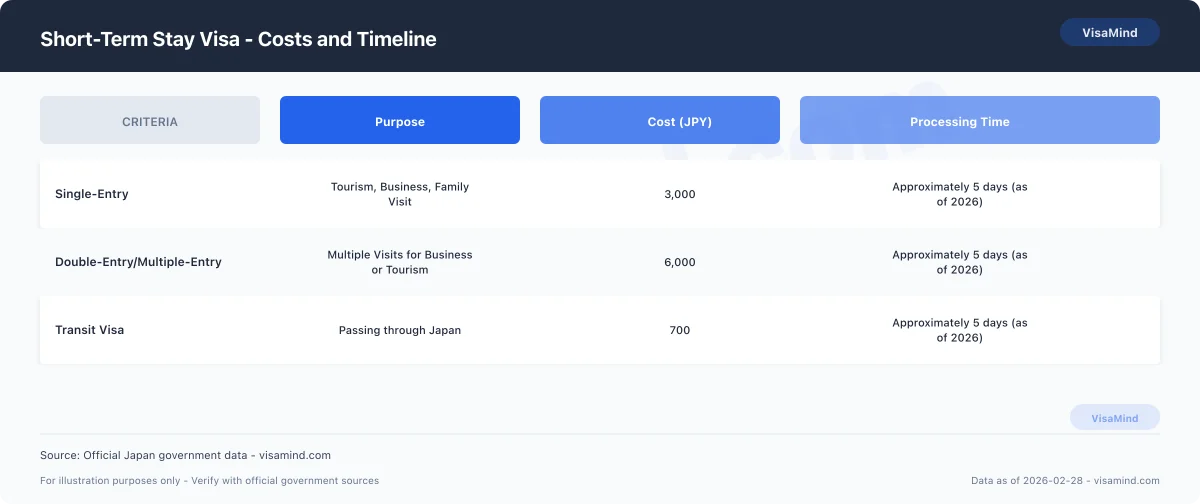
Japan charges a fee for issuing a visa. As of February 2026, the single-entry visa issuance fee is ¥3,000.
| Visa Type | Issuance Fee (JPY) | Notes |
|---|---|---|
| Single-entry short-stay visa | ¥3,000 | Pay upon issuance |
| Transit Visa | Confirm with embassy/consulate | May vary by case |
| Working Holiday Visa | Confirm with embassy/consulate | Depends on nationality |
| Student Visa | Confirm with embassy/consulate | Long-stay category |
| Long-term Resident | Confirm with embassy/consulate | Status-specific |
You pay the fee when the visa is issued—not when you submit the application.
Some applicants don’t pay a fee, depending on:
- Nationality
- Whether you qualify for Visa Exemption (Visa-Free Entry)
- Purpose and duration of stay
If you enter Japan under Visa Exemption, you don’t pay a visa issuance fee because no visa is issued.
The ISA manages immigration status inside Japan, including changes to Student Visa, Working Holiday Visa, or Long-term Resident status.
Typical processing windows
For short-stay tourist visas under the standard category, processing usually takes 5 to 7 business days as of March 2026.
| Application Type | Standard Processing Time |
|---|---|
| Short-stay (tourism, standard) | 5–7 business days |
The processing time depends on the visa category, application volume, embassy or consulate location, and whether your documents are complete.
Apply at least 2–3 weeks before your planned travel date. While many applications finish in about 5 business days, peak travel seasons can stretch the timeline.
A Transit Visa or long-stay category such as a Student Visa or Working Holiday Visa may face different review procedures.
Check current timelines directly with the Japanese embassy or consulate where you submit your Form Visa Application.
How to Apply Step by Step
#Confirm your visa type, prepare the correct form, and submit your Form Visa Application through the right channel. Some travelers can use online processing, while others need to apply in person at a Japanese embassy or consulate.
Before you start
First, check if you need a visa. If you qualify for Visa Exemption (Visa-Free Entry) or only need a Transit Visa, you might not need a tourist visa application.
Identify your correct category. A short‑stay tourist visa is different from a Student Visa, Working Holiday Visa, or Long-term Resident status.
Applying under the wrong category can delay everything.
Always use the latest version.
Complete every required field and sign the form. Prepare all supporting evidence listed in the instructions.
Incomplete forms or missing documents can get your application refused or returned.
If you're from an eligible country, see if you can use the JAPAN eVISA system for short‑stay tourism instead of visiting the embassy.
| Step | What You Must Do | Where to Confirm |
|---|---|---|
| Check eligibility | Confirm visa-free or visa-required status | ISA website |
| Select visa type | Tourist vs. other statuses | ISA website |
| Download form | Use current short-stay form | ISA website |
| Review eVISA | Confirm nationality eligibility | ISA website |
Filing and follow-up
Submit your completed Visa Application at the Japanese embassy or consulate responsible for your area, unless you qualify for the JAPAN eVISA system.
Include all required supporting documents and pay the applicable visa fees in JPY (¥) if needed.
Check the ISA website or the embassy handling your case for current fee amounts.
After submission, watch for any communication from the embassy or consulate. Respond quickly if they ask for more documents or information.
The Immigration Services Agency (ISA) oversees immigration procedures and status decisions.
Follow instructions from the diplomatic mission handling your application, as procedures can differ by location.
Required Documents — short-term visa Japan
#Submit complete identity details, nationality-based documents, and a compliant photo with your Form Visa Application.
Requirements vary by passport and purpose of stay. The Immigration Services Agency of Japan (ISA) reviews what you provide.
Identification and form fields
Provide accurate biographical and identity details on your Visa Application.
Enter your full legal name, date of birth, nationality, and other identifying information exactly as shown on your passport.
All fields must be complete and consistent. Incomplete or inconsistent entries can delay review by the Immigration Services Agency of Japan (ISA).
If you apply for a status involving work or a longer stay—such as a Working Holiday Visa, Student Visa, or Long-term Resident—your sponsor in Japan should get a Certificate of Eligibility (CoE) before you apply.
CoE processing usually takes 1–3 months, so start early.
A CoE isn't required for typical short visits, but check if it applies to your category.
| Purpose of Stay | CoE Needed Before Visa Application |
|---|---|
| Short-term visit (tourism, business) | Usually not required |
| Work-related stay | Recommended |
| Study (Student Visa) | Recommended |
| Long-term Resident status | Recommended |
Nationality-specific and special documents
Document requirements depend on your nationality and the exact short-term category you select.
Before applying, confirm whether you qualify for Visa Exemption (Visa-Free Entry).
If you're visa-exempt, you don't submit a short-term Visa Application in advance.
If you need a visa, collect all documents required for your passport nationality. Requirements can differ even for the same visit purpose.
For certain purposes, additional documents may be needed:
- Transit Visa applicants may need documents tied to onward travel.
- Working Holiday Visa and Student Visa applicants generally need a Certificate of Eligibility (CoE) from a sponsor in Japan.
- Applicants planning employment or long-term residence should secure a CoE before filing the Visa Application.
Always verify nationality-based requirements with the Immigration Services Agency of Japan (ISA) or the Japanese diplomatic mission handling your case.
Photo and technical specs
Your photo must meet strict technical standards. Non-compliant photos often cause delays.
Provide one photo that meets all of the following:
- Size: 4.5 cm x 4.5 cm
- Taken within the last 6 months
- Plain white background
- No hats or sunglasses
Make sure your face is clearly visible and unobstructed. The image must reflect your current appearance.
Don't submit edited or low-quality images. If your photo doesn't meet specifications, the Immigration Services Agency of Japan (ISA) may ask for a replacement, delaying your application.
What Consular Officers Evaluate
#Consular officers review your purpose of travel, supporting evidence, and ties outside Japan.
They confirm that your planned stay matches the visa category you selected and fits within short‑stay rules.
Decision factors and evidence
You must show that your trip fits a short-stay Form Visa Application and doesn't require a different status, such as a Student Visa, Working Holiday Visa, or Long-term Resident.
Officers focus on:
- Clear purpose of visit (tourism, visiting friends, short business activities)
- Consistent travel plans that match your stated purpose
- Complete and accurate application forms
- Supporting documents that align with your itinerary
They also check whether you may qualify for Visa Exemption (Visa-Free Entry) instead of a tourist visa, or whether your travel qualifies as a Transit Visa case.
If your activities suggest study, paid work, or long-term residence, a tourist visa isn't appropriate.
Your documents must be internally consistent. Dates, names, and stated activities must match across all forms and supporting records.
The Immigration Services Agency (ISA) oversees immigration control and status decisions within Japan, and consular officers evaluate your application in line with those standards.
| Factor Reviewed | What Officers Look For |
|---|---|
| Purpose of stay | Tourism or other permitted short-stay activity |
| Length of stay | Temporary and limited duration |
| Visa category match | Tourist visa vs. Student, Working Holiday, or other status |
| Documentation quality | Complete, consistent, and credible records |
Why approval is not guaranteed
Submitting a short-stay application doesn't guarantee approval.
Officers exercise discretion in every case. Even with all required documents, they must be satisfied that your visit fits the permitted scope of activities and duration.
Common issues include:
- Applying for a tourist visa when your activities indicate study or work
- Inconsistent information across forms and supporting materials
- Insufficient explanation of your travel purpose
- Applying for a visa when visa-free entry may apply, or vice versa
A tourist visa can't serve as a substitute for a Student Visa, Working Holiday Visa, or long-term status.
If your plans fall outside short-term tourism or similar activities, you must apply for the correct status from the start.
Officers make decisions based on the full record you submit. Accuracy, consistency, and category alignment determine the outcome.
Fees
#| Component | Amount |
|---|---|
| Visa issuance feeVisa issuance fee: ¥3,000 (approx $20 USD) (as of 2026-02). Verify the current fee on the official schedule before filing. | ¥3,000 (approx $20 USD) |
Fees change; always verify the current fee with the Japanese embassy or consulate before filing.