Japan student visa: Overview
#The Japan student visa allows you to enter Japan for study after you complete two main steps: obtain a Certificate of Eligibility and submit a Form Visa Application. The Immigration Services Agency of Japan (ISA) manages immigration status and confirms whether you meet landing conditions.
Japan student visa: key points
The student visa is an official status issued by the Immigration Services Agency of Japan (ISA). The process begins before you travel.
First, you must secure a Certificate of Eligibility (CoE). This document confirms you meet the conditions required to land in Japan for study.
Once you receive the CoE, you move on to your Visa Application. The visa reflects your approved status as a student.
| Stage | Purpose | Authority Involved |
|---|---|---|
| Form CoE Application | Confirms you meet landing conditions | Immigration Services Agency (ISA) |
| Visa Application | Issues the visa based on approved status | Relevant Japanese authorities under ISA framework |
The ISA handles immigration applications and status changes. If you later change your residence status—such as to Specified Skilled Worker (i), Specified Skilled Worker (ii), or Long-term Resident—you must apply through the ISA.
This visa is different from categories like Working Holiday Visa or Trainee status, which have their own requirements and purposes.
Who the visa is for
The student visa is for foreign nationals intending to study in Japan and who meet landing requirements confirmed through the CoE process.
You qualify if:
- You apply for and obtain a Certificate of Eligibility confirming you meet entry conditions
- You submit a Visa Application based on that approved status
- You intend to engage in study as your primary activity in Japan
This visa is not for those whose main purpose is employment under categories such as Specified Skilled Worker (i) or Specified Skilled Worker (ii). It also differs from a Working Holiday Visa, which is designed around travel with incidental work, and from Trainee status, which focuses on structured training.
Your eligibility depends on whether the ISA determines you satisfy the conditions for landing under student status.
Basic permissions and scope
A student visa authorizes you to enter Japan under a residence status designated for study. Your permission to land depends on approval of your Certificate of Eligibility and successful completion of the visa application process.
The scope is specific:
- Your primary activity must be study
- Your landing must align with the conditions certified in your CoE
- Any change in your activity or long-term plans may require a status change application through the ISA
If you later seek a different residence category—such as Long-term Resident or Specified Skilled Worker (i)—you must apply separately with the Immigration Services Agency.
The student visa does not convert automatically into other statuses. Each category has its own legal basis and application process managed by the ISA.
When to Get Help (study Japan)
#Targeted help is needed when your sponsor cannot complete the Certificate of Eligibility process correctly, when timelines start slipping, or when your background raises red flags. These issues can delay or derail both your Form CoE Application and your Form Visa Application if not addressed early.
Sponsor and CoE complications
You cannot file your own Certificate of Eligibility (CoE) if you are outside Japan. Your sponsor—school, employer, or family member—must submit the CoE Application to the Immigration Services Agency of Japan (ISA) at the regional office.
Seek help if your sponsor:
- Does not understand ISA documentation standards
- Submits incomplete company or school records
- Fails to include your diplomas or work history (if required)
- Delays filing without explanation
Incomplete evidence is a common cause of processing delays. For work-related statuses, the sponsor must provide corporate registration documents and financial statements, along with proof of your qualifications.
This issue also affects applicants switching from statuses such as Working Holiday Visa, Trainee, Long-term Resident, or Specified Skilled Worker (i)/(ii). An error in status category selection can trigger rejection.
| Risk Area | Why It Matters |
|---|---|
| Missing sponsor documents | ISA may pause or question the CoE Application |
| Incorrect status category | Application may not match your actual activity |
| Weak financial proof | ISA may doubt the sponsor’s stability |
If your sponsor hesitates or lacks experience with ISA filings, professional review can reduce preventable errors.
Processing and timing issues
CoE processing usually takes 1–3 months, depending on visa category and the regional ISA office’s workload. If your timeline becomes tight due to school start dates or job contracts, you should act.
Priority categories such as Highly Skilled Professional often move faster. Most student-related cases do not receive priority handling.
You should seek help if:
-
Your CoE exceeds the typical 1–3 month window.
-
Your school term begins soon and the CoE has not issued.
-
The Japanese consulate questions your Visa Application despite a valid CoE.
A CoE does not guarantee visa approval. The consulate makes its own decision.
If you previously overstayed, violated status, or have a criminal record, you face higher scrutiny.
A visa does not guarantee entry. At the airport, officers can request:
- Return ticket
- Accommodation details
- Proof of funds
Preparation reduces last‑minute refusal risk.
Complex eligibility or background issues
Complex history should not be handled alone. Criminal records, prior deportation, visa overstays, or misrepresentation in past applications increase refusal risk—even if ISA issued a CoE.
This applies if you previously held:
- Working Holiday Visa
- Trainee status
- Long-term Resident status
- Specified Skilled Worker (i) or (ii)
You must disclose accurate immigration history in your Visa Application. Inconsistencies between your CoE Application and consular forms can lead to denial.
| Issue | Why Legal Review Helps |
|---|---|
| Criminal history | Consulate independently assesses admissibility |
| Prior visa violation | Raises credibility concerns |
| Status change history | Must align with ISA records |
If your case involves past refusals or violations, get advice before submitting new documents. Fixing problems after a denial is harder than preventing one.
Fees and Processing Times
#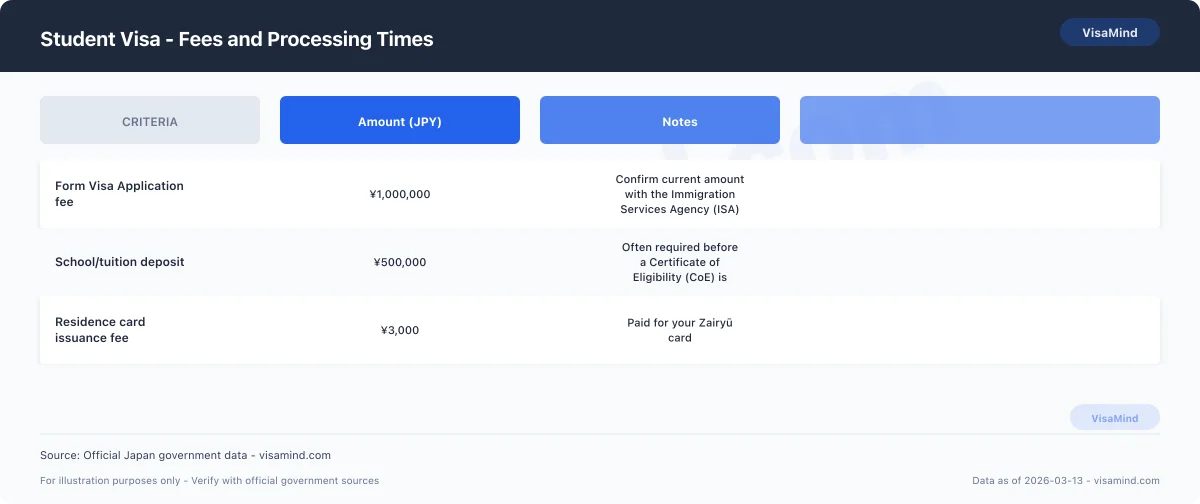
You must budget for government application charges, school deposits, and residence card issuance. Standard processing for a student status typically takes 1 to 2 months, but timelines and costs depend on your category and where you apply.
Fees and deposits
You’ll face two main cost stages: the visa-related government fees and the institution’s required tuition deposit.
| Item | Amount (JPY) | Notes |
|---|---|---|
| Form Visa Application fee | ¥1,000,000 | Confirm current amount with the Immigration Services Agency (ISA) |
| School/tuition deposit | ¥500,000 | Often required before a Certificate of Eligibility (CoE) is issued |
| Residence card issuance fee | ¥3,000 | Paid for your Zairyū card |
Many schools require payment of the ¥500,000 deposit before they proceed with your Form CoE Application. Without a CoE, you cannot complete your Visa Application.
You pay the residence card fee when your status is granted and your Zairyū card is issued. Always verify current fees directly with the Immigration Services Agency (出入国在留管理庁) (ISA), as amounts can change.
If you later change status—for example, from Student to Specified Skilled Worker (i) or Long-term Resident—new government fees may apply.
Standard processing timelines
For a student under standard processing, expect 1 to 2 months from submission to decision. This timeframe applies to typical student cases handled under normal conditions.
It covers review by the ISA after your documents and CoE are submitted. Processing does not begin until you file a complete application.
Missing documents can delay the clock. Other statuses follow different timelines.
A Working Holiday Visa, Trainee, or Specified Skilled Worker (ii) application may move on a separate track with its own review period. You must confirm the applicable timeframe with the issuing authority handling your case.
Plan your school start date around the 1–2 month range. Do not book travel until you receive approval.
When times and costs may vary
Your timeline can shift based on:
- Your visa category
- Your country of application
- Application volume at the ISA
- Whether your documents are complete
A change of status inside Japan, such as moving from Student to Specified Skilled Worker (i), may involve different review steps than an initial overseas application.
Costs may also vary if your institution sets a higher deposit requirement. Some schools adjust payment schedules, but you must confirm this directly with your admissions office.
If you apply under a different residence status, such as Trainee or Long-term Resident, fee structures and processing times will differ. You need to confirm current requirements and timelines with the Immigration Services Agency before submitting your application.
Student Visa Document Checklist
#You must submit complete and compliant documents to avoid delays in your Certificate of Eligibility (Form CoE Application) and subsequent Form Visa Application. The Immigration Services Agency of Japan (ISA) reviews your identity documents, photo specifications, and supporting evidence carefully.
Mandatory ID documents
Your core identity documents confirm who you are and whether you can legally receive a student status.
Provide:
- Valid passport
- Any required forms for your CoE Application
- Any required forms for your Visa Application
Your passport must remain valid for the entire planned period of stay in Japan. If it expires during your program, ISA may refuse the application.
You also need to ensure your passport contains blank pages for visa attachment. A passport without sufficient space can lead to rejection, even if the rest of your application is complete.
The same standard applies if you previously held another status such as:
- Working Holiday Visa
- Trainee
- Long-term Resident
- Specified Skilled Worker (i)
- Specified Skilled Worker (ii)
ISA reviews your current status and identity history as part of the application process.
| Document | Key Requirement | Common Issue |
|---|---|---|
| Passport | Valid for full stay | Expiring during studies |
| Passport pages | Blank visa page available | No space for visa sticker |
| Application forms | Properly completed | Missing signatures or fields |
Photos and passport requirements
Japan enforces strict photo standards. Non-compliant photos frequently delay processing.
Your photo must meet these requirements:
- Size: 4.5 cm × 4.5 cm
- Taken within: Last 6 months
- Background: Plain white
- No hats or sunglasses
Submit a clear, front-facing image. Avoid shadows, filters, or altered images.
Photos that fail size or background requirements often result in resubmission requests. That delay affects both your CoE Application and your Visa Application timeline.
Before submission, confirm your passport also meets these conditions:
- Valid through your intended stay
- Undamaged and machine-readable
- Contains blank space for visa attachment
ISA applies these specifications strictly.
Other supporting evidence
Beyond identity documents and photos, ISA evaluates the completeness of your overall application package.
You must submit:
-
Documents required for your CoE Application
-
Documents required for your Visa Application
-
Any materials requested by ISA based on your status history
If you are changing from another residence status, such as Trainee or Specified Skilled Worker (i), include documentation that reflects your current legal status.
Ensure all documents are consistent. Names, passport numbers, and personal details must match exactly across forms and identification.
Incomplete submissions, expired passports, and incorrect photos are among the most preventable reasons for delay or refusal. Review every document carefully before filing with ISA.
Can You Work?
#You cannot work in Japan on a student status unless you obtain permission from the Immigration Services Agency of Japan (ISA). Your student status allows study as your primary activity, and any paid work requires separate authorization.
Part-time limits while you study Japan
If your residence status is “Student,” you’re not automatically allowed to work.
To take on part-time work, you’ll need to apply to the Immigration Services Agency (ISA) for permission to engage in activity other than that permitted under your current status. You can apply once you have your Residence Card.
Basic conditions include:
- Holding valid Student status
- Staying enrolled at your school
- Making sure your work doesn’t interfere with studies
- Avoiding jobs prohibited under Japanese law
ISA can revoke your permission if you stop attending classes or break the terms of your stay. Schools sometimes report attendance issues to immigration authorities.
Your Certificate of Eligibility (CoE) Application and Form Visa Application show you’re a student, but they don’t grant work rights.
| Item | Student Status |
|---|---|
| Primary purpose | Study |
| Work allowed automatically | No |
| Separate work permission required | Yes |
| Authority in charge | Immigration Services Agency (ISA) |
If your main purpose is employment, consider a different status, such as Specified Skilled Worker (i) or Specified Skilled Worker (ii), if you qualify.
Internships, co-op and summer work
Internships must fit your student status. If you’re paid, you still need work permission from ISA.
Unpaid academic internships that are part of your curriculum may be handled differently, but your school must verify that the activity is required for graduation. You’re responsible for checking compliance with ISA rules.
Verify the following:
- Is the internship paid or unpaid?
- Is it required for your degree?
- Does your school support the placement?
- Is further ISA permission necessary?
Trainee status is separate and doesn’t convert automatically from Student. If your activities no longer qualify as study, you must apply for a change of status.
Working Holiday Visa is also a separate category. It allows broader work, but is not a student status. You can’t informally switch; ISA procedures are required for any change.
Complying with work permissions
You must follow all conditions attached to your permission. Working outside approved activities risks cancellation of your status.
ISA monitors compliance through:
-
School reporting
-
Residence record reviews
-
Status extension or change applications
If you later qualify for Specified Skilled Worker (i) or Specified Skilled Worker (ii), you have to file a formal change of status with ISA. Employers can’t legalize unauthorized work retroactively.
Long-term Residents and other categories have different rules. Don’t assume their flexibility applies to student status.
Before accepting any job, confirm:
- You have permission
- The job matches what ISA allows
- Your residence period is still valid
You’re responsible for staying within the authorized scope.
Post-Study Options
#After finishing your studies, you must change your status of residence if you want to remain in Japan. The Immigration Services Agency of Japan (ISA) handles all status changes, Certificates of Eligibility (CoE) applications, and visa applications.
Your main options are employment-based statuses, Specified Skilled Worker categories, or other residence types depending on your qualifications and long-term plans.
Common next steps
Most graduates move from student status to a work-authorized status. You can’t keep working in Japan under student status after your studies end.
Typical steps:
-
Secure a job offer from a Japanese employer
-
Prepare documents for a status change application with ISA
-
Submit the application before your current period of stay ends
If you leave Japan after graduation, your employer may need to apply for a Certificate of Eligibility (Form CoE Application) on your behalf. You’ll then complete a Form Visa Application at a Japanese embassy or consulate before re-entering.
Some graduates look at alternatives such as the Working Holiday Visa (if eligible by nationality) or Long-term Resident status, depending on circumstances. Each path requires a separate application and approval from ISA.
Transitioning to skilled or specialist status
If you land professional employment, you’ll usually change to a skilled or specialist work status. The exact category depends on your job and academic background.
You’ll need:
- A valid job offer
- Duties that fit the authorized work category
- Supporting documents from your employer
- Compliance with ISA requirements
Apply for a Change of Status of Residence if you’re in Japan. If you’re outside, your employer generally files a CoE Application, followed by your Visa Application abroad.
ISA reviews whether your proposed activities match the new status. Approval isn’t guaranteed. You must wait for formal permission before starting work under the new category.
Specified Skilled Worker and other paths
The Specified Skilled Worker (i) and Specified Skilled Worker (ii) categories offer employment options in certain fields.
- Specified Skilled Worker (i) covers specific industries under defined conditions
- Specified Skilled Worker (ii) applies in limited sectors and may allow broader stay options than (i)
You must meet ISA’s requirements for the specific field. This usually means documented skills and an employment contract.
Comparison table:
| Path | Job Offer Required | CoE Needed if Abroad | Managed by ISA |
|---|---|---|---|
| Skilled/Specialist Status | Yes | Usually | Yes |
| Specified Skilled Worker (i) | Yes | Usually | Yes |
| Specified Skilled Worker (ii) | Yes | Usually | Yes |
| Working Holiday Visa | Not always | Yes | Yes |
| Long-term Resident | Case-specific | Often | Yes |
Each route needs a formal application and ISA approval. You must keep valid status throughout any transition.

Extending Your Student Visa
#You need to track your Certificate of Eligibility (CoE) validity and file on time. Most problems happen when students miss the three‑month validity window or delay their Form Visa Application at the embassy.
CoE validity and timing
Your Certificate of Eligibility (CoE) is valid for 3 months from the date of issuance. You must submit your Visa Application at the Japanese embassy or consulate within that period.
If you wait too long, the CoE can’t be used for visa issuance. The embassy won’t accept it once it expires.
Timeline reference:
| Step | Deadline |
|---|---|
| CoE issued | Day 0 |
| Latest date to apply for visa at embassy | Within 3 months of issuance |
| After 3 months | CoE no longer valid |
Plan your travel and document preparation as soon as you get your CoE. Delaying your appointment risks expiration.
ISA issues the CoE, but you apply for the visa at the embassy or consulate. The three‑month period is strict.
If the CoE expires before application
If your CoE expires before you apply for your visa, you can’t revive or extend it.
Your sponsor in Japan must file a new Form CoE Application with ISA. You can’t reuse the expired document.
This rule applies to all intended statuses, including:
- Student
- Trainee
- Working Holiday Visa
- Long-term Resident
- Specified Skilled Worker (i)
- Specified Skilled Worker (ii)
An expired CoE doesn’t convert into another status. The process must restart through your sponsor.
Move quickly if your three‑month window is closing. Delays mean more paperwork and longer processing since ISA has to review a new application.
When to file for extensions or changes
Monitor both your current period of stay and any planned status change.
If you plan to:
- Extend your Student status, or
- Change to another status such as Specified Skilled Worker (i), Specified Skilled Worker (ii), Trainee, or Long-term Resident,
follow ISA’s procedures.
If a change requires a new CoE, make sure you complete the Visa Application within three months of issuance. Missing that window means your sponsor must file a new CoE Application.
Procedures and requirements differ depending on whether you’re extending your stay or changing to a different status. Check directly with ISA for updates.
How to Apply
#You’ll need to complete two main steps: your sponsor in Japan secures a Certificate of Eligibility (CoE), and you file your Form Visa Application at a Japanese embassy or consulate. Timing and correct filing location affect how quickly you get your student visa.
Step-by-step application process
Follow these steps to avoid delays:
-
Confirm your eligibility category with your school in Japan
-
Your school or sponsor files the Form CoE Application with ISA
-
Wait for CoE issuance (usually 1–3 months)
-
Submit your Visa Application at the Japanese embassy or consulate in your country
-
Receive your visa after processing (typically 5 business days, sometimes longer during busy periods)
Complete every required field and sign before submitting.
Read the instructions carefully for your specific status. Japan has other categories such as Trainee, Working Holiday Visa, Long-term Resident, Specified Skilled Worker (i), and Specified Skilled Worker (ii), each with different requirements. Don’t use forms intended for another status.
| Stage | Who Files | Where | Processing Time |
|---|---|---|---|
| CoE Application | Sponsor in Japan | ISA regional office | 1–3 months |
| Visa Application | You | Japanese embassy/consulate | ~5 business days |
Apply at least 2–3 weeks before your planned travel date.
Applying at the embassy or consulate
Apply at the Japanese embassy or consulate in your country of residence. Don’t file in a third country unless that mission accepts applications from non-residents.
Submit your completed visa form and all required documents, including your CoE. Check the mission’s instructions for document formatting and submission.
Processing is usually about 5 business days, but it can take longer during busy periods. Only plan travel after you have your visa.
If you held a different status before, like Working Holiday Visa or Trainee, double-check that you’re applying for the student visa category. Status types aren’t interchangeable.
Sponsor's role and regional filing
Your sponsor in Japan—usually your school—is central to the CoE process. You can’t skip this for long-term study.
The sponsor must:
- Prepare and submit the CoE Application to ISA
- File with the regional office that has jurisdiction over the sponsor’s location in Japan
- Provide supporting documents as required by ISA
Don’t file with the office based on your intended place of residence. Filing in the wrong region causes delays.
ISA reviews the CoE application and issues the certificate if approved. You then use that certificate for your Visa Application at the embassy or consulate.
Student Visa Requirements
#You’ll need to meet eligibility standards, have a valid passport, and secure a Certificate of Eligibility before filing your Form Visa Application. ISA checks whether you meet the conditions for student status.
Basic eligibility overview
Apply for the status that matches your purpose of stay. A student visa is for study, not employment.
ISA checks whether you fit the student category—not other statuses like:
- Trainee
- Working Holiday Visa
- Long-term Resident
- Specified Skilled Worker (i)
- Specified Skilled Worker (ii)
Each status has its own permitted activities. If your main purpose is academic, use the student category—not a work-based or residency-based status.
Eligibility depends on whether you meet the conditions for landing as a student. ISA reviews this during the CoE review and the Visa Application stage.
| Status | Primary Purpose | Suitable for Full-Time Study |
|---|---|---|
| Student | Academic study | Yes |
| Trainee | Training program | No |
| Working Holiday Visa | Travel with limited work | No |
| Specified Skilled Worker (i)/(ii) | Employment | No |
| Long-term Resident | Residence based on specific grounds | No |
Your activities in Japan must match the student status you request.
Passport and travel-document rules
You must hold a valid passport to apply for a student visa. Without it, you can’t complete your Visa Application.
Your passport must:
- Be valid at the time of application
- Serve as your official travel document for entry into Japan
ISA relies on your passport to confirm your identity and nationality during the visa review and landing inspection. An expired or invalid passport means your application stops.
Check your passport’s validity before starting the Form CoE Application process. If you need to renew, do it first to avoid delays.
Certificate of Eligibility requirement
You’ll need a Certificate of Eligibility (CoE) before you can apply for a student visa. The CoE confirms you meet the legal conditions for entering Japan under student status.
ISA reviews your application and issues the CoE if you meet the requirements. This happens before you submit your visa application at a Japanese embassy or consulate.
Here’s the order things usually happen:
-
Submit the CoE Application to ISA.
-
Receive the Certificate of Eligibility.
-
File your Visa Application using the issued CoE.
The CoE isn’t a visa. It supports your visa application by showing ISA has already checked your eligibility as a student.
Without a valid CoE, you can’t move forward with a standard student visa application.
What Goes Wrong
#Most problems come from mismatched information, missing documents, or choosing the wrong visa category. Rejections and delays often start with errors in the Form CoE Application or Form Visa Application—these are usually preventable.
Common reasons for rejection
The Immigration Services Agency of Japan (ISA) can refuse your application even if you hold a Certificate of Eligibility (CoE). A CoE does not guarantee visa approval.
Rejection is common when your qualifications don’t match the status of residence you select. This happens when applicants mix up categories like Student, Trainee, Working Holiday Visa, Long-term Resident, or Specified Skilled Worker (i) and Specified Skilled Worker (ii).
If you apply for a category with education or experience requirements, you must meet them exactly. For example:
- You must satisfy the stated education or work experience criteria for that status.
- Your background must align with the activities permitted under that visa.
Applications are also refused when:
- There’s inconsistent information between your CoE Application and Visa Application.
- Personal details, salary, dates, or sponsor information don’t match.
- You apply at a Japanese embassy or consulate that doesn’t have jurisdiction over your residence.
- You fail to obtain a CoE for a long-term stay such as study.
Even small discrepancies can lead to denial.
Frequent delays and their causes
Delays usually happen because documents are incomplete or non-compliant. ISA won’t process a CoE Application efficiently if required materials are missing.
If a sponsor submits supporting documents, missing company records can slow things down. Required items often include:
- Company registration certificate (登記事項証明書)
- Most recent financial statements
- Business overview document
Photograph errors are another common cause of delays. Your photo needs to meet all the requirements:
| Requirement | Standard |
|---|---|
| Size | 4.5 cm x 4.5 cm |
| Background | White |
| Age of photo | Taken within 6 months |
| Appearance | No accessories |
Applications also stall when forms have incomplete answers or inconsistent entries. If passport details differ from what’s on your forms, ISA may pause processing until the issue is clarified.
How to avoid application errors
You can avoid most issues by double-checking accuracy and making sure you’re eligible for the category before you file. Confirm that the Student status matches your planned activities and how long you intend to stay.
Take these steps:
-
Review every entry on your CoE Application against your passport and supporting documents.
-
Make sure all details match exactly on your Visa Application.
-
Apply through the correct Japanese embassy or consulate.
-
Check that your photograph meets the required specifications.
If you previously held another status, like Working Holiday Visa or Trainee, your current application needs to reflect your present purpose of stay. Don’t rely on what worked in the past.
ISA looks for consistency and eligibility. Accurate forms, correct documents, and choosing the right visa category help protect your application from avoidable refusal.
Fees
#| Component | Amount |
|---|---|
| Application feeExtracted from guide content — verify against official source | ¥1,000,000 (approx $6,700 USD) |
| School/tuition depositOften required by institution — verify with school | ¥500,000 (approx $3,350 USD) |
| Residence card feeZairyū card issuance — verify against MOFA | ¥3,000 (approx $20 USD) |
Fees change; always verify on ISA.