Overview — Japan working holiday visa
#Japan’s Working Holiday Visa lets young adults spend up to a year in Japan, working to support their stay. The program operates under rules set by the Immigration Services Agency of Japan (ISA).
Program summary
Japan launched its first working holiday arrangement with Australia in
- By February 1, 2026, agreements cover 31 countries and regions.
The program targets young people aged 18 to 30 from 26 partner countries. You can stay in Japan for up to one year and combine travel with short-term work.
Key program facts:
| Item | Details |
|---|---|
| Managing authority | Immigration Services Agency of Japan (ISA) |
| Status category | Designated Activities |
| Age range | 18–30 |
| Duration | Up to 1 year |
| Participating partners | 31 countries/regions (as of Feb 1, 2026) |
| Core purpose | Travel with incidental work |
You apply through a formal Form Visa Application process. ISA oversees your entry and status once you arrive.
This status is distinct from long-term work categories such as Specified Skilled Worker (i) or Specified Skilled Worker (ii). It’s also separate from residence categories like Long-term Resident or a Student Visa.
Who participates
You need to meet both age and nationality requirements. The program is only for citizens of Japan’s partner countries.
Basic eligibility:
- Age between 18 and 30
- Citizenship of an eligible partner country
- Intent to holiday in Japan
- Willingness to work only to supplement travel funds
This visa is for young adults seeking cultural exposure, not career employment. It isn’t a pathway for long-term labor migration.
Unlike a Student Visa, this status doesn’t focus on academic study. Unlike Specified Skilled Worker (i) or (ii), it’s not about filling labor shortages.
ISA administers your status under the Designated Activities category. Your stay is temporary and purpose-specific.
Purpose and benefits
The Working Holiday Visa encourages cultural exchange. You experience daily life in Japan and support yourself with short-term work.
Employment is secondary; your main activity is travel and cultural exploration.
You get:
- Direct exposure to Japanese culture and lifestyle
- Freedom to travel throughout Japan
- Legal permission to work during your stay
- A structured immigration status managed by ISA
The program fosters exchange between Japan and its partners. It lets you live in Japan temporarily without committing to a long-term immigration category.
If you want to stay longer, you must qualify separately under another status, such as Specified Skilled Worker (i), Specified Skilled Worker (ii), Long-term Resident, or a Student Visa, through a new Visa Application reviewed by ISA.
The Application Process
#You must use the correct Working Holiday Form Visa Application issued by the Immigration Services Agency of Japan (ISA) and follow the official instructions exactly. Errors, missing signatures, or non-compliant photos can delay approval.
Download forms & official instructions
Download the current Working Holiday Visa Application and its instructions from the Immigration Services Agency of Japan (出入国在留管理庁). Use only the latest version.
Review the instructions before you fill anything out. Make sure you meet the eligibility criteria for the Designated Activities status tied to the working holiday program.
Don’t rely on guidance for other residence statuses:
| Status Type | Purpose |
|---|---|
| Specified Skilled Worker (i) | Employment in designated industries |
| Specified Skilled Worker (ii) | Advanced skilled employment with broader benefits |
| Long-term Resident | Special long-term residence categories |
| Student Visa | Study at approved institutions |
Each category has its own rules and documentation.
If you’re unsure about any requirement, consult the ISA site before submitting your Visa Application. Japan also operates the JAPAN eVISA system for short-stay tourism in eligible countries, but that doesn’t replace the working holiday application process. Confirm your nationality qualifies before visiting a Japanese embassy or consulate.
Complete, sign and submit
Fill out every required field clearly and accurately. Don’t leave blank sections unless the form says to.
Follow this sequence:
-
Fill out the application form.
-
Review all answers for accuracy.
-
Sign where required.
-
Prepare all supporting documents.
-
Submit the package as instructed by the embassy or consulate.
You need:
- A valid passport
- A return travel ticket or enough funds to buy one
Unsigned forms or incomplete submissions will delay processing. The Immigration Services Agency (ISA) handles immigration applications and status determinations.
Photo & evidence requirements
Photo standards are strict. Non-compliant photos are a common cause of delays.
Your photo must be:
- 4.5 cm x 4.5 cm in size
- Taken within the last 6 months
- Against a plain white background
- No hats or sunglasses
The image should be clear and professional. Casual photos rarely meet requirements.
Submit all required evidence with your application. Missing documents can prevent acceptance at the counter.
Before your appointment, check that your passport is valid and your financial evidence supports your return travel requirement.
What You Can Do
#
You can work in most fields, travel throughout Japan, and enter the country subject to inspection by immigration officers. Your status is Designated Activities, and the Immigration Services Agency of Japan (ISA) oversees compliance and any future status changes.
Work restrictions
You may work during your stay, but there are clear limits on the type of work you can accept. Jobs in businesses that affect public morals are prohibited.
You cannot work in:
- Bars
- Cabarets
- Nightclubs
- Similar establishments linked to adult entertainment
ISA enforces these restrictions. Violations can affect both your current stay and any future Form Visa Application.
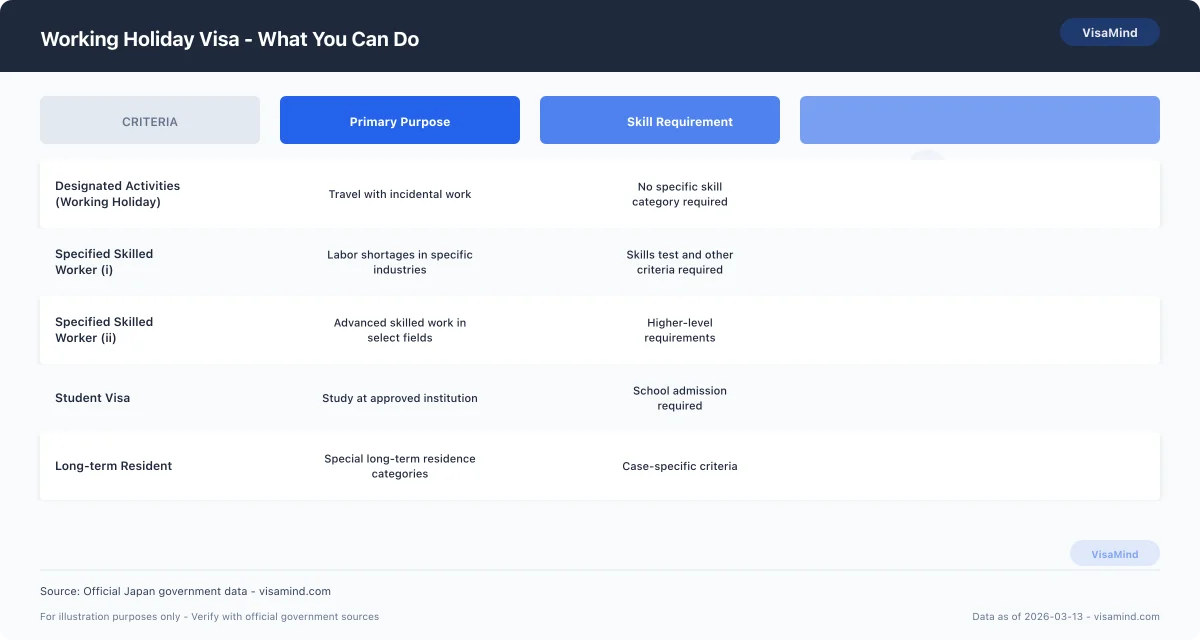
Your Working Holiday status is classified as Designated Activities, which isn’t the same as employment-focused statuses:
| Status | Primary Purpose | Skill Requirement |
|---|---|---|
| Designated Activities (Working Holiday) | Travel with incidental work | No specific skill category required |
| Specified Skilled Worker (i) | Labor shortages in specific industries | Skills test and other criteria required |
| Specified Skilled Worker (ii) | Advanced skilled work in select fields | Higher-level requirements |
| Student Visa | Study at approved institution | School admission required |
| Long-term Resident | Special long-term residence categories | Case-specific criteria |
Don’t assume you can do the same work as under Specified Skilled Worker (i) or (ii). If you want to change status, ISA reviews your eligibility under the new category.
Entry and inspection
A visa lets you travel to Japan, but admission isn’t guaranteed. Immigration officers at the airport or seaport decide whether to grant landing permission.
You should carry:
- Proof of onward or return travel
- Accommodation details in Japan
- Evidence of sufficient funds
Officers may ask about your plans, work intentions, and length of stay. Answers should match your Visa Application.
If there are discrepancies between your stated plans and your status under Designated Activities, entry may be refused.
ISA controls admission decisions at the port of entry. You must follow inspection procedures each time you enter Japan under this status.
Travel freedom
You’re free to travel within Japan during your stay. The program supports cultural exchange and exploration alongside short-term work.
Domestic travel doesn’t require extra immigration approval. You must still follow the conditions of your Designated Activities status while working or moving between regions.
If you leave Japan and seek re-entry, immigration officers will inspect you again. Bring updated proof of funds, travel details, and accommodation information.
Your Working Holiday status doesn’t convert automatically into Long-term Resident, Student Visa, or Specified Skilled Worker (i) status. To change categories, you must apply through ISA and meet eligibility rules for that status.
Beyond the Working Holiday
#You can move from a Working Holiday status to a longer stay if you qualify for work or study. The main requirement is securing a Certificate of Eligibility (CoE) before submitting your Form Visa Application to the Immigration Services Agency of Japan (ISA).
Switching to work or study
If you want to stay in Japan, you must change your status to one that matches your new purpose. Common options include a Student Visa, a work status under Designated Activities, or employment-based categories such as Specified Skilled Worker (i) or Specified Skilled Worker (ii). Some applicants may qualify as a Long-term Resident, depending on their situation.
Your sponsor in Japan must first obtain a Certificate of Eligibility (CoE) from ISA. Without it, ISA will reject your long-term Visa Application.
Key steps:
-
Secure a sponsor (employer or school) in Japan.
-
Have the sponsor apply for the CoE with ISA.
-
Wait for CoE issuance (typically 1–3 months).
-
Submit your Visa Application after the CoE is issued.
| Requirement | Work Status | Student Visa |
|---|---|---|
| Japanese sponsor required | Yes | Yes |
| Certificate of Eligibility (CoE) | Required | Required |
| Issued by | ISA | ISA |
| Typical CoE processing time | 1–3 months | 1–3 months |
Start early. The CoE process alone can take up to three months.
Long-term visa documentation
Your long-term stay depends on complete and accurate documentation. The most common reason for refusal is applying without a valid Certificate of Eligibility.
You must prepare:
- Certificate of Eligibility (issued by ISA)
- Completed Visa Application
- Supporting documents required for your specific status
ISA reviews whether your planned activities match the status you request. For example, a Specified Skilled Worker (i) application must align with the designated work category, while a Student Visa must reflect full-time study.
Confirm that your sponsor submits correct and consistent information to ISA. Errors or missing documents delay processing and can result in denial. Always verify current document requirements directly with the Immigration Services Agency of Japan (ISA) before filing.
When to Consult a Professional
#Some situations require more than a standard Form Visa Application. If your history or status doesn’t fit neatly within the Working Holiday framework, you should seek legal guidance before you apply through the Immigration Services Agency of Japan (ISA).
Complex eligibility or prior visas
Consult a professional if you previously held a Student Visa, Designated Activities status, or any other residence status in Japan and are unsure how it affects your Working Holiday application.
You should also seek advice if you:
- Changed status in the past (for example, from Student Visa to Specified Skilled Worker (i))
- Previously applied for Long-term Resident status
- Held Specified Skilled Worker (ii) or another work-based status
- Overstayed or had gaps in lawful stay
- Submitted multiple Visa Applications under different categories
ISA reviews your immigration history as part of its decision-making process. Filing a Working Holiday application doesn’t guarantee approval, especially if your prior status raises eligibility questions.
A professional can:
-
Review your prior residence records.
-
Identify conflicts between past and current visa purposes.
-
Advise whether a different status, such as Designated Activities, may be more appropriate.
| Situation | Why Legal Advice Helps |
|---|---|
| Prior work status (e.g., Specified Skilled Worker (i)) | Confirms compatibility with Working Holiday intent |
| Prior Long-term Resident application | Clarifies how prior residence purpose affects eligibility |
| Multiple status changes | Identifies inconsistencies in stated activities |
After a refusal or unclear case
Seek professional advice if ISA refuses your Working Holiday Visa Application.
A refusal can affect how ISA reviews future applications, especially if the reason relates to eligibility, documentation, or stated activities in Japan. It’s important to understand the exact basis for the decision before reapplying.
Consult a professional if:
- The refusal notice lacks clear reasoning
- ISA questioned your intended activities
- Your prior status (e.g., Student Visa or Designated Activities) was referenced
- You are considering switching to another category such as Specified Skilled Worker (i)
An advisor can review your refusal notice and immigration history to determine whether you should:
-
Reapply with stronger documentation.
-
Change to a different residence status.
-
Delay filing until your circumstances change.
Professional review helps you avoid repeating the same issue in a second application.
Second Year and Beyond
#Most applicants cannot receive a second Japan Working Holiday visa. To stay longer, you must consider other residence statuses handled by the Immigration Services Agency of Japan (ISA).
Re-application and exceptions
Japan typically issues the Working Holiday visa only once per person. If you’ve already held this visa, you should expect not to receive it again unless your nationality falls under a specific exception.
Eligibility must be confirmed directly with the Immigration Services Agency of Japan (ISA) or the Japanese embassy or consulate where you apply. Rules sometimes vary depending on the bilateral agreement with your country.
Use this checklist before submitting a new Form Visa Application:
- You have not previously been granted a Japan Working Holiday visa; or
- Your country has a formal exception allowing a second participation;
- You still meet the age and nationality requirements under the relevant agreement.
If you don’t qualify for a second Working Holiday visa, ISA won’t approve another period under the same status. In that case, you’ll need to apply for a different residence status within Japan’s immigration system.
| Scenario | Likely Outcome |
|---|---|
| Never held a Working Holiday visa | May apply if all other criteria are met |
| Previously held Working Holiday visa | Not eligible, unless a country-specific exception applies |
| Seeking extended stay without exception | Must change to another status |
Longer-term planning
If you want to stay in Japan after your Working Holiday period, you must change your status of residence before your current period of stay expires. ISA reviews these applications using its standard procedures.
Common alternatives include:
- Student Visa (for full-time study at an approved institution)
- Designated Activities (for specific approved purposes)
- Specified Skilled Worker (i)
- Specified Skilled Worker (ii)
- Long-term Resident (if you qualify independently)
Each status comes with its own eligibility rules and documentation requirements. You’ll need to submit a formal application to ISA for a change of status.
Approval depends on meeting the requirements for the new category. You can’t assume time spent in Japan on a Working Holiday visa will count toward other statuses.
Check the conditions for your intended category and gather supporting documents before your current status expires.
Fees and Processing Times
#A fixed government fee applies for visa issuance. Most applications process within a short, defined window, but timelines can vary by location and season.
Visa issuance fee
Japan charges a ¥3,000 visa issuance fee for the Working Holiday Visa as of February 2026. This fee covers a single-entry visa.
| Item | Amount (JPY) | Notes |
|---|---|---|
| Visa issuance fee | ¥3,000 | Single-entry Working Holiday Visa |
You pay the fee after approval, at the embassy or consulate when the visa is issued. The fee is only for visa issuance—it doesn’t include travel costs, document preparation, or other personal expenses.
The Working Holiday Visa falls under a specific status framework, separate from categories like Designated Activities, Specified Skilled Worker (i), Specified Skilled Worker (ii), Long-term Resident, or a Student Visa. Each has its own rules and fees. Confirm the correct category before submitting your application.
ISA oversees immigration status in Japan, but embassies and consulates handle visa issuance abroad.
Processing time ranges & tips
Standard processing for a Working Holiday Visa is typically 5 to 10 business days as of March 2026.
| Processing Type | Estimated Time |
|---|---|
| Standard | 5–10 business days |
Apply at least 2–3 weeks before your planned travel date. While many cases finish in about five business days, processing can stretch longer during busy travel seasons.
To reduce delays:
-
Submit your application at the Japanese embassy or consulate in your country of residence.
-
Make sure all your documents are complete and accurate.
-
Allow extra time if you’re applying close to holidays or peak periods.
Don’t book non-refundable travel until your visa is issued. Approval must happen before issuance, and processing times aren’t guaranteed.
Variable timelines by location
The processing times depend on:
- The specific embassy or consulate handling your case
- Application volume at that location
- The visa category under review
A Working Holiday Visa processed under standard procedures may move faster or slower than applications for other statuses, such as Designated Activities or Specified Skilled Worker categories. Each follows its own review track.
You’ll need to check current processing times directly with the Japanese embassy or consulate where you apply. Local conditions affect timelines more than national averages.
ISA manages immigration policy and status inside Japan, but visa processing abroad is handled by local consulates or embassies. Confirm expected timelines before applying to avoid travel disruptions.
Eligibility Requirements — working holiday Japan
#You must meet strict age, health, and travel conditions before submitting your Form Visa Application. Japan grants this status under Designated Activities, and ISA reviews each requirement closely.
Age and nationality
Applicants must be between 18 and 30 years old at the time of application. If you’re outside this range, ISA will not issue a working holiday visa.
You also need to hold nationality from a country with a working holiday arrangement with Japan. Eligibility is based on your passport, not your place of residence.
Your main purpose should be a holiday in Japan. Work can support your stay, but it can’t be your main reason for entering the country.
Key criteria:
- Age 18–30 at application
- Passport from an eligible partner country
- Primary intent: holiday, not full-time employment
ISA issues this status under Designated Activities, not under a Student Visa, Specified Skilled Worker (i), Specified Skilled Worker (ii), or Long-term Resident status. Each of those has its own rules and purpose.
Health and dependents
You need to be in good health when you apply. ISA expects you to participate in travel and temporary work without medical issues that would prevent normal daily life.
You cannot bring dependents or children with you under the working holiday program. This visa is strictly for individual applicants.
Important restrictions:
- No accompanying spouse or partner
- No accompanying children
- You apply as an individual only
If you want to live in Japan with family, you’ll need to look at other residence statuses, such as Long-term Resident or employment-based categories. The working holiday visa doesn’t convert automatically into those statuses; you must qualify separately if you later apply to change status with ISA.
Passport and return ticket/funds
You must have a valid passport from an eligible country when you apply. Your passport needs to remain valid for the period required by Japanese authorities.
You’ll need to show you plan to leave Japan at the end of your stay. This usually means:
- A return ticket, or
- Enough funds to buy one
ISA may also ask for proof you can support yourself at the start of your stay. The working holiday program isn’t designed for long-term settlement or full-time career employment.
| Requirement | What You Must Show |
|---|---|
| Passport | Valid passport from eligible country |
| Intent to depart | Return ticket or funds to buy one |
| Financial readiness | Ability to support initial stay |
If you can’t clearly document these points, your application may be refused.
Why Applications Get Rejected
#Most rejections stem from avoidable errors in your paperwork, passport, or filing location. Your documents must match exactly, and you need to follow the consulate’s technical rules.
Common application mistakes
Delays or refusals often happen when your Form Visa Application form has missing answers or inconsistent details. Even small differences—like spelling variations in your name or mismatched passport numbers—can result in rejection.
Use the exact information printed in your passport and supporting documents. Review every field before you submit.
Frequent errors include:
- Leaving sections blank
- Providing dates that conflict with other documents
- Using shortened or informal versions of your legal name
- Entering incorrect passport numbers
ISA reviews your status under Designated Activities, so your information needs to be accurate and complete.
| Mistake | Likely Outcome | How to Prevent It |
|---|---|---|
| Incomplete form | Rejection | Answer every question clearly |
| Inconsistent personal data | Rejection | Match passport details exactly |
| Incorrect document references | Delay or refusal | Cross-check all entries before filing |
Minor discrepancies aren’t usually overlooked. Officers assess credibility based on consistency.
Passport, photo and consulate jurisdiction errors
Technical document issues can lead to immediate refusal. Your passport must remain valid for your intended stay and have blank space for visa placement.
If your passport expires too soon or lacks space, the consulate may reject your application.
Your photograph must meet these specifications:
- Size: 4.5 cm x 4.5 cm
- White background
- Taken within the last 6 months
- No accessories
Non-compliant photos often cause processing delays.
You must apply at the Japanese Embassy or Consulate that has jurisdiction over your place of residence. Filing outside your assigned jurisdiction usually results in rejection, regardless of eligibility.
These technical errors aren’t about your qualifications—they reflect failure to follow submission rules.
Fees
#| Component | Amount |
|---|---|
| Visa issuance feeVisa issuance fee: ¥3,000 (approx $20 USD) (as of 2026-02). Verify the current fee on the official schedule before filing. | ¥3,000 (approx $20 USD) |
Fees change; always verify on ISA.