What the Startup Visa Covers — Japan startup visa
#
The Japan startup visa allows you to prepare for business establishment in specific government-designated zones.
It operates under a defined immigration status and follows a formal application process with the Immigration Services Agency (ISA).
Purpose and scope
The startup visa supports preparation activities for establishing a business in Japan.
You use it to set up operations before transitioning to a standard work-based status such as Business Manager.
This visa does not grant open-ended work rights.
It covers activities directly tied to prepare your company, such as planning, arranging facilities, and organizing your business structure within the approved framework.
You apply under a status classified as Designated Activities.
The Immigration Services Agency (出入国在留管理庁, ISA) reviews your Form Visa Application and decides whether to grant this status.
Approval is not automatic.
Filing the startup visa form does not guarantee that ISA will issue your residence status.
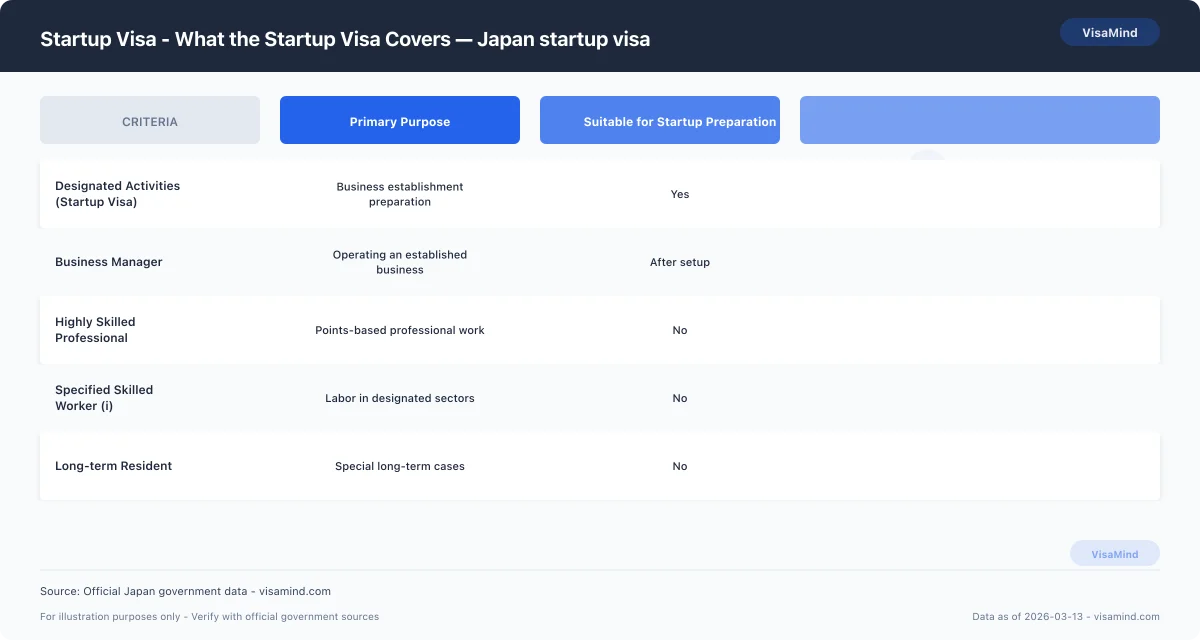
The startup visa differs from other statuses:
| Status | Primary Purpose | Suitable for Startup Preparation |
|---|---|---|
| Designated Activities (Startup Visa) | Business establishment preparation | Yes |
| Business Manager | Operating an established business | After setup |
| Highly Skilled Professional | Points-based professional work | No |
| Specified Skilled Worker (i) | Labor in designated sectors | No |
| Long-term Resident | Special long-term cases | No |
You must align your activities strictly with business establishment.
Any work outside that scope may violate your status.
Where it's available
You can apply only in designated National Strategic Special Zones.
These zones operate under special government authorization to accept startup visa applicants.
If your planned business location falls outside these zones, you cannot use this visa route.
You would need to consider another status, such as Business Manager, if eligible.
Before filing, confirm that:
- Your business will operate in a designated zone
- The local authority in that zone supports startup visa applications
- Your activities match the approved preparation purpose
ISA processes the immigration side of the application.
However, availability depends on the specific zone’s designation.
Because availability is location-specific, always verify the current list of eligible zones with the Immigration Services Agency (ISA).
Form authority
The startup visa uses an official form titled “Startup Visa.”
The Immigration Services Agency of Japan (ISA) administers and reviews this form.
You submit the form as part of your Visa Application for a residence status under Designated Activities.
ISA evaluates whether your planned activities meet the preparation purpose.
Key points about form authority:
- Form name: Startup Visa
- Administering authority: Immigration Services Agency (ISA)
- Status category: Designated Activities
- Outcome: Approval or denial at ISA’s discretion
Submitting the form does not create legal status by itself.
ISA must formally grant your residence status before you can begin activities in Japan under this category.
Renewal and Path to Residency
#You must shift from a temporary startup status to a standard work or long-term status before your current period of stay expires.
The Immigration Services Agency of Japan (ISA) reviews whether your business is viable and whether you meet the requirements of the next residence category.
Common next steps
Most founders transition from a startup-related Designated Activities status to Business Manager once they meet the formal requirements.
You typically move forward by:
-
Establishing your company structure in Japan.
-
Securing a physical business office.
-
Meeting the capital and operational requirements for the Business Manager status.
-
Filing a status change application with the ISA.
If you qualify under the points system, you may consider the Highly Skilled Professional status instead.
This category can offer immigration advantages, but you must meet specific scoring criteria set by the ISA.
Other statuses, such as Long-term Resident or Specified Skilled Worker (i), do not usually align with entrepreneurial activities.
You should only pursue them if your circumstances change and you meet their separate eligibility standards.
| Current Status | Typical Next Step | Purpose |
|---|---|---|
| Designated Activities (Startup) | Business Manager | Operate your own company |
| Designated Activities (Startup) | Highly Skilled Professional | Qualify under points-based system |
You must apply for a change of status before your current period of stay expires.
Certificate of Eligibility (CoE) & timing
If you remain in Japan and change status, you generally file a Change of Status of Residence application with the ISA.
If you leave Japan and apply from abroad, you may need a new Certificate of Eligibility (CoE) sponsored by your company.
A CoE confirms that you meet the conditions for the intended residence status.
It is not a visa, but you use it to obtain a visa at a Japanese embassy or consulate.
Your timing must align with:
- The expiration date of your current period of stay
- Your company registration status
- Office lease and operational setup
- Readiness of financial and business documentation
Processing times vary.
Check the Immigration Services Agency (ISA) for current estimates and procedural updates before filing your Form Visa Application or status change request.

Fees and Processing Times
#You pay a government fee when the Immigration Services Agency of Japan (ISA) issues your startup visa.
Standard processing typically takes 1 to 3 months, but timing depends on your category and where you apply.
Visa fees
ISA charges a fee when it issues your visa.
As of February 2026, the issuance fee for a multiple-entry visa is ¥6,000.
You do not pay this amount at the planning stage; you pay it when ISA approves and issues the visa.
Fee rules apply to statuses granted under Designated Activities for startup purposes and may also apply when you later change status to Business Manager, Highly Skilled Professional, Long-term Resident, or Specified Skilled Worker (i).
| Fee Type | Amount (JPY) | When You Pay |
|---|---|---|
| Visa issuance fee (multiple-entry) | ¥6,000 | Upon visa issuance |
If you apply to change your status of residence after entering Japan, confirm the current fee schedule directly with the Immigration Services Agency (ISA).
Fees can change, and ISA publishes the official amounts.
Standard processing window
Under standard handling, startup visa processing takes 1 to 3 months as of March 2026.
This timeframe applies to applications reviewed under regular procedures.
It does not guarantee approval within that period, and it does not include time you spend preparing documents.
You should plan your business timeline around this 1–3 month window.
If you intend to transition from Designated Activities to Business Manager status, factor in additional review time for the new application.
| Processing Type | Estimated Time |
|---|---|
| Standard startup visa processing | 1–3 months |
ISA controls adjudication and issues the final decision.
Variations and verification
processing times vary based on:
- Your visa category
- Your location of application
- The specific status requested (for example, Designated Activities vs. Business Manager)
Applications filed inside Japan may move on a different schedule than those filed abroad.
Transitions to statuses such as Highly Skilled Professional or Long-term Resident can follow separate review tracks.
ISA may also adjust timelines based on workload.
You must verify current processing times directly with the Immigration Services Agency (ISA) before you submit your Form Visa Application.
Do not rely on informal estimates.
Always confirm the most recent fee amounts and processing windows with ISA before finalizing your business launch schedule.
How to Apply
#You must use the correct startup visa form, complete every required field, and submit it through the proper channel to the Immigration Services Agency of Japan (ISA).
Accuracy and category selection matter, especially if you may later change to Business Manager, Highly Skilled Professional, or another residence status.
Download and prepare the form
Download the most recent startup Form Visa Application form and instructions from the Immigration Services Agency of Japan (出入国在留管理庁) (ISA).
Do not use outdated copies saved on third-party websites.
Before you start, confirm your intended residence status.
The startup visa is typically granted under Designated Activities, and you may later transition to Business Manager if your business becomes operational.
Review the instructions carefully for your category and situation.
Pay close attention if you:
- Currently hold Specified Skilled Worker (i) status
- Hold Long-term Resident status
- Plan to change to Highly Skilled Professional later
- Are filing a first-time Visa Application from outside Japan
Use the official instructions to verify required attachments and procedural notes.
If you need current procedural updates, consult the ISA website directly.
| Step | What to Check | Why It Matters |
|---|---|---|
| 1 | Correct form version | ISA rejects outdated forms |
| 2 | Residence status category | Determines how ISA reviews your case |
| 3 | Required supporting documents | Incomplete filings cause delays |
Filling and signing
Complete every required section of the form.
Do not leave mandatory fields blank.
Write clearly and consistently.
Your name, passport details, and intended activities in Japan must match your supporting documents and business plan.
If you are applying under Designated Activities (startup preparation), describe your planned business activities precisely.
Keep your explanation consistent with any documents you will later use when applying for Business Manager status.
Before signing, review:
- Personal information accuracy
- Residence status selection
- Contact details
- Dates and signatures
Sign the form where indicated.
If a legal representative prepares your Visa Application, confirm that all required signatures appear in the correct places.
Submission routes
Submit your completed application to the Immigration Services Agency (ISA) using the method permitted for your situation.
The correct route depends on whether you apply from inside or outside Japan and whether you request a change of status.
Typical submission contexts include:
-
Applying from overseas for entry to Japan
-
Changing status within Japan (for example, from Specified Skilled Worker (i) to Designated Activities)
-
Preparing for a later change to Business Manager
Confirm the designated submission office and procedural steps in the official ISA instructions for your category.
Requirements differ depending on your current residence status.
| Applicant Situation | Likely Procedure Focus |
|---|---|
| Outside Japan | Initial Visa Application under Designated Activities |
| In Japan, changing status | Application for change of residence status |
| Planning business launch | Future transition to Business Manager |
Follow the ISA’s published instructions exactly.
Incomplete or incorrectly routed applications delay review.

Legal Requirements
#You must meet entry inspection rules and maintain proper travel documents to activate your Japan startup visa status.
Immigration officers from the Immigration Services Agency of Japan (ISA) make the final decision at the airport or seaport, not the visa sticker alone.
Port-of-entry and entry conditions
A visa does not guarantee admission to Japan.
An ISA officer examines you at the port of entry and decides whether to grant landing permission.
You should carry documents that support the purpose of your stay under your intended status, such as Business Manager, Highly Skilled Professional, Designated Activities, Long-term Resident, or Specified Skilled Worker (i).
Be prepared to present:
- Your return or onward ticket
- Your accommodation details in Japan
- Proof that you can financially support yourself
- Documents linked to your approved Form Visa Application
If the officer finds inconsistencies between your declared activities and your granted status, you may face refusal of entry.
Your answers must align with the status issued by ISA.
ISA handles landing examinations and status determinations in Japan.
You should review official guidance from the Immigration Services Agency of Japan (出入国在留管理庁) before travel.
| Stage | Authority | What Happens |
|---|---|---|
| Visa issuance | Japanese mission abroad | Visa placed in passport |
| Port of entry inspection | ISA | Final decision on landing permission |
Passport validity and visa pages
Your passport must remain valid for the entire period of your intended stay in Japan.
If it expires during your planned stay, you risk denial of boarding or entry.
You also need sufficient blank pages for visa placement and entry stamps.
Lack of space can delay or prevent processing at the airport.
Before travel, confirm:
- Passport validity covers your full stay
- At least one blank visa page is available
- Your passport is undamaged and machine-readable
Airlines may deny boarding if your passport does not meet these standards.
ISA officers can also refuse landing permission if documentation is incomplete or invalid.
Check your passport well before departure to avoid last-minute disruption to your startup plans.
Who Can Apply
#You can apply if you intend to start and manage a business in Japan under a recognized residence status handled by the Immigration Services Agency (ISA).
Your eligibility depends on the specific status of residence you seek and the purpose of your stay.
Check your eligibility category
You need to fit within a residence status that allows business activities. Most startup founders use one of these categories:
| Status of Residence | Typical Purpose | Relevance to Startups |
|---|---|---|
| Business Manager | Establishing or managing a company in Japan | Primary category for founders and directors |
| Highly Skilled Professional | Advanced professional activities | May apply if you meet specific professional criteria |
| Designated Activities | Activities specifically authorized by ISA | Used in limited, case-specific startup scenarios |
| Long-term Resident | Long-term stay based on special circumstances | Not startup-specific but may allow business activity |
| Specified Skilled Worker (i) | Work in designated labor sectors | Generally not intended for business founders |
File your Form Visa Application with the Immigration Services Agency (ISA) or at a Japanese embassy or consulate, depending on where you are.
ISA reviews your residence status category, not just your business idea. If your proposed activities don’t match what your chosen status allows, your application won’t move forward.
Short-stay eligibility notes
You can’t launch a business in Japan on a short-stay status.
Some nationalities can use the Japan eVISA system for tourism, but that only covers temporary visits. It doesn’t permit business establishment or company management.
Before visiting a Japanese embassy or consulate, check:
- If your nationality qualifies for eVISA short-stay entry
- Whether you need a formal Visa Application for a business-related status
- If your intended activities require a change to Business Manager, Highly Skilled Professional, or Designated Activities
Short-stay entry is narrow in scope. If you plan to incorporate a company, sign long-term contracts, or actively manage operations, you’ll need to apply for the right residence status through ISA.

When to Get Help
#Act early and make sure you’re dealing with the correct Japanese authority. Many issues come from timing errors or filing your Form Visa Application at the wrong location.
Timing and embassy guidance
Plan your Visa Application well before you travel. Submit it to the Japanese Embassy or Consulate in your country of residence at least 2–3 weeks before departure.
Processing usually takes about 5 business days. It can take longer during busy periods.
| Step | What You Should Do | Why It Matters |
|---|---|---|
| 1 | Confirm your residence jurisdiction | Each embassy/consulate only accepts applicants who live in its district |
| 2 | Prepare documents early | Delays often happen due to missing paperwork |
| 3 | Apply 2–3 weeks before travel | Peak seasons can extend processing beyond 5 business days |
If you plan to change from a startup-related status to Business Manager, Highly Skilled Professional, Designated Activities, Specified Skilled Worker (i), or Long-term Resident, confirm procedures with ISA. ISA handles status changes and extensions inside Japan.
Get help right away if your timeline is tight, your business launch date is set, or investors need proof of status by a certain date.
If you're unsure where to apply
Apply only at the Japanese Embassy or Consulate with jurisdiction over your place of residence. Filing at the wrong location leads to rejection.
Don’t pick a consulate based on convenience or your travel route. Jurisdiction is based on where you legally live.
Check these points:
- Confirm your registered residential address
- Verify which embassy or consulate covers that address
- Make sure your application matches that jurisdiction before you submit
| Situation | Where to Apply |
|---|---|
| You live outside Japan | Japanese Embassy/Consulate with jurisdiction over your residence |
| You are changing status inside Japan | Immigration Services Agency (ISA) |
If you’re unsure whether your case involves a Visa Application abroad or a status change with ISA, get guidance before filing. Incorrect filing can delay your startup plans and affect your ability to move into Business Manager or other long-term statuses.
What to Submit — startup visa Japan
#File the correct Form Visa Application with all supporting evidence and a compliant photograph. ISA reviews both the form and attachments closely. Small technical errors cause delays.
Required form and supporting evidence
Submit the official Visa Application form required for your status under the startup framework, typically under Designated Activities. Confirm the exact form and checklist with ISA before filing.
At minimum, prepare:
- Completed and signed Visa Application form
- Supporting documents for your designated startup category
- Any additional evidence requested by ISA
If you later change status to Business Manager, Highly Skilled Professional, or another status such as Long-term Resident or Specified Skilled Worker (i), file the right status change application instead of reusing startup documents.
Quick check before submission:
| Item | What ISA Looks For | Common Issue |
|---|---|---|
| Application form | Fully completed, consistent answers | Missing fields or unsigned form |
| Supporting evidence | Matches your declared activities | Documents that contradict the form |
| Status category | Correct residence status selected | Applying under the wrong status |
Submit copies exactly as instructed. Inconsistent names, dates, or business details can slow things down.
Photo and ID requirements
Your photograph must meet strict technical standards. ISA often delays applications due to non-compliant photos.
Photo specifications:
- Size: 4.5 cm x 4.5 cm
- Taken within the last 6 months
- Plain white background
- No hats, sunglasses, or accessories that obscure your face
Use a professional photo service familiar with Japanese visa standards. Don’t crop a casual photo or reuse an old residence card image.
| Requirement | Standard |
|---|---|
| Dimensions | 4.5 cm x 4.5 cm |
| Background | White only |
| Age of photo | Within 6 months |
| Headwear | Not allowed (unless legally required) |
If your photo doesn’t meet these standards, ISA may request a replacement, which pauses processing.
Common document pitfalls
Most delays happen because of technical mistakes, not eligibility. You can avoid them by checking details line by line.
Frequent issues include:
- Submitting a photo that doesn’t meet size or background rules
- Incomplete forms
- Supporting evidence that doesn’t match your declared startup activities
- Selecting the wrong residence status (like confusing Designated Activities with Business Manager)
Check every document for consistency in your name, dates, and business description. Even small discrepancies can cause extra scrutiny.
Before filing, confirm current procedural requirements directly with the Immigration Services Agency of Japan (ISA). Procedures change, and ISA controls all visa and status applications in Japan.
Why Applications Get Denied
#Most denials come from errors you can control: inconsistent details in your forms and missing long-term authorization documents. ISA reviews your file for accuracy and proper status documentation before it looks at your business plan.
Incomplete or inconsistent information
ISA checks every entry in your Form Visa Application against your passport and supporting records. If your name spelling, date of birth, passport number, or address history doesn’t match exactly, the officer can reject the filing.
Even small discrepancies can raise doubts about credibility. Use the precise details shown in your passport and official documents, including spacing and name order.
Problem areas include:
- Different spellings of your name across forms
- Mismatched passport numbers or expiration dates
- Inconsistent employment or residence history
- Blank fields left unanswered
| Document | What Must Match Exactly |
|---|---|
| Passport | Full name, number, date of birth |
| Visa Application | All biographical data |
| Supporting records | Dates and identifying details |
Review every page before you submit. If you plan to change to a status such as Business Manager, Highly Skilled Professional, or Specified Skilled Worker (i) later, inconsistencies in your initial startup filing can complicate things.
Missing long-term documentation
Many startup visa applicants intend to stay beyond a short-term period. For long-term statuses, ISA generally requires a Certificate of Eligibility (CoE) issued in advance.
If you apply without the required CoE for a long-term category, ISA can deny the application outright. This applies when you plan to transition to statuses such as:
- Business Manager
- Highly Skilled Professional
- Long-term Resident
- Designated Activities (long-term categories)
- Dependent statuses linked to your stay
| Situation | Required Action |
|---|---|
| Work-based long-term stay | Obtain CoE before visa issuance |
| Study or dependent stay | Obtain CoE before applying |
You need to secure the CoE through the proper channel before submitting your long-term Visa Application. ISA won’t overlook this requirement, even if everything else is in order.
Fees
#| Component | Amount |
|---|---|
| Visa issuance feeVisa issuance fee: ¥6,000 (approx $40 USD) (as of 2026-02). Verify the current fee on the official schedule before filing. | ¥6,000 (approx $40 USD) |
Fees change; always verify on ISA.