What the Designated Activities Covers — Japan Designated Activities visa
#
The Japan Designated Activities visa covers specific activities that don’t fit standard residence statuses.
The Immigration Services Agency of Japan (ISA) defines each permitted activity individually and ties it to your Certificate of Eligibility (CoE) and Form Visa Application.
Who uses this visa
You use the Designated Activities status when no other residence category matches your situation.
It often applies when you don’t qualify for statuses such as Engineer/Specialist in Humanities/International Services, Highly Skilled Professional, Intra-company Transferee, or Specified Skilled Worker (i) or (ii), but the ISA recognizes a defined reason for you to stay.
Common users include:
- Individuals participating in activities specifically authorized by the ISA
- People transitioning between statuses when a standard category does not apply
- Dependents or related parties covered under a specially designated activity
- Individuals approved for activities defined in an official public notice
Eligibility depends entirely on the activity named in your approval.
The ISA will state the exact scope of your permitted activities in your CoE and residence status decision.
If your purpose changes, you must apply for a change of status with the ISA before starting any new activity.
Typical activities covered
The Designated Activities visa doesn’t cover general employment.
It covers activities individually specified by the ISA.
Unlike structured categories such as:
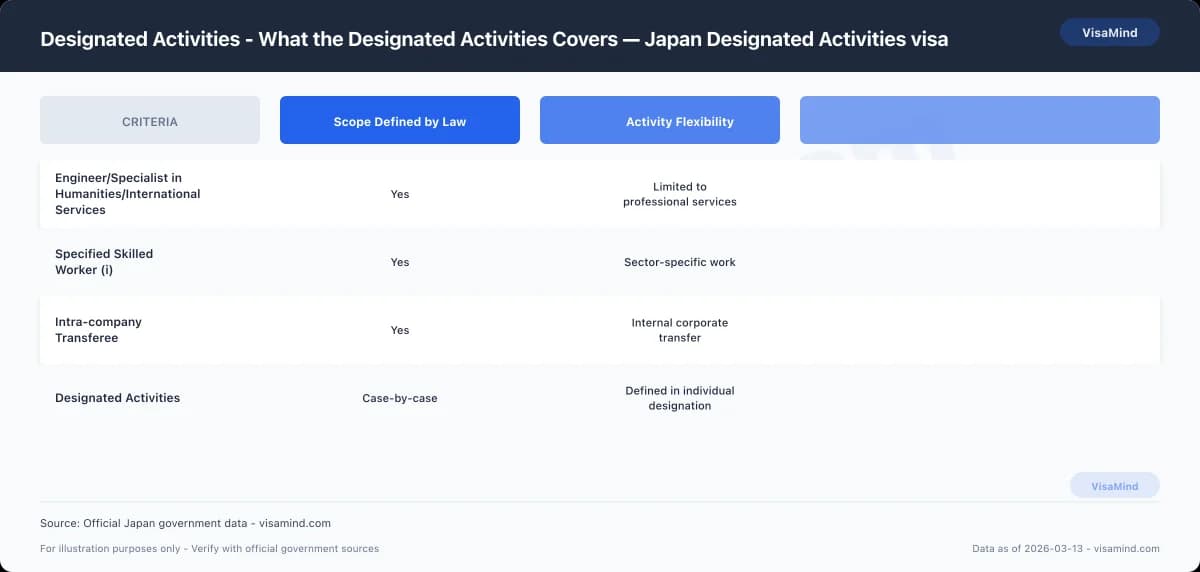
| Status | Scope Defined by Law | Activity Flexibility |
|---|---|---|
| Engineer/Specialist in Humanities/International Services | Yes | Limited to professional services |
| Specified Skilled Worker (i) | Yes | Sector-specific work |
| Intra-company Transferee | Yes | Internal corporate transfer |
| Designated Activities | Case-by-case | Defined in individual designation |
Your permitted activities are written directly into your approval.
You must follow those conditions exactly.
The ISA may impose restrictions such as:
- Specific employer or host organization
- Defined project or purpose
- Limited duration
- Restrictions on paid work
If you engage in activities outside your designation, you risk violating your status of residence.
Always confirm what your approval states before beginning work or any compensated activity.
Official form and source
The Immigration Services Agency of Japan (出入国在留管理庁) (ISA) manages all applications under this category.
You generally complete the process in two stages:
-
Certificate of Eligibility (CoE) Application filed in Japan
-
Visa Application submitted at a Japanese embassy or consulate
Your Form CoE Application must clearly describe the exact activity you will perform.
The ISA reviews whether your case fits a publicly designated activity.
Key documents typically include:
- Application for Certificate of Eligibility
- Detailed explanation of activities
- Supporting documents from your sponsor or host
- Identification documents
The ISA issues the final decision on whether your activity qualifies under Designated Activities.
For application forms and current requirements, refer to the Immigration Services Agency of Japan (ISA).
Application Process
#You file through the Immigration Services Agency of Japan (ISA) and then apply for a visa at a Japanese embassy or consulate.
The process involves preparing the correct form, securing a Certificate of Eligibility (CoE) when required, and completing a consular Form Visa Application.
Getting the form and preparing your filing
Use only the latest version.
Complete every required field, sign where indicated, and attach all supporting evidence specified in the instructions.
Incomplete forms or missing documents delay review.
Use this checklist before filing:
- Correct Designated Activities application form
- All required supporting documents listed by ISA
- Your signature where required
- Any sponsor documents, if applicable
Submitting an application does not guarantee approval.
ISA reviews your eligibility based strictly on the activity category authorized under this status, which differs from categories such as Highly Skilled Professional, Engineer/Specialist in Humanities/International Services, Specified Skilled Worker (i), Specified Skilled Worker (ii), or Intra-company Transferee.
Always confirm current document requirements with ISA before submission.
Certificate of Eligibility (CoE) & sponsor role
Many applicants first obtain a Certificate of Eligibility (CoE) through a sponsor in Japan.
The sponsor typically files the Form CoE Application with ISA on your behalf.
Your sponsor’s role may include:
- Preparing and submitting the CoE Application
- Providing supporting documentation about the planned activity
- Confirming the nature and duration of your stay
A CoE confirms that ISA has reviewed your planned activities in Japan.
However, a CoE does not guarantee visa issuance.
If you have a criminal record or prior immigration violations in Japan, the authorities may deny your case even if ISA issued a CoE.
| Stage | Authority | Key Point |
|---|---|---|
| CoE review | Immigration Services Agency (ISA) | Confirms eligibility for planned activities |
| Visa decision | Japanese Embassy/Consulate | Makes independent final determination |
Consular visa application and final decision
After receiving your CoE (if required), apply for your visa at the Japanese Embassy or Consulate in your country of residence.
File your Visa Application at least 2–3 weeks before your intended travel date.
Processing typically takes 5 business days, but peak seasons may extend this timeline.
The consulate independently reviews your case.
It may deny your visa even if ISA approved your CoE.
Plan your travel only after visa issuance.
The final decision rests with the consular officer, not with ISA.

Dependents
#Your spouse and children can join you in Japan, but they must complete their own immigration process.
Most family members need a Certificate of Eligibility (CoE) before applying for a visa, and processing through the Immigration Services Agency of Japan (ISA) takes time.
When dependents need a CoE
If you hold a long-term status under the Japan Designated Activities visa, your dependents generally require a Certificate of Eligibility (CoE) before they apply for a visa at a Japanese embassy or consulate.
ISA requires a CoE for long-term stays, including dependent visas linked to work categories such as:
- Highly Skilled Professional
- Engineer/Specialist in Humanities/International Services
- Intra-company Transferee
- Specified Skilled Worker (i)
- Specified Skilled Worker (ii)
The same principle applies if your Designated Activities status connects to programs such as ISA-approved internships or other long-term assignments.
CoE processing typically takes 1–3 months.
A missing CoE is a common reason for visa refusal.
| Step | Who Handles It | Key Point |
|---|---|---|
| Form CoE Application | Sponsor in Japan submits to ISA | Required before Form Visa Application |
| Visa Application | Dependent applies at embassy/consulate | Must present approved CoE |
| Entry Inspection | Immigration officer at airport | Final decision on entry |
Applying for spouse and children
Your sponsor in Japan submits the CoE application to ISA on behalf of your spouse and children.
You can’t skip this step for long-term dependent stays.
Follow this sequence:
-
Sponsor files the CoE application with ISA.
-
ISA reviews and issues the CoE if approved.
-
Your spouse and children apply for a visa using the approved CoE.
-
They travel to Japan after visa issuance.
You must ensure all required documents match the principal applicant’s status.
If you hold Designated Activities tied to employment similar to an Engineer/Specialist in Humanities/International Services or Intra-company Transferee role, your dependent applications must clearly reflect that relationship.
ISA makes the decision on both the CoE and any later status changes.
Entry considerations for family members
A visa does not guarantee entry.
Immigration officers at the port of entry make the final determination.
Your spouse and children should carry:
- Passport with valid visa
- Certificate of Eligibility
- Return ticket, if applicable
- Accommodation details in Japan
- Proof of financial support
Officers may ask how they will support themselves and where they will live.
Prepare clear, consistent answers that match the principal applicant’s status and residence plans.
If your Designated Activities status has specific conditions, ensure your family understands them.
Entry inspection focuses on compliance with the approved status and the information submitted to ISA.
What Your Employer Must Do
#Your employer controls the Certificate of Eligibility (CoE) process and must submit a complete and accurate application to the Immigration Services Agency of Japan (ISA).
Most delays happen because the sponsor files incomplete documents or submits the case to the wrong regional office.
Accuracy and consistency between the Form CoE Application and your later Form Visa Application are critical.
Sponsor responsibilities (filing the CoE)
Your employer must file the CoE Application with the Immigration Services Agency (ISA) in Japan.
You cannot submit this application yourself from abroad.
The sponsor prepares and submits the application on your behalf for the specific status listed under your Designated Activities permission.
This may relate to roles similar to Engineer/Specialist in Humanities/International Services, Intra-company Transferee, Highly Skilled Professional, or other structured categories such as Specified Skilled Worker (i) or Specified Skilled Worker (ii).
Your employer must ensure:
-
All personal details match your passport exactly.
-
Your job title, duties, salary, and contract dates are accurate.
-
The employment terms are consistent across all documents.
Any mismatch between the CoE Application and your later Visa Application can lead to rejection.
ISA officers compare both filings carefully.
Company documentation to include
ISA reviews both your qualifications and the company’s legitimacy.
Incomplete corporate evidence is the most common reason for processing delays.
Your employer should include:
- Company registration certificate (登記事項証明書)
- Most recent financial statements
- Business overview document describing operations
- Your diplomas and documented work history
ISA uses these documents to confirm that the company operates legally and can support the offered position.
| Document Type | Purpose |
|---|---|
| Company registration certificate | Confirms legal establishment in Japan |
| Financial statements | Demonstrates business stability |
| Business overview | Explains operations and role necessity |
| Applicant qualifications | Verifies eligibility for assigned duties |
If your role resembles established work categories such as Engineer/Specialist in Humanities/International Services, the documentation must clearly support that alignment.
Filing at the correct regional office
Your employer must file the CoE Application at the ISA regional office with jurisdiction over the company’s location in Japan.
The correct office is based on the sponsor’s address, not your intended residence.
Filing at the wrong regional bureau causes unnecessary delay because the application may be redirected or returned.
Your employer should confirm:
- The company’s registered address
- The correct ISA regional office for that jurisdiction
- That all supporting documents match the filing location
Correct filing avoids administrative setbacks and keeps your Designated Activities process on track.
When to Get Professional Help
#You should consider professional help when your qualifications, documents, or past filings create risk under the Immigration Services Agency of Japan (ISA) review standards.
Errors in category selection, inconsistent forms, or prior refusals can lead to rejection of your Form CoE Application or Form Visa Application.
Cases that commonly need a lawyer
You need legal guidance when your background does not clearly match the status of residence you selected.
ISA reviews whether your education and work history align with the specific category requirements.
For example:
| Status of Residence | Key Qualification Standard to Verify |
|---|---|
| Engineer/Specialist in Humanities/International Services | Relevant university degree or 10+ years of related experience |
| Highly Skilled Professional | Must meet the criteria of the designated category claimed |
| Specified Skilled Worker (i) / (ii) | Must match the requirements of the selected SSW classification |
| Intra-company Transferee | Must fit the defined employment transfer structure |
You should seek help if:
- Your degree does not directly relate to your job duties.
- You rely on work experience instead of formal education.
- Your employer assigns you duties that differ from your job title.
Misalignment between your qualifications and the selected status often leads to rejection.
A lawyer can assess whether the Japan Designated Activities visa is appropriate or whether another status fits your profile better.
Handling inconsistent or missing evidence
ISA reviews your CoE Application and Visa Application for internal consistency. Even minor discrepancies can cause delays or lead to refusal.
You should get help if:
- Your passport details don’t match the information on your forms.
- Employment dates are inconsistent across your documents.
- Your job description doesn’t fit your selected visa category.
- Required fields are left incomplete.
Use the exact information from your official documents. Don’t estimate dates or abbreviate names differently on separate forms.
A professional will:
-
Cross-check each entry against your passport and certificates.
-
Confirm your employment history supports the status you claim.
-
Make sure all answers stay consistent across every submission.
If you previously applied under Engineer/Specialist in Humanities/International Services or Highly Skilled Professional and now want Designated Activities, consistency is even more important. ISA compares your records.
Prior denials or complex employer structures
Consult a lawyer if ISA has denied your application before. Prior refusal means your next CoE Application or Visa Application will be examined more closely.
Risk factors include:
- Earlier rejection because your qualifications didn’t meet the category standards.
- Findings that your experience fell short of the required years.
- Inconsistencies in previous filings.
Complex employer setups need careful review. This covers:
- Transfers under Intra-company Transferee structures.
- Employers restructuring roles across related entities.
- Moving between statuses like Specified Skilled Worker (i), Specified Skilled Worker (ii), or Highly Skilled Professional.
If your job duties have changed since your last filing, you need to confirm your current qualifications support the new status. ISA looks at whether your background fits the requested category, not just the job title your employer uses.
How to Renew
#You need to track both your Certificate of Eligibility (CoE) validity and the timing of your Form Visa Application. Many renewal problems happen when applicants delay and let the CoE expire before filing the Visa Application at a Japanese embassy or consulate.
CoE and visa validity timelines
The Certificate of Eligibility (CoE) is valid for 3 months from the date of issuance.
You must submit your Visa Application at the embassy or consulate within that 3‑month window. If you miss it, the CoE is no longer usable.
| Document | Issued By | Validity | Action Required |
|---|---|---|---|
| Certificate of Eligibility (CoE) | Immigration Services Agency of Japan (ISA) | 3 months from issuance | Apply for your visa before expiration |
| Visa | Embassy/Consulate | Depends on visa issued | Enter Japan within its validity |
This applies to all categories, including:
- Highly Skilled Professional
- Engineer/Specialist in Humanities/International Services
- Specified Skilled Worker (i)
- Specified Skilled Worker (ii)
- Intra-company Transferee
- Other Designated Activities classifications
You can’t extend a CoE. You must use it within its validity period.
If a CoE expires before you apply
If your CoE expires before you file your Visa Application, you can’t use it.
Embassies and consulates won’t accept an expired CoE. The document has no effect after the 3‑month validity period ends.
When this happens:
-
You cannot proceed with the visa application.
-
Your sponsor must start again with a new Form CoE Application through the Immigration Services Agency (ISA).
-
You must wait for a newly issued CoE before applying for the visa.
This delay applies to all categories, including Highly Skilled Professional and Specified Skilled Worker (i) applicants. The immigration authority does not make exceptions based on the reason for delay.
You avoid this by scheduling your visa appointment as soon as you receive the CoE.
When the sponsor must re-file
Your sponsor must file a new CoE Application if:
- The original CoE has passed the 3‑month validity period.
- You didn’t file your Visa Application before expiration.
Only the Immigration Services Agency (ISA) can issue a new CoE.
The sponsor’s role is central for categories such as:
- Engineer/Specialist in Humanities/International Services
- Intra-company Transferee
- Specified Skilled Worker (i) and (ii)
- Certain Designated Activities cases
You can’t revive or amend an expired CoE on your own. The process restarts at the CoE stage, and you need to wait for approval before you can submit a new Visa Application.
Check the issuance date closely and act before the deadline.
Conditions and Portability
#Your admission and stay under a Japan Designated Activities visa depend on immigration inspection and the specific activities approved in your Certificate of Eligibility (CoE) and Form Visa Application. It’s important to understand how discretion at entry works, how short-stay eVisa access is different from long-term statuses, and what documents to have ready when you arrive in Japan.
Entry is at immigration’s discretion
A visa from a Japanese embassy or consulate doesn’t guarantee entry. An immigration inspector from the Immigration Services Agency of Japan (ISA) makes the final decision at the port of entry.
You must show that:
- Your purpose of stay matches your approved Designated Activities category
- Your activities align with your Form CoE Application
- You intend to follow the conditions attached to your status
If your planned activities differ from what ISA approved, the officer can refuse entry.
Portability is limited. Unlike employment-based statuses such as Engineer/Specialist in Humanities/International Services, Intra-company Transferee, or Highly Skilled Professional, a Designated Activities visa is generally tied to the specific purpose in your approval. If your situation changes, you need to apply to ISA for a status change before starting new activities.
ISA also handles requests to move from Designated Activities to categories such as Specified Skilled Worker (i) or Specified Skilled Worker (ii). You can’t switch activities first and update your status later.
Short-stay eVisa vs long-term visas
Japan runs an online visa system for short-term tourism for certain nationalities. This is only for temporary visits and doesn’t replace long-term statuses.
Compare the two:
| Feature | Short-Stay eVisa | Designated Activities (Long-Term) |
|---|---|---|
| Purpose | Tourism | Specific approved activity |
| Duration | Short stay only | As granted by ISA |
| Work permitted | No | Only if explicitly authorized |
| Requires CoE | No | Yes, in most cases |
| Overseen by | ISA at entry | ISA for approval and stay management |
You can’t enter Japan on a short-stay eVisa and begin activities that require a long-term status such as Designated Activities, Engineer/Specialist in Humanities/International Services, or Specified Skilled Worker (i).
If you intend to reside in Japan beyond a short visit, you need to complete the proper CoE Application and Visa Application process before traveling.
What to have ready at the port of entry
Bring documents that match the purpose approved in your visa and CoE. Immigration officers may ask for details verbally or in writing.
You should have:
- Your valid passport with the issued visa
- Your Certificate of Eligibility (if applicable)
- Documentation describing your approved activities
- Contact information for your sponsoring organization, if any
Make sure your explanation matches your visa category. If you hold Designated Activities connected to employment, research, training, or another defined purpose, state that purpose clearly and consistently.
Keep copies of your application details. ISA checks whether your entry matches your approved status, not your future plans.
Path to Permanent Residence
#You don’t receive permanent residence automatically under a Japan Designated Activities visa. You need to build a lawful, stable stay and usually transition to a different residence status before applying for permanent residence through the Immigration Services Agency of Japan (ISA).
Common long-term steps after the visa
Most Designated Activities holders first switch to a more standard work or residence status that supports long-term stay. ISA reviews both your current status and your residence history when you apply for permanent residence.
Common transition pathways include:
- Engineer/Specialist in Humanities/International Services
- Highly Skilled Professional
- Specified Skilled Worker (i)
- Specified Skilled Worker (ii)
- Intra-company Transferee
The usual sequence:
-
Secure qualifying employment or activity.
-
Submit a Certificate of Eligibility (CoE) Application if required for the new status.
-
File a Form Visa Application or apply for a status change with ISA.
-
Maintain continuous, lawful residence.
The table below outlines how these statuses typically function in long-term planning:
| Status | Work Scope | Long-Term Stability |
|---|---|---|
| Highly Skilled Professional | Advanced professional roles | Structured path for career-based stay |
| Engineer/Specialist in Humanities/International Services | Broad professional roles | Common long-term employment status |
| Specified Skilled Worker (i) | Sector-specific roles | Limited duration unless upgraded |
| Specified Skilled Worker (ii) | Expanded sector roles | Designed for longer-term work |
| Intra-company Transferee | Company transfers | Tied to sponsoring employer |
ISA reviews each status change individually.
When to consider PR options
You should consider permanent residence only after building a stable record under an appropriate status. A temporary or narrowly defined Designated Activities category rarely leads directly to permanent residence.
Before applying, confirm that you:
- Hold a qualifying residence status.
- Maintain continuous lawful stay.
- Comply with all conditions of your current status.
- Have accurate residence records with ISA.
Permanent residence applications go through the Immigration Services Agency of Japan (ISA). ISA reviews your immigration history, current status, and compliance record.
If you recently changed from Designated Activities to another status, allow time to show stability under the new category before applying. ISA bases its decision on your documented residence record, not plans for the future.
Eligibility Requirements
#You must meet the exact conditions for your specific Designated Activities category. The Immigration Services Agency of Japan (ISA) reviews both your eligibility and the supporting documents you submit with your Certificate of Eligibility (CoE) Application and Form Visa Application.
Reviewing category-specific instructions
Designated Activities covers multiple narrowly defined activities. Each category has its own written criteria and document list issued by the Immigration Services Agency of Japan (ISA).
Before preparing a Form CoE Application, confirm:
- The exact name of your Designated Activities category
- The permitted scope of activities
- Any limits on work hours, employer, or organization
- Required supporting documents from you and your host organization
You can’t rely on requirements for other statuses such as Highly Skilled Professional, Engineer/Specialist in Humanities/International Services, Specified Skilled Worker (i), Specified Skilled Worker (ii), or Intra-company Transferee. Each status has its own legal criteria.
If you apply under the wrong category, ISA may refuse your CoE Application or your change of status request. Always match your planned activity in Japan to the specific Designated Activities classification described in the official ISA instructions.
Confirming qualifications and experience
You need to show your background fits the category’s stated conditions. ISA reviews your education, work history, and purpose of stay against the written eligibility rules for that category.
Prepare documents that clearly prove:
- Your educational credentials, if required
- Your professional experience, if required
- A detailed activity plan or contract describing what you’ll do in Japan
- Evidence of support from a host company, school, or organization, where applicable
Your qualifications must align with the activity described in your CoE Application. If your duties overlap with Engineer/Specialist in Humanities/International Services or Intra-company Transferee, ISA may decide a different status is more appropriate.
Inconsistent job descriptions, vague activity plans, or missing documentation often lead to delays or denial at either the CoE Application or Visa Application stage.
Category examples and limitations
Designated Activities is a flexible status for cases that don’t fit standard work or residence categories. It doesn’t replace structured statuses such as:
| Status | Purpose | Structured Criteria |
|---|---|---|
| Highly Skilled Professional | Advanced professional work | Points-based assessment |
| Engineer/Specialist in Humanities/International Services | Technical or professional services | Field-specific education or experience |
| Specified Skilled Worker (i) / (ii) | Labor shortages in specific industries | Skill tests and industry designation |
| Intra-company Transferee | Transfer within a multinational company | Prior employment with related entity |
You can’t use Designated Activities to bypass the formal requirements of these categories. ISA expects your planned activity to match the designated purpose.
Some Designated Activities categories limit:
- The length of stay
- The employer or host institution
- Permission to engage in paid work
- The ability to bring dependents
If your actual activities go outside the approved scope, you need to apply for a change of status with ISA before starting that activity.
Fees and Processing Times
#You’ll need to budget for a government issuance fee and plan for a processing period that usually runs one to three months. The exact timeline depends on your Designated Activities category and the Immigration Services Agency of Japan (ISA) office handling your case.
Visa issuance fee and payment
You pay a visa issuance fee of ¥3,000 for a single-entry Designated Activities visa (as of February 2026). This fee is due when the visa is issued.
| Item | Amount (JPY) | Notes |
|---|---|---|
| Single-entry visa issuance fee | ¥3,000 | Paid upon visa issuance |
You don’t pay this fee at the time you submit your Certificate of Eligibility (CoE) application. The payment comes later, only after the visa is granted.
If you apply under a different status—like Highly Skilled Professional, Engineer/Specialist in Humanities/International Services, Intra-company Transferee, or Specified Skilled Worker (i) or (ii)—but end up with Designated Activities, confirm the correct fee with the ISA or the Japanese embassy or consulate handling your case.
Check the current fee with the Immigration Services Agency (出入国在留管理庁) or the diplomatic mission where you apply, since these amounts can change.
Standard processing ranges
For Designated Activities under standard processing, expect 1 to 3 months from submission to decision (as of March 2026).
| Stage | Typical Range |
|---|---|
| Form CoE Application (Designated Activities – standard) | 1–3 months |
The usual sequence is:
-
Submit your CoE Application to the ISA in Japan.
-
Wait for the Certificate of Eligibility to be issued.
-
File your Form Visa Application at a Japanese embassy or consulate.
The processing time depends on both the visa category and the workload at the regional ISA office. If you apply during busy periods or in a high-volume jurisdiction, expect to wait toward the longer end of the range.
Category and location variations (including priority cases)
Processing times aren’t uniform across all Designated Activities cases.
Applications connected to the Highly Skilled Professional (HSP) framework often get priority handling. HSP-related CoE applications may move faster, depending on the office.
Other statuses that intersect with Designated Activities—like Engineer/Specialist in Humanities/International Services, Intra-company Transferee, and Specified Skilled Worker (i) or (ii)—can see different review speeds based on the assignment and documents.
The specific ISA regional office matters too. Workload and internal capacity vary by location.
Before submitting your CoE Application or Visa Application, check category-specific processing details with the Immigration Services Agency.
Common Petition Challenges
#Many Japan Designated Activities visa refusals result from filing in the wrong location, inconsistent information, or incomplete supporting documents. Small mistakes can lead to rejection even if you otherwise qualify.
Applying at the wrong embassy or consulate
A frequent reason for rejection is submitting your Form Visa Application to a Japanese Embassy or Consulate that doesn’t have jurisdiction over your residence.
You must apply at the embassy or consulate that serves the area where you legally live. If you file elsewhere, your application may be refused or not processed.
This applies no matter your status, including:
- Highly Skilled Professional
- Engineer/Specialist in Humanities/International Services
- Specified Skilled Worker (i)
- Specified Skilled Worker (ii)
- Intra-company Transferee
Even if you’ve obtained a Certificate of Eligibility (Form CoE Application) through the Immigration Services Agency of Japan (ISA), your Visa Application must go to the correct embassy or consulate.
Check the following before filing:
-
Your current legal residence.
-
The embassy or consulate assigned to your area.
-
Local submission procedures.
| Issue | What Happens | How to Avoid It |
|---|---|---|
| Applying at the wrong embassy/consulate | Application may be rejected | Apply only where you reside and where the office has jurisdiction |
Inconsistent information between filings
If your CoE Application and Visa Application contain inconsistent information, you risk credibility concerns.
Personal details, planned activities, sponsoring organization, and intended period of stay must match across all filings. Mismatches in dates, job titles, or activity descriptions can cause delays or refusal.
If you previously held a status like Engineer/Specialist in Humanities/International Services or Highly Skilled Professional, make sure your new Designated Activities purpose aligns with all documents.
Review your forms line by line before submission. Don’t rely on memory—double-check everything.
Missing or insufficient supporting evidence
Incomplete documentation weakens your application and can result in rejection.
You need to submit all required supporting materials for your specific Designated Activities category. If documents are missing or unclear, the reviewing authority may decide you haven’t met the requirements.
Focus on:
- Whether each document supports your stated activity.
- Names and dates matching across documents.
- Copies being clear and legible.
The Immigration Services Agency of Japan (ISA) evaluates eligibility based on what you provide. Inadequate evidence can result in denial, even if you qualify in reality.
What Documents Do You Need? (designated activities Japan)
#You must submit precise identity documents with both your Form CoE Application and Form Visa Application. Small technical errors can delay review by the Immigration Services Agency of Japan (ISA).
Photo and biometric requirements
Your photograph has to meet strict specifications. Non-compliant photos are a common reason applications stall.
Required photo specifications
| Requirement | Standard |
|---|---|
| Size | 4.5 cm × 4.5 cm |
| Background | Plain white |
| Age of photo | Taken within the last 6 months |
| Accessories | No hats or sunglasses |
Submit a recent photo that clearly shows your full face. Avoid shadows, colored backgrounds, or edited images.
Don’t staple or damage the photo if it needs to be attached separately. A rejected photo delays processing for all categories, including Designated Activities, Highly Skilled Professional, Engineer/Specialist in Humanities/International Services, Intra-company Transferee, and Specified Skilled Worker (i) or (ii).
If your photo doesn’t meet size, background, or recency standards, ISA may ask for a replacement before continuing review.
Passport validity and visa pages
Your passport has to be valid for your entire intended stay in Japan. If it expires too soon, you risk refusal or delays.
You also need blank pages for visa attachment. Without enough space, the visa can’t be issued.
Passport checklist
- Valid for the full planned stay
- Has blank visa pages
- Not damaged or altered
If you’re applying under a Designated Activities status linked to another category—such as Highly Skilled Professional or Specified Skilled Worker (i)—passport validity is still your responsibility. ISA won’t extend your passport for you.
Renew your passport before submitting your Visa Application if it will expire during your stay.
Common document mistakes to avoid
Most delays come from preventable document errors.
Frequent issues
-
Incorrect photo size or background
-
Photo older than six months
-
Passport expiring during the intended stay
-
No blank page for visa placement
These problems affect both your CoE Application and your Visa Application. They apply whether you’re transitioning from Engineer/Specialist in Humanities/International Services, Intra-company Transferee, or applying directly under Designated Activities.
Check every document before submission. ISA reviews technical compliance first, and incomplete or incorrect documents can hold up approval.
Fees
#| Component | Amount |
|---|---|
| Visa issuance feeVisa issuance fee: ¥3,000 (approx $20 USD) (as of 2026-02). Verify the current fee on the official schedule before filing. | ¥3,000 (approx $20 USD) |
Fees change; always verify on ISA.