
Is This Comparison for You?
#A valid work contract or binding job offer for highly-qualified employment is essential if you are considering applying for an EU Blue Card in Spain. This comparison between the Spain Work Permit and the EU Blue Card is particularly beneficial for non-EU nationals aiming to legally work in Spain. Understanding which option aligns better with your professional qualifications and employment situation can significantly impact your immigration process.
Who Should Consider This Comparison?
Professionals who have received a job offer in Spain and are trying to determine the most suitable path for legal employment can benefit from comparing these two options. The Spain Work Permit is a more general option, suitable for a wider range of professions and employment types, whereas the EU Blue Card targets those in highly-skilled positions and requires meeting specific salary thresholds. If you are uncertain about which permit suits your career and qualifications, or if you are in a regulated profession where specific legal requirements must be met, this comparison will clarify your choices.
What Are the Key Considerations?
When evaluating the Spain Work Permit versus the EU Blue Card, it's important to consider factors such as eligibility requirements, salary thresholds, and the type of employment. The Spain Work Permit can be more accessible for those in unregulated professions or jobs that don't meet the high salary standards of the EU Blue Card. Additionally, if your role involves a regulated profession, you'll need to provide documentation to prove compliance with Spanish legal standards.
Important: Failing to meet the minimum salary threshold or not providing a valid work contract can result in a rejected application. Make sure to verify all eligibility criteria with the State Secretariat for Migration before proceeding.
Are You Planning to Bring Family?
For those intending to bring family members to Spain, both options allow for family reunification, although processes and documentation may vary. For detailed information on family reunification, you might want to explore the Family Reunification visa.
By understanding these aspects, you can make an informed decision on whether the Spain Work Permit or the EU Blue Card is the optimal route for your employment in Spain.
At a Glance
#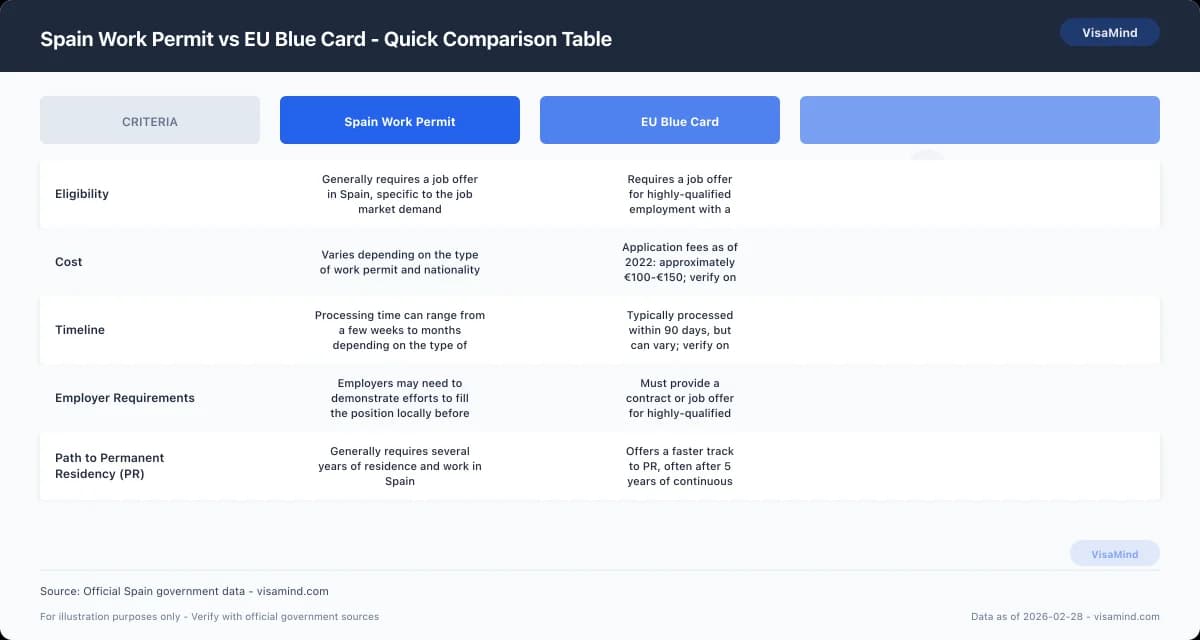
| Aspect | Spain Work Permit | EU Blue Card |
|---|---|---|
| Eligibility | Designed for a wide range of employment categories, including both skilled and unskilled positions. | Requires a highly-qualified employment contract of at least 6 months. Must meet minimum salary thresholds. |
| Cost | Varies depending on the type of work permit and nationality. Check the latest fees on the SEM website. | Fees are generally higher due to the highly-qualified nature of the position. Verify the current rates online. |
| Timeline | Processing times can range from 1 to 3 months, depending on the workload of the local immigration office. | Typically processed within 3 months. However, processing times can vary, so check the Processing Times. |
| Employer Requirements | Must provide a valid job offer or employment contract. Additional documentation may be required based on the job type. | Must provide a highly-qualified job offer. Employers may need to justify the role's need for a highly-qualified worker. |
| Path to PR | After 5 years of continuous residency in Spain, you may apply for permanent residency (PR). | Eligible for PR after 5 years of continuous residence in Spain and the EU. |
Eligibility Considerations
When considering the Spain Work Permit, eligibility is broad, encompassing various employment sectors, which may include both skilled and unskilled positions. This makes it accessible to a wider range of applicants. In contrast, the EU Blue Card is tailored for highly-qualified professionals. To qualify, you must have a job offer for highly-skilled work, meet specific salary thresholds, and, for regulated professions, demonstrate that legal requirements are met.
Cost Implications
The costs associated with each permit can vary significantly. The expenses for a Spain Work Permit depend on the type of permit and your nationality. It's crucial to verify the fees on the official SEM website to ensure accurate budgeting. The EU Blue Card generally involves higher fees, reflecting the specialized nature of the employment it covers.
Timeline for Processing
The processing times for a Spain Work Permit typically range between 1 to 3 months, but this can fluctuate based on local office workloads. For the EU Blue Card, the expected processing period is around 3 months, though variations may occur. It's advisable to consult the Processing Times for updates.
Employer Requirements
Employers play a critical role in your application process. For a Spain Work Permit, a valid job offer or employment contract is essential, and additional documentation could be required depending on the job type. For the EU Blue Card, the employer must provide a highly-qualified job offer, and they might need to justify the necessity of hiring a highly skilled worker for the position.
Tip: Ensure your employment contract or job offer meets all the specified requirements to avoid delays or denials in your application process.
Path to Permanent Residency
Both permits offer a pathway to permanent residency. After residing in Spain continuously for 5 years under a Spain Work Permit, you may apply for permanent residency. Similarly, the EU Blue Card allows for PR application after 5 years of continuous residence, not just in Spain but across the EU.
For detailed information on permanent residency pathways, refer to the PR Pathway Guide.
Option A Is Better When...
#A software developer from India received a job offer from a tech company in Barcelona. The offer was enticing but did not meet the high salary threshold required for the EU Blue Card in Spain. Concerned about his ability to secure a permit, he explored the National Work Visa option.
To proceed, he collaborated closely with his employer, who supported his application by providing the necessary job contract and company documentation. He submitted his application to the Secretaría de Estado de Migraciones (SEM), ensuring all documents met Spain’s requirements. Within three months, he received his work permit, allowing him to start his career in Spain while gaining valuable international experience.
Scenario: An Architect Considering Family Relocation
An architect from South Africa faced a dilemma: he wanted to relocate his family to Spain but worried about the complexities of the EU Blue Card requirements, especially with a spouse and two children. Additionally, his current job offer did not classify as highly-qualified employment, a key criterion for the Blue Card.
Opting for the Family Reunification path alongside a National Work Visa, he filed his application with SEM, including marriage and birth certificates, and a rental agreement in Madrid. This strategic choice enabled him to secure a work permit and bring his family to Spain within six months, without the stringent salary and qualification benchmarks of the Blue Card.
Scenario: A Marketing Specialist with Non-Regulated Qualifications
A marketing specialist from Brazil landed a job offer from a startup in Valencia. Although she had substantial experience, her qualifications were not recognized as highly-specialized under Spain's criteria for the EU Blue Card. Instead, she opted for the Spain Work Permit, which required presenting her non-regulated qualifications and job offer.
Her application to SEM involved gathering documentation, such as her university degree and letters of recommendation. Despite facing initial hesitations, her thorough preparation and clear demonstration of her role’s relevance to the company’s growth led to her successful work permit approval. Within four months, she was working in Valencia, contributing to her new company’s marketing strategy.
Tip: For non-EU nationals, choosing the right work permit path in Spain can significantly impact the ease and speed of the relocation process. Consider your job offer details and family circumstances carefully when deciding between the Spain Work Permit and the EU Blue Card.
When to Pick the Second Option
#An experienced software engineer, Maria, received an attractive job offer from a leading tech company in Madrid. The position was for a highly-qualified role, and the company promised a salary well above the minimum threshold required for an EU Blue Card. Maria's qualifications and work experience aligned perfectly with the job requirements, making her an ideal candidate for the position.
Maria decided to apply for the EU Blue Card to take advantage of its benefits, such as easier mobility within the EU and a path to long-term residency. She gathered her documents, including her work contract and proof of her professional qualifications, and submitted her application through Spain's Secretaría de Estado de Migraciones. Within three months, Maria received her EU Blue Card, allowing her to start her new job and build a career in Spain with significant flexibility for her future in Europe.
Scenario: Specialist Doctor Seeking Long-Term Residency
Dr. Ahmed, a specialist doctor from Egypt, received an offer from a prestigious hospital in Barcelona. The hospital required his expertise and was ready to sponsor his work permit. However, Dr. Ahmed was interested in a long-term residency opportunity that would allow him to work across the EU in the future. Given his specialized skills and the hospital's offer exceeding the salary threshold, the EU Blue Card was a better option for him.
Dr. Ahmed applied for the EU Blue Card, emphasizing his medical qualifications and the high demand for his expertise in Spain. The Secretaría de Estado de Migraciones processed his application, and within four months, he was granted the card. This not only secured his position in Barcelona but also offered him the chance to expand his practice across different EU countries in the coming years.
Scenario: IT Consultant with Family in Spain
Alex, an IT consultant from India, was offered a senior position at a multinational company based in Valencia. Alex's top priority was relocating with his family, who were eager to join him in Spain. The EU Blue Card was particularly appealing because it facilitated family reunification more efficiently than a standard work permit.
After ensuring his job offer met the salary and qualification criteria, Alex applied through the Secretaría de Estado de Migraciones for the EU Blue Card, including documentation for his spouse and children. The streamlined process allowed him to secure the permits for his entire family within six months. This comprehensive solution enabled Alex to transition smoothly into his new role while ensuring his family settled comfortably in Spain.
Important: The EU Blue Card is particularly advantageous for highly-qualified professionals seeking mobility and long-term residency in the EU. Always ensure your job offer meets the salary and qualification requirements before applying.
What Really Sets Them Apart
#Understanding the differences between a Spain Work Permit and the EU Blue Card can significantly impact your decision. Here's a detailed look at the key factors that set these two options apart.
Eligibility Criteria
One of the most significant differences between a Spain Work Permit and an EU Blue Card is the eligibility criteria. For the EU Blue Card, you must have a valid work contract or a binding job offer for highly-qualified employment with a duration of at least six months. Additionally, you need to meet the minimum salary threshold set by Spain. This salary threshold is designed to ensure that Blue Card holders are adequately compensated for their skills and qualifications.
In contrast, the Spain Work Permit is generally more accessible for a broader range of employment types but may require various documents depending on the job category. For example, if you're in a regulated profession, you must show that you meet the national legal requirements, whereas unregulated professions require proof of relevant higher professional qualifications.
Employment and Mobility
Regarding employment flexibility, the EU Blue Card offers greater mobility within the EU compared to a Spain Work Permit. Blue Card holders can move and work in other EU countries after meeting specific residency requirements, significantly enhancing career opportunities across Europe. This mobility is a key advantage if your career path involves potential transfers within the EU.
The Spain Work Permit, however, is more restrictive in terms of mobility outside Spain. It is tied specifically to the Spanish labor market, making it less flexible for transitioning to other EU countries. It is often a more suitable option if your employment plans are focused solely on Spain.
Family Reunification
Family reunification is an essential consideration for many applicants. Both the Spain Work Permit and the EU Blue Card allow for family reunification, but the processes and timelines can differ. The EU Blue Card generally facilitates quicker family reunification, often allowing your family to join you more swiftly in Spain. This is because the EU Blue Card is designed to attract highly-qualified professionals, and streamlined family reunification incentives are part of the package.
For those holding a Spain Work Permit, the process might be more bureaucratic, potentially involving longer wait times for approval. Nevertheless, the option remains available for bringing your family to Spain, though careful planning and understanding of the specific requirements are essential. For more detailed guidance on family reunification, you can refer to the Family Reunification visa information.
Tip: If you're considering future mobility within the EU, the EU Blue Card's flexibility can be highly advantageous compared to the Spain Work Permit.
In conclusion, the choice between a Spain Work Permit and an EU Blue Card hinges on factors like eligibility, mobility, and family reunification. Assess your career goals and personal circumstances carefully to determine which option aligns best with your needs. For more information on these visas, you may want to explore the EU Blue Card and National Work Visa sections.
Common Misconceptions
#-
EU Blue Card Qualifications: One common misconception is that any job offer in Spain qualifies for an EU Blue Card. However, the position must be for highly-qualified employment, and the applicant must meet specific professional qualifications. Additionally, the contract should have a duration of at least six months.
-
Salary Thresholds: Many assume that the salary requirements for both the Spain Work Permit and the EU Blue Card are the same. In reality, the EU Blue Card requires meeting a minimum salary threshold, which varies by Member State and is generally higher than that for a standard work permit.
Tip: Review the Documents Checklist to ensure your application meets the specific financial and professional criteria.
Application Process Confusions
-
Form Requirements: Some applicants mistakenly believe that the same application form can be used for both the Spain Work Permit and the EU Blue Card. In fact, these are distinct processes with different forms and requirements. The Highly Qualified Professional Visa may also have overlapping criteria.
-
Family Reunification: It's often misunderstood that an EU Blue Card automatically allows family reunification. While it does facilitate the process, you must still apply separately for family members through the appropriate channels, such as the Family Reunification process.
Employment and Residence Misunderstandings
-
Changing Employers: Many believe that once you have an EU Blue Card or a Spain Work Permit, you can freely change employers. However, changing employers often requires notifying the State Secretariat for Migration and possibly obtaining a new permit.
-
Residency Status: There is a misconception that holding an EU Blue Card or a work permit automatically grants permanent residency. Both are initially temporary and require renewal and meeting specific conditions to transition to long-term residency, such as the Long Term Residence pathway.
Important: Failing to renew your permit on time can affect your ability to remain in Spain. Always check the Processing Times to plan your application timeline effectively.
Converting Between Options
#Converting between a Spain Work Permit and an EU Blue Card requires understanding the specific criteria and requirements for each. Both pathways allow non-EU nationals to work in Spain, but they serve different professional categories and have distinct eligibility requirements.
Is Conversion Possible?
Yes, it is possible to transition from a Spain Work Permit to an EU Blue Card, and vice versa, but it involves meeting the eligibility criteria of the new permit type you wish to obtain. Here's a brief overview:
-
Spain Work Permit to EU Blue Card:
- You must have a valid job offer or employment contract for highly-qualified work, with a duration of at least six months.
- Ensure you meet the minimum salary threshold for highly-skilled positions in Spain.
- For regulated professions, you need to prove that you meet national legal requirements. For non-regulated professions, demonstrate higher professional qualifications.
-
EU Blue Card to Spain Work Permit:
- If moving to a position not qualifying as highly-qualified employment, you may need to apply for a standard work permit.
- Your employer must have a valid work offer, and you should meet any specific qualifications for the role.
1. Assess Eligibility:
- Review the eligibility criteria for the permit you wish to convert to. For the EU Blue Card, check salary and qualification requirements. For a work permit, ensure the job offer is in line with the Spanish labor market needs.
2. Gather Necessary Documents:
- Collect evidence of your qualifications, employment contracts, and any other supporting documents required for the new application.
3. Lodge an Application:
- Submit your application to the Secretaría de Estado de Migraciones, ensuring all documents are complete and accurate.
Tip: Always double-check the latest requirements and salary thresholds on the official SEM website before applying.
Considerations for Each Path
| Criteria | Spain Work Permit | EU Blue Card |
|---|---|---|
| Employment Type | All employment types | Highly-qualified employment |
| Salary Requirement | Minimum wage varies by role | Must meet higher salary threshold |
| Validity Duration | Typically up to 1 year, renewable | Up to 4 years (renewable) |
| Qualification Proof | Required for job-related qualifications | Higher professional qualifications needed |
For more detailed information, check the National Work Visa and EU Blue Card sections for specific requirements and procedures.
Real Scenarios
#A software developer from India received an enticing job offer from a tech company in Barcelona. The position required highly-qualified personnel, making the EU Blue Card a suitable option. The developer needed to ensure that their job offer met the minimum salary threshold set by Spanish authorities, a key eligibility criterion for the Blue Card. They carefully reviewed the offer alongside the guidelines provided by the Secretaría de Estado de Migraciones and confirmed that it surpassed the required salary level.
To proceed, they gathered the necessary documents, including their work contract and proof of qualifications, and submitted their application through the designated immigration office. Within three months, their EU Blue Card was approved, allowing them to relocate to Spain and start their new role.
Scenario: Marketing Specialist Opting for a National Work Visa
A marketing specialist from Argentina was hired by a growing digital marketing agency in Madrid. The position did not require the high skill level necessary for an EU Blue Card, leading the specialist to consider the National Work Visa. This option was more suited to their circumstances, as it allowed them to work legally in Spain without needing to meet the specific salary and qualification criteria of the Blue Card.
The specialist applied through the Spanish consulate in Buenos Aires, providing their employment contract and a valid travel document. They also coordinated with their employer to ensure all required documentation was in order. After careful preparation and submission, the visa was granted within six weeks, enabling them to move to Spain and begin working in their new capacity.
Scenario: Engineer Transitioning from Schengen Business Visa
An engineer from South Africa initially entered Spain on a Schengen Business Visa for a short-term project. During their stay, they received a job offer from a Spanish company specializing in renewable energy solutions. The engineer, aiming for a long-term stay, decided that an EU Blue Card would be the most appropriate route, given the skilled nature of their new position.
They applied for the EU Blue Card through the Secretaría de Estado de Migraciones, submitting their employment offer, proof of qualifications, and other necessary documents. The transition from a business visa to a long-term work permit was completed smoothly within four months, allowing the engineer to continue their career in Spain without any interruption.