
Who Should Read This
#To begin your journey toward retirement in Thailand, it's important to note that foreign nationals must be at least 50 years old to apply for a retirement visa. This guide is particularly relevant for individuals planning to spend their golden years in Thailand, a country renowned for its tropical climate, affordable cost of living, and vibrant culture.
Who Is This Guide For?
This guide is designed for those who wish to navigate the retirement visa process, officially known as the Non-Immigrant Visa O-A (Retirement) or Non-Immigrant Visa O-X (10-year Retirement). If you are considering relocating to Thailand for an extended period, possibly even permanently, this guide will provide valuable insights into the necessary steps, requirements, and considerations for obtaining a retirement visa.
When to Use This Guide
This guide is essential for individuals who are currently outside Thailand and are planning to apply for an e-Visa. It provides detailed information on how to create an account on the Thai e-Visa website, complete the online application, and upload all required supporting documents. Ensuring that your application is lodged correctly and that all necessary documentation is included will help avoid common pitfalls, such as having your application rejected due to missing documents.
Additional Considerations
Applicants will find this guide useful if they are also interested in understanding the differences between various visa options available for long-term stays in Thailand. Exploring alternatives such as the Thailand Elite Visa and the Permanent Residence can provide additional pathways for those looking to enjoy a more extended stay.
Tip: Always verify the most updated requirements and procedures on the official website of the Immigration Bureau of Thailand to ensure compliance with current regulations.
The Big Picture
#Retiring in Thailand is an attractive option for many individuals seeking a peaceful and cost-effective lifestyle. To facilitate this, the Thailand Retirement Guide provides comprehensive information on applying for a retirement visa, focusing on the necessary steps and requirements. This guide is instrumental for navigating the application process through the Immigration Bureau of Thailand and the Royal Thai Embassies and Consulates abroad.
What is a Retirement Visa?
The retirement visa for Thailand, often referred to as the Non-Immigrant Visa O-A (Retirement), allows individuals aged 50 and above to reside in Thailand for an extended period. There is also the Non-Immigrant Visa O-X (10-year Retirement) option for those seeking longer stays. These visas are specifically designed for retirees who meet the financial and health requirements set by Thai authorities.
Key Steps in the Application Process
Applying for a retirement visa involves several critical steps, primarily conducted through the Thai e-Visa system:
1. Account Creation:
Initiate the process by creating an account on the Thai e-Visa website. 2.
Application Submission:
Complete the application form online, ensuring all personal and financial details are accurate. 3.
Document Upload:
Upload necessary supporting documents, including proof of financial stability and health insurance. 4.
Fee Payment:
Pay the requisite visa fee online. 5.
Processing Period:
Wait for the visa to be processed, which typically takes a few weeks. 6.
Confirmation Receipt:
Receive your e-Visa confirmation document by email.
Important: Ensure you are not in Thailand when applying for an e-Visa, as this is a common pitfall that can delay the process.
Required Documents
To successfully apply for a retirement visa, you must prepare and submit several essential documents:
- Valid passport with at least one year of validity
- Proof of financial means, such as a bank statement showing a minimum balance or income
- Health insurance policy that meets Thai requirements
- Recent passport-sized photographs
- Completed visa application form
Supporting documents must be uploaded online and may need to be presented in person at a Royal Thai Embassy or Consulate-General.
Common Pitfalls to Avoid
While the process is straightforward, there are common pitfalls applicants should be aware of:
- Incomplete Documentation: Failing to upload all required supporting documents can result in application delays.
- Wrong Timing: Applying while present in Thailand is not allowed and can complicate the process.
For more detailed guidance on preparing your documents, you can refer to the Documents Checklist.
Related Visa Options
In addition to retirement visas, Thailand offers various other long-term stay options, such as the Thailand Elite Visa and Permanent Residence. Each option has distinct advantages and requirements, making it crucial to select the one that best fits your long-term plans in Thailand.
Tip: Consider consulting the Visa Extension Guide if you plan to extend your stay beyond the initial visa period.
Overall, the Thailand Retirement Guide serves as a vital resource for understanding the retirement visa application process, ensuring that future retirees can enjoy a seamless transition to their new life in Thailand.
Who Qualifies
#To qualify for a retirement visa in Thailand, you must meet specific criteria set by the Immigration Bureau of Thailand. The process involves several requirements and prerequisites to ensure eligibility.
Basic Eligibility Requirements
- Age Requirement: You must be at least 50 years old to qualify for a retirement visa.
- Financial Requirements:
- Bank Account: Maintain a Thai bank account with a minimum balance of 800,000 THB for at least three months before applying.
- Monthly Income: Alternatively, you can show proof of a monthly income of at least 65,000 THB.
- Combination: A combination of bank balance and annual income totaling 800,000 THB is also acceptable. For detailed financial documentation, refer to the Financial Requirements guide.
Prerequisites
- Outside Thailand: You must apply for the e-Visa from outside Thailand. Being in Thailand during application submission is a common pitfall.
- Health Insurance: Obtain health insurance that meets the requirements specified by the Thai authorities. For the Non-Immigrant Visa O-A (Retirement), this typically includes coverage of at least 400,000 THB for inpatient and 40,000 THB for outpatient treatment.
- Police Clearance Certificate: Provide a police clearance certificate from your home country or the country where you have resided for the past year.
Required Documentation
- Passport: A valid passport with at least 18 months of validity remaining.
- Application Form: Complete the online application through the Thai e-Visa platform.
- Photographs: Recent passport-sized photographs as per the specifications listed on the application guidelines.
- Financial Statements: Bank statements or proof of income to substantiate financial requirements.
- Health Certificate: A medical certificate confirming you are free from certain diseases such as leprosy, tuberculosis, and drug addiction.
Important: Ensure all documents are submitted in English or Thai and are certified where necessary. Missing documents can lead to delays or rejection.
For more detailed instructions on the application process, consider checking the How To Apply guide. Additionally, consult the Documents Checklist to ensure you have all necessary paperwork in order. By meeting these criteria and preparing thoroughly, you can streamline your application for a retirement visa to enjoy your stay in Thailand.
The Process from Start to Finish
#1. Determine Eligibility
Before you begin the process, ensure you meet the eligibility criteria for a Thailand retirement visa. Typically, this involves being 50 years or older, having no intention to work in Thailand, and possessing adequate financial means. You must remain outside Thailand when applying for the e-Visa, as in-country applications are not accepted. To dive deeper into specific eligibility requirements, you may refer to the Retirement section for more detailed information.
2. Create an Account on the Thai e-Visa Website
Start by creating an account on the Thai e-Visa portal. This is where you will manage your application and track its progress. Ensure that you have a stable internet connection and a valid email address ready.
3. Complete the Online Application Form
Once your account is set up, proceed to complete the online application form. Be thorough and accurate with your information to avoid delays. Refer to the How To Apply guide for additional pointers on filling out the application correctly.
4. Upload Supporting Documents
The application process requires you to upload several supporting documents. These may include your passport, proof of financial stability, and other documentation as specified by the Immigration Bureau. Ensure that you have digital copies of these documents prepared and that they meet the upload specifications on the e-Visa platform.
Important: Failing to upload all required documents can result in processing delays or application rejection.
5. Pay the Visa Fee
After uploading your documents, you will need to pay the visa fee. This fee is typically paid online through the e-Visa portal. Keep a record of the payment confirmation for your reference.
6. Wait for Processing
The processing time for a retirement visa can vary, but you should generally expect a wait of several weeks. During this period, you can log into your e-Visa account to monitor the status of your application. For more details on expected timelines, consult the Processing Times guide.
7. Receive the e-Visa Confirmation
Once processed, you will receive an e-Visa confirmation document via email. This document will serve as your official visa approval until you present your passport and supporting documents in person at a Royal Thai Embassy or Consulate-General.
8. Visit the Royal Thai Embassy or Consulate-General
With your e-Visa confirmation in hand, you must visit a Royal Thai Embassy or Consulate-General to finalize your visa. Bring your passport and any additional required documents. This step is crucial for the issuance of your retirement visa.
Tip: Plan your visit to the embassy or consulate well in advance, considering their operational hours and any regional holidays that might affect processing times.
Completing these steps will lead you to successfully obtaining a retirement visa for Thailand. Each stage is vital, so ensure you follow the guidelines accurately and prepare all necessary documents as per the Documents Checklist.
Costs and Timeline
#
Important: Ensure you are not in Thailand when applying for an e-Visa. Applications submitted from within Thailand will not be accepted.
Costs and Fees
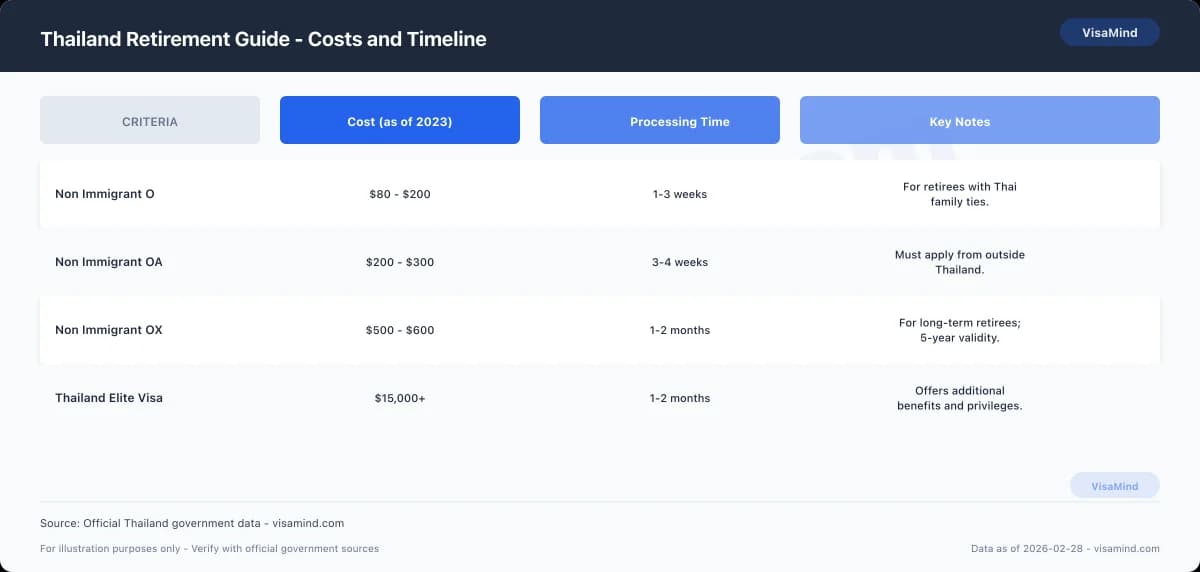
When planning your retirement in Thailand, understanding the associated costs is crucial. Below is a table detailing the fees for different types of retirement visas:
| Visa Type | Cost (THB) | Cost (USD) Approx. | Notes |
|---|---|---|---|
| Non-Immigrant Visa O-A | 5,000 | 140 | Single entry, valid for one year |
| Non-Immigrant Visa O-X | 10,000 | 280 | Multi-entry, valid for five years |
| Thailand Elite Visa | 500,000 | 14,000 | Membership fee, valid for five years |
| Permanent Residence | 191,400 | 5,350 | One-time fee, additional annual fee applies |
Tip: Currency exchange rates fluctuate, so check the current rates before making a payment.
Timeline and Processing
The processing time for your retirement visa application can vary depending on the visa type and the completeness of your application. Here's what to expect:
| Visa Type | Processing Time | Notes |
|---|---|---|
| Non-Immigrant Visa O-A | 15-20 working days | May vary based on the applicant's country of residence |
| Non-Immigrant Visa O-X | 20-30 working days | Longer processing time due to additional checks |
| Thailand Elite Visa | 1-3 months | Includes membership approval process |
| Permanent Residence | 6-12 months | Lengthy due to extensive background checks |
1. Application Submission:
Start by creating an account on the Thai e-Visa website. Follow the steps to complete your application. 2.
Document Upload:
Be prepared to upload all required documents, including your passport and financial statements. 3.
Fee Payment:
Pay the relevant visa fee online. Ensure you have a receipt for your records. 4.
Processing:
After submission, monitor your email for updates from the Immigration Bureau or the Royal Thai Embassy/Consulate-General. 5.
Visa Issuance:
Once approved, you will receive an e-Visa confirmation document via email.
For more detailed steps on the application process, refer to our How To Apply guide.
By understanding the costs and timelines associated with each visa type, you can better plan your retirement journey in Thailand. Ensure all your documents meet the requirements to avoid delays. For more on staying long-term in Thailand, check out the Long Stay section.
Tips and Best Practices
#- Start Early: Begin gathering your documents several months in advance to ensure you meet all requirements. This includes financial statements and health insurance, which can take time to arrange.
- Check Eligibility: Ensure you are not currently in Thailand when applying for a retirement visa, as applicants must apply from outside the country. Consider a Non-Immigrant Visa O if your plans involve more than retirement.
- Account Creation: Create an account on the Thai e-Visa website as your first step. This account will help you track your application status and receive updates.
Tip: Double-check that your passport is valid for at least 18 months from the date of your application to avoid any processing delays.
Document Preparation
- Comprehensive Checklist: Use a detailed checklist to ensure all required documents are ready. This includes proof of financial means, valid health insurance, and other required documentation.
- Digital Copies: Prepare high-quality scans of your documents for online submission. This includes your passport, financial statements, and proof of insurance.
- Upload Requirements: Upload all required supporting documents during the online process to avoid delays. Missing documents are a common reason for application setbacks.
Important: Failing to upload required documents can result in application rejection. Use the Documents Checklist to ensure completeness.
Navigating the Online Process
- Visa Fee Payment: Ensure you have a credit card ready for the visa fee payment. Double-check transaction completion to avoid issues.
- Confirmation and Updates: After submitting your application, monitor your email for the e-Visa confirmation document. This document is crucial for entry into Thailand.
- Processing Times: Be aware that processing times can vary. Regularly check the Processing Times guide for updates.
Avoid Common Pitfalls
- Location of Application: Remember that applications must be lodged from outside Thailand. Avoid starting the process if you are already in the country.
- Document Accuracy: Ensure all information is accurate and matches your supporting documents. Inconsistencies can lead to delays or refusals.
- Visa Type: Confirm that you are applying for the correct type of retirement visa. For longer stays, consider the Non-Immigrant Visa O-X (10-year Retirement) as an alternative.
By following these tips and best practices, you can enhance your chances of a successful application and enjoy your retirement in Thailand without unnecessary complications.
Common Mistakes
#Navigating the retirement visa process in Thailand can be straightforward if you avoid common pitfalls. Here are some frequent mistakes applicants make and how to steer clear of them:
Application Errors
-
Applying While in Thailand: One of the most common errors is applying for an e-Visa while physically present in Thailand. Remember, applicants must be outside the country to successfully lodge an application through the Thai e-Visa system.
-
Incorrect Submission: Ensure that you follow the process correctly by creating an account on the Thai e-Visa website, filling in the application form online, and uploading all necessary documents. This includes your passport and any required supporting documents.
Documentation Issues
-
Incomplete Documentation: Failing to submit all required documents is a major reason for application delays or denials. Double-check the Documents Checklist to ensure you have everything needed before submitting your application.
-
Not Reviewing Eligibility Instructions: Applicants often ignore checking the specific requirements for their eligibility category. Make sure to review the instructions relevant to your category on the official Immigration Bureau of Thailand website.
Important: Missing any required documents or submitting incorrect information can lead to delays or denial of your visa application. Always review your documents thoroughly before submission.
Financial Requirements
- Insufficient Financial Proof: Many applicants overlook the financial requirements for the retirement visa. Ensure you have the necessary proof of funds or income to support your stay in Thailand, as outlined in the Financial Requirements.
Timeliness and Follow-Up
- Ignoring Processing Times: Applicants sometimes underestimate the time it takes for visa processing. Make sure to factor in the Processing Times when planning your move.
Tip: To avoid unnecessary delays, monitor your application status regularly and ensure any additional requests from the Immigration Bureau are addressed promptly.
By understanding these common mistakes and taking steps to avoid them, you can improve your chances of a smooth application process for your retirement in Thailand.
What Other Applicants Experienced
#A retired engineer from Canada was excited to spend his golden years in Thailand but was unsure how to apply for the retirement visa while residing outside of Thailand. Understanding that he couldn't apply while in Thailand, he began the process from Canada. He started by creating an account on the Thai e-Visa website and carefully filled out the application form online. He ensured that all required supporting documents, like his financial statements and proof of retirement, were uploaded correctly. After paying the visa fee, he waited for the process to be completed. Within a few weeks, he received the e-Visa confirmation document by email, allowing him to plan his move to Thailand confidently.
Scenario: Overcoming Document Submission Challenges
An American teacher, eager to retire in Thailand, faced challenges when some of her supporting documents were not accepted during the online application process. She realized she had missed a crucial step: reviewing the instructions specific to her eligibility category on the Immigration Bureau of Thailand website. After correcting the document format and ensuring all necessary papers, such as her Non-Immigrant Visa O-A (Retirement) application, were updated, she resubmitted them. This time, her application was processed smoothly, and she received her visa without further delays. Her experience highlights the importance of closely adhering to document requirements to avoid potential pitfalls.
Tip: Always verify document specifications and eligibility criteria on the official Immigration Bureau of Thailand website to prevent submission errors.