
What Permanent Residence Grants — Thailand permanent residence
#
Thailand permanent residence gives you the right to live in Thailand without annual visa extensions. You keep your status without relying on a Non-Immigrant Visa B (Business/Work), Non-Immigrant Visa O, or Marriage Extension (Non-O), and you deal directly with the Immigration Bureau for ongoing compliance.
Who typically qualifies
You must already hold a qualifying long-term non-immigrant status before applying through the Immigration Bureau (สำนักงานตรวจคนเข้าเมือง). Most applicants transition from established visa categories.
Common backgrounds include:
- Non-Immigrant Visa B (Business/Work) holders employed by a Thai company
- Non-Immigrant Visa O holders based on marriage or family ties
- Individuals on a Marriage Extension (Non-O) with documented spousal support
- Long-term residents who maintained lawful status through repeated annual extensions
Short-term categories, such as Non-Immigrant Visa B (Business Meetings) or Non-Immigrant Visa ED (Education), generally do not reflect long-term economic or family integration on their own.
You must show consistent compliance with Immigration Bureau rules. That means timely extensions, proper reporting like Form TM.47 90-day notifications, and a clean immigration record.
Eligibility depends on your immigration history, legal stay, and documented ties to Thailand. The Immigration Bureau reviews your full record before approving permanent residence.
Reasons people apply
People apply for permanent residence to remove the uncertainty of annual visa renewals. Once approved, you no longer need to extend your Non-Immigrant Visa B (Business/Work) or Marriage Extension (Non-O) each year.
Key benefits include:
- No annual visa renewal required; PR holders can also register in the Thai household registry and may purchase condominiums without transferring funds from abroad
- Continued residence without reapplying for temporary status
- Easier access to work permits, with the option to apply for PR for non-Thai family members and eligibility to serve as directors of Thai public companies
- Streamlined long-term stay planning
You still interact with the Immigration Bureau for required procedures, including TM.47 reporting if applicable. Permanent residence does not eliminate compliance obligations.
Many applicants want stability for employment or family life. If you work under a Non-Immigrant Visa B (Business/Work), permanent residence reduces dependence on employer-sponsored extensions.
If you rely on a Non-Immigrant Visa O based on marriage, permanent residence reduces the risk tied to annual financial and relationship documentation reviews.
How PR fits into longer-term plans
Permanent residence strengthens your long-term position in Thailand. It shifts you from temporary status to an indefinite right of residence, subject to Immigration Bureau regulations.
You stop structuring your life around annual Form Visa Application cycles. Planning employment, property arrangements, and family matters becomes much more predictable.
| Status Type | Duration | Annual Extension Required | Immigration Reporting |
|---|---|---|---|
| Non-Immigrant Visa B (Business/Work) | Temporary | Yes | TM.47 required |
| Non-Immigrant Visa O / Marriage Extension (Non-O) | Temporary | Yes | TM.47 required |
| Permanent Residence | Indefinite | No annual visa extension | TM.47 may still apply |
Permanent residence often serves as a foundation for deeper integration in Thailand. You maintain lawful status without restarting your stay each year, while continuing to comply with Immigration Bureau procedures.
-
Eligibility to apply for Thai citizenship after holding PR status for 10 years
-
A secure, permanent base in Thailand without reapplying for temporary status
Official sources: https://www.thailand.go.th/public/index.php/visit-thailand-detail/applying-for-thailand-permanent-residency-pr-visa
Maintaining PR Status (Thailand PR)
#You must continue meeting Immigration Bureau requirements after you receive Thailand permanent residence. Your immigration history, visa background, and official records remain relevant even after approval.
Residence expectations before and after PR
Before you qualified for permanent residence, you held a valid non‑immigrant visa and maintained residence in Thailand for at least three consecutive years. Many applicants build eligibility through visas such as:
- Non-Immigrant Visa B (Business/Work)
- Non-Immigrant Visa B (Business Meetings)
- Non-Immigrant Visa ED (Education)
- Non-Immigrant Visa O
- Marriage Extension (Non-O)
Your long-term stay under one of these categories forms the foundation of your PR status.
After you obtain PR, you no longer rely on annual extensions under those non-immigrant categories. Your residence in Thailand must remain consistent with the conditions recognized by the Immigration Bureau at the time of approval.
You should maintain clear proof that Thailand remains your primary place of residence. If your circumstances change significantly, confirm your obligations directly with the Immigration Bureau.
| Stage | Immigration Status | Key Requirement |
|---|---|---|
| Before PR | Valid Non-Immigrant Visa | Continuous residence for at least 3 years |
| After PR | Thailand Permanent Resident | Ongoing compliance with Immigration Bureau rules |
Record-keeping and official documents
You must keep complete immigration records. This includes copies of:
- Your original Form Visa Application
- Previous non-immigrant visa stamps
- Extension approvals (such as Marriage Extension (Non-O))
- PR approval documentation
- Any filings made with the Immigration Bureau, including Form TM.47, if applicable to your situation
Organize these documents chronologically. You may need them when dealing with administrative matters or status verification.
If you previously held a Non-Immigrant Visa B (Business/Work) or Non-Immigrant Visa ED (Education), retain evidence of that lawful stay. The Immigration Bureau relies on your documented immigration history.
Do not discard older passports that contain relevant visa stamps or entry records. They remain part of your official file.
Consequences of non-compliance
Your PR status depends on compliance with Immigration Bureau regulations. Failure to follow reporting, documentation, or procedural requirements can create administrative problems.
If you ignore required filings or fail to maintain proper records, you risk complications when interacting with immigration authorities. Issues may arise during status verification or when updating official documents.
Serious or repeated non-compliance can lead to review of your immigration standing. You should address any uncertainty directly with the Immigration Bureau before taking action that could affect your residency status.
You are responsible for understanding and meeting your obligations. Don’t rely on assumptions based on your prior Non-Immigrant Visa B, Non-Immigrant Visa O, or other temporary status.
How to Apply
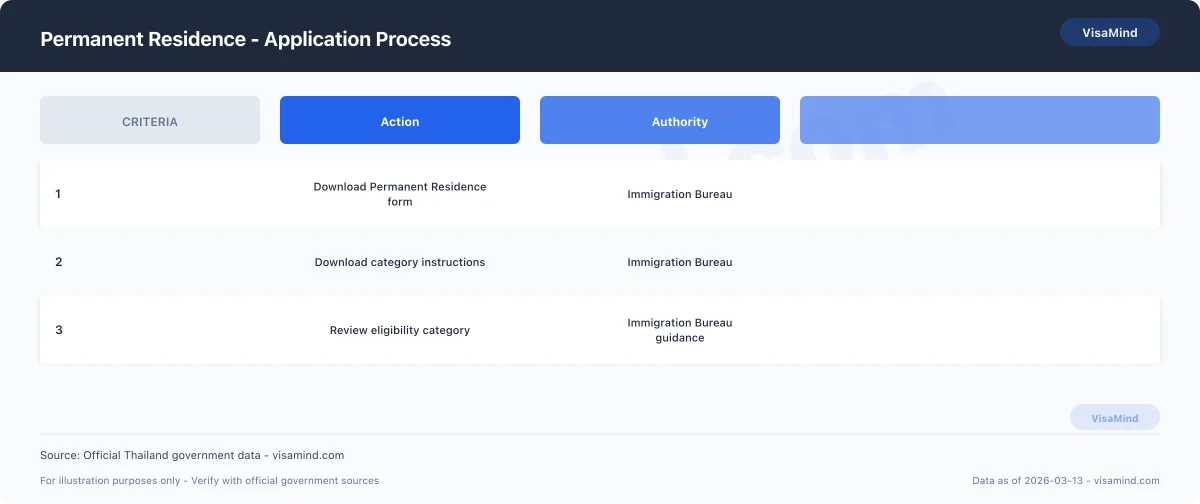
#You must use the official Permanent Residence form issued by the Immigration Bureau (สำนักงานตรวจคนเข้าเมือง). Follow the written instructions closely, complete every required section, and submit the form with all supporting evidence in one package.
Download and read the official form and instructions
Use only the latest version available on the official site.
Read the instructions that apply to your specific eligibility category before you begin. Your category may relate to a visa you currently hold, such as:
| Current Status | Example Visa Type |
|---|---|
| Employment | Non-Immigrant Visa B (Business/Work) |
| Business activities | Non-Immigrant Visa B (Business Meetings) |
| Education | Non-Immigrant Visa ED (Education) |
| Family or marriage | Non-Immigrant Visa O or Marriage Extension (Non-O) |
Check whether your ongoing compliance history, including reports such as Form TM.47, aligns with the requirements described in the instructions.
Do not rely on summaries or third-party guides. The Immigration Bureau instructions control what you must file and how you must prepare it.
Filling out the permanent-residence form
Complete every required field in the Permanent Residence form. Don’t leave mandatory sections blank.
Follow these core steps:
-
Enter your personal details exactly as shown in your passport and current visa.
-
Identify your eligibility category correctly.
-
Provide accurate information about your current immigration status.
-
Sign the form where required.
Write clearly and use consistent information across all documents. Your visa classification—such as Non-Immigrant Visa B (Business/Work) or Non-Immigrant Visa O—must match your supporting records.
Review the checklist in the official instructions before you finalize the form. Missing signatures or incomplete sections can delay acceptance.
If any part of the form does not apply to you, follow the instructions on how to indicate that properly rather than leaving it unanswered.
Submitting the application and supporting evidence
Submit the completed Permanent Residence form together with all required supporting documents to the Immigration Bureau as instructed on the official form.
Your application package should include:
- The signed Permanent Residence form
- All documents listed in the official instructions for your category
- Evidence that supports your current visa status (for example, Non-Immigrant Visa ED, Non-Immigrant Visa B, or Marriage Extension (Non-O))
- Any required immigration records, such as recent TM.47 reports if applicable
Organize your documents in the order listed in the instructions. Clear labeling and complete documentation reduce processing issues.
Before submission, confirm on the Immigration Bureau website that you are using the correct form version and following the most current filing guidance.
When to Get Help
#You should involve a qualified professional when your immigration record is not straightforward, when your eligibility sits near a cutoff, or when local processing practices affect your case. Permanent residence decisions depend not only on category but also on where and how your file moves through the Immigration Bureau.
Complex immigration or employment histories
Seek advice if you have held multiple visa types, changed employers, or shifted between categories such as Non-Immigrant Visa B (Business/Work), Non-Immigrant Visa B (Business Meetings), Non-Immigrant Visa ED (Education), or Non-Immigrant Visa O.
Frequent status changes can create gaps, overlaps, or documentation inconsistencies. You must ensure that every Form Visa Application and extension aligns with your current basis of stay.
Pay close attention to:
- Transitions from a Marriage Extension (Non-O) to employment-based status
- Periods of study under Non-Immigrant Visa ED (Education) followed by work
- Employer changes under a Non-Immigrant Visa B (Business/Work)
- Ongoing Form TM.47 reporting compliance
If your record includes interruptions or corrections, a professional can organize your history into a clear timeline and confirm that your file matches Immigration Bureau records.
| Issue Type | Why It Matters |
|---|---|
| Multiple visa categories | Officers review continuity and lawful stay |
| Employer changes | Work authorization must match your visa basis |
| Reporting gaps (TM.47) | Incomplete compliance can delay review |
processing times vary by category and by the office handling your case. Confirm current timelines directly with the Immigration Bureau.
Borderline eligibility and quota issues
You should get help if your qualifications barely meet the required standard for your chosen category. Borderline cases receive closer scrutiny.
This often applies when:
- Your income history fluctuates
- Your employment duration is close to the minimum threshold
- Your relationship status under a Marriage Extension (Non-O) recently changed
- Your education-based stay under Non-Immigrant Visa ED (Education) recently converted
An advisor can assess whether you meet the eligibility criteria before you submit your Visa Application. Filing too early or without full documentation can result in delays.
Because processing times differ by category and location, timing affects strategy. Confirm current estimates with the Immigration Bureau before deciding when to file.
Interpreting location-specific processing rules
Permanent residence applications are handled through the Immigration Bureau, but procedures and practical requirements can vary by office.
You may need guidance if:
- You relocated and now apply in a different province
- Your employment is registered in one location but you reside in another
- Your past filings, including TM.47, were made at different offices
Offices may apply internal review steps differently. While the core legal framework remains the same, document sequencing and interview scheduling can differ.
| Factor | Impact on Your Case |
|---|---|
| Processing location | Affects queue length and review pace |
| Category of application | Determines review track |
| Completeness of file | Influences whether additional requests occur |
Since processing times depend on both category and location, verify the current timeline with the Immigration Bureau before relying on informal estimates.
PR Fees and Timeline
#Thailand permanent residence requires a high government fee and a long review period. You must budget for the official charge and prepare for a wait that typically lasts most of a year.
Application and related fees
You pay a government application fee of ฿191,400 for Thailand permanent residence (as of February 2026). The Immigration Bureau (สำนักงานตรวจคนเข้าเมือง) collects this amount when you submit your permanent residence application.
| Item | Amount (THB) | Paid To |
|---|---|---|
| Permanent Residence Application Fee | ฿191,400 | Immigration Bureau |
This fee applies no matter if you currently hold a Non-Immigrant Visa B (Business/Work), Non-Immigrant Visa B (Business Meetings), Non-Immigrant Visa ED (Education), or Non-Immigrant Visa O, including a Marriage Extension (Non-O).
You should also budget for costs tied to maintaining your current status while your PR application is pending. For example, you must continue filing Form TM.47 90-day reports and keep your underlying visa or extension valid until approval.
For the most current fee details or any additional government charges, confirm directly with the Immigration Bureau before you submit your application.
Standard processing window
The standard processing time for Thailand permanent residence is 6 to 12 months (as of March 2026). The Immigration Bureau manages this review period.
| Stage | Typical Timeframe |
|---|---|
| PR Application Processing | 6–12 months |
You should expect several months of review even in straightforward cases. The clock generally runs from the time the Immigration Bureau formally accepts your complete application.
During this period, you must maintain your valid non-immigrant status (such as Non-Immigrant Visa B, ED, or O). You also need to comply with 90-day reporting (TM.47).
Avoid gaps in extensions, including a Marriage Extension (Non-O), if that applies to you. If your underlying status expires or becomes invalid, your PR process can face delays or complications.
Factors that change wait times
While the standard window is 6–12 months, individual timelines vary. The Immigration Bureau reviews each case based on documentation, eligibility category, and their current workload.
Wait times often increase if your application contains incomplete or inconsistent information. Changing employers while holding a Non-Immigrant Visa B (Business/Work) or switching visa categories—such as from Non-Immigrant Visa ED (Education) to Non-Immigrant Visa O—can also slow things down.
Missing a TM.47 report or failing to maintain continuous lawful status may cause further delay. You reduce risk by submitting a complete file, keeping your visa valid, and responding promptly to any Immigration Bureau requests.
Renewing Your PR Card
#You must keep your Permanent Residence documents current to avoid administrative issues with the Immigration Bureau. This includes your alien registration book and your Certificate of Residence, as well as confirming any updated requirements that may apply to your status.
Alien book / certificate of residence details
As a permanent resident, you receive an alien registration book (red book) and a Certificate of Residence (pink book). These documents confirm your legal status in Thailand and record key personal details.
The current government fee for issuing the alien registration book is:
| Document | Fee (THB) | Authority |
|---|---|---|
| Alien registration book | ฿7,600 | Immigration Bureau |
You pay this fee directly to the Immigration Bureau at the time of issuance or replacement. Always confirm the latest fee schedule with the Immigration Bureau before filing.
Your Certificate of Residence (pink book) serves as local address confirmation. Requirements and procedures for issuance or replacement can change. You must verify current rules directly with the Immigration Bureau before applying.
If you previously held a Non-Immigrant Visa B (Business/Work), Non-Immigrant Visa B (Business Meetings), Non-Immigrant Visa ED (Education), or Non-Immigrant Visa O, your PR status replaces those temporary visas. Your alien book becomes your primary immigration identity document.
Keep both books accurate and in good condition. Report errors to the Immigration Bureau promptly.
When to renew or replace documents
Permanent residence itself does not function like a temporary visa extension such as a Marriage Extension (Non-O) or a stay based on a Non-Immigrant Visa B (Business/Work). However, you must replace documents when specific events occur.
You should contact the Immigration Bureau if your alien registration book is lost, stolen, or damaged. Update them if your personal details change (such as name or marital status), your address changes and needs updating, or if an officer instructs you to obtain a replacement.
Follow these steps:
-
Confirm document requirements with the Immigration Bureau.
-
Prepare supporting identification and your existing PR documents.
-
Pay the applicable government fee.
-
Attend in person if required.
Do not assume requirements match your prior visa process. Permanent residence documentation follows its own procedures.
Continue filing Form TM.47 (90-day reporting) if required under current rules. Verify whether your reporting obligations remain active.
Verify current requirements with Immigration
The Immigration Bureau (สำนักงานตรวจคนเข้าเมือง) controls all permanent residence documentation. Requirements, forms, and processing steps can change without notice.
Before renewing or replacing documents, confirm required forms and whether an appointment is necessary. Check for updated fees and reporting obligations such as TM.47.
Do not rely on outdated information from prior visa categories such as Non-Immigrant Visa ED (Education) or Non-Immigrant Visa O. Permanent residence procedures differ from temporary stay extensions.
Check directly with the Immigration Bureau office that has jurisdiction over your registered address. Officers will confirm the correct process based on your current status and record.
Who Qualifies
#You must hold a valid non-immigrant visa and maintain continuous residence in Thailand for at least three years before you apply. The Immigration Bureau (สำนักงานตรวจคนเข้าเมือง) reviews your visa history, purpose of stay, and the category under which you file your application.
Visa and residence duration requirements
You must hold a non-immigrant visa and complete at least three consecutive years of residence in Thailand before submitting your permanent residence application. Your status must remain valid throughout that period.
This includes maintaining extensions properly and complying with reporting duties such as Form TM.47 (90-day reporting), where required.
Common qualifying visa types include:
- Non-Immigrant Visa B (Business/Work)
- Non-Immigrant Visa B (Business Meetings)
- Non-Immigrant Visa ED (Education)
- Non-Immigrant Visa O
- Marriage Extension (Non-O)
The Immigration Bureau will review your visa history as part of your application. Gaps in status or non-compliance may affect eligibility.
| Requirement | What You Must Show |
|---|---|
| Visa type | Valid non-immigrant visa |
| Residence period | At least 3 consecutive years |
| Status compliance | Proper extensions and required reporting (e.g., TM.47) |
| Application authority | Immigration Bureau |
Eligible application categories
You must apply under a recognized category accepted by the Immigration Bureau. The category must match the purpose of your stay during the qualifying period.
Recognized categories include:
- Investment
- Employment (Work)
- Humanitarian reasons
- Specialist roles
- Specific cases determined by authorities
If you worked in Thailand, your application typically falls under the employment category. If you stayed based on family ties, you may qualify under humanitarian grounds.
Your visa history must match the category you select. For example, employment-based applicants generally hold a Non-Immigrant Visa B (Business/Work) during the qualifying period.
Common pathways leading to PR
Most applicants follow a structured visa progression before applying for permanent residence.
A common pathway includes:
-
Entering Thailand on a Non-Immigrant Visa B (Business/Work)
-
Maintaining lawful extensions of stay
-
Completing at least three consecutive years of residence
-
Filing a permanent residence application with the Immigration Bureau
Some professionals may hold a Smart Visa before applying, depending on their role and qualifications.
Family-based applicants often begin with a Non-Immigrant Visa O, including a Marriage Extension (Non-O), and maintain that status for the required three-year period.
Your pathway must show consistent lawful residence, a clear purpose of stay, and compliance with Immigration Bureau requirements throughout the qualifying period.
Why PR Applications Fail
#Most rejections stem from avoidable filing errors and unrealistic expectations. You must submit complete, accurate information and understand that the Immigration Bureau makes the final decision without any obligation to approve your case.
Incomplete or incorrect information
Incomplete or inaccurate details delay or derail your application. The Immigration Bureau reviews every field and compares your answers against your immigration history.
Errors often appear in personal data that does not match your passport, visa history (such as entries under Non-Immigrant Visa B (Business/Work) or Non-Immigrant Visa ED (Education)), extension records, or reporting history such as Form TM.47 submissions.
Even small inconsistencies can raise credibility concerns. If your stated status does not align with prior records, officers may question the reliability of your entire file.
You must review every form before submission. Confirm that names, dates, visa categories, and prior filings match official records exactly.
| Common Issue | Risk to Your Application |
|---|---|
| Misspelled name or incorrect passport number | Processing delay or credibility concerns |
| Incorrect visa category listed | Mismatch with Immigration Bureau records |
| Omitted prior extension or report | Perceived lack of full disclosure |
Accuracy is your responsibility. The Immigration Bureau does not correct your mistakes for you.
Missing required evidence
Submitting forms without all required supporting documents weakens your case immediately. Officers expect a complete file at the time of submission.
If you previously held a Non-Immigrant Visa B (Business Meetings), Non-Immigrant Visa O, or another qualifying visa, you must provide documentation that supports your status history as instructed. Missing records create gaps that officers cannot ignore.
Common problems include leaving out required supporting documents, providing incomplete copies, or failing to follow document instructions precisely.
An incomplete file often leads to delays. In some cases, the Immigration Bureau may refuse to proceed if key evidence is absent.
Use the official instructions from the Immigration Bureau and verify that every required item appears in your submission. Do not assume prior filings remain on record or will be retrieved for you.
No guarantee of approval
Filing for permanent residence does not create a right to approval. The Immigration Bureau evaluates each case under its own standards and discretion.
Even if you previously held lawful status under a Non-Immigrant Visa B (Business/Work), Non-Immigrant Visa ED (Education), or Non-Immigrant Visa O, approval is not automatic. Past compliance, including timely TM.47 reporting, does not obligate the authority to grant permanent residence.
You should approach the process with realistic expectations:
-
Submission does not equal acceptance.
-
Meeting basic criteria does not ensure approval.
-
Final discretion rests with the Immigration Bureau.
Your role is to present a complete, accurate, and well-documented application. The final decision remains with the government authority.
Fees
#| Component | Amount |
|---|---|
| Application feeExtracted from guide content — verify against official source | ฿191,400 (approx $5,551 USD) |
| Alien book feeCertificate of Residence (pink book) — verify against Immigration Bureau | ฿7,600 (approx $220 USD) |
Fees change; always verify on Immigration Bureau.