
What the Non-Immigrant Visa O Covers — Thailand non-immigrant O visa
#
The Thailand Non-Immigrant Visa O allows you to remain in Thailand for specific personal and family-based reasons.
It covers family relationships, retirement in certain cases, and other non-business activities approved by the Immigration Bureau (สำนักงานตรวจคนเข้าเมือง).
Who it's for
Apply for the Non-Immigrant Visa O if your stay in Thailand is based on a personal relationship or a non-commercial purpose.
Common situations include:
- Marriage to a Thai national and planning to apply for a Marriage Extension (Non-O)
- Being a parent or child of a Thai national
- Being a dependent family member of a foreigner who holds a valid Thai visa
- Remaining in Thailand for retirement under the standard Non-O category
- Needing to stay for another purpose approved by the Immigration Bureau that doesn’t involve employment or formal study
You do not use this visa for employment.
If you plan to work, you’ll need the Non-Immigrant Visa B (Business/Work).
If your main goal is full-time study, the Non-Immigrant Visa ED (Education) is the proper category.
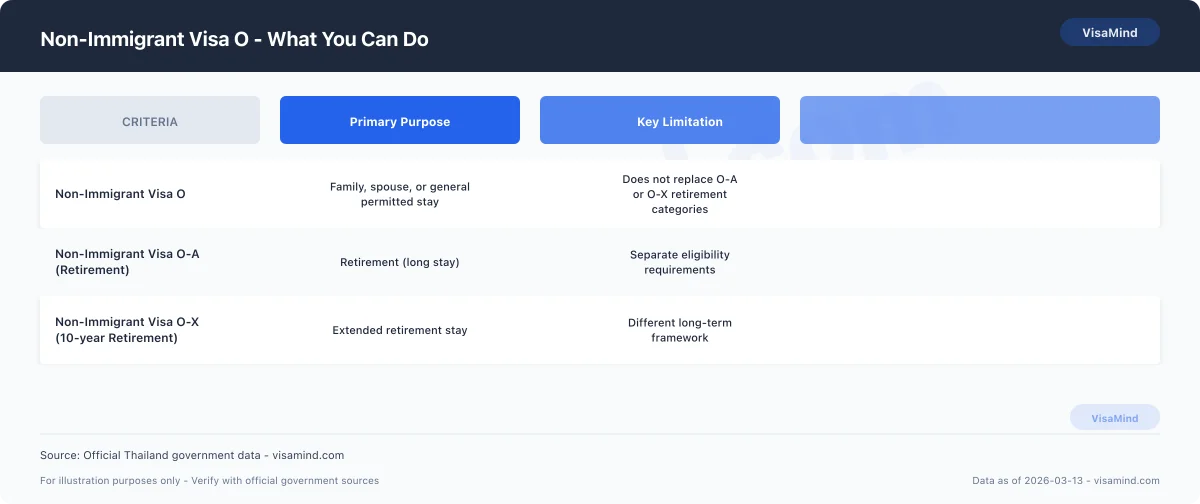
Long-term retirement with specific financial requirements falls under the Non-Immigrant Visa O-A (Retirement) or Non-Immigrant Visa O-X (10-year Retirement), each with their own rules.
Allowed purposes
The Non-Immigrant Visa O lets you stay in Thailand for clearly defined non-commercial activities approved during your Form Visa Application and monitored by the Immigration Bureau.
Typical allowed purposes:
- Living with your Thai spouse
- Staying with your Thai child or parent
- Supporting a spouse who holds a valid Thai visa
- Remaining in Thailand for retirement under the Non-O category
You need to keep the same purpose of stay throughout your permission period.
If your circumstances change, you may need to apply for a new visa or request a change with the Immigration Bureau.
Here’s a look at how the Non-Immigrant Visa O compares with related visa types:
| Visa Type | Main Purpose | Employment Allowed | Typical Applicant Profile |
|---|---|---|---|
| Non-Immigrant Visa O | Family, dependency, retirement (standard category) | No | Spouse, parent, dependent, retiree |
| Non-Immigrant Visa B (Business/Work) | Employment or business | Yes (with proper authorization) | Employee, company director |
| Non-Immigrant Visa ED (Education) | Formal study | No (unless separately authorized) | Student |
| Non-Immigrant Visa O-A (Retirement) | Long-stay retirement | No | Retiree meeting specific criteria |
| Non-Immigrant Visa O-X (10-year Retirement) | Extended retirement stay | No | Long-term retiree under special program |
On arrival, you must follow entry and reporting requirements set by the Immigration Bureau, including the Form TM.6 if it’s issued for your entry.
The Two-Stage Process
#First, you apply for your visa at a Royal Thai Embassy or Consulate.
After arrival in Thailand, you handle extensions and further matters with the Immigration Bureau (สำนักงานตรวจคนเข้าเมือง).
Each stage requires accurate forms, signatures, and supporting documents.
Where to submit
Submit your Non-Immigrant Visa O application in person at a Royal Thai Embassy or Royal Thai Consulate-General.
Bring your passport and all required supporting documents.
The embassy or consulate reviews your application and checks if it meets the category requirements.
This process applies to the standard Non-Immigrant Visa O, including cases that might lead to a Marriage Extension (Non-O) with the Immigration Bureau inside Thailand.
It’s different from other visa categories:
| Visa Type | Primary Purpose | Filed At |
|---|---|---|
| Non-Immigrant Visa O | Family, spouse, or other qualifying reasons | Royal Thai Embassy/Consulate |
| Non-Immigrant Visa B (Business/Work) | Employment or business | Royal Thai Embassy/Consulate |
| Non-Immigrant Visa ED (Education) | Study | Royal Thai Embassy/Consulate |
| Non-Immigrant Visa O-A (Retirement) | Retirement (long stay) | Royal Thai Embassy/Consulate |
| Non-Immigrant Visa O-X (10-year Retirement) | Long-term retirement | Royal Thai Embassy/Consulate |
After you enter Thailand, the Immigration Bureau takes over for extensions of stay and related matters.
If you receive a Form TM.6 arrival/departure card, keep it with your passport.
How to complete the form
Fill out all required sections of the Form Visa Application form before handing it in.
Don’t leave mandatory fields blank.
You need to:
-
Enter your personal details exactly as shown in your passport.
-
Select the right visa category (Non-Immigrant Visa O).
-
Sign the form where required.
Double-check your details.
Inconsistent names, passport numbers, or unsigned pages can delay things or cause a refusal.
If you previously held another Thai visa, such as a Non-Immigrant Visa B (Business/Work) or Non-Immigrant Visa ED (Education), make sure your details match your earlier records.
Consistency across applications helps when you later apply for an extension with the Immigration Bureau.
Submitting evidence
You must submit your passport along with all required supporting documents.
The embassy or consulate won’t finalize your request without the right evidence.
Organize your documents in a file.
Include originals and copies as required by the specific post.
Supporting documents should relate directly to your reason for applying under the Non-Immigrant Visa O category.
For example:
- Evidence of relationship for marriage-based applications
- Identification documents supporting your eligibility
- Any extra documents required by the specific embassy or consulate
If you later apply for a Marriage Extension (Non-O) inside Thailand, the Immigration Bureau will ask for a separate set of documents at that point.
Keep copies of everything you submit.
You may need these records for extensions, re-entry permits, or future applications under categories like Non-Immigrant Visa O-A (Retirement) or Non-Immigrant Visa O-X (10-year Retirement).
Fees and Processing Times — Thailand O visa
#You pay government fees when you submit your application.
processing times depend on your location and the visa category.
The Immigration Bureau sets the official fees and manages in-country extensions.
Application and extension fees
The standard Non-Immigrant O Form Visa Application fee is ฿5,000.
This fee is paid when you submit your application.
It doesn’t cover later extensions or changes of status inside Thailand.
If you apply for a stay extension—like a Marriage Extension (Non-O)—you’ll pay a separate extension fee directly to the Immigration Bureau of Thailand (สำนักงานตรวจคนเข้าเมือง).
The exact amount can change, so you need to check the current rate with the Immigration Bureau before filing.
Different visa categories have their own fee structures:
- Non-Immigrant Visa B (Business/Work)
- Non-Immigrant Visa ED (Education)
- Non-Immigrant Visa O-A (Retirement)
- Non-Immigrant Visa O-X (10-year Retirement)
Don’t assume the Non-Immigrant O fee matches these other categories.
Always verify the correct fee before you pay.
| Item | Fee (THB) | Paid To |
|---|---|---|
| Non-Immigrant O Visa Application | ฿5,000 | Issuing authority |
| Extension of Stay (e.g., Marriage Extension) | Confirm with Immigration Bureau | Immigration Bureau |
Processing time estimates
A Non-Immigrant O visa typically takes 5–10 business days under standard processing.
This estimate applies to most cases, but it can vary depending on:
- The specific Non-Immigrant O category
- The issuing location
- How busy the office is when you file
If you apply inside Thailand for an extension of stay, the Immigration Bureau handles your request separately from the initial visa issuance.
The processing times for extensions aren’t necessarily the same as for initial visa applications.
Other visa categories—like the Non-Immigrant Visa B (Business/Work) or Non-Immigrant Visa ED (Education)—have their own timelines.
You should check the current estimate with the issuing authority before making travel plans.
| Application Type | Standard Processing Time |
|---|---|
| Non-Immigrant O Visa | 5–10 business days |
Don’t book non-refundable travel until you have your approval.
Visa fees are non-refundable.
If your Non-Immigrant O visa is denied, you won’t get the ฿5,000 application fee back.
This rule applies whether you’re refused for missing documents, ineligibility, or if you withdraw your application.
You need to make sure your documents are complete and accurate before you file.
This includes any required forms and entry documentation, such as the Form TM.6, if it applies to your travel.
The Immigration Bureau won’t credit previously paid fees toward a different visa category.
If you switch from a Non-Immigrant O to a Non-Immigrant Visa O-A (Retirement) or another type, you’ll need to pay a new fee.
Extending Your Family Visa
#You extend a Non-Immigrant Visa O (Family) at the Immigration Bureau before your current permission to stay expires.
You must pay the official fee and follow the Bureau’s in-country extension process.
Extension fees and steps
The Immigration Bureau charges ฿2,000 for a family-based extension of stay (as of February 2026).
| Item | Amount (THB) | Paid To |
|---|---|---|
| Extension of stay (Non-Immigrant Visa O – Family) | ฿2,000 | Immigration Bureau |
You complete the process in Thailand at your local Immigration Bureau office.
Here’s what you do:
-
Prepare your Form Visa Application and supporting documents.
-
Go to the Immigration Bureau in person.
-
Pay the ฿2,000 government fee.
-
If approved, you’ll get your updated permission to stay.
Bring your passport and arrival record, including your Form TM.6 if you were issued one.
Officers will review your current visa category, especially if you previously held a different type like Non-Immigrant Visa B (Business/Work), Non-Immigrant Visa ED (Education), Non-Immigrant Visa O-A (Retirement), or Non-Immigrant Visa O-X (10-year Retirement) before switching to a family-based status such as a Marriage Extension (Non-O).
Confirm current document requirements directly with the Immigration Bureau, as these can change.
90-day extension note
Sometimes, the Immigration Bureau may grant a 90-day extension.
You’ll need to check your eligibility and the conditions with the Immigration Bureau before applying.
A 90-day period doesn’t remove your responsibility to keep valid permission to stay.
If you’re using short-term extensions, keep close track of your expiry date and apply before your current stamp lapses.
Check the latest policy, required documents, and processing practices with the Immigration Bureau.
Officers decide extensions based on your current Non-Immigrant Visa O status and your family relationship.
What to Submit
#You must file the correct Non-Immigrant Visa O form issued by the Immigration Bureau.
Follow the official instructions.
Prepare your supporting documents in advance and submit complete, consistent records to avoid delays.
Official form and instructions
You must use the official Non-Immigrant Visa O application form issued by the Immigration Bureau (สำนักงานตรวจคนเข้าเมือง). Always use the current version and read the instructions before filling it out.
This form is only for the Non-Immigrant Visa O category. Don’t confuse it with other visa types:
| Visa Category | Purpose |
|---|---|
| Non-Immigrant Visa B (Business/Work) | Employment or business activities |
| Non-Immigrant Visa ED (Education) | Study or academic programs |
| Non-Immigrant Visa O-A (Retirement) | Long-stay retirement |
| Non-Immigrant Visa O-X (10-year Retirement) | Long-term retirement |
Fill out every required field. If your form and supporting documents don’t match, you could face refusal or delays.
Submission procedures vary by location. Requirements differ if you apply inside Thailand through the Immigration Bureau or another authorized channel.
Documents to prepare
Gather documents that prove you qualify for the Non-Immigrant Visa O category. Your paperwork has to match your stated purpose for staying.
Prepare:
- A completed Non-Immigrant Visa O application form
- Supporting documents for your reason (like marriage certificate for a Marriage Extension (Non-O))
- Any required arrival or departure records, including Form TM.6, if it applies
- Identification and status documents that match your visa history
If you’ve previously held a different visa, such as Non-Immigrant Visa B (Business/Work) or Non-Immigrant Visa ED (Education), your records need to show lawful status before switching to Visa O.
Organize your documents in a clear order. The Immigration Bureau expects legible copies and may ask for originals.
When to Get Help
#You can file a Form Visa Application for a Thailand Non-Immigrant O visa on your own. Approval isn’t guaranteed.
Mistakes, incomplete documents, or using the wrong visa category often result in delays or refusal by the Immigration Bureau (สำนักงานตรวจคนเข้าเมือง).
When to consult a professional
If your situation doesn’t fit a clear category, consult a professional before submitting your application. The Non-Immigrant O visa covers family and retirement-related stays, but each has its own document standards.
You should seek advice if:
- You’re planning a Marriage Extension (Non-O) after entry.
- You’re unsure whether to apply for Non-Immigrant Visa O-A (Retirement) or Non-Immigrant Visa O-X (10-year Retirement).
- You previously held a Non-Immigrant Visa B (Business/Work) or Non-Immigrant Visa ED (Education) and want to change status.
- The Immigration Bureau has questioned your prior stay history or documentation.
- You’re unsure about completing arrival or departure records like the Form TM.6.
A professional can help review your eligibility, confirm your documents match your purpose, and lower your chance of refusal.
| Situation | Why Legal Review Helps |
|---|---|
| Switching visa categories | Avoid filing under the wrong visa type |
| Applying for extensions | Ensure documents meet Immigration Bureau standards |
| Prior refusals or overstays | Address issues before submission |
Common complex cases
Some cases require extra preparation because officers look at them closely. If your purpose of stay overlaps with another visa category, you need to pick the right visa from the start.
Examples include:
- Applying for a Non-Immigrant O visa when your activities look more like those under a Non-Immigrant Visa B (Business/Work).
- Studying in situations that might require a Non-Immigrant Visa ED (Education).
- Deciding between a standard Non-Immigrant O for family and a Non-Immigrant Visa O-A (Retirement) or Non-Immigrant Visa O-X (10-year Retirement).
- Moving from a temporary stay to a Marriage Extension (Non-O) without full civil documents.
If the Immigration Bureau has previously denied your Thai visa application, you’ll need to review everything carefully. Officers check for credibility and consistency across your entries, extensions, and records like TM.6.
| Complex Issue | Risk |
|---|---|
| Wrong visa category | Refusal or forced reapplication |
| Inconsistent stay history | Increased scrutiny |
| Incomplete supporting documents | Delays or denial |
Eligibility Requirements
#You must fit a specific purpose and meet the Immigration Bureau’s requirements for that category. Your sponsor (if you need one) and your own status have to match the visa purpose in your application.
Sponsor and applicant basics
You apply for a Thailand Non-Immigrant O visa based on a defined relationship or purpose. In many cases, a Thai sponsor—like a spouse or family member—supports your application.
Make sure:
- Your purpose of stay matches the Non-Immigrant O category.
- Your sponsor’s status supports your application (for example, a Thai spouse for a Marriage Extension (Non-O)).
- You use the required Form Visa Application form from the Immigration Bureau.
If you enter Thailand, you might need to complete arrival documentation like the Form TM.6 form, depending on what the Immigration Bureau asks for.
Don’t mix up the Non-Immigrant O visa with other types:
| Visa Type | Primary Purpose |
|---|---|
| Non-Immigrant Visa B (Business/Work) | Employment or business activities |
| Non-Immigrant Visa ED (Education) | Study or academic programs |
| Non-Immigrant Visa O-A (Retirement) | Retirement (long stay) |
| Non-Immigrant Visa O-X (10-year Retirement) | Extended retirement stay |
| Non-Immigrant O (Marriage/Family) | Family ties or other approved purposes |
Pick the right category before you file. Filing under the wrong category usually leads to delays or refusal.
Review your eligibility category
You qualify for a Non-Immigrant O visa only if your situation matches an approved purpose. The Immigration Bureau checks your reason for staying in Thailand and the documents you provide.
Common eligibility bases include:
- Marriage to a Thai national (often followed by a Marriage Extension (Non-O) inside Thailand).
- Family relationship with a Thai citizen.
- Other approved purposes under the Non-Immigrant O framework, not Business, Education, or Retirement categories.
If your main reason is employment, look at the Non-Immigrant Visa B (Business/Work).
If you plan to study, consider the Non-Immigrant Visa ED (Education).
If you’re retiring, compare the Non-Immigrant Visa O-A (Retirement) and Non-Immigrant Visa O-X (10-year Retirement).
Before submitting your Visa Application, review the instructions issued by the Immigration Bureau for your specific eligibility category. Each has its own documentary requirements, and you need to meet them at the time of filing.
Why Family Visas Get Denied
#Thai authorities review every Non-Immigrant O Form Visa Application individually. You need to meet the requirements and present them clearly, or the Immigration Bureau may refuse your application.
Common reasons for refusal
Submitting a Visa Application doesn’t guarantee approval.
You risk refusal if you:
- Submit incomplete forms or leave sections blank
- Provide inconsistent personal details across documents
- Fail to show a clear qualifying relationship for a family-based Non-Immigrant O visa
- Present documents that don’t match your stated purpose of stay
If you apply as a spouse for a Marriage Extension (Non-O) but your records don’t line up, officers may question your intent.
Problems also come up when applicants previously held other visa types, such as:
- Non-Immigrant Visa B (Business/Work)
- Non-Immigrant Visa ED (Education)
- Non-Immigrant Visa O-A (Retirement)
- Non-Immigrant Visa O-X (10-year Retirement)
If your history suggests a different main purpose, you’ll need to show why you now qualify under a family category.
Not following entry or reporting rules, like completing arrival documentation (Form TM.6), can also cause issues during review.
| Issue Type | Why It Leads to Refusal |
|---|---|
| Incomplete paperwork | Officer cannot verify eligibility |
| Inconsistent information | Credibility concerns |
| Unclear purpose of stay | Category mismatch |
| Weak relationship evidence | Fails core eligibility requirement |
How submission affects outcome
The way you prepare and organize your submission affects how the Immigration Bureau reviews your case.
Officers look at documents in the order you give them. Disorganized files slow things down and can cause misunderstandings.
You should:
-
Complete every required form.
-
Make sure all names, dates, and passport details match.
-
Present supporting documents in a logical order.
-
Make your qualifying relationship clear and easy to verify.
If your previous status was under Non-Immigrant Visa B, Non-Immigrant Visa ED, Non-Immigrant Visa O-A, or Non-Immigrant Visa O-X, clearly show your transition to a family-based Non-Immigrant O category. Don’t expect officers to figure it out themselves.
If officers have to hunt for key information, your case is weaker. A clear, consistent, and complete file makes a better impression.
| Submission Quality | Likely Impact |
|---|---|
| Complete and consistent | Smoother review |
| Missing or conflicting data | Higher scrutiny |
| Clear relationship evidence | Stronger eligibility assessment |
| Disorganized documents | Delays or refusal |
Fees
#| Component | Amount |
|---|---|
| Application feeExtracted from guide content — verify against official source | ฿5,000 (approx $145 USD) |
| Extension fee90-day extension — verify against Immigration Bureau | ฿2,000 (approx $58 USD) |
Fees change; always verify on Immigration Bureau.
Required forms
#Want someone to handle this for you?
#You can file this yourself. If you would rather hand it to a professional, these lists only include providers a VisaMind editor has verified in the last 120 days. Nobody pays to be listed.
Every list for this country: Verified Visa Help in Thailand