
Extension Eligibility Overview
#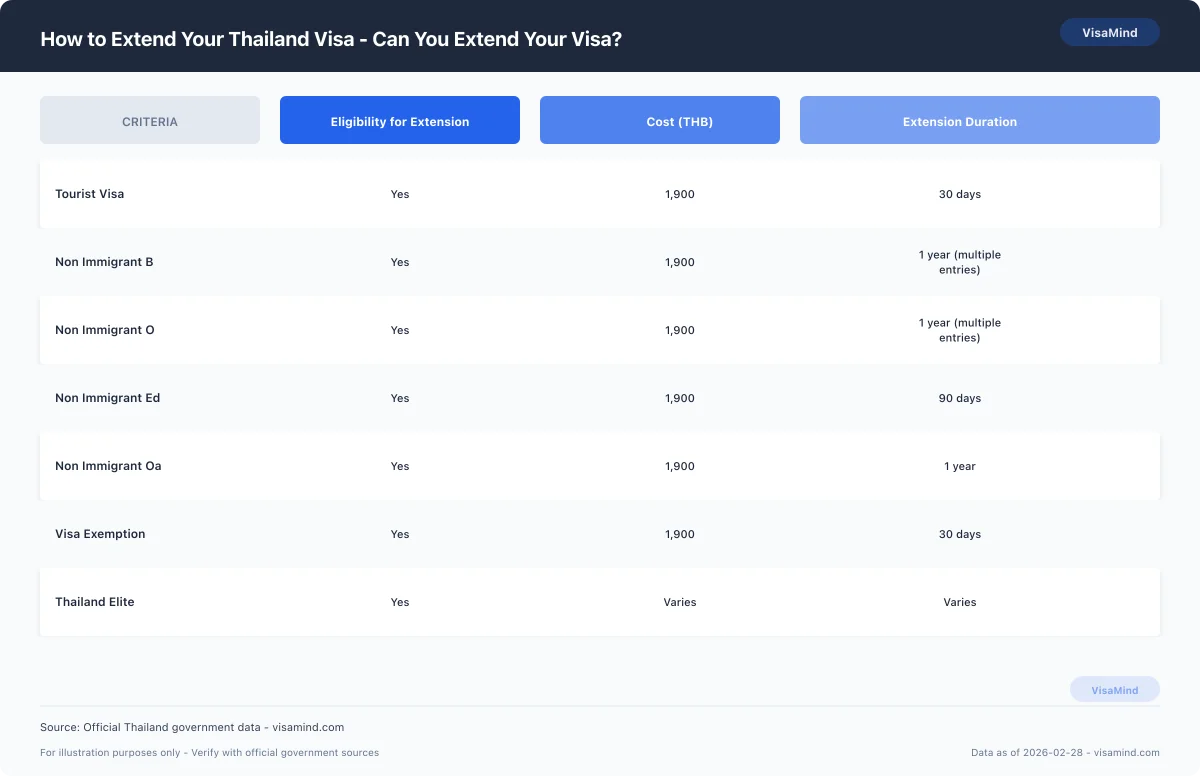
It's essential to know which visas are eligible for extensions. The Immigration Bureau of Thailand offers various options for those looking to prolong their stay for tourism, work, study, and more. Below is an overview of the visa types that can be extended and those that cannot:
| Visa Type | Eligibility for Extension | Typical Duration of Extension |
|---|---|---|
| Tourist Visa (TR) | Yes | Up to 30 days |
| Non-Immigrant Visa B (Business/Work) | Yes | Varies based on employment contract |
| Non-Immigrant Visa O | Yes | Up to 12 months |
| Non-Immigrant Visa ED (Education) | Yes | Duration of the study program |
| Marriage Extension (Non-O) | Yes | Up to 12 months |
| Smart Visa | Yes | 1-4 years depending on category |
| Long-Term Resident Visa | Yes | 10 years |
| Thailand Privilege Card | Yes | Varies, offers multiple-year stays |
| Visa Exemption | No | Not eligible for extension |
| Destination Thailand Visa (DTV) | Yes | Depends on specific conditions |
Which Visas Can Be Extended?
Many of Thailand's visa categories allow for extensions, which can be sought through the Immigration Bureau. Visas such as the Tourist Visa (TR), Non-Immigrant Visa B (Business/Work), and Non-Immigrant Visa ED (Education) are typically extendable, allowing you to stay longer based on your purpose of visit.
For those holding a Tourist Visa, extensions are usually granted for an additional 30 days. If you are in Thailand for work or business purposes, the Non-Immigrant Visa B allows for extensions that align with the terms of your employment or business activities. Similarly, students can extend their Non-Immigrant Visa ED for the duration of their study program.
Important: Ensure you apply for an extension before your current visa expires to avoid overstaying penalties.
What Are the Conditions for Non-Extension?
Certain visas, such as the Visa Exemption, typically do not allow for extensions. This is designed for short-term stays and requires leaving the country when the visa-free period ends. If you hold a visa under the exemption scheme and wish to stay longer, consider applying for a different visa type that supports extensions.
Special Considerations for Long-Term Stays
For those seeking long-term residency in Thailand, options like the Long-Term Resident Visa and Thailand Privilege Card offer extended stay durations with certain benefits. These visas are suited for individuals planning to reside in Thailand for extended periods, such as retirees or high net-worth individuals.
It's crucial to review the specific requirements and conditions of your visa type to ensure eligibility for extension. Each category has distinct criteria that must be met, including necessary documentation and adherence to the application timeline.
For more detailed guidance, you might explore specific guides like the Retirement Guide or Non-Immigrant B Vs Smart Visa to better understand how your visa category fits into the broader immigration landscape in Thailand.
The Extension Application Process
#-
Determine the Appropriate Immigration Office: To extend your visa within Thailand, you must visit an Immigration Bureau office. The main office is located in Bangkok, but there are regional offices throughout the country, such as in Chiang Mai and Phuket. Ensure you choose the office nearest to your current location.
-
Consider Online Options: The Immigration Bureau of Thailand offers an online platform for certain visa types. It is best to check if your specific visa category is eligible for an online extension. This can save time and help avoid long queues at the immigration office.
Tip: Applying online allows you to receive an immediate confirmation and receipt number, which can be useful if you need to track the status of your application.
Online vs. In-Person Application
-
Online Application Process:
- Create an Account: Start by creating an account on the official Immigration Bureau website.
- Fill in the Application: Complete the online application form, ensuring all sections are accurately filled as per your visa category.
- Upload Documents: Gather and upload all required supporting documents, such as your passport and any specific documents related to your visa type.
- Await Confirmation: Once submitted, wait for the processing of your application. You will receive an e-Visa confirmation document via email.
-
In-Person Application Process:
- Visit the Immigration Office: Arrive at the designated Immigration Bureau office early to avoid long waits.
- Submit Required Documents: Present your passport and all necessary supporting documents in person. Refer to the Documents Checklist to ensure you have everything needed.
- Complete the Application Form: Fill out the required application form provided at the office. You may also find it useful to review the How To Apply guide for detailed instructions.
- Wait for Processing: After submission, you will need to wait for your application to be processed. Processing times can vary, so check the Processing Times for up-to-date information.
Required Forms and Documentation
-
Gather Necessary Forms: Depending on your visa type, you will need specific forms. Commonly used forms include TM-7 for visa extension requests. Ensure you have the correct form for your visa category.
-
Compile Supporting Documents: Different visa types require various documents. These may include proof of financial means, a letter from an employer, or a school enrollment letter. Always verify the exact requirements for your visa type to avoid any pitfalls.
Important: Failing to provide all necessary documents can result in delays or rejection of your application. Always double-check your documentation before submission.
By following these steps, you can navigate the visa extension process in Thailand effectively, whether you choose to apply online or in person.
What to Submit with Your Extension
#When extending your visa in Thailand, you'll need to submit several documents to the Immigration Bureau of Thailand. The specific documents required can vary based on the type of visa you hold, but there are common elements across different visa categories. Here’s a breakdown of what you generally need to prepare:
General Documents Required
- Passport: Your passport must be valid for at least six months beyond your intended stay. Ensure it has blank pages for new stamps.
- Visa Application Form: Obtain and complete the appropriate visa extension form from the Immigration Bureau.
- Recent Photographs: Provide two passport-sized photos taken within the last six months.
Tip: Make sure your passport photos meet the specific size and background requirements of the Immigration Bureau.
Tourist Visa Extensions
- Proof of Financial Means: Bank statements or proof of funds to demonstrate your ability to support yourself.
- Accommodation Details: Hotel bookings or a letter from your host, confirming where you will be staying.
For more detailed information on tourist visa extensions, see our Tourist Visa guide.
Non-Immigrant Visa Extensions (e.g., Work, Education)
- Employment Contract or Letter: If you're extending a Non-Immigrant B (Business/Work) visa, include a letter from your employer.
- School Enrollment Certificate: For Non-Immigrant ED (Education) visa holders, provide documentation from your educational institution.
Explore more about the Non-Immigrant B visa and Non-Immigrant ED visa to understand specific requirements.
Retirement and Long-Term Stay Visas
- Proof of Income or Pension: Evidence of a stable income, such as pension slips or bank statements, is necessary for retirement visas.
- Health Insurance: Some long-term visas require proof of health insurance covering your stay.
For those considering retirement in Thailand, our Retirement Guide offers comprehensive insights.
Additional Considerations
- TM-30 Form: Ensure you have registered your residence with the TM-30 form, especially if you have changed addresses.
- Original Documents and Copies: Bring both the original documents and photocopies for submission.
Important: Failure to provide complete and accurate documentation can result in delays or denial of your extension application.
Remember, each visa type may have additional specific requirements, so it’s crucial to verify the exact documents needed for your situation on the official Immigration Bureau website or contact them directly for the most accurate guidance.
What It Costs and How Long It Takes
#Understanding the associated costs and timelines is crucial. The Immigration Bureau of Thailand is responsible for processing visa extensions, and fees and processing times can vary depending on the visa type. Here's what you need to know about costs and timelines:
Costs and Processing Times
The table below outlines the costs and processing times for extending different types of visas in Thailand:
| Visa Type | Cost (THB) | Processing Time |
|---|---|---|
| Tourist Visa (TR) | 1,900 | Usually 1-2 weeks |
| Non-Immigrant Visa B (Business/Work) | 1,900 | Approximately 2-4 weeks |
| Non-Immigrant Visa O (Family) | 1,900 | About 1-2 weeks |
| Non-Immigrant Visa ED (Education) | 1,900 | Typically 1-2 weeks |
| Smart Visa | 10,000 | 1-2 weeks (check eligibility) |
| Long-Term Resident Visa | 50,000 | Up to 4 weeks |
| Thailand Privilege Card | Included in membership | Varies |
Expedited Options
In some cases, expedited processing options may be available for certain visa categories, subject to additional fees. It's advisable to contact the Immigration Bureau directly or consult their official website for the most current information regarding expedited services.
Tip: To avoid delays, ensure all your supporting documents are complete and accurate when you apply for your visa extension. Missing documents can lead to extended processing times or rejection.
Additional Considerations
-
Tourist Visa Extensions: Typically, a 30-day extension is granted, but further extensions may be possible under exceptional circumstances. Check the Tourist Visa page for more details.
-
Work and Business Visas: These extensions might require additional documentation from your employer or business. Visit the Non-Immigrant B Visa page for guidance.
-
Educational Visas: Extensions for educational purposes usually require a confirmation letter from your educational institution. For more information, see the Non-Immigrant ED Visa page.
Always verify the most up-to-date information and fees on the official Immigration Bureau of Thailand website, as costs and processing times may change.
The Risks of Staying Past Your Visa
#Overstaying your visa in Thailand can lead to serious consequences that affect not only your immediate situation but also your future travel plans. Understanding these risks is crucial for maintaining your legal status and ensuring a smooth experience with Thai immigration.
What Happens if You Overstay Your Visa?
If you find yourself in Thailand past the expiration date of your visa, you are considered to be overstaying. The Immigration Bureau of Thailand strictly enforces regulations regarding overstays, and penalties can be severe:
- Fines: Overstaying your visa results in daily fines. As of 2026, fines are typically 500 THB per day, up to a maximum of 20,000 THB. Verify the current fines on the official website.
- Detention: Serious overstay cases, particularly those exceeding 90 days, may result in detention.
- Deportation: In some instances, overstaying can lead to deportation at your own expense. This process can be both costly and stressful.
Important: Overstaying for even one day will result in a fine and could impact your ability to extend your stay.
Future Travel and Visa Bans
Overstaying not only causes immediate issues but can also affect your ability to return to Thailand or travel to other countries. The consequences include:
- Entry Ban: Depending on the duration of your overstay, you might face a re-entry ban into Thailand. For example, overstaying more than 90 days could lead to a one-year ban.
- Impact on Future Applications: A history of overstays can complicate future visa applications, making it harder to obtain visas for Thailand or other destinations.
| Duration of Overstay | Potential Consequence |
|---|---|
| Less than 90 days | Daily fines |
| More than 90 days | Possible 1-year re-entry ban |
| More than 1 year | Up to 10-year re-entry ban |
How Can You Avoid Overstaying?
Preventing an overstay is straightforward if you plan ahead. Here are some steps you can take:
- Track Your Visa Expiry: Always be aware of your visa expiration date. Set reminders well in advance.
- Apply for an Extension Early: If you wish to extend your stay, ensure you apply for a visa extension with the Immigration Bureau well before your current visa expires.
- Keep Updated: Immigration rules can change, so regularly check for updates on the official Immigration Bureau website or consult reliable resources like the Documents Checklist.
Tip: If you're unsure about your visa status or need assistance, consult with an immigration attorney or a reputable visa service.
By staying informed and proactive, you can avoid the pitfalls of overstaying and continue to enjoy your time in Thailand without legal complications.
Visa-by-Visa Extension Rules
#It's crucial to understand the specific requirements and processes for each visa category. Below is a detailed breakdown of the extension rules for four common visa types: Tourist, Student, Work, and Family.
Visa-by-Visa Extension Rules
| Visa | Eligibility | Cost | Timeline | Additional Notes |
|---|---|---|---|---|
| Tourist Visa (TR) | For tourism, MICE, and medical treatment | Approximately ฿1,900 | Extension up to 30 days | May require proof of onward travel; apply at local Immigration Office |
| Student Visa (ED) | For study visits and training | Approximately ฿1,900 | Extension up to 90 days | Requires enrollment proof from educational institution; Non Immigrant Ed |
| Work Visa (Non-Immigrant B) | For employment or business purposes | Approximately ฿1,900 | Extension up to 1 year | Requires work permit and employer documentation; Non Immigrant B |
| Family Visa (Non-Immigrant O) | For staying with family, including retirement | Approximately ฿1,900 | Extension up to 1 year | Requires proof of family relationship or retirement status; Retirement Guide |
Tourist Visa Extensions
Tourists can apply for an extension of up to 30 days at the local Immigration Office. It's important to have proof of onward travel and accommodation details ready.
Tip: Applying in person at the Immigration Office allows you to address any issues immediately and avoid delays.
Student Visa Extensions
Students may extend their stay for up to 90 days by providing proof of enrollment from their educational institution. Be prepared to show your student ID and a letter from your school confirming your course details and duration.
Work Visa Extensions
For those on a Non Immigrant B Visa, extensions are usually granted for up to one year. A valid work permit and documentation from your employer are required. Ensure all documents are up-to-date to avoid complications.
Family Visa Extensions
Family visas, including those for retirement, can be extended up to one year. Proof of family relationship or retirement status is mandatory. Consult the Retirement Guide for more details specific to retirement extensions.
Application Process and Common Pitfalls
The application process generally involves visiting a local Immigration Office, presenting the necessary documentation, and paying the applicable fee.
Important: Ensure all supporting documents are complete and accurate. Missing documents can lead to application delays or denials.
For more detailed instructions on how to apply, visit the How To Apply guide.
By understanding these specific requirements, you can better prepare your application, ensuring a smoother extension process. Always verify the latest requirements on the official Immigration Bureau of Thailand website, as policies and fees can change.
What Else Can You Do?
#You have several options depending on your circumstances. Here's what else you can do if you're planning to remain in Thailand or need to make changes to your visa status.
Can You Change Visa Types?
If your situation has changed and you need a different type of visa, you may be eligible to switch to another visa category within Thailand. This is particularly common for individuals whose purpose of stay has evolved, such as moving from tourism to employment or education. To change your visa type, you should:
-
Visit the Immigration Bureau of Thailand to assess your eligibility.
-
Prepare the necessary documents relevant to the new visa category, such as proof of employment for a Non-Immigrant Visa B or an acceptance letter for a Non-Immigrant Visa ED.
-
Lodge an application with the Immigration Bureau and await approval.
Tip: If you are considering a Smart Visa, check the specific criteria and benefits, such as longer stays and fewer reporting requirements, which may suit your circumstances.
Can You Leave and Re-enter Thailand?
If you plan to leave Thailand temporarily and return during your visa period, consider applying for a re-entry permit. This allows you to maintain the validity of your current visa while traveling outside Thailand. Here's how:
- Obtain a re-entry permit from the Immigration Bureau or at the airport before departure.
- Choose between a single-entry or multiple-entry permit, depending on your travel plans.
Is Voluntary Departure an Option?
If extending your stay or changing your visa type is not feasible, you may choose to depart Thailand voluntarily before your visa expires. This can be a straightforward option to avoid overstay penalties and potential bans on re-entry. Upon deciding to leave:
- Ensure all your affairs are in order and inform relevant parties of your departure.
- Consider applying for a different visa type from your home country or a Thai embassy abroad if you plan to return.
Important: Overstaying your visa can lead to fines and restrictions on future entries. Always keep track of your visa's expiration date and plan accordingly.
Summary of Options
| Option | Action Required | Considerations |
|---|---|---|
| Change Visa Type | Apply at Immigration Bureau with new category documents | Verify eligibility and document requirements |
| Leave and Re-enter | Obtain re-entry permit before departure | Choose between single or multiple entries |
| Voluntary Departure | Depart Thailand before visa expiry | Avoid overstay penalties |
For more detailed information about each visa type or specific application processes, visit the relevant sections, such as Non-Immigrant O and Permanent Residence. Always verify current requirements and procedures on the official Immigration Bureau of Thailand website.