
How Officers Evaluate Your Documents
#Thailand's Immigration Bureau is responsible for evaluating the documents you submit when applying for a visa. Understanding the key criteria they use will help ensure that your application meets their requirements.
The Importance of Document Completeness
The Immigration Bureau places a high emphasis on the completeness of your application. Each visa type, such as the Tourist Visa (TR) or the Non-Immigrant Visa B (Business/Work), has specific document requirements that must be met. Missing documents can lead to delays or even rejection of your application. It is crucial to gather all necessary paperwork before lodging your application. This includes filling out all sections of the form accurately and providing clear, legible copies of supporting documents.
Accuracy and Authenticity Checks
Accuracy in your submitted documents is critical. The Immigration Bureau carefully checks each document for discrepancies or inaccuracies. Inconsistencies between your application and your supporting documents, such as differing spellings or mismatched dates, can raise red flags. Moreover, the authenticity of your documents is scrutinized. Providing forged or altered documents is a serious offense that can lead to immediate rejection and potential bans from entering Thailand. Always ensure that your documents are genuine and officially verified where required.
Consistency with Eligibility Criteria
Each visa type has specific eligibility criteria that your documents must support. For instance, if you're applying for an Education Visa (Non-Immigrant ED), your application should include enrollment confirmation from a recognized Thai educational institution. The Immigration Bureau will assess whether your documents effectively demonstrate your eligibility for the visa category you are applying for. If your documents do not align with the stated requirements, your application could be at risk.
Timeliness and Validity
Timeliness is another critical factor in document evaluation. Some documents, like police clearances or medical certificates, have a validity period and must be current at the time of submission. Be mindful of these timelines to ensure that all documents remain valid throughout the application process. For example, a police clearance should typically be no older than six months. Always verify specific timelines on the official Immigration Bureau website to avoid any issues.
Important: Submitting outdated documents can result in your application being rejected. Check all validity periods before submission.
Final Considerations
By focusing on these key areas—completeness, accuracy, consistency with eligibility criteria, and timeliness—you can enhance your chances of a successful visa application. Always refer to the latest guidelines provided by the Immigration Bureau to ensure that you are meeting all requirements. For more information on how to navigate the application process, consider visiting our How To Apply guide.
Proving Your Identity
#Proving your identity is a crucial step. Here’s a detailed checklist to ensure you meet the requirements set by the Immigration Bureau of Thailand.
Passport Requirements
- Validity Duration: Your passport must be valid for at least six months beyond your intended stay in Thailand. This is a common requirement for most visa categories, including the Tourist Visa (TR) and Non-Immigrant Visa B (Business/Work).
- Blank Pages: Ensure your passport has at least two blank pages for visa stamps and entry/exit stamps.
- Condition: The passport should be in good condition, with no damage or missing pages that could lead to complications at entry points.
Identity Documentation
- Passport Copy: A clear photocopy of the personal details page of your passport is often required. This applies to various visa types, such as the Non-Immigrant Visa Ed (Education).
- Photographs: Recent passport-sized photographs are required. Ensure they meet the specific size and background color requirements, which can be found in the Photo Specifications section.
Name and Identity Consistency
- Name Consistency: Ensure that your name is consistent across all documentation. Any discrepancies might lead to delays or issues with your visa application.
- Additional ID: While not always mandatory, having additional identification like a national ID card or birth certificate can be useful, especially if there are questions about identity verification.
Important: Double-check all personal information on your documents. Errors in your name or passport number can lead to delays or rejections.
Special Considerations
- Multiple Nationalities: If you hold multiple nationalities, always use the same passport for your visa application and travel to Thailand. This helps avoid confusion and ensures smoother processing.
- Previous Visas: If you have previously held a Thai visa, include copies of these visas. This can be particularly relevant for those applying for extensions or Long Stay permits.
Remember, each visa category might have specific requirements, so it’s wise to refer to the relevant guide or consult with the Immigration Bureau of Thailand for the most accurate and up-to-date information.
Photo Specifications
#To apply for a visa to Thailand, you must submit a photograph that meets specific requirements set by the Immigration Bureau of Thailand (สำนักงานตรวจคนเข้าเมือง). These specifications ensure consistency and help in the smooth processing of your visa application.
What Are the Photo Requirements?
When preparing to lodge an application for a Thai visa, ensure your photograph complies with the following specifications:
| Specification | Requirement |
|---|---|
| Dimensions | 4 x 6 cm |
| Background Color | Plain white |
| Format | JPEG or PNG |
Additional Photo Guidelines
- Recent Photo: The photograph must be taken within the last six months to reflect your current appearance.
- Facial Expression: Maintain a neutral facial expression with both eyes open and mouth closed.
- Attire: Wear clothing that contrasts with the background. Avoid uniforms or colors that blend with the background.
- Head Position: The head should be centered and occupy 70-80% of the photograph.
Important: Failure to adhere to these specifications can result in delays or rejection of your visa application.
Tips for a Successful Application
- Review your eligibility and specific requirements for the type of visa you are applying for, such as the Tourist Visa (TR) or Non-Immigrant Visa B (Business/Work).
- Consider professional photography services to ensure your photo meets all the criteria.
For more detailed guidance on the application process, visit our How To Apply guide.
Showing You Can Support Yourself
#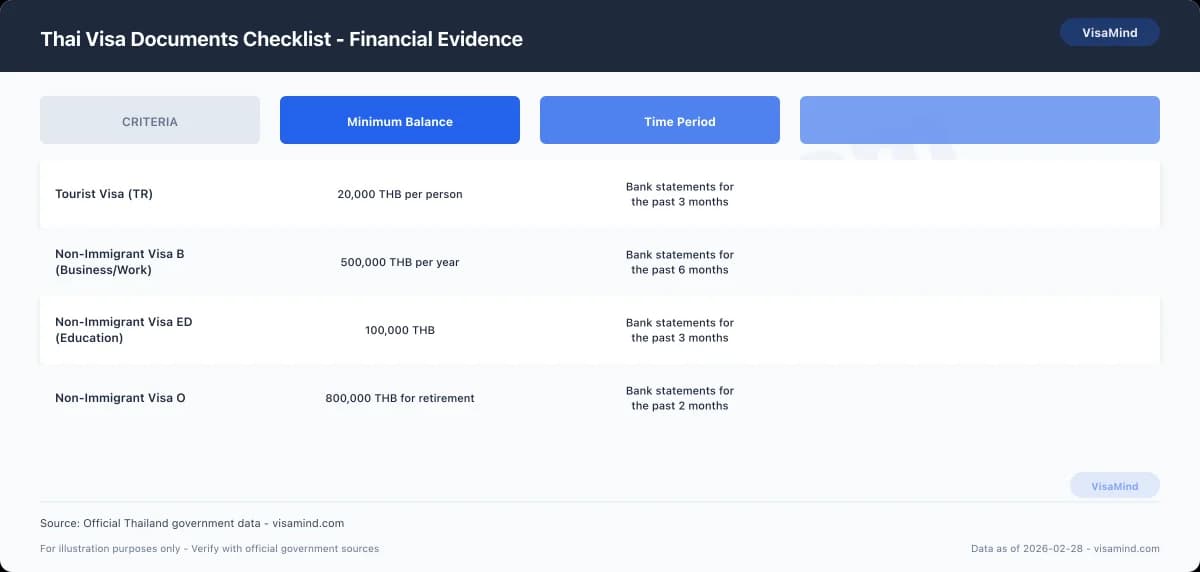
Demonstrating your financial capability is a critical part of the process. This ensures that you can support yourself during your stay in the country. The financial requirements vary depending on the type of visa you are applying for. Below, we outline the bank statement requirements for different visa categories.
Bank Statement Requirements by Visa Type
| Visa Type | Minimum Balance | Time Period Required | Additional Notes |
|---|---|---|---|
| Tourist Visa (TR) | 20,000 THB per person or 40,000 THB per family | At least three months prior to application | Must be a current account, savings account, or fixed deposit account |
| Non-Immigrant Visa B (Business/Work) | 100,000 THB | At least three months prior to application | Employer's sponsorship letter may be required |
| Non-Immigrant Visa ED (Education) | 20,000 THB per month for the duration of study | At least three months prior to application | Proof of tuition payment may substitute for part of the balance |
| Non-Immigrant Visa O | 400,000 THB for retirees or 40,000 THB per month for family | At least three months prior to application | For retirees, a letter from the embassy may be required |
How to Prepare Your Bank Statement
To meet the Immigration Bureau's requirements, ensure that your bank statement includes:
- Account holder's name: Your name must match exactly as it appears on your passport.
- Account number and bank details: These should be clearly visible on the statement.
- Transaction history: A detailed list of transactions for the required period, showing consistent account activity.
Important: Ensure your bank statement is recent and up-to-date at the time of application submission. Outdated statements may lead to delays or rejection.
Tips for a Successful Application
- Maintain a steady balance: It's advisable to keep your account balance above the required minimum for a few months before applying, as sudden large deposits may be scrutinized.
- Documentation consistency: Make sure all personal information on your bank documents matches your other application materials.
Tip: If your financial situation changes, notify the Immigration Bureau promptly and seek guidance on any additional documentation that may be needed.
For further details on the financial requirements for Thailand visas, you can consult the Financial Requirements guide. Always verify the latest requirements on the official Immigration Bureau of Thailand website before applying.
Purpose-Specific Documents
#It's important to gather all necessary documents specific to your visa's purpose. This section details what you need for work, education, and relationship-based visas.
Work-Related Documents
For those seeking a Non-Immigrant Visa B (Business/Work) or a Smart Visa to work in Thailand, you must provide documentation related to your employment:
- Employment Contract: A signed contract from your Thai employer outlining your position, salary, and duration of employment.
- WP-3 Form: This approval from the Thai Ministry of Labour is essential for obtaining a work permit.
- Company Registration Documents: Include the business's registration certificate and list of shareholders, certified by the Thai Ministry of Commerce.
- Employer’s Letter: A letter from your employer detailing the necessity of your position and confirming your employment status.
Important: Ensure your employment documents are translated into Thai if they are originally in another language.
Education-Related Documents
If you're applying for a Non-Immigrant Visa ED (Education) to study in Thailand, you will need:
- Acceptance Letter: An official letter from a recognized Thai educational institution confirming your enrollment.
- Course Details: An outline of the course or program you are enrolled in, including the duration and schedule.
- Financial Proof: Evidence of sufficient funds to cover tuition and living expenses for the duration of your studies.
Tip: Check with your educational institution for any additional documents they may require for international students.
Relationship-Based Documents
For visas based on family or marriage, such as the Marriage Visa or Non-Immigrant Visa O, the following documents are necessary:
- Marriage Certificate: If you're applying based on marriage, provide a certified copy of your marriage certificate.
- Proof of Relationship: This can include joint bank statements, lease agreements, or photos together.
- Thai Spouse’s ID: A copy of your Thai spouse's identification card and household registration book.
Always verify the specific requirements for each document on the official Immigration Bureau website, as requirements can change. Properly preparing these documents will help ensure a smoother process when applying for your Thai visa.
Mistakes That Get Applications Rejected
#It is crucial to ensure all documents are prepared correctly to avoid common mistakes that could lead to application rejection. Here are some specific issues to watch out for:
Incorrect or Incomplete Photos
- Photo Specifications: Ensure your passport photos meet the Photo Specifications required by the Immigration Bureau. Common errors include incorrect size, background color, or outdated photos.
- Recent Photos: Use photos taken within the last six months. Older photos may result in rejection.
Important: Photos that do not meet the specified guidelines are among the most frequent causes of application delays or denials.
Financial Documentation Errors
- Expired Statements: Financial statements should be recent, typically no older than three months. Double-check the date of issuance to prevent submission of outdated documents.
- Sufficient Funds: Ensure your bank statements clearly demonstrate the required financial thresholds for your visa type. For more details, visit Financial Requirements.
Language and Translation Issues
- Missing Translations: Any documents not in Thai or English must be accompanied by certified translations. This includes legal documents, bank statements, and educational certificates.
- Certification: Ensure translations are certified by a recognized authority, such as a Thai embassy or consulate, to avoid rejection.
Omitting Vital Documents
- Eligibility Category Instructions: Each visa category, such as Non-Immigrant Visa O or Marriage Visa, has specific document requirements. Review these carefully to ensure no documents are missing.
- Checklists: Use the official checklists available from the Immigration Bureau as a reference to verify that you have included all necessary documents.
Tip: Regularly consult the Immigration Bureau's official website to verify document requirements, as they may change periodically.
By paying attention to these details, you can significantly reduce the risk of your visa application being rejected due to avoidable mistakes. Always double-check each document and consult the How To Apply guide for comprehensive instructions on the application process.
Medical Exams and Police Clearances
#For many visa categories, you will need to undergo specific medical examinations to ensure you are fit to stay in Thailand. The requirements can vary based on the type of visa you are applying for, such as a Non Immigrant Oa or a Marriage Visa.
- Tuberculosis (TB) Test: A negative TB test is often required. This can typically be done at an approved hospital or medical facility.
- General Health Examination: This may include blood tests, a chest X-ray, and other checks as specified by the Immigration Bureau of Thailand.
- Proof of Health Insurance: For some visa types, especially long-term stays, you'll need to show proof of valid health insurance in Thailand.
Important: Always ensure that medical exams are conducted at approved facilities to avoid delays in your visa application process.
Police Clearances
A police clearance certificate is a critical document for many visa applications, especially for long-term stays or work-related visas like the Smart Visa.
- Home Country Police Clearance: Obtain a police clearance certificate from your home country before arriving in Thailand. This document verifies that you have no criminal record.
- Thai Police Clearance: If you have lived in Thailand for an extended period, you may also be required to provide a police clearance from the Royal Thai Police.
Tip: Start the process of obtaining police clearances early, as these can take several weeks to be issued and authenticated.
How to Prepare
- Schedule Appointments: Contact approved medical facilities and police departments to schedule your exams and clearances.
- Gather Supporting Documents: Ensure you have all necessary identification documents, such as your passport and visa application forms, when attending appointments.
- Verify Requirements: Always check the specific requirements for your visa type on the official Immigration Bureau website to ensure compliance with the latest guidelines.
By preparing these documents in advance, you can prevent potential delays in your visa application process. Each visa type may have unique requirements, so it's essential to verify the specific needs related to your situation. For further guidance on preparing your application, consider reviewing the Visa Extension Guide.
Country-Specific Requirements
#Each type has unique requirements that you must fulfill. The Immigration Bureau of Thailand oversees the process and provides detailed guidelines specific to each visa category. Whether you're applying for a Tourist Visa or a Non-Immigrant Visa O, understanding these distinct requirements is crucial.
Required Documentation
Each visa type requires specific documentation, which varies based on your purpose of stay. Here's a general overview of what you might need:
- Valid Passport: Your passport must be valid for at least six months beyond your intended stay.
- Application Form: Complete the relevant visa application form provided by the Immigration Bureau.
- Photographs: Recent passport-sized photographs that meet the photo specifications.
- Financial Evidence: Proof of sufficient funds, such as bank statements, for the duration of your stay. Check the financial requirements for specific amounts.
Important: Ensure all documents are current and meet the Immigration Bureau's standards to avoid delays.
Visa-Specific Conditions
Different visa categories come with additional conditions. For instance, if you are applying for a Non-Immigrant Visa B (Business/Work), you may need:
- Employment Offer: A letter from your Thai employer detailing your role and salary.
- Work Permit: Supporting documents for your work permit.
Those seeking a Non-Immigrant Visa ED (Education) should prepare:
- Acceptance Letter: From a recognized Thai educational institution.
- Enrollment Evidence: Proof of enrollment details and tuition payments.
Tips for a Successful Application
Tip: Review the specific requirements for your visa category on the official Immigration Bureau website before gathering your documents. This ensures you have the latest information.
Finally, it’s worth noting that applying for a Thai visa involves careful preparation. The Thai Visa Extension Guide can provide additional insights if you plan to extend your stay beyond the initial visa duration. Always verify exact requirements on the official website to accommodate any recent updates or changes.