What the Non-Immigrant Visa B (Business/Work) Covers — Thailand non-immigrant B visa
#The Non-Immigrant Visa B (Business/Work) is an official visa category managed by the Immigration Bureau of Thailand (สำนักงานตรวจคนเข้าเมือง).
You use this category if your purpose in Thailand is related to business or work, and you file the required application with the Immigration Bureau.
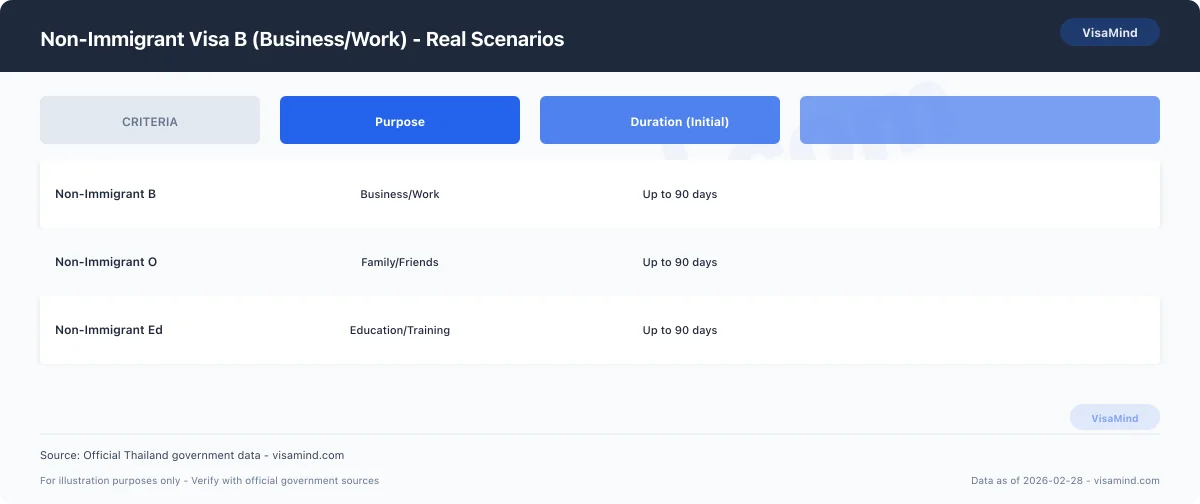
Who this visa is for
The Non-Immigrant Visa B (Business/Work) is for individuals whose stay in Thailand is directly tied to business or employment matters.
If your main reason for entering or remaining in Thailand involves structured business activities or work recognized by the Immigration Bureau, this is your category.
This visa isn’t for other non-immigrant objectives.
For reference:
| Visa Category | Primary Focus |
|---|---|
| Non-Immigrant Visa B (Business/Work) | Business and work purposes |
| Non-Immigrant Visa ED (Education) | Education-related stay |
| Non-Immigrant Visa O | Other specific non-business purposes |
| Non-Immigrant Visa O-A (Retirement) | Retirement stay |
| Non-Immigrant Visa O-X (10-year Retirement) | Long-term retirement stay |
You need to pick the category that matches your real purpose. Filing under the wrong type can delay or prevent approval.
All applications in this category go through the Immigration Bureau.
Purpose and scope
The Non-Immigrant Visa B (Business/Work) covers activities directly tied to business or employment.
It requires the official “Non-Immigrant Visa B (Business/Work)” form from the Immigration Bureau. You have to complete and submit this as part of your application.
Sometimes, this category is referred to as Non-Immigrant Visa B (Business Meetings) if your activities are limited to business engagement.
The scope is strictly business and work. It doesn’t cover:
- Education-based stays (Non-Immigrant Visa ED)
- Retirement (Non-Immigrant Visa O-A, Non-Immigrant Visa O-X)
- Other non-business purposes (Non-Immigrant Visa O)
Your activities in Thailand must line up with the business or work basis stated in your application.
Key requirements at a glance
Apply using the official Non-Immigrant Visa B (Business/Work) form from the Immigration Bureau.
Your application needs to clearly state your business or work purpose and follow the steps set by the Bureau.
At a minimum, you should:
-
Complete the official Form Visa Application form.
-
Submit your application to the Immigration Bureau.
-
Ensure your declared purpose fits the Business/Work category.
If you plan to work, you might see references to forms like Form WP.1 in related processes.
Check current document and procedural requirements with the Immigration Bureau before you file.
For eligibility, document lists, and any fees in THB (฿), refer to the Immigration Bureau’s official guidance.
Conditions and Portability
#
Your eligibility depends on the specific category you choose and how closely you follow the official instructions.
Filing a Form Visa Application doesn’t guarantee that the Immigration Bureau will approve your Non-Immigrant Visa B.
Approval is not guaranteed
Submitting a Non-Immigrant Visa B (Business Meetings) application doesn’t mean you’ll be approved. The Immigration Bureau reviews each case on its own.
Approval depends on whether you meet the criteria for your purpose of stay and if your documentation matches that purpose.
An incomplete or incorrectly prepared application can be refused.
The Immigration Bureau has full authority to decide your eligibility.
Filing forms like Form WP.1 or submitting supporting documents doesn’t obligate them to grant status.
If you previously held another visa type, that approval doesn’t transfer to a Non-Immigrant Visa B.
Each application is reviewed separately.
Review eligibility categories
Review the exact eligibility category that matches your purpose before you apply.
Different non‑immigrant visas serve different functions.
| Visa Category | Primary Purpose | Requires Separate Review of Instructions |
|---|---|---|
| Non-Immigrant Visa B (Business Meetings) | Business-related activities | Yes |
| Non-Immigrant Visa ED (Education) | Study or training | Yes |
| Non-Immigrant Visa O | Other approved purposes | Yes |
| Non-Immigrant Visa O-A (Retirement) | Retirement | Yes |
| Non-Immigrant Visa O-X (10-year Retirement) | Long-term retirement | Yes |
Eligibility for a Non-Immigrant Visa ED (Education) or Non-Immigrant Visa O-A (Retirement) doesn’t qualify you for a Non-Immigrant Visa B.
Each category has its own instructions and standards.
Before you file, make sure your activities fit the Business category.
Applying under the wrong classification leads to denial.
When instructions matter
Follow the official instructions for your eligibility category before submitting your application.
This is mandatory.
Check:
- The correct visa classification
- Required forms, including any reference to WP.1
- Supporting documents tied to your purpose
- Submission procedures required by the Immigration Bureau
Don’t use instructions for another visa type, like Non-Immigrant Visa O or Non-Immigrant Visa O-X (10-year Retirement).
Instructions differ by category.
If you don’t follow the correct instructions, the Immigration Bureau may refuse your application, even if your purpose appears valid.
Accuracy and compliance with category-specific rules affect your outcome.
Fees and Processing Times
#You must pay the right fee and plan for a realistic processing window before you set up travel or business in Thailand.
For a Non-Immigrant Visa B, both cost and timeline depend on where and how you apply, and the Immigration Bureau (สำนักงานตรวจคนเข้าเมือง) controls final approval.
Application fee
As of February 2026, the application fee for a Thailand Non-Immigrant Visa B is ฿2,000.
| Item | Amount (THB) | Notes |
|---|---|---|
| Non-Immigrant Visa B application fee | ฿2,000 | Payable at the time of Form Visa Application |
Check the accepted payment method with the authority handling your application.
Some locations require payment at submission and won’t start processing until you’ve paid in full.
Fees for other categories—Non-Immigrant Visa ED, Non-Immigrant Visa O, Non-Immigrant Visa O-A (Retirement), Non-Immigrant Visa O-X (10-year Retirement)—may differ.
The amount can also change based on visa entry type or location.
Standard processing time
Standard processing for the Non-Immigrant Visa B is 5 to 10 business days as of March 2026.
| Processing Type | Estimated Time |
|---|---|
| Standard | 5–10 business days |
This timeframe applies to routine cases that meet all document requirements.
Incomplete applications delay decisions.
Business travelers applying under Non-Immigrant Visa B (Business Meetings) shouldn’t schedule meetings in Thailand until they receive the visa.
Processing starts only when the issuing authority accepts your complete file.
Variations by category/location
processing times for a Non-Immigrant Visa B depend on visa category and processing location.
Timelines can differ if you apply for:
- Employment-related activities that will require a Form WP.1 work permit later
- Short-term Non-Immigrant Visa B (Business Meetings) activities
The location where you submit your application affects timing.
Each embassy, consulate, or Immigration Bureau office has its own workload and review procedures.
Other non-immigrant categories—Non-Immigrant Visa ED, Non-Immigrant Visa O, Non-Immigrant Visa O-A, Non-Immigrant Visa O-X—follow their own processing patterns.
Confirm current timelines with the issuing authority before making travel or employment plans.
Application Process
#Use the current official form and follow the exact filing steps.
Prepare your documents carefully and submit them in person at the correct Thai diplomatic office.
Download the form and instructions
Download the latest Non-Immigrant Visa B (Business Meetings) application form from the Immigration Bureau (สำนักงานตรวจคนเข้าเมือง).
Use only the current version listed by the Immigration Bureau.
Review the official instructions before you start.
The instructions explain required fields, signature requirements, and supporting evidence.
Don’t use forms for other visa categories:
| Visa Category | Purpose |
|---|---|
| Non-Immigrant Visa ED (Education) | Study in Thailand |
| Non-Immigrant Visa O | Family or other approved purposes |
| Non-Immigrant Visa O-A (Retirement) | Long-stay retirement |
| Non-Immigrant Visa O-X (10-year Retirement) | Extended retirement stay |
Each category has its own form and requirements.
Submitting the wrong form delays processing.
If you plan to work in Thailand, check whether you’ll need a Form WP.1 work permit application after visa issuance.
Visa and work authorization are separate steps.
Complete, sign and assemble evidence
Fill out every required section of the application form clearly and accurately.
Use information that matches your passport and supporting documents.
Sign the form where required; unsigned forms aren’t accepted.
Gather your supporting documents as listed in the instructions.
This typically includes:
- Your valid passport
- Supporting documents relevant to your business purpose
- Any additional evidence specified in the instructions
Your passport details must match your application.
Inconsistent information can cause refusals or delays.
Organize your documents in a logical order, with the signed form on top.
If your purpose is business meetings, make sure your documentation reflects Non-Immigrant Visa B (Business Meetings).
Submit in person where required
Submit your completed application and passport in person at the Royal Thai Embassy or Consulate-General with jurisdiction over your location.
Bring:
- Your signed application form
- Your passport
- All required supporting documents
Embassy or consular officers will review your documents and decide if your application meets the requirements.
For procedural updates, check directly with the Immigration Bureau or the relevant Royal Thai Embassy or Consulate-General before your appointment.
Dependents — Thailand B visa
#Your spouse and children can apply to stay in Thailand while you hold a Non-Immigrant Visa B.
Each family member must submit a separate application and provide complete identity documents in the required format.
Which family members may accompany you
Thailand allows certain close family members to request permission to stay with a Non-Immigrant Visa B holder.
Confirm eligibility with the Immigration Bureau (สำนักงานตรวจคนเข้าเมือง). Rules can change and may differ from other visa categories.
In practice, dependents generally include:
- Your legally married spouse
- Your children
Each dependent files their own application.
Approval for your Non-Immigrant Visa B (Business Meetings) or work authorization (such as a Form WP.1 filing) doesn’t automatically grant status to your family members.
For questions about specific family relationships, request written guidance from the Immigration Bureau before submitting.
Document rules for dependents
Every dependent must provide a valid passport.
If a passport is unavailable, submit a copy of an official document used in place of a passport. The substitute must clearly establish identity.
Any supporting document written in a foreign language must meet strict translation standards.
- Translate the document into Thai
- Ensure the translation is certified
- Certification must be completed by an academic Thai native speaker
Untranslated or uncertified documents may delay or prevent approval.
The core document standards are summarized below:
| Document Type | Requirement |
|---|---|
| Passport | Valid passport required |
| Document in lieu of passport | Copy required if passport unavailable |
| Foreign-language documents | Must be translated into Thai |
| Translation certification | Certified by an academic Thai native speaker |
Prepare clear copies and keep originals available if requested.
Submission for family members
Each dependent must submit a separate Form Visa Application. Applications cannot be combined into a single filing.
Follow these steps:
-
Prepare the passport or accepted substitute document.
-
Translate all foreign-language documents into Thai.
-
Obtain certification from an academic Thai native speaker.
-
Submit the complete application to the Immigration Bureau.
Incomplete translations or missing certification often cause processing delays.
If your status changes to a different category—such as Non-Immigrant Visa O or Non-Immigrant Visa ED (Education)—your dependents may need to adjust their applications to match your current visa classification. Confirm procedural requirements with the Immigration Bureau before filing.
Renewal and Extension
#You must manage your stay carefully once you enter Thailand on a Non-Immigrant Visa B. Initial validity, work permit status, and employer sponsorship determine your permitted duration and whether you may qualify for a one-year extension from the Immigration Bureau.
Initial validity and follow-up
A Non-Immigrant Visa B (Business Meetings) or employment-based Non-Immigrant Visa B is typically issued with limited initial validity. The visa in your passport allows entry, but your length of stay on arrival is controlled by the Immigration Bureau.
After entry, you must:
-
Check the admitted-until date stamped in your passport.
-
Ensure your purpose of stay matches your visa category.
-
Apply for an extension before your permitted stay expires, if you intend to remain longer.
Your visa does not automatically grant a one-year stay. Extensions inside Thailand are controlled by the Immigration Bureau.
If your purpose changes—for example, from business to study—you may need a different category such as Non-Immigrant Visa ED (Education) or Non-Immigrant Visa O. Retirement categories like Non-Immigrant Visa O-A (Retirement) and Non-Immigrant Visa O-X (10-year Retirement) follow separate rules and do not extend a B visa.
Verify current extension rules and fees in THB (฿) directly with the Immigration Bureau.
| Item | Controlled By |
|---|---|
| Visa issuance | Thai Embassy/Consulate |
| Length of stay in Thailand | Immigration Bureau |
| Stay extension | Immigration Bureau |
When a work permit is required
If you perform work in Thailand, you must obtain a work permit. A Non-Immigrant Visa B alone does not authorize employment.
Your employer typically initiates the work permit process. The application usually involves the Form WP.1 form and supporting corporate documents.
You generally need a work permit if you:
- Receive salary from a Thai employer
- Perform services for a company in Thailand
- Act in a management or director role
- Engage in ongoing business operations beyond meetings
Short-term business meetings under a Non-Immigrant Visa B (Business Meetings) may not require a full work permit, depending on the activity. The scope of permitted activities is important. If you manage or operate a business, you need proper authorization.
The Immigration Bureau may require proof of a valid work permit when you apply for a stay extension based on employment.
Typical extension to 1 year
If you work for a Thai company, you may apply for a one-year extension of stay based on employment. Apply before your current permission to stay expires.
The general process involves:
-
Holding a valid Non-Immigrant Visa B.
-
Securing an approved work permit.
-
Submitting extension documents to the Immigration Bureau.
Typical required documents include:
- Passport and visa pages
- Work permit
- Employer company registration documents
- Employment contract
- Completed extension application form
The Immigration Bureau reviews your employer’s eligibility and your role. Approval grants a one-year extension tied to your specific employer.
If you change employers, update your work permit and possibly submit a new extension application. Fees for extensions are payable in THB (฿); confirm the current amount with the Immigration Bureau before filing.
Path to Permanent Residence
#Your Non-Immigrant Visa B can support long-term plans in Thailand, but permanent residence depends on meeting the Immigration Bureau’s formal criteria. You must maintain lawful status, document your employment, and follow correct extension procedures before considering permanent residence.
Common next steps after the visa
After receiving your Non-Immigrant Visa B, you typically extend your stay and formalize your work status with the Immigration Bureau.
You will usually:
-
Apply for a stay extension based on employment.
-
Submit a Form WP.1 work permit application.
-
Maintain continuous lawful stay through timely extensions.
If you entered on a Non-Immigrant Visa B (Business Meetings), you must change to a work-authorized basis before performing employment. Attending meetings alone does not establish long-term eligibility.
Some applicants later change status depending on life changes. For example:
| Visa Type | Typical Purpose | Long-Term Implication |
|---|---|---|
| Non-Immigrant Visa B | Employment or business | Employment-based stay |
| Non-Immigrant Visa ED (Education) | Study | Not employment-based |
| Non-Immigrant Visa O | Family or other purposes | Depends on category |
| Non-Immigrant Visa O-A (Retirement) | Retirement (long stay) | Not employment-based |
| Non-Immigrant Visa O-X (10-year Retirement) | Extended retirement | Not employment-based |
Only employment-based status generally aligns with a work-focused long-term residence strategy.
How the visa relates to PR eligibility
The Immigration Bureau evaluates permanent residence applications based on your lawful status history and compliance.
Your Non-Immigrant Visa B matters because it shows:
- Legal entry and stay
- Lawful employment
- Ongoing compliance with reporting and extensions
- Proper work authorization through WP.1 approval
You must maintain valid extensions without gaps. Overstays or unauthorized work can affect future eligibility.
Switching to a category such as Non-Immigrant Visa O-A (Retirement) or Non-Immigrant Visa O-X (10-year Retirement) changes the legal basis of your stay. Retirement status does not reflect employment activity.
If you plan to pursue permanent residence through employment, keep your records consistent. Ensure your employer documentation, tax filings, and extension approvals align with your visa category.
Confirm current eligibility criteria directly with the Immigration Bureau before preparing a permanent residence application.
Timing considerations
Permanent residence is not automatic after holding a Non-Immigrant Visa B.
You must:
- Maintain uninterrupted lawful stay.
- Renew extensions before expiration.
- Keep your work authorization valid.
- Monitor official announcement periods from the Immigration Bureau.
Permanent residence applications typically open during specific acceptance periods. The Immigration Bureau publishes official requirements and deadlines.
If you change from Non-Immigrant Visa B to another category, your timeline may reset depending on the legal basis of your stay. Plan changes carefully before submitting a new Form Visa Application.
Review current procedural rules issued by the Immigration Bureau to confirm timing and document requirements.
Eligibility Requirements
#You must show clear evidence of your qualifications, your job or business purpose in Thailand, and supporting documents matching your specific activity. The Immigration Bureau reviews whether your background and paperwork align with the purpose stated in your Form Visa Application.
Qualifications and education evidence
You must present documents that prove you are qualified for the position or activity listed in your Non-Immigrant Visa B application.
Commonly required evidence includes:
- Education certificates or diplomas
- Completed determination form
- Letter of teacher or instructor assignment
- Signed employment contract
If you will teach, your file must include proof of your academic credentials and a formal assignment letter confirming your role. The employment contract must clearly identify your position and employer.
If you will work for a private university, also provide a certification letter issued by the relevant organization under the Ministry of Education. The Immigration Bureau uses this document to confirm that the institution and your position meet regulatory standards.
Your qualifications must match the job described in your Visa Application and any related Form WP.1 work permit documentation. Inconsistencies often lead to delays or refusal.
Category-specific documentary proof
Your required documents depend on your stated purpose under the Non-Immigrant Visa B category.
For example, applicants under Non-Immigrant Visa B (Business Meetings) must submit documents that clearly support the business purpose declared in the application. If you state that you will attend meetings, your paperwork must reflect that limited scope of activity.
Do not confuse this visa with:
| Visa Type | Primary Purpose |
|---|---|
| Non-Immigrant Visa B | Business or employment |
| Non-Immigrant Visa ED (Education) | Study |
| Non-Immigrant Visa O | Other specific purposes |
| Non-Immigrant Visa O-A (Retirement) | Retirement (long stay) |
| Non-Immigrant Visa O-X (10-year Retirement) | Extended retirement stay |
If your purpose fits one of these other categories, you must apply under the correct visa type. Filing under the wrong category can result in rejection by the Immigration Bureau.
Your documents must consistently reflect one clear purpose. Mixed or conflicting reasons for entry create risk.
Reviewing eligibility before applying
Before you submit your Visa Application, confirm that your qualifications, job description, and supporting documents align.
Use this checklist:
- Your education certificates match your intended role.
- Your employment contract clearly states your position.
- Your teacher or instructor assignment letter is signed and complete, if applicable.
- A Ministry of Education certification letter is included for private university roles.
- Your declared activity matches the correct visa category.
Any WP.1-related information should correspond to the same employer and position listed in your visa file.
The Immigration Bureau assesses whether your background supports the purpose of stay. If your documentation does not directly support your stated activity, you risk refusal or delay.
Employer Obligations
#Your employer must prove that the business legally operates in Thailand and can support your role. The Immigration Bureau reviews corporate, tax, and operational records as part of your Form Visa Application for a Non-Immigrant Visa B.
Business registration and VAT
Your employer must show that the company is properly registered and actively operating. The Immigration Bureau expects clear evidence that the business engages in lawful commercial activity in Thailand.
Key documents typically include:
- Company registration records
- Documentation describing the company’s business activities involving foreign nationals
- Evidence of funds brought into Thailand for business operations
- VAT registration form (Phor Por 01) identifying the company’s registered business type
- VAT amendment form (Phor Por 09), if the company has changed or added business activities
If the company modifies its business scope, it must update its VAT records accordingly. The registered business type must align with the position offered to you under the Non-Immigrant Visa B (Business Meetings) or work-related category.
If you previously held a Non-Immigrant Visa ED (Education), Non-Immigrant Visa O, Non-Immigrant Visa O-A (Retirement), or Non-Immigrant Visa O-X (10-year Retirement), your employer must ensure that the business purpose now supports employment, not study or retirement.
Forms identifying business type
The Immigration Bureau reviews VAT documentation to confirm the company’s declared business activities. The Phor Por 01 form identifies the company’s registered VAT status and business classification.
If the company has expanded or changed its operations, it must submit Phor Por 09 to record the update. The business description in these forms must match:
- The job position stated in your employment documents
- The activities described in your Visa Application
- Any work authorization filings, including Form WP.1
Inconsistent descriptions can delay or disrupt your application. For example, a company registered for retail activity should not sponsor a foreign employee for unrelated services unless it formally amends its VAT registration first.
You should verify that the business type listed on VAT records accurately reflects the role you will perform.
Employer evidence for applications
Your employer must provide corporate and financial evidence directly supporting your Non-Immigrant Visa B application. The Immigration Bureau evaluates whether the company can legally hire a foreign national for the stated role.
The employer should prepare:
- Company registration documentation
- Records describing foreign business operations
- Evidence of funds imported for business use
- VAT registration forms (Phor Por 01 and, if applicable, Phor Por 09)
These documents must align with your employment details and any related filings, including WP.1.
If you apply for a Non-Immigrant Visa B (Business Meetings) for short-term business activities, the employer must still demonstrate legitimate business operations consistent with the purpose of your visit.
Accurate, consistent corporate records reduce scrutiny and help the Immigration Bureau process your application without avoidable delays.
Common Petition Challenges
#Most refusals trace back to avoidable document errors, weak explanations, or inconsistent filings. Present complete, properly certified paperwork and understand that approval is never automatic, even with employer support.
Document translation and certification issues
Every foreign-language document needs a Thai translation.
A qualified academic Thai native speaker must certify that translation. If you submit documents that aren’t translated or properly certified, the Immigration Bureau may question or delay your Form Visa Application.
Common trouble spots include:
- Employment contracts issued outside Thailand
- Corporate registration documents in another language
- Educational records used to support your role
- Supporting letters attached to Form Form WP.1
Officers check both the original and the Thai translation. If there’s a mismatch, it can raise credibility concerns.
| Document Type | Frequent Issue | Result |
|---|---|---|
| Employment contract | No Thai translation | Application questioned |
| Corporate documents | Translation not properly certified | Additional scrutiny |
| Academic records | Partial translation only | Delay or request for clarification |
Translating the entire document, not just a summary, helps. The certification should clearly state the translator’s academic credentials.
Why petitions get questioned
A Non-Immigrant Visa B (Business Meetings) petition isn’t automatically approved. The Immigration Bureau reviews each application individually.
Officers often weigh your submission against other non-immigrant categories, such as:
- Non-Immigrant Visa ED (Education)
- Non-Immigrant Visa O
- Non-Immigrant Visa O-A (Retirement)
- Non-Immigrant Visa O-X (10-year Retirement)
If your stated purpose doesn’t fit the Business category, expect more scrutiny.
Your job description, supporting documents, and any WP.1 filing need to match up with business activities. Vague roles or mismatched details across forms invite questions.
Small discrepancies between your Visa Application and supporting paperwork can cause delays or trigger additional review.
How processing location affects outcomes
Different Immigration Bureau offices handle Non-Immigrant Visa B applications. The legal requirements are the same, but the reviewing officer looks at your documents directly.
Approval is discretionary. Submitting a similar application in two places doesn’t mean you’ll get the same answer.
You should:
-
Confirm document requirements with the specific Immigration Bureau office handling your case.
-
Make sure all translations and certifications meet Thai standards before you file.
-
Keep copies of every document you submit, including WP.1 and supporting letters.
Fees
#| Component | Amount |
|---|---|
| Application feeSingle-entry Non-Immigrant B visa | ฿2,000 (approx $58 USD) |
Fees change; always verify on Immigration Bureau.