On this page
- Your Work Visa Options
- Employer Sponsorship Requirements
- How to Apply for a Work Visa
- What You Can and Cannot Do
- From Work Visa to PR
- What Goes Wrong
- Credential Requirements
- Salary Thresholds and Fees
- Tax Rules for Foreign Workers
- Real Scenarios
- Visa options for this goal
- Guides for United Kingdom
- Other goals for United Kingdom
Your Work Visa Options
#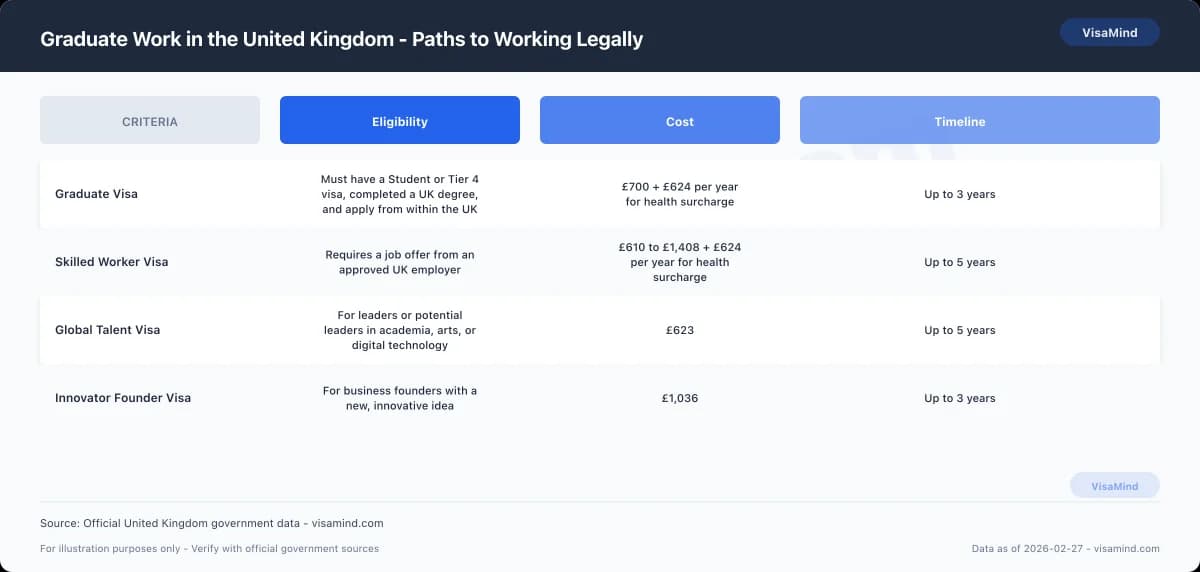
It's essential to understand the various work visa categories available. The UK Visas and Immigration (UKVI) oversees a range of visas that cater to different needs and circumstances. Here's a concise comparison of several key work visas you might consider:
| Visa Type | Eligibility | Cost | Timeline |
|---|---|---|---|
| Graduate Visa | Completed a UK bachelor's, postgraduate, or eligible course; current Student or Tier 4 visa | £715 | At least 18 months |
| Skilled Worker Visa | Job offer from an approved UK employer | £625 - £1,423 | Up to 5 years |
| Global Talent Visa | Recognized leader or potential leader in academia, arts, or digital technology | £623 | Up to 5 years |
| Health Care Worker Visa | Job offer in a UK healthcare role | £232 - £464 | Up to 5 years |
| Innovator Founder Visa | Endorsed to start a business in the UK | £1,036 | Up to 3 years |
Key Work Visa Categories
Graduate Visa
The Graduate Visa is designed to allow students who have completed their studies in the UK to remain for at least 18 months. To be eligible, you must be in the UK on a Student or Tier 4 visa and have completed a qualifying course. Your education provider must confirm your course completion with the Home Office. It's crucial to apply before your current visa expires.
Important: Ensure your education provider has reported your course completion to avoid application delays.
Skilled Worker Visa
The Skilled Worker Visa is aimed at individuals who have a job offer from a licensed UK employer. This visa allows you to work in the UK for up to five years, and you can apply for an extension or switch to another visa, such as Indefinite Leave to Remain, if eligible. The cost varies depending on your circumstances and the length of your stay.
Global Talent Visa
The Global Talent Visa is for highly skilled individuals in fields like academia, arts, and digital technology. You can apply directly if you've won an eligible prestigious prize. Otherwise, you'll need to obtain an endorsement to prove your leadership potential. This visa provides the flexibility to switch roles or employers in the UK.
Tips for Choosing the Right Visa
- Determine Eligibility: Review the specific eligibility criteria for each visa type to ensure you meet all requirements.
- Consider Long-term Goals: Some visas, like the Skilled Worker Visa, can lead to permanent residency.
- Budget for Costs: Keep in mind the application fees and any associated costs, such as healthcare surcharges.
For more guidance on applying for these visas and understanding the UK work visa landscape, consult the Visa Extension Guide and Documents Checklist. Each visa category serves different purposes, so assess your qualifications and career objectives carefully to choose the most suitable pathway.
Employer Sponsorship Requirements
#It’s essential for employers to understand their responsibilities and the regulatory framework set by UK Visas and Immigration (UKVI). This section will guide you through the key requirements and responsibilities for employers.
Employer Sponsorship Requirements
Employers do not need to sponsor graduates on a Graduate visa, as this visa type does not require a Certificate of Sponsorship (CoS). However, understanding sponsorship requirements for other visa types, such as the Skilled Worker Visa, is crucial for long-term employment planning.
Key Sponsorship Licenses
For employers interested in hiring graduates under different types of work visas, such as the Skilled Worker or Health Care Worker visas, having a sponsor license is mandatory. Here’s a quick overview of what's required:
- Eligibility Check: Ensure your business is eligible to obtain a sponsor license.
- Valid License: Once granted, your sponsor license remains valid as long as you meet all ongoing compliance requirements.
- Record Keeping: Maintain accurate records of sponsored employees, including job descriptions and employment history.
- Compliance: Adhere to UKVI regulations, including reporting any employee changes, such as role changes or employment termination.
Important Considerations
While the Graduate visa doesn't involve direct sponsorship, it’s beneficial for employers to consider future visa needs:
- Long-Term Employment: If planning for long-term employment, a transition to a Skilled Worker visa might be necessary, which does require sponsorship.
- Visa Expiry: Ensure awareness of visa expiration dates and any required transitions for continued employment legality.
Important: Employers must ensure compliance with all employment laws and immigration regulations, including the right to work checks for all employees, to avoid penalties.
Transitioning from Graduate Visa
For graduates on a Graduate visa looking to continue their work in the UK beyond the initial period, transitioning to a different visa type may be necessary. Employers can support this transition by:
- Providing necessary documentation to assist with visa transitions.
- Offering roles that meet the criteria for other visa categories, such as the Skilled Worker Visa.
- Understanding the differences between visa types by referring to the Skilled Worker vs Global Talent guide.
Being aware of these requirements and preparing in advance can significantly ease the process for both the employer and the graduate, ensuring a seamless transition and continued compliance with UK immigration regulations.
How to Apply for a Work Visa
#Confirm Eligibility
Before applying for a work visa in the United Kingdom, ensure you meet the specific eligibility criteria set by UK Visas and Immigration (UKVI). For a Graduate Visa, you must currently hold a Student visa or Tier 4 (General) student visa. Additionally, you should have completed a UK bachelor's degree, postgraduate degree, or another eligible course, and your education provider must have confirmed your course completion to the Home Office. Make sure to apply while you are still in the UK and before your current visa expires.
Gather Required Documents
You'll need to prepare several documents to support your visa application. These typically include:
- Proof of identity, such as a valid passport.
- Evidence of course completion from your education provider.
- Personal information, including your National Insurance number.
- Financial information, such as credit card details.
For a complete list of documents, refer to the Documents Checklist.
Submit Your Application Online
The application process for a Graduate visa is conducted online through the UKVI portal. Make sure to have all your documents ready in digital format for submission. While completing your application, you will also need to pay the relevant application fee. The fee amount can vary, so it's recommended to verify the current fee on the official UKVI website.
Tip: Applying online ensures you receive a receipt number immediately, which can be useful for tracking your application status.
Prove Your Identity
As part of the application process, you will need to prove your identity. This may involve using the UK Immigration: ID Check app to scan your documents and upload a photo, or attending a biometric appointment at a Visa Application Centre to provide your fingerprints and photo.
Await a Decision
Once your application is submitted, the processing time can vary. It's usually quicker if you applied online and used the ID Check app. For more detailed timelines, consult the Processing Times.
Important: Ensure that your application is submitted before your current visa expires to avoid complications, as failing to do so may result in being unable to apply for the Graduate visa.
By following these steps, you can effectively apply for a Graduate visa and continue your career journey in the UK. For more comprehensive guides on different work visas, consider exploring options such as the Skilled Worker Visa or the Global Talent Visa.
What You Can and Cannot Do
#- On a Graduate visa, you have the flexibility to work in most jobs without a specific employer sponsorship. This means you can change employers or work multiple jobs if you choose.
- However, if you switch to a visa type that requires employer sponsorship, such as the Skilled Worker Visa, you will need a confirmed job offer from an approved employer.
Can Family Join You?
- Your family members, including your partner and children, can apply to join you in the UK if they are eligible as your dependents.
- They must usually apply before entering the UK, and their visa will be linked to the duration of your Graduate visa.
Important: Ensure that your family members meet the eligibility requirements and provide necessary documentation to avoid delays.
Can You Study?
- While on a Graduate visa, you are permitted to engage in further study. However, the study should not interfere with the work you are doing in the UK.
- If you wish to pursue a course that requires a Student visa, you must apply for a Student Visa to continue your education in the UK.
Work and Study Balance
- Balancing work and study is crucial, as your primary reason for staying in the UK under a Graduate visa is to gain work experience.
- It's advisable to consider the demands of both commitments to ensure you can effectively manage your time and responsibilities.
For further information on transitioning from a Graduate visa to other types of visas, such as the Global Talent Visa or Indefinite Leave To Remain, consult the relevant sections on the UKVI website.
From Work Visa to PR
#Obtaining a work visa in the UK can be a strategic step towards securing permanent residency (PR). The process involves transitioning from temporary work visas, like the Graduate visa, to more permanent statuses such as Indefinite Leave to Remain (ILR).
Pathway from Graduate Visa to PR
After completing an eligible course in the UK, international graduates can apply for a Graduate Visa, which allows them to stay in the UK for at least 18 months. This visa serves as a stepping stone to other work visas, such as the Skilled Worker Visa, which can eventually lead to PR.
-
Graduate Visa (18 months minimum): This visa allows graduates to work or look for work at any skill level, providing flexibility to gain employment experience in the UK.
-
Skilled Worker Visa: To transition from a Graduate visa to a Skilled Worker visa, you must secure an eligible job offer from a UK employer with a sponsor licence. This visa can last up to 5 years, and it is a key route for those aiming for permanent residency.
Tip: Start seeking employment early during your Graduate Visa period to ensure a smooth transition to a Skilled Worker Visa.
Transition to Indefinite Leave to Remain (ILR)
Securing a Skilled Worker Visa opens the door to applying for Indefinite Leave to Remain. ILR allows you to live in the UK without time limits and is a critical step towards British citizenship.
-
Eligibility for ILR:
- You must have lived in the UK for a continuous period on a qualifying visa, typically 5 years.
- Meet specific salary thresholds and language requirements.
- Demonstrate knowledge of life in the UK.
-
Application Process:
- Gather necessary documents, including proof of continuous residence and employment.
- Submit an ILR application through the UKVI.
- Attend a biometric appointment if required.
Timeline to Permanent Residency
The timeline from starting with a Graduate Visa to obtaining PR varies depending on individual circumstances and visa transitions. Here's a typical timeline:
| Visa Type | Duration | Transition to Next Step |
|---|---|---|
| Graduate Visa | 18 months | Secure employment, apply for Skilled Worker Visa |
| Skilled Worker Visa | Up to 5 years | Eligible to apply for ILR after 5 years |
| Indefinite Leave to Remain | Permanent | Eligible to apply for British citizenship after 1 year on ILR |
Important: Ensure your employment meets the salary and skill requirements for the Skilled Worker Visa to avoid delays in achieving PR.
For more details on the pathways to PR and the specific requirements, consider referring to the PR Pathway Guide. Remember, each step in this journey requires careful planning and timely action to meet eligibility criteria.
What Goes Wrong
#When applying for a Graduate visa in the United Kingdom through UK Visas and Immigration (UKVI), it's important to be aware of common pitfalls that could lead to an application refusal. Here are some typical issues and how to avoid them:
Timing Issues
- Application Timing: Ensure you apply for the Graduate visa before your current Student visa or Tier 4 (General) student visa expires. Failure to do so will result in a refusal.
- Course Completion Notification: Your education provider must have informed the Home Office that you’ve successfully completed your course. Ensure this notification is sent before you lodge your application.
Important: You must be in the UK to apply for the Graduate visa. Attempting to apply from outside the UK will lead to a refusal.
Documentation Errors
- Proof of Completion: You must provide evidence that your course provider has confirmed your successful completion to the Home Office. Lack of this evidence will lead to refusal.
- Identity Verification: Properly verify your identity and ensure all personal details match across documents. Discrepancies can lead to issues during processing.
Eligibility Missteps
- Correct Visa Category: Verify that you are applying under the correct visa category. The Graduate visa is distinct from other types like the Skilled Worker Visa or Global Talent Visa. Ensure your current visa is a Student or Tier 4 (General) student visa.
- Course Eligibility: Only courses at a UK bachelor’s level or higher qualify. Double-check that your course meets these requirements.
Financial and Personal Data
- Financial Information: Provide accurate financial information, such as your National Insurance number. Missing or incorrect financial details can delay processing or lead to refusal.
- Contact Details: Ensure that your contact information is up-to-date and matches what is on file with UKVI.
For additional guidance on the process, consider reviewing the Visa Refusal Reasons or consulting the Documents Checklist to verify you have everything in order.
Tip: Always apply online through the official UKVI portal to streamline the process and receive immediate confirmation of your application submission.
Credential Requirements
#Important: Ensure your academic qualifications are recognized by UK authorities before applying for the Graduate visa.
Recognized Qualifications
To apply for a Graduate visa, it is essential that your degree or qualification is recognized by the UK system. Here are the key requirements:
- Degree Type: You must have completed a UK bachelor’s degree, postgraduate degree, or another eligible course.
- Course Duration: Your course must have been completed within the period specified by your Student visa or Tier 4 (General) student visa.
- Educational Institution: The course should be from a recognized UK higher education provider. The institution must have informed the Home Office of your successful course completion.
Skills Assessment
Skills assessments are generally not required for the Graduate visa application. However, if you transition to a Skilled Worker Visa or other specialized visas later, a skills assessment might be necessary depending on your job role and sector.
Proof of Qualification
When lodging your application, you must provide evidence of your academic achievements:
- Completion Notification: Your education provider must confirm to the Home Office that you've successfully completed your course. This is a crucial step to ensure eligibility.
- Documentation: Present official documents such as your degree certificate or official transcripts as proof of completion.
Tip: Keep digital copies of all documents. These can be helpful for future visa applications or for transitioning to other visa types like the Indefinite Leave To Remain.
Transitioning from Study to Work
For those considering transitioning from a Graduate visa to other work-related visas, understanding the qualification requirements is critical:
- Graduate Visa Duration: The Graduate visa allows you to stay in the UK for at least 18 months after completing your course. Plan your next steps within this timeframe.
- Further Studies: If you intend to pursue further education, consider applying for a Student Visa before your Graduate visa expires.
Ensure you meet all the credential requirements before applying to avoid delays or refusals. For more details on the documents required, consult the Documents Checklist.
Salary Thresholds and Fees
#Important: Make sure to submit your application for a Graduate visa before your current Student visa or Tier 4 (General) student visa expires to avoid any interruptions in your stay in the UK.
Salary Thresholds for Work Visas
For a Graduate visa, there is no specific salary threshold you must meet. However, if you intend to switch to a Skilled Worker Visa later, you will need to meet the salary requirements for that visa. Typically, this means having a job offer with a minimum salary of £26,200 per year or the 'going rate' for your occupation, whichever is higher, as of 2023. Always verify the latest thresholds on the official UKVI website.
Application Fees
The fee for applying for a Graduate visa is £715. Additionally, you must pay the Immigration Health Surcharge, which is £624 per year of your stay. This surcharge gives you access to the National Health Service (NHS) in the UK. Make sure to budget for these costs when planning your post-graduation stay.
| Visa Type | Salary Threshold | Application Fee | Immigration Health Surcharge |
|---|---|---|---|
| Graduate Visa | No specific salary threshold | £715 | £624 per year |
| Skilled Worker Visa | £26,200 per year or occupation rate | £625 - £1,423 | £624 per year |
| Global Talent Visa | No minimum salary requirement | £623 | £624 per year |
Fee Payment and Timeline
You must pay the application fee and Immigration Health Surcharge when you apply online. Typically, you will receive a decision on your application within 8 weeks. Remember, your application must be lodged while you are still in the UK, and before your current visa expires. For further guidance, consider reviewing the full Graduate visa process.
Tip: Consider applying for the Graduate Visa online to streamline the process and receive immediate confirmation of your application submission.
Tax Rules for Foreign Workers
#When working in the United Kingdom on a Graduate visa, it is important to understand your tax responsibilities, including income tax obligations and social security contributions, often referred to as National Insurance contributions in the UK. Complying with these obligations ensures a smooth transition into the UK workforce.
Income Tax Obligations
As a Graduate visa holder working in the UK, you are required to pay income tax on your earnings. The tax system in the UK is progressive, meaning the rate of tax increases with higher income bands. Here are the basic tax bands for the current tax year:
- Personal Allowance: £12,570 (0% tax)
- Basic Rate: 20% on income over £12,570 and up to £50,270
- Higher Rate: 40% on income over £50,270 and up to £125,140
- Additional Rate: 45% on income over £125,140
Tip: Ensure you register for a Personal Tax Account with HM Revenue and Customs (HMRC) to manage your tax affairs online.
National Insurance Contributions
In addition to income tax, National Insurance contributions (NICs) are mandatory for individuals working in the UK. These contributions fund state benefits, including the National Health Service (NHS) and state pension. The NICs you pay depend on your earnings and employment status.
- Class 1 Contributions: Paid by employees earning above £242 a week (as of 2023). The rate is 12% of earnings between £242 and £967 per week, then 2% on earnings above this.
Double Taxation Treaties
The UK has double taxation treaties with many countries to prevent international workers from being taxed twice on the same income. As a Graduate visa holder, check if your home country has such a treaty with the UK.
- Check Treaties: Visit the UK Government's official website to see if a treaty applies to you.
Important: Ensure you maintain documentation of your tax residency status to benefit from treaty relief.
Understanding these tax rules will help you comply with UK regulations and manage your finances effectively while on a Graduate visa. For more detailed guidance, consider reviewing the Visa Extension Guide if you plan to extend your stay beyond the Graduate visa period.
Real Scenarios
#A recent university graduate, Tom, completed his master's degree in computer science at a UK university. With his Student visa nearing expiration, Tom wanted to remain in the UK to gain work experience and potentially transition to a more permanent visa option. To achieve this, he explored the Graduate visa option, which UK Visas and Immigration (UKVI) offers to individuals like him who have recently completed an eligible course.
Tom ensured his university had informed the Home Office of his successful course completion, a critical step in confirming his eligibility. He then applied online for the Graduate visa while still in the UK, as required, and before his Student visa expired. Within a few weeks, Tom received confirmation of his Graduate visa, allowing him to stay in the UK for at least 18 more months. This period provided him the opportunity to gain valuable work experience and eventually explore options like the Skilled Worker Visa for a longer-term stay.
Scenario: Addressing a Potential Application Pitfall
Sophia, a postgraduate student in the UK, was eager to continue her career in the UK after completing her studies in biotechnology. However, as the deadline for her Student visa expiration approached, she realized she had not yet confirmed whether her university had informed the Home Office of her course completion. Concerned about the potential pitfall of not providing this proof, Sophia immediately contacted her university's international student office.
The university promptly confirmed they had notified the Home Office, and Sophia added this confirmation to her electronic application for the Graduate visa through the UKVI portal. Thanks to her proactive approach, Sophia successfully avoided a common pitfall and, within a month, received her Graduate visa, allowing her to explore work opportunities in the UK biotech industry.
Important: Ensure your education provider informs the Home Office of your course completion before applying for the Graduate visa to avoid application delays.
FAQs
Can I apply for a Graduate visa if I'm outside the UK and want to work in the United Kingdom?
What are the potential pitfalls when applying for a Graduate visa for work in the United Kingdom?
How long can I stay in the UK on a Graduate visa for Graduate Work in the United Kingdom?
What are the employer sponsorship requirements for a Skilled Worker visa related to Graduate Work in the United Kingdom?
What credential requirements must be met for Graduate Work in the United Kingdom?
Can I switch from a Graduate visa to a Skilled Worker visa while working in the United Kingdom?
What are the tax rules for foreign workers on a Graduate visa in the United Kingdom?
Sources
Last reviewed: March 1, 2026
VisaMind provides informational guidance only and is not a government agency. This is not legal advice. Requirements can change and eligibility depends on your specific facts. If your case is complex or high-stakes, consult a licensed immigration attorney.
Next steps
Requirements vary by nationality, purpose, timeline, and case details. Use Find My Visa to get a personalized checklist for United Kingdom with official sources and deadlines.
Find my visa