
What the E-1 Treaty Trader Visa Covers
#The E-1 classification allows entry to the United States for nationals of treaty countries to carry out international trade.
It also extends to certain employees of qualifying traders or organizations.
Who uses this visa
You use the E-1 Treaty Trader Visa if you're from a country with a qualifying treaty relationship and you intend to engage in international trade for yourself.
This visa also covers certain employees of a qualifying trader or trading organization. The employer must share your treaty nationality to qualify under this classification.
You may qualify if you are:
- A national of a treaty country
- Engaging in international trade on your own behalf
- An employee of a qualifying treaty trader or organization
| Applicant Type | Basic Requirement |
|---|---|
| Individual trader | Treaty country national engaging in international trade |
| Employee | Same treaty nationality as employer and working for qualifying trader |
You apply through the U.S. Department of State by submitting Form Form DS-160 and attending a consular interview. USCIS handles immigration benefits inside the United States.
What it allows
The E-1 visa authorizes you to work in international trade as stated in your application.
You may conduct trade activities on your own behalf as the principal trader. Approved employees may work for the qualifying employer in the approved role.
This classification restricts you to the trade activities that form the basis of your eligibility.
| Benefit | What It Means for You |
|---|---|
| Work authorization | You may work in the approved international trade activity |
| Employer-based authorization | Employees may work only for the qualifying trader |
| U.S. admission | You may seek entry for approved trade activities, subject to inspection |
CBP determines admission at the port of entry. USCIS manages extensions or changes of status if you apply inside the United States.
Sponsor Requirements
#You must prove that the treaty trader business and any affected employee continue to qualify for E-1 classification.
USCIS expects complete documentation, timely filings, and prompt notice of material changes.
Filing obligations
You carry the burden of showing that the treaty trader enterprise and the employee still meet E-1 requirements.
Your filing must include evidence that eligibility continues at the time of submission.
If you're in the United States in lawful nonimmigrant status and want to change status to E-1, you must:
-
File Form I-129, Petition for a Nonimmigrant Worker, with USCIS.
-
Include documentation supporting ongoing E-1 qualification.
If you're outside the United States, you typically apply for a visa using Form DS-160 with the U.S. Department of State.
| Your Location | Primary Filing | Agency Involved | Purpose |
|---|---|---|---|
| Inside the U.S. in lawful status | Form I-129 | USCIS | change of status to E-1 |
| Outside the U.S. | Form DS-160 | U.S. Department of State | E-1 visa application |
Notifying changes
You must notify USCIS of substantive changes that affect eligibility for E classification.
A substantive change is one that impacts whether the business or employee still qualifies under E-1 rules.
Failing to report material changes can jeopardize the employee’s ability to work in the United States. It can also affect future filings or extensions.
You should review any significant operational or employment changes before implementing them.
If the change affects eligibility, you may need to file an amended petition with USCIS.
Key situations that require close review include:
- Changes that affect the treaty trader’s qualifying activities
- Changes that affect the employee’s qualifying role
- Any development that calls E-1 eligibility into question
Petition filing options
Your filing option depends on the employee’s location and current immigration status.
If the employee is already in the United States in lawful nonimmigrant status, you may request a change of status by filing Form I-129 with USCIS.
Approval allows the employee to remain in the United States and work in E-1 classification, consistent with the petition.
If the employee is outside the United States, the process generally involves:
-
Completing Form DS-160.
-
Applying for an E-1 visa through the U.S. Department of State.
-
Seeking admission at a U.S. port of entry, where U.S. Customs and Border Protection determines entry.
Each path serves a different purpose. USCIS handles petitions and changes of status, while the Department of State manages visa issuance.
How to Apply
#You apply for E-1 classification either through USCIS if you're in the United States or through a U.S. embassy or consulate if you're abroad.
The process requires accurate forms, matching biographical information, and complete supporting evidence.
Applying from inside the U.S.
If you're already in the United States, you file the E-1 classification request with USCIS.
Start by downloading the current E-1 form and instructions from USCIS.
Review the instructions for your eligibility category before completing the form.
Follow these steps:
-
Complete all required sections of the form.
-
Sign where required.
-
Submit the form with supporting evidence.
-
Include the correct filing fee listed on the USCIS website.
All information must match your passport and supporting documents exactly. Even small inconsistencies can delay adjudication or lead to denial.
If you have questions about filing fees or mailing instructions, confirm the details on the USCIS website before sending your packet.
Consular application basics
If you're outside the United States, you apply for an E-1 visa through a U.S. embassy or consulate under the U.S. Department of State.
You must complete the Form DS-160, Online Nonimmigrant Visa Application. This form applies to all nonimmigrant visa categories.
After submitting the DS-160:
- Print and keep the barcode confirmation page.
- Save your application ID.
- Retrieve and complete the form within 30 days if you do not finish it in one session.
Prepare passport-style photos before starting. Non-compliant photos can delay visa processing.
All information on your DS-160 must match your passport and supporting documents exactly. Consular officers will verify consistency during processing.
For details about interview scheduling and visa issuance procedures, consult the U.S. Department of State.
Form completion and submission
Accuracy and document consistency determine whether your application moves forward without delay.
Use this checklist before submitting any E-1 application:
- All names, dates, and passport numbers match exactly.
- Required fields are complete.
- You signed the form where required.
- You included all supporting evidence.
- You retained copies of confirmation pages.
For consular filings, upload and print the DS-160 confirmation page before leaving the Consular Electronic Application Center (CEAC) system. You’ll need that page for your visa appointment.
If you're filing with USCIS, submit the completed form and required evidence together in one package.
Review the official form instructions for the current mailing address and filing procedures.
Gather Required Documents
#
You must prove two core elements: that you and your business share the nationality of a treaty country, and that your company engages in substantial and principal trade.
Your documents should directly support these points and align with what you state in your Form DS-160 and any filing with USCIS.
Nationality evidence
You must show that the trader and the trading enterprise have the nationality of a treaty country.
Focus on clear, official records that establish ownership and citizenship.
Provide documents such as:
- Passport biographic page showing your nationality
- Articles of incorporation or formation documents
- Stock certificates or membership records
- Ownership ledgers identifying shareholders and their nationalities
- Organizational charts tracing ownership to individual owners
Your evidence must demonstrate that the business is at least 50% owned by nationals of the same treaty country.
If ownership runs through multiple entities, include documents for each layer so the nationality trail remains clear.
Use a simple ownership summary table to organize your evidence:
| Item | What It Shows | Why It Matters |
|---|---|---|
| Passport | Your citizenship | Confirms treaty nationality |
| Corporate formation documents | Place of incorporation | Identifies company nationality |
| Shareholder records | Ownership percentages | Confirms majority treaty ownership |
Ensure all documents are consistent with the information listed in your DS-160 and any petition filed with USCIS if you seek a change or extension of status for work in the United States.
Trade and business records
You must prove that your company conducts substantial trade and that the trade is principally between the United States and the treaty country.
Submit detailed commercial records, not just summaries.
Key documents include:
- Invoices and purchase orders
- Bills of lading or shipping documents
- Contracts with U.S. and treaty-country partners
- Bank statements reflecting international transactions
- Accounting records showing volume and frequency of trade
Substantial trade requires a steady flow of qualifying transactions over time.
Present multiple transactions, not just one large deal. Organize them chronologically to show ongoing activity.
Principal trade means that more than 50% of the total international trade occurs between the United States and the treaty country.
Use a table to clarify this:
| Trade Category | Total Volume | U.S.–Treaty Country Volume | Percentage |
|---|---|---|---|
| Goods/Services | — | — | — |
Your records should clearly show that U.S.–treaty country trade exceeds 50% of total international trade.
The U.S. Department of State will review this evidence during visa processing, and Customs and Border Protection will determine admission at entry.
Extending Your Work Visa
#You can continue your E-1 treaty trader classification by requesting additional periods of stay.
USCIS grants extensions in fixed increments, and you must file the proper request before your current status expires.
Extension length and limits
USCIS may approve an extension of stay in E-1 classification for up to two years at a time.
Each approval covers a specific period, not an open-ended authorization.
| Item | Rule |
|---|---|
| Maximum time per extension | Up to 2 years |
| Who decides | U.S. Citizenship and Immigration Services (USCIS) |
| Type of request | Extension of stay or change of status to E-1 |
You must submit your extension request to USCIS while you remain in valid status.
If you travel abroad instead of extending status in the United States, you would apply for a new E-1 visa through the U.S. Department of State using Form Form DS-160, and a consular officer would decide visa issuance.
Your ability to keep working depends on maintaining valid E-1 status at all times.
Evidence to include
You must show that you continue to qualify for E-1 classification when you request the extension.
USCIS reviews whether your employment and activities remain consistent with E-1 requirements.
Include clear documentation that supports:
- Your ongoing eligibility for E-1 classification
- The continuation of your qualifying work
- Your request for an additional period of stay (up to two years)
Organize your evidence so USCIS can quickly confirm that you still meet E-1 standards.
Provide copies, not originals, unless the form instructions require otherwise.
Family Members
#Your business may qualify certain employees for E-1 classification, and family eligibility connects directly to the principal treaty trader or qualifying organization.
Nationality and the relationship to the principal matter most.
Who can be included
U.S. immigration law permits certain employees of a treaty trader or qualifying organization to apply for E-1 classification.
To be eligible as an employee, you must work for a treaty trader or a qualifying organization and share the same nationality as the principal treaty trader employer.
USCIS reviews eligibility for status inside the United States. If you apply for a visa outside the country, the U.S. Department of State manages the process.
Nationality alignment is the main requirement here. If the principal trader is a national of the treaty country, you also need to hold that nationality.
| Role | Nationality Requirement | Authority Involved |
|---|---|---|
| Principal Treaty Trader | Must be a national of the treaty country | USCIS / U.S. Department of State |
| Employee | Must have the same nationality as the principal employer | USCIS / U.S. Department of State |
Dependents' status and notes
Family members of E-1 treaty traders and qualifying employees may qualify for dependent status if the principal maintains valid E-1 classification.
If the principal loses E-1 status, dependent eligibility ends as well.
USCIS handles dependent status requests inside the United States. The U.S. Department of State issues visas abroad, while U.S. Customs and Border Protection manages admission at the port of entry.
A qualifying relationship with the principal must be maintained at all times. Changes in employment, nationality, or eligibility can impact dependent status.
Documentation for family members
Two things must be documented: the principal’s valid E-1 classification and your qualifying relationship to that principal.
Submit proof of the principal’s E-1 approval or visa, evidence of nationality alignment if needed, and records showing the family relationship.
If you’re applying inside the United States, file the appropriate request with USCIS and follow current instructions.
If applying abroad, complete the nonimmigrant visa application process with the U.S. Department of State and follow consular instructions.
Always check current filing procedures and form requirements with USCIS or the Department of State before you apply.
When to Get Professional Help
#E-1 treaty trader cases depend on accuracy, consistency, and timing. Errors on your Form DS-160 or incomplete answers to security questions can lead to delays, RFEs, or denials that disrupt your ability to work in the United States.
When to consult an expert
Consult an immigration attorney if you’re unsure about any answer on your DS-160, especially security and background questions. Vague or incomplete responses often trigger a Request for Evidence (RFE) or denial.
Legal review is helpful if your information has changed since a previous application. Even minor differences between DS-160 submissions or between your DS-160 and passport details can cause credibility issues.
If several people from your company are applying for E-1 status, consistency across applications is important. An attorney can review each form to ensure dates, names, and travel history match.
Official instructions from USCIS and the Department of State are essential, but avoid guessing on required questions.
Handling denials and RFEs
If you receive an RFE from USCIS, respond to every issue raised. Don’t leave security or background questions incomplete.
A denial requires you to review the stated reasons and compare:
| Issue Identified | What to Review Immediately |
|---|---|
| Incomplete answers | All security and background sections on your DS-160 |
| Inconsistent information | Passport data, travel dates, prior DS-160 submissions |
| Missing clarification | Any section where your answer may appear vague |
An attorney can help identify whether issues stem from inconsistent dates, mismatched passport information, or earlier submissions. Fixing these problems before reapplying lowers the risk of another denial.
Complex evidence or timing issues
Timing mistakes can happen if you submit multiple DS-160 sessions and enter different information each time. Even small discrepancies in travel dates or passport details can cause delays.
Seek professional help if you started a DS-160 more than once, updated your passport or travel history during the process, or aren’t sure whether prior answers match your current submission.
Accuracy is more important than speed. Review every entry against your passport and previous applications before submitting.
A line-by-line review by an attorney helps ensure all biographic data, travel history, and security responses match exactly. This step can reduce RFEs and protect your E-1 eligibility.
Path to Permanent Residence
#The E-1 treaty trader classification doesn’t provide a direct route to a green card. You’ll need a separate immigrant strategy while staying compliant with your current status.
Long-term options overview
The E-1 visa lets you work in the United States based on qualifying treaty trade, but it doesn’t lead to permanent residence by itself. To obtain a green card, you must qualify in another immigrant category.
Some long-term options include:
- An employment-based immigrant petition with USCIS
- A family-based petition by a qualifying relative
- Another immigrant classification for which you independently qualify
Your process depends on whether you apply inside the United States with USCIS or complete immigrant visa processing through the U.S. Department of State after submitting Form Form DS-160 and attending a consular interview.
| Path | Who Files | Agency Involved | Key Point |
|---|---|---|---|
| Employment-based | U.S. employer (or self, if eligible) | USCIS | Requires separate immigrant petition |
| Family-based | Qualifying U.S. citizen or permanent resident relative | USCIS | Relationship must meet statutory requirements |
| Consular processing | Applicant after petition approval | Department of State | Visa issued abroad before entry |
Nonimmigrant intent considerations
E-1 classification requires nonimmigrant intent. You must intend to depart the United States when your E-1 status ends.
This intent is reviewed at the visa interview after submitting Form DS-160, when seeking admission with U.S. Customs and Border Protection, and when applying for extensions with USCIS.
If you pursue permanent residence, timing is important. Actions suggesting permanent intent can impact future E-1 applications or entries.
Maintain documentation showing your treaty trade remains active, your enterprise continues to qualify, and you comply with authorized work terms.
USCIS evaluates extensions and changes of status separately from immigrant petitions. The Department of State determines visa eligibility at each consular interview.
Conditions and Portability
#You must keep meeting E-1 treaty trader requirements as long as you’re in the United States. The most significant ongoing requirement is a clear intent to leave when your E-1 status ends.
Maintaining E-1 status
You need to maintain the intent to depart when your E-1 status expires or terminates. If you stop planning to leave after your authorized stay, you risk falling out of status.
USCIS checks your compliance with classification terms when you apply for an extension or change of status. The Department of State reviews the same intent when you submit Form Form DS-160 for a new visa.
Focus on these obligations:
- Maintain genuine intent to depart at the end of your E-1 stay
- Avoid actions that conflict with your stated temporary purpose
- Ensure your activities are consistent with your E-1 Work authorization
| Requirement | What You Must Show |
|---|---|
| Temporary intent | You plan to leave the U.S. when E-1 status ends |
| Ongoing eligibility | Your actions match the purpose of your E-1 classification |
| Consistency | Your applications and statements reflect the same intent |
A change in your intent may affect eligibility.
Reporting changes that affect eligibility
You must address any change that impacts E-1 eligibility. A shift in your intent to remain in the United States beyond your authorized period directly affects your status.
When filing with USCIS, provide accurate and updated information about your circumstances. When applying for a visa through the Department of State using Form DS-160, disclose current and truthful details.
Pay attention to changes involving your intention to depart, the continuation of qualifying E-1 activities, or any facts that could contradict your temporary stay.
If your actions don’t align with your stated temporary intent, you could face denial of extensions, visa refusals, or other immigration consequences. Ensure your filings and conduct consistently reflect a temporary purpose.
Eligibility Requirements
#Strict nationality and trade standards apply for E-1 classification. USCIS and the Department of State review whether your nationality and business activities meet treaty requirements before you can work in the United States.
Treaty-country and nationality rules
You must be a national of a country that has a qualifying treaty of commerce and navigation with the United States, or is otherwise recognized by U.S. law as eligible.
Eligibility is based on citizenship, not residence. Permanent residence in a treaty country isn’t enough if you don’t hold that country’s nationality.
You need to hold citizenship from a qualifying treaty country, the treaty must remain in force, and you must apply for the visa through the Department of State (usually by submitting Form DS-160). If applying for status in the United States, file with USCIS.
Check your country’s status on the Department of State’s list of treaty countries before applying.
| Requirement | What You Must Show |
|---|---|
| Nationality | Citizenship of a qualifying treaty country |
| Treaty status | Active treaty or qualifying agreement with the United States |
| Government review | USCIS (status) or Department of State (visa issuance) |
Trade activity criteria
You must engage in substantial trade. The government reviews both the volume and ongoing nature of your trade activity.
Substantial trade means a steady flow of international trade items between the United States and your treaty country. The focus is on consistent, meaningful commercial exchange—not just a single transaction.
You also need to show that your business conducts principal trade between the United States and the same treaty country of your nationality.
This means the majority of your international trade must occur between the United States and your treaty country. The trade must be active and ongoing, supporting your request to work under E-1 classification.
| Trade Standard | What It Means |
|---|---|
| Substantial trade | Continuous and meaningful volume of trade |
| Principal trade | Majority of international trade is with your treaty country |
| U.S. connection | Trade occurs between the United States and the treaty country |
Employee nationality and role
If you’re applying as an employee of a treaty trader, your nationality must match the treaty country of the qualifying business.
You can’t qualify under E-1 classification if your citizenship is different from the treaty country supporting the company’s eligibility.
Your job must directly support the qualifying trade activities. The position must be tied to the business’s substantial and principal trade between the United States and the treaty country.
To qualify as an employee, you need to show you share the same treaty-country nationality as the employer, your employment connects to the company’s qualifying trade, and your purpose is to work for that treaty trader.
USCIS reviews employee eligibility for status requests, while the Department of State evaluates eligibility during visa processing. Admission is determined at the port of entry.
Fees and Processing Times
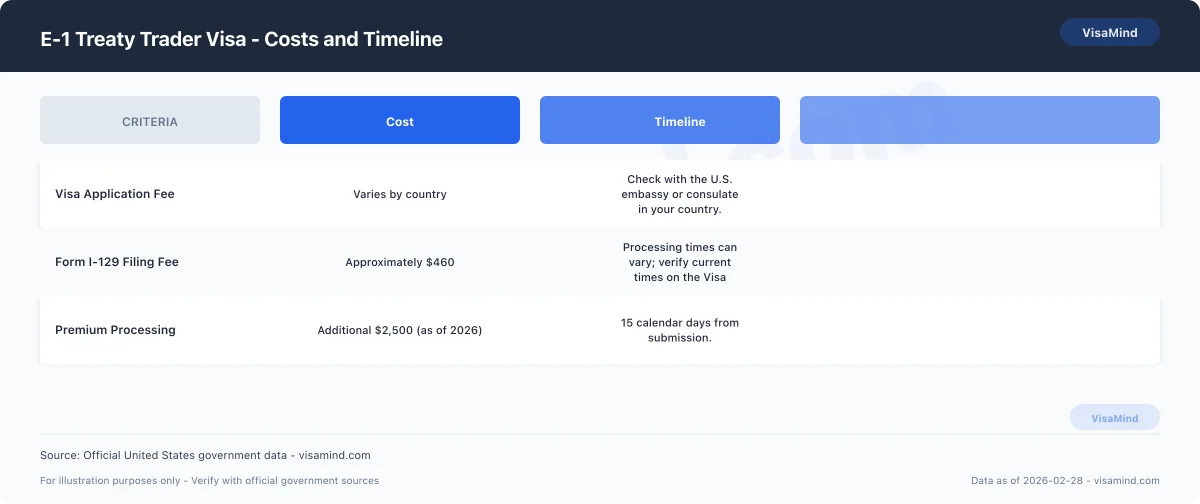
#You pay a fixed visa application fee and complete Form DS-160 before scheduling your interview. processing times vary by embassy or consulate and can range from a few weeks to several months.
Visa and filing fees
The E-1 Treaty Trader visa requires payment of the Machine Readable Visa (MRV) application fee.
| Fee Type | Amount (USD) | Paid To | When You Pay |
|---|---|---|---|
| MRV Application Fee | $315 | U.S. Department of State | Before scheduling your visa interview |
Pay the $315 fee when submitting Form DS-160 and scheduling your interview with the Department of State system. This fee covers visa processing at the embassy or consulate.
If you file related applications with USCIS from inside the United States, separate filing fees apply. Those amounts depend on the form. Always check current USCIS filing fees before submitting your application.
DS-160 and consular timelines
You’ll need to complete and submit Form DS-160, Online Nonimmigrant Visa Application before your interview. Processing times depend on both visa category and the specific embassy or consulate.
As of February 2026, reported ranges look like this:
| Visa Category | Reported Time Range |
|---|---|
| Visitor (B1/B2) | 0.5 to 23 months |
| Student/Exchange (F, M, J) | 0.5 to 7.5 months |
| Petition-based (H, L, O, P, Q) | 0.5 to 4.5 months |
| Crew and Transit (C, D, C1/D) | 0.5 to 14 months |
The E-1 category is handled by the U.S. Department of State. It doesn’t follow typical USCIS petition-based timelines unless you’re applying for a change of status from inside the U.S.
Most E-1 applicants see processing in the range of 2 to 8 weeks. Actual timing hinges on interview slots, document review, and local post workload.
Some consular posts ask for extra documentation before approving E-1 visas for business-related work.
How to verify current processing times
Always confirm timelines before making travel or business commitments.
Here’s what to do:
-
Check interview wait times with the U.S. Department of State for your specific consulate or embassy.
-
Look up E visa processing details for your post.
-
If you’re filing with USCIS, review current form processing times directly with USCIS.
The processing times shift often, depending on staffing and application volume. Relying on informal estimates or third-party sites can throw off your relocation or business plans.
Common Petition Challenges
#Small mistakes and wrong selections can delay or block an E-1 treaty trader case. Pay close attention to photo standards, visa category choice, and every security question on the Form DS-160.
Photo and format issues
A photo that doesn’t meet requirements can stall your case at the U.S. Department of State. If the image fails to meet specifications, you’ll likely be asked to resubmit before your interview can proceed.
Common problems:
- Incorrect size or cropping
- Poor lighting or shadows
- Improper background
- Digital alterations
- Low resolution
Stick to the Department of State’s exact photo requirements. Using a professional service or a validated tool helps avoid issues before uploading to your DS-160.
| Issue | Likely Result | How to Prevent It |
|---|---|---|
| Wrong dimensions | Processing delay | Verify size before upload |
| Background not compliant | Rejection at interview | Use plain, approved background |
| Blurry or pixelated image | Request for replacement | Submit high-resolution file |
If you submit anything to U.S. Citizenship and Immigration Services (USCIS), follow every formatting instruction. Technical rejections waste time and can disrupt your work plans in the U.S.
Selecting the correct visa category
Choosing the wrong visa type can lead to denial. You need to pick a category that truly matches your purpose in the U.S.
Some common categories:
- B-1/B-2 for business or tourism
- F-1 visa for academic study
- H-1b visa for specialty occupation employment
- E-1 for treaty trade activities
If you select a category unrelated to treaty trader activity, the officer may refuse your application. Using a visitor visa for E-1 work isn’t allowed.
Check your purpose carefully before submitting the DS-160. If USCIS is involved, make sure the petition classification matches the visa category at the consulate.
| Selected Category | Actual Activity | Risk |
|---|---|---|
| B-1/B-2 | Ongoing trade operations | Refusal |
| F-1 | Managing treaty trade business | Denial |
| E-1 | Treaty trade work | Proper classification |
Getting this right prevents unnecessary problems.
Incomplete security/background items
Leaving security or background questions blank often causes delays or requests for more evidence. Every question on the DS-160 and any USCIS form needs a full answer.
Don’t leave blanks. If a question doesn’t apply, write:
- “None”
- “N/A”
Skipping items can result in:
- Requests for Evidence (RFE) from USCIS
- Administrative processing at the consulate
- Application refusal
Security questions determine admissibility. Officers review them closely, and missing or inconsistent answers can raise concerns.
Go through your application line by line before submitting. Make sure every field is complete and accurate. This helps prevent delays and keeps your E-1 work plans moving.
Fees
#Total estimated cost: $315
| Component | Amount |
|---|---|
| Application fee (MRV)MRV fee (E treaty trader) | $315 |
Verify current fees — official United States fee schedule
Fees shown are as of 2026-02. Verify on the official United States government website before applying.
Required forms
#Plan your E-1 Treaty Trader Visa with free United States tools
#Itemized government fees for E-1 Treaty Trader Visa and other United States categories.
Check United States eligibility
See how your profile scores against E-1 Treaty Trader Visa and other United States visas.
United States processing times
Typical wait times and stage breakdowns for E-1 Treaty Trader Visa and related United States visas.
Practice United States interview
Common interview questions and feedback for United States visa applicants.
Verified United States directory
#Browse source-backed, publication-certified records related to this visa route.
Browse source-backed, publication-certified records related to this visa route.
Browse source-backed, publication-certified records related to this visa route.