On this page
- What the H-1B1 Chile/Singapore FTA Professional Visa Covers
- When to Get Professional Help
- Fees and Processing Times
- Bringing Your Spouse and Children
- Path to Permanent Residence
- Renewal and Extension
- Conditions and Portability
- Application Process
- Eligibility Requirements
- Employer Obligations
- Common Petition Challenges
- How to Complete the DS-160 and Supporting Documents
- Fees
- Required forms
- Related visa types
- Related guides
- Related goals
- Next steps
What the H-1B1 Chile/Singapore FTA Professional Visa Covers
#The H-1B1 classification allows professionals from Chile and Singapore to work in the United States in specialty occupations. It centers on a specific job offer, verified qualifications, and review by U.S. government agencies.
Basic purpose
The H-1B1 visa allows a U.S. employer to hire you for professional work in a specialty occupation. The position must require specialized knowledge and professional qualifications.
Your employer files the required petition with U.S. Citizenship and Immigration Services (USCIS). The petition includes details about the U.S. company, the offered position, the terms of employment, and your professional background.
You must show that you have a legitimate job offer in the United States and that your qualifications match the role. If you apply for a visa at a U.S. embassy or consulate, you complete Form DS-160 with the U.S. Department of State.
The Department of State handles visa interviews and visa issuance. U.S. Customs and Border Protection decides whether to admit you when you arrive in the United States.
The H-1B1 category is separate from the standard H-1b visa classification, even though both involve specialty occupations.
Who uses it
You use the H-1B1 visa if you are a citizen of Chile or Singapore, have a job offer from a U.S. employer, will work in a specialty occupation, and meet the professional qualifications for that job.
This visa does not apply to nationals of other countries. Citizenship is a required element.
Your U.S. employer plays a central role. The employer submits the required petition to USCIS and provides details about the job offer.
You provide documentation of your education, credentials, and experience to show that you qualify for the position. The process typically involves two stages:
-
Petition review by USCIS
-
Visa application processing through the U.S. Department of State (if applying from outside the United States)
| Party | Role in H-1B1 Process |
|---|---|
| U.S. Employer | Files petition and provides job details |
| You (Applicant) | Proves qualifications and completes DS-160 |
| USCIS | Reviews and adjudicates petition |
| U.S. Department of State | Conducts visa interview and issues visa |
Occupation types included
The H-1B1 covers specialty occupations, meaning positions that require professional-level knowledge and qualifications. The job must be clearly defined and supported by a formal offer from a U.S. employer.
The employer must describe the duties of the role, the professional requirements, and how your background fits the position. You must show that your education and experience align with the job’s requirements.
USCIS evaluates whether the position qualifies as a specialty occupation and whether you meet the stated criteria. This visa does not cover general labor or casual employment.
It applies to structured professional roles tied to a specific U.S. employer and a specific offer of work.
When to Get Professional Help
#Certain H-1B1 cases involve added scrutiny, prior selection steps, or third-party verification. Seek legal guidance when your eligibility depends on specific documentation or government-issued notices that must align exactly with your petition and visa application.
Complex or high-risk scenarios
Consult an attorney if your case involves prior electronic registration selection or crossover issues with an H-1b visa filing. A selection notice from the electronic registration system must match your petition details exactly.
Any inconsistency can lead to delays or denial by U.S. Citizenship and Immigration Services (USCIS). Filing an H-1B1 petition does not guarantee approval.
USCIS reviews each submission independently, even if you previously held H-1B status or were selected through registration. Seek help if you:
- Rely on a prior H-1B selection notice
- Transition between H-1B and H-1B1 classifications
- Have discrepancies between your petition and your Form DS-160 visa application
- Face prior refusals or compliance concerns tied to your work history
| Scenario | Why Legal Help Matters |
|---|---|
| Prior electronic selection | Ensures notice details match the petition |
| Change between H-1B and H-1B1 | Prevents classification errors |
| Inconsistent records | Reduces risk of denial or delay |
An attorney can review your documents before submission and identify inconsistencies that trigger Requests for Evidence.
When government verifications are involved
You need professional guidance if your employment depends on a Department of Defense (DOD) project or other government-linked work. Some cases require a verification letter from the DOD project manager confirming your role on a specific project.
This letter must clearly identify the project and your involvement. If the letter lacks detail or conflicts with your petition, USCIS may question whether the offered work qualifies.
Obtain legal review when your employer must provide a DOD project manager verification letter, your work assignment connects to a government contract, or the verification letter supports eligibility for your H-1B1 petition.
Government-related employment often faces closer examination. An attorney can confirm that the verification letter, petition details, and DS-160 disclosures remain consistent before you appear for visa processing with the U.S. Department of State.
Fees and Processing Times
#You will pay a consular application fee and should plan for processing that ranges from a few weeks to several months, depending on the stage of your case. Costs and timelines differ between the visa application handled by the U.S. Department of State and any petition or change of status handled by U.S. Citizenship and Immigration Services (USCIS).
Government fees
For an H-1B1 visa application at a U.S. consulate, you must pay the Machine Readable Visa (MRV) fee of $
- You pay this fee when you submit the Form DS-160 Online Nonimmigrant Visa Application and schedule your interview with the U.S. Department of State.
This fee applies to petition-based categories, which include H classifications such as H-1b visa and H-1B
- The consular officer will not issue your visa until you pay the required MRV fee.
In limited circumstances, a presidential proclamation requires an additional $100,000 payment as a condition of eligibility. If this applies to you, you must make the required payment as instructed by USCIS, submit proof of payment, and complete the payment before USCIS adjudicates a change of status request.
If you are filing anything with USCIS, confirm current filing fees directly with USCIS before submitting your forms.
Processing timelines by category
processing times depend on whether you apply abroad through a consulate or request a change of status with USCIS inside the United States. For DS-160 visa applications, reported time ranges (as of February 2026) vary by category and location:
| Visa Category (DS-160) | Reported Time Range |
|---|---|
| Petition-based (H, L, O, P, Q) | 0.5 to 4.5 months |
| Visitor (B1/B2) | 0.5 to 23 months |
| Student/Exchange (F, M, J) | 0.5 to 7.5 months |
| Crew and Transit (C, D, C1/D) | 0.5 to 14 months |
As an H-1B1 applicant, you fall under the petition-based grouping. Actual timing depends on the U.S. embassy or consulate where you apply.
For certain immigration-related requests, general processing may take 2 to 8 weeks, but timelines can change without notice.
Special payment requirements
Some applicants face additional financial requirements beyond the standard $205 MRV fee. If a presidential proclamation applies to your case, you must make an additional $100,000 payment as a condition of eligibility.
USCIS requires proof of payment before it will adjudicate a related change of status request. You must follow the payment instructions provided by USCIS exactly.
Failure to submit proof in the required format can delay or prevent approval. Keep copies of payment confirmation receipts, any USCIS notices related to the payment, and evidence that the payment was made before adjudication.
If you are unsure whether this special requirement applies to your H-1B1 or related H-1B work authorization request, review the official USCIS guidance before filing.
Bringing Your Spouse and Children
#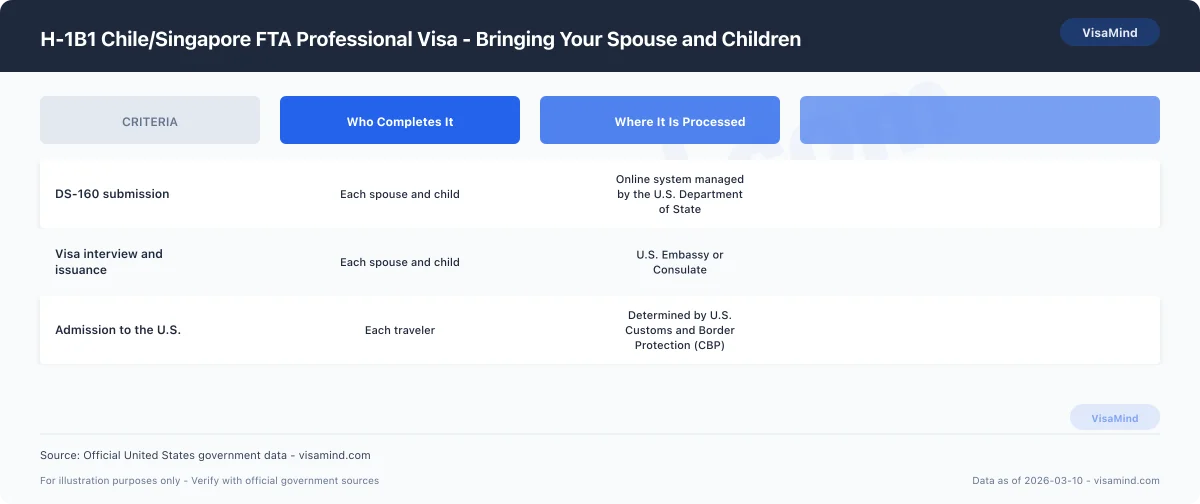
Your spouse and unmarried children must apply for their own nonimmigrant visas to join you in the United States. Each family member completes a separate application and attends visa processing through a U.S. Embassy or Consulate abroad.
Visa application steps for family
If your spouse and children are outside the United States, they apply for visas through a U.S. Embassy or Consulate, which the U.S. Department of State manages. They cannot receive a visa automatically based on your H-1B1 approval.
Follow these steps:
-
Complete Form DS-160, Online Nonimmigrant Visa Application, for each family member.
-
Submit the application electronically.
-
Print and keep the DS-160 confirmation barcode page for the visa interview.
-
Apply for the appropriate visa classification at a U.S. Embassy or Consulate.
| Step | Who Completes It | Where It Is Processed |
|---|---|---|
| DS-160 submission | Each spouse and child | Online system managed by the U.S. Department of State |
| Visa interview and issuance | Each spouse and child | U.S. Embassy or Consulate |
| Admission to the U.S. | Each traveler | Determined by U.S. Customs and Border Protection (CBP) |
USCIS does not issue visas abroad. The embassy or consulate decides visa issuance, and CBP determines admission at the port of entry.
Required forms and confirmations
Each dependent must submit a completed Form DS-160, the DS-160 confirmation barcode page, and any additional documentation required by the specific U.S. Embassy or Consulate.
You must ensure that every DS-160 is accurate and fully completed before submission. Incomplete or inconsistent information can delay visa processing.
Keep copies of all confirmations for your records.
If you have questions about required documents or appointment procedures, review the U.S. Department of State instructions for the specific embassy or consulate where your family will apply.
Path to Permanent Residence
#The H-1B1 classification does not automatically lead to permanent residence, but you can pursue immigrant options while maintaining valid status. You must understand how numerical limits and recordkeeping affect your long-term plans.
How this classification interacts with caps
The H-1b visa category has an annual numerical limit of 65,000 new statuses or visas per fiscal year, with adjustments based on H-1B1 set‑asides and actual usage. H-1B1 numbers are reserved specifically for nationals of Chile and Singapore.
Unused set‑aside numbers may affect how the broader H-1B cap is calculated for that fiscal year.
| Category | Annual Numerical Limit | Notes |
|---|---|---|
| H-1B | 65,000 (subject to adjustments) | Standard annual cap |
| H-1B1 (Chile/Singapore) | Set aside from H-1B cap | Usage affects overall calculations |
If you later seek classification under the standard H-1B category, cap availability may become relevant. USCIS manages petitions and cap tracking.
If you apply for a visa abroad, you submit Form DS-160 to the U.S. Department of State for consular processing. Visa issuance remains separate from USCIS petition adjudication.
Information to keep on file
You must maintain clear records of your qualifications and employment. USCIS evaluates eligibility based on your educational background and professional credentials.
Keep copies of diplomas and academic transcripts, credential evaluations if applicable, employment offer letters describing your specialty occupation, prior approval notices from USCIS, and copies of submitted DS-160 confirmations if you applied abroad.
If your employment ends, review your options promptly to maintain lawful status and authorized work authorization. Accurate documentation supports future filings, including changes of status or immigrant petitions.
Missing records can delay adjudication or result in requests for evidence from USCIS.
Renewal and Extension
#You must take action before your current H-1B1 employment authorization ends or when your job terms change. The process depends on whether you stay with the same employer, add an employer, or apply for a new visa abroad.
When to refile or extend
If you keep working for the same employer but your job terms change, you need to file Form I-129 with U.S. Citizenship and Immigration Services (USCIS).
This is required when you want to modify the conditions of your approved employment. You can't use your prior approval if the employment terms are different.
Use this checklist when deciding whether to file:
- Your employment start date is on or after October 1
- You want to change the terms of your work with the same employer
- You need continued authorization under H-1B1 classification
If you apply for a new visa stamp outside the United States, you must submit Form DS-160 to the U.S. Department of State and attend a consular interview.
The Department of State manages visas, while USCIS handles petitions filed inside the U.S.
| Situation | Action Required | Agency |
|---|---|---|
| Change in job terms, same employer | File Form I-129 | USCIS |
| Visa application abroad | File DS-160 and attend interview | U.S. Department of State |
Concurrent or changed employment filings
You can work for more than one employer, but each employer has to act separately.
For concurrent employment, the additional employer must file a non-frivolous Form I-129 with USCIS before you start working. Approval allows you to work for both employers under H-1B1 status.
If you switch employers entirely, the new employer must file its own petition. H-1B1 employment doesn't transfer automatically.
Key points:
- Each employer files a separate Form I-129
- A pending, non-frivolous filing supports concurrent employment
- USCIS reviews and decides each petition independently
Don't start new or concurrent work until the required filing is in place.
Conditions and Portability
#Your H-1B1 status is tied to the specific job and employer listed in your petition and visa application.
You must maintain qualifying employment and proper labor certification at all times.
Job and occupation conditions
You must work in a specialty occupation and have proof of that employment.
To qualify, you need:
- A valid job offer in a specialty occupation
- Evidence showing the role requires specialized knowledge
- A certified Labor Condition Application (LCA) from the U.S. Department of Labor
- Documentation submitted to U.S. Citizenship and Immigration Services (USCIS) or presented during visa processing
Your employer must secure the certified LCA before you apply for the visa or seek status.
The LCA confirms the terms of your employment.
| Requirement | Why It Matters |
|---|---|
| Specialty occupation role | Confirms the job meets H-1B1 standards |
| Certified LCA | Verifies approved employment conditions |
| Proof of employment | Supports your Form DS-160 and visa interview |
If your job doesn't meet these conditions anymore, your work authorization in the U.S. doesn't just continue on its own.
Special project or agency verifications
Government agencies review your employment at different stages.
USCIS reviews petitions and status filings inside the United States.
If you apply for a visa abroad, the U.S. Department of State reviews your DS-160 and supporting documents during consular processing.
You must present:
- The certified LCA
- Evidence of your qualifying job
- Confirmation of your employment terms
Each agency checks that your position is a specialty occupation and that your work matches the approved terms.
If you change employers, don't assume portability under general H-1b visa rules. You need proper authorization. The new employment must meet H-1B1 requirements and be properly documented before you start.
Application Process
#You and your employer must complete both a petition stage with USCIS and, in most cases, a visa application stage with the U.S. Department of State.
The process centers on proper registration, a certified Labor Condition Application (LCA), and an approved Form I-129 before you can seek admission to the United States to work.
Employer petition (Form I-129) steps
Your U.S. employer begins the process.
Electronic registration (if required during the applicable period)
Create or use a USCIS online account.
-
Register each beneficiary electronically.
-
Pay the registration fee listed by USCIS.
If selected or otherwise eligible to file, your employer submits a petition package to USCIS.
Required components include:
- Completed Form I-129, Petition for a Nonimmigrant Worker
- A certified Form ETA-9035/9035E, Labor Condition Application (LCA) from the U.S. Department of Labor (DOL)
- Proof of required filing fee payment or documentation of any applicable exception
The LCA must be certified before your employer files Form I-129.
USCIS reviews the petition and supporting evidence to determine if the position and your qualifications meet H-1B1 requirements.
Your employer must follow the current Form I-129 instructions for filing location and fee details.
| Step | Responsible Party | Agency |
|---|---|---|
| Electronic registration (if required) | Employer | USCIS |
| LCA certification | Employer | U.S. Department of Labor |
| Form I-129 filing | Employer | USCIS |
Consular or admission steps for beneficiaries
After USCIS approves Form I-129, you typically apply for a visa abroad unless you're eligible to seek admission directly.
You must complete Form DS-160, Online Nonimmigrant Visa Application, and follow the U.S. Department of State process for scheduling a visa interview.
The Department of State issues visas, not USCIS.
At your visa interview, be ready to present:
- Confirmation of your DS-160 submission
- Evidence of the approved Form I-129 petition
- Any additional documents required by the U.S. embassy or consulate
If the visa is issued, you can travel to the United States.
U.S. Customs and Border Protection (CBP) makes the final decision on your admission at the port of entry and authorizes your period of stay for work.
Selection/registration and timing
When electronic registration applies, your employer must complete it during the registration window announced by USCIS.
USCIS only accepts registrations submitted through an online account during that time.
If there's a selection process, only selected beneficiaries can proceed to full petition filing.
Your employer must file Form I-129 within the filing period listed by USCIS.
Key timing points:
- Registration comes before petition filing.
- LCA certification must happen before filing Form I-129.
- Petition filing must occur within the authorized filing window, if selection applies.
You should monitor both USCIS and U.S. Department of State resources for current processing updates and procedural changes.
Eligibility Requirements
#You must qualify as a professional from Chile or Singapore with a valid job offer in a specialty occupation in the United States.
Your education, the position, and any required licenses must meet specific regulatory standards enforced by USCIS.
Degree and credential thresholds
You must hold at least a U.S. bachelor’s degree or higher in a field directly related to the offered position.
The degree must be from an accredited college or university.
If your degree is from outside the U.S., you must show that it's equivalent to a U.S. bachelor’s degree or higher in the required specialty.
USCIS reviews equivalency evidence during adjudication.
Your qualifications must match the job’s academic requirements.
The position must require a bachelor’s or higher degree, or its equivalent, as a minimum entry standard.
You may qualify if you have:
- A U.S. bachelor’s or higher degree in the specific specialty
- A foreign degree equivalent to a U.S. bachelor’s or higher degree in that specialty
- Education or experience directly related to the specialty occupation
| Requirement | What You Must Show |
|---|---|
| Minimum education | Bachelor’s degree or higher |
| Field of study | Directly related to the job |
| Foreign degree | Equivalent to U.S. degree |
| Evidence review | Determined by USCIS |
You submit supporting documentation to USCIS as part of the petition.
Occupation and specialty requirements
Your job must qualify as a specialty occupation under federal regulations.
The role must require the theoretical and practical application of highly specialized knowledge.
The employer must prove that the position normally requires at least a bachelor’s degree in a specific specialty.
General degree requirements aren't enough; the degree must relate directly to the job duties.
You must also have a valid job offer from a U.S. employer for work in a qualifying specialty occupation under the U.S.–Chile or U.S.–Singapore Free Trade Agreements.
Key occupation criteria include:
- Duties require highly specialized knowledge
- A bachelor’s or higher degree is a minimum requirement
- The degree must be in a directly related field
- The employer offers professional-level work in the United States
For regulatory definitions, review 8 CFR § 214.2(h)(4)(ii) and related provisions.
Licensing and special categories
If your occupation requires a state or local license, you must have that license before USCIS approves the petition.
Filing without the required license can delay or prevent approval.
You must have an unrestricted license, registration, or certification authorizing you to fully practice the specialty occupation in the state of intended employment.
Certain specialized classifications have additional rules:
- H-1B2 (Department of Defense Researcher and Development Project Worker): Requires a bachelor’s or higher degree and verification from the DOD project manager.
- H-1B3 (Fashion Model): You must show distinguished merit and ability as a fashion model.
After USCIS approves the petition, you apply for a visa through the U.S. Department of State by submitting Form DS-160 and attending a consular interview.
Admission at a U.S. port of entry is determined by U.S. Customs and Border Protection.
Employer Obligations
#You must complete specific filings with the U.S. Department of Labor and USCIS before a Chilean or Singaporean professional can work in H-1B1 status.
These steps focus on labor condition compliance, accurate petition filing, and maintaining proper records.
Labor Condition Application requirements
You must apply for and receive certification of a Labor Condition Application (LCA) from the U.S. Department of Labor before filing with USCIS.
The LCA confirms that the position involves the theoretical and practical application of specialized knowledge.
Complete the LCA with accurate job details and worker information.
Errors or inconsistencies can delay certification and affect the H-1B1 petition.
Key requirements include:
- Submit the LCA to the Department of Labor for certification
- Ensure the job reflects specialized knowledge
- Provide correct wage, job title, and work location details
- Obtain employer certification before moving to the USCIS stage
You can't file Form I-129 for H-1B1 classification without an approved LCA.
| Step | Agency | Purpose |
|---|---|---|
| File LCA | U.S. Department of Labor | Certify labor condition compliance |
| Receive certification | U.S. Department of Labor | Required before USCIS filing |
| Include with petition | USCIS | Support Form I-129 |
Maintain documentation supporting the information listed in the LCA in case of review.
Filing and documentation duties
After LCA certification, you must submit Form I-129 to USCIS.
Use the current H-1B1 version of the form and follow the official instructions.
Prepare a complete petition package.
Include the certified LCA and supporting documents that verify the job and beneficiary details.
Your filing process generally involves:
-
Download the current Form I-129 and instructions
-
Complete all sections accurately
-
Attach the certified LCA
-
Provide supporting documentation
-
Submit the petition to USCIS
If the worker applies for a visa abroad, they will complete Form DS-160 with the U.S. Department of State after petition approval, if required.
USCIS handles the petition. The Department of State handles visa issuance.
Keep copies of everything you submit.
Resources and compliance steps
You must rely on official government sources to stay compliant.
Forms and instructions change, and you have to use the most current versions.
Use these primary resources:
- USCIS for Form I-129, instructions, and filing guidance
- U.S. Department of Labor for LCA submission and certification
- U.S. Department of State for visa application procedures, including Form DS-160
Create an internal checklist to confirm:
- LCA certification is complete
- All job and worker details match across forms
- The petition package includes required supporting documents
- You retain copies for your records
Accurate filings protect your ability to employ H-1B1 professionals and allow them to begin authorized work in the United States.
Common Petition Challenges
#Most H-1B1 Chile and Singapore denials stem from missing core documents, licensing gaps, or filing at the wrong time.
You can avoid these issues by tracking required evidence, confirming your qualifications, and filing within the allowed window.
Documentation omissions and fee proof
USCIS rejects or denies plenty of H-1B1 petitions when the filing package is missing required evidence. Even a minor omission can halt your case before anyone reviews your qualifications.
A DOL-certified Labor Condition Application (LCA) must be included with Form I-
- Without the certified LCA, USCIS will not approve the petition.
You also need to provide proof that you paid the required filing fee through pay.gov, unless you qualify for an exemption. If you don’t submit fee confirmation or evidence of an exemption, expect a rejection.
Before you file, double-check this list:
- Copy of the DOL-certified LCA
- Form I-129, completed and signed
- pay.gov payment confirmation or proof of exemption
- All supporting documents listed in the Form I-129 instructions
| Required Item | Common Problem | Result |
|---|---|---|
| Certified LCA | Not included with petition | Denial or rejection |
| pay.gov receipt | No proof of payment | Rejection |
| LCA compliance | Terms not followed | Denial |
If you’re applying for a visa abroad, you’ll also need to complete Form Form DS-160 with the U.S. Department of State. Errors or inconsistencies between your DS-160 and the petition can slow down visa issuance.
Licensing and qualification issues
Some H-1B1 occupations require a state license before you can legally work. If your job needs a license in the state where you’ll work, you have to show you already have it.
USCIS won’t approve your petition if you’re missing a required license. The agency checks whether you’re authorized to perform the specialty occupation at the time you file.
Check these points before you submit:
- Your occupation requires a state license in the state of intended employment
- You already obtained the license, if required
- Your petition includes proof of licensure
If you’re going into a regulated profession, don’t assume you can get the license later. USCIS reviews eligibility at the time of filing.
For visa applicants abroad, the U.S. Department of State may also review your qualifications during the visa interview. Inconsistent information between your petition and DS-160 can raise questions about your eligibility.
Timing and filing errors
You can’t file an H-1B1 petition more than six months before the requested start date. Filing too early leads to rejection.
Calculate your intended employment start date carefully. Count back six months and make sure USCIS receives your petition within that timeframe.
Follow this sequence:
-
Obtain the certified LCA.
-
Confirm your start date.
-
File Form I-129 within six months of that date.
If USCIS rejects your petition for timing, you’ll have to refile, which can delay your ability to begin work.
How to Complete the DS-160 and Supporting Documents
#Fill out the Form DS-160 carefully and make sure every answer matches your passport and approved petition. Prepare your photo and documents in advance, and check each security question to avoid delays or refusal by the U.S. Department of State.
Form completion tips
The DS-160 must be completed online through the Consular Electronic Application Center (CEAC) before your H-1B1 visa interview.
Here’s the general order:
-
Wait for your Form I-129 petition to be approved by U.S. Citizenship and Immigration Services (USCIS).
-
Select the correct visa category for your work purpose (H-1b visa classification).
-
Enter your information exactly as it appears on your passport and petition.
-
Save your application ID and try to finish the form in one session.
CEAC saves data for up to 30 days, but inconsistent entries across sessions can cause issues. Always use the same passport number, spelling, and travel details.
After you submit:
- Print the DS-160 confirmation page
- Upload it with your visa application as instructed
- Keep a copy for your interview
The consulate checks your approved petition electronically, so your DS-160 details need to line up with the USCIS record.
Photo and identity requirements
Get your passport-style photo ready before starting the DS-
- Non-compliant photos often cause delays.
Your photo must meet U.S. Department of State specifications. If the system rejects your upload, you’ll need to provide a compliant photo before your interview.
Use this checklist:
| Requirement | What You Must Do |
|---|---|
| Passport | Valid and matches DS-160 exactly |
| Photo | Meets State Department format rules |
| Petition | Approved Form I-129 |
| Confirmation | Printed DS-160 confirmation page |
Your name, date of birth, and passport number must match across:
- Passport
- DS-160
- Form I-129 petition
Any discrepancy can delay processing or lead to refusal.
Common online mistakes and avoidance
Many H-1B and H-1B1 applicants pick the wrong visa classification. Choose the work visa category that matches your approved petition.
Other frequent mistakes:
- Leaving security or background questions blank
- Providing inconsistent travel or employment dates
- Uploading low-quality photos
Answer every security and background question completely. If a question doesn’t apply, use “None” or “N/A” where allowed. Don’t leave fields incomplete.
Before submitting, review each page for consistency. Even small errors—like mismatched passport numbers or different employment dates—can cause delays or refusal at the consular stage.
Fees
#| Component | Amount |
|---|---|
| Application fee (MRV)MRV fee (petition-based work visa) | $205 |
Fees change; always verify on USCIS.
Required forms
#Next steps
#Use Find My Visa to build a sequenced plan with official sources and deadlines.
FAQs
Where can I confirm current fees and forms?
Government filing fees and form editions change. It’s not unusual for requirements to shift without much notice.
Always verify:
- Current filing fees with USCIS
- Visa application procedures through the U.S. Department of State
- Admission requirements from CBP
Check these agencies directly before filing or traveling.
What is this visa used for?
U.S. employers use the H-1B1 petition to bring nonimmigrant professionals from Chile or Singapore to work in specialty occupations; it facilitates employment of individuals with highly specialized knowledge and at least a bachelor's degree or equivalent in the occupational field.
What education or credentials do I need to qualify?
Qualification typically requires a U.S. bachelor's or higher degree required by the specialty occupation or a foreign degree equivalent; alternatively an unrestricted state license/registration/certification that authorizes full practice may satisfy requirements; proof of education or experience related to the specialty occupation is required.
Does the employer need a Labor Condition Application (LCA)?
Yes. Employers or agents must apply for and receive DOL certification of an LCA; a certified LCA is required with Form I-129 and petitioners must submit evidence that the ETA-9035/9035E LCA has been certified by the Department of Labor with Form I-129.
How does the application process work?
The employer/agent submits a completed Form I-129 to USCIS (with a certified LCA and required supporting documents); prospective workers outside the United States then apply for a visa or admission at a U.S. Embassy or Consulate, completing the online Form DS-160 as part of the visa application.
What fees and processing times should I expect?
The MRV (application) fee is $205 (as of 2026-02). processing times vary by category and location (examples include 0.5 to 4.5 months for petition-based Form DS-160 categories) and some processes list typical processing of 2–8 weeks; certain registration or special payment conditions may also apply.
How should my spouse and children apply?
Family members must complete the Form DS-160, follow the posted 'Important Notice to Visa Applicants' steps (print and keep the DS-160 barcode page), and apply at a U.S. Embassy or Consulate for their nonimmigrant visas following the standard consular procedures.
What are common mistakes that can cause delays or denials?
Common errors include filing without proof of payment from pay.gov, failing to include a certified LCA with Form I-129, omitting required fee payment or evidence of an exception, failing to meet state licensing when required, and filing a petition more than six months before the requested start date.
What documents should be submitted with a petition or visa application?
Typical documents include information on the beneficiary's educational background and qualifications, details about the employer and the job offer, the Department of Labor–certified LCA, and proof of education or experience related to the specialty occupation.
What must the employer do to sponsor an H-1B1 beneficiary?
The employer or agent must apply for and obtain a DOL-certified LCA, submit the completed Form I-129 to USCIS (with required supporting documents and certifications), ensure accurate job and personal details on filings, and follow USCIS instructions and compliance obligations (including downloading current forms and instructions from USCIS).
Official sources referenced
Last reviewed: 2026-03-10
VisaMind provides informational guidance only and is not a government agency. This is not legal advice. Requirements can change and eligibility depends on your specific facts. If your case is complex or high-stakes, consult a licensed immigration attorney.
Next steps
Every United States visa case depends on your nationality, purpose, and timeline. Get a personalized plan with official sources and deadlines.
Find my visa