On this page
- What the H-3 Trainee/Special Education Visitor Visa Covers
- When to Get Professional Help
- Bringing Your Spouse and Children
- Extending Your Work Visa
- From Work Visa to PR
- What Your Employer Must Do
- How to Apply
- Conditions and Portability
- Who Can Apply
- Fees and Processing Times
- Why Petitions Get Questioned
- What Documents to Submit?
- What Are Typical Processing Times?
- Fees
- Required forms
- Related visa types
- Related guides
- Related goals
- Next steps
What the H-3 Trainee/Special Education Visitor Visa Covers
#The H-3 classification is for nonimmigrants who want to receive specific training or participate in a structured special education exchange program in the United States for a limited period.
This is not a visitor/tourist category. The focus is on organized learning, not leisure travel.
USCIS oversees this classification, and filings are made on Form I-129 when needed.
Purpose of the classification
The H-3 category is designed for those coming to the United States temporarily for training unavailable in their home country or for involvement in a special education exchange program.
Entry must be for a defined training purpose.
The visa does not authorize general employment or casual study.
The classification supports two main objectives:
- Receiving structured training in a professional or practical field
- Participating in a special education visitor program with practical experience
USCIS examines whether your activities match this training-based purpose.
If your intent is travel or tourism, you should consider a visitor/tourist visa instead.
The focus is on organized instruction and supervised practical learning.
Types of training covered
The H-3 visa covers training in various fields, provided the program is structured and temporary.
It also permits participation in a special education exchange program, including practical training in teaching children with disabilities.
There are two main tracks:
| Track | What It Involves | Key Feature |
|---|---|---|
| Trainee | Practical or structured training in a professional field | Skill development through an organized program |
| Special Education Visitor | Exchange program focused on special education | Practical training in educating children with disabilities |
Your program must include actual training, not just observation or tourism.
Emphasis is on hands-on learning and educational development.
Temporary nature
The H-3 visa is strictly temporary.
You get permission to enter for a limited period tied to your approved training or special education program.
This visa does not lead to permanent status.
Key temporary elements:
- Entry for a defined training period
- Participation limited to the approved program
- No conversion into a visitor/tourist stay for other purposes
USCIS treats this as a short-term, purpose-specific stay. When your training or program ends, your H-3 status ends.
When to Get Professional Help
#H-3 petitions require careful preparation. Approval is not automatic.
You need to know who files the petition, when legal advice is valuable, and how to respond if USCIS takes adverse action.
Employers often handle sponsorship
Your employer files Form I-129, Petition for a Nonimmigrant Worker, with USCIS for you.
Often, the employer’s HR team prepares and submits the petition without outside counsel.
Make sure the petition clearly states the requested training period and that the validity dates match throughout. Inconsistencies can trigger Requests for Evidence (RFEs).
Ask your employer to check:
- Start and end dates are consistent in all documents
- Training period on Form I-129 matches supporting evidence
- H-3 classification is selected, not Visitor/tourist
If you previously entered as a Visitor/tourist, your employer must address your current status accurately in the filing.
USCIS reviews the petition and takes action accordingly.
| Possible USCIS Adjudicative Actions | What It Means for You |
|---|---|
| Approval | Petition granted for the requested period |
| Denial | Petition refused |
| Request for Evidence (RFE) | USCIS needs additional documentation |
| Notice of Intent to Deny (NOID) | USCIS plans to deny unless you respond |
| Referral for investigation | Case sent for further review |
Filing does not guarantee approval.
When a lawyer is helpful
Legal guidance is especially useful if your case involves prior immigration history, changes from Visitor/tourist status, or inconsistencies in earlier filings.
A lawyer reviews your I-129 package before submission and checks for any conflicts. Even minor date errors can cause delays or trigger requests for more evidence.
Consider counsel if:
- Your employer has never filed an H-3 petition
- USCIS denied a similar petition before
- You received a prior RFE or NOID
Attorneys do not control USCIS decisions, but careful preparation can prevent problems.
Dealing with RFEs and adjudicative actions
If you get an RFE or NOID from USCIS, respond carefully and by the deadline.
An RFE requests more documentation. A NOID signals USCIS intends to deny unless you address specific concerns.
You should:
-
Read every issue in the notice.
-
Match each issue with clear supporting documentation.
-
Confirm the petition validity dates align with the training period.
If USCIS denies the petition or refers it for investigation, seek professional review right away.
Bringing Your Spouse and Children
#
Your spouse and unmarried children can apply for dependent status while you train in H-3 classification.
You can file their applications with your petition. Understanding work authorization and coordinating filings with USCIS and, if needed, the Department of State is important.
Filing and adjudication options
Dependents apply using Form I-539, Application to Extend/Change Nonimmigrant Status.
USCIS may decide your family’s applications at the same time as your Form I-129 if you file both forms together, at the same location.
If your spouse or children are outside the United States, they must apply for visas through the U.S. Department of State after USCIS approves your petition.
A consular officer decides visa issuance, and U.S. Customs and Border Protection (CBP) determines admission at entry.
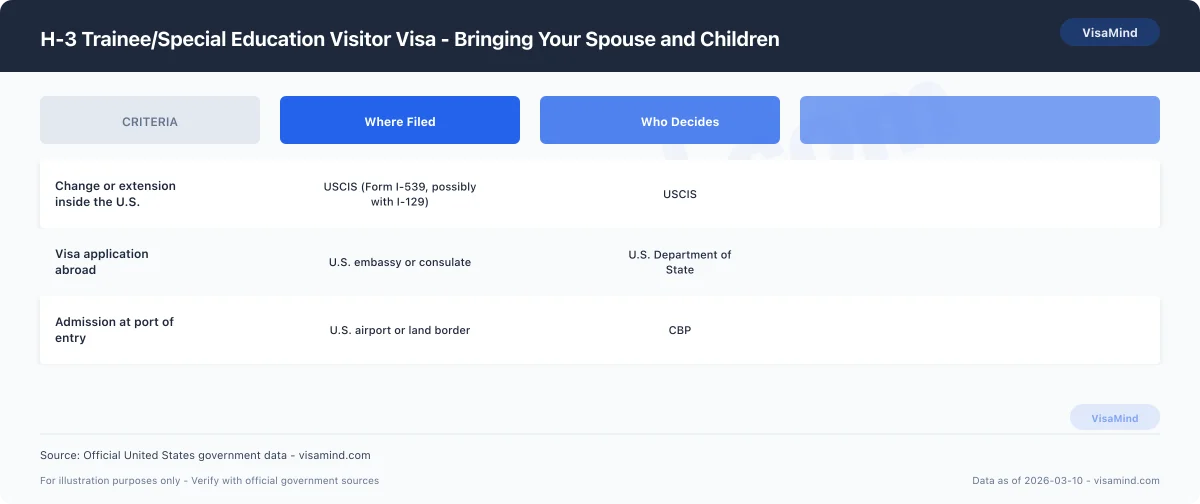
| Scenario | Where Filed | Who Decides |
|---|---|---|
| Change or extension inside the U.S. | USCIS (Form I-539, possibly with I-129) | USCIS |
| Visa application abroad | U.S. embassy or consulate | U.S. Department of State |
| Admission at port of entry | U.S. airport or land border | CBP |
Review the USCIS webpage for your classification before filing to confirm current procedures and fees.
Work authorization for dependents
Dependent status does not automatically grant your spouse work authorization.
Some nonimmigrant spouses in other categories are considered employment authorized incident to status, but not all. Confirm whether employment authorization is required before your spouse starts any work.
Check the USCIS webpage for your dependent classification to determine:
- If employment authorization is permitted
- If a separate application is required
- When employment may begin
Your spouse must not accept employment unless the rules for the specific dependent category allow it.
Children in dependent status are not authorized to work.
How to combine filings
You can file your dependents’ Form I-539 with your Form I-129 to streamline processing.
Steps:
-
Prepare Form I-129 for your H-3 petition.
-
Prepare a separate Form I-539 for your spouse and children.
-
Package the forms together.
-
File them at the location listed in the form instructions.
USCIS may adjudicate the applications together if you file them correctly and at the same time.
If your dependents entered as a Visitor/tourist and later seek a change of status in the U.S., they must file Form I-539 with USCIS.
Always confirm the correct filing address and fee using the USCIS website before submission.
Extending Your Work Visa
#To extend H-3 status, your sponsor must file a new petition with USCIS.
The sponsor submits the correct form, signs it, and includes evidence that you continue to qualify.
Petition to extend or continue status
Your employer or training sponsor files Form I-129, Petition for a Nonimmigrant Worker, with USCIS for you.
You cannot file this petition yourself. The petitioner requests that USCIS extend or continue your H-3 classification.
Steps:
-
Complete Form I-129.
-
Select H-3 trainee classification.
-
Indicate that the petition requests an extension or continuation.
-
Submit the petition with required evidence.
If you entered as a Visitor/Tourist, you cannot work or train unless USCIS approves the H-3 petition and grants status.
Do not begin or continue training without authorization.
USCIS decides if you may remain in H-3 status. If you plan to apply for a visa abroad, the U.S. Department of State handles visa issuance, and CBP decides admission at the port of entry.
Form completion and signing
USCIS will reject incomplete or unsigned petitions.
Ensure the petitioner:
- Completes all required sections of Form I-129
- Uses accurate information about the employer and beneficiary
- Signs the form in the designated block
An unsigned form is invalid. USCIS will not process it.
Use the most current Form I-
- Review the official instructions before filing.
For current filing fees, consult the USCIS Fee Schedule or Fee Calculator.
Before submission, check:
| Requirement | Action Needed |
|---|---|
| Correct form edition | Download from USCIS website |
| All required fields completed | Review each section |
| Proper signature | Petitioner signs and dates |
| Filing fee included | Verify current amount on USCIS website |
Keep a complete copy of your submission for your records.
Submitting required evidence
Supporting documentation must be included with Form I-129.
Your petitioner should provide evidence supporting the extension or continuation request. Organize documents clearly and label them.
At minimum, include:
- Completed and signed Form I-129
- Supporting documentation required by the instructions
- Any additional evidence requested for H-3 classification
Place evidence in logical order and use tabs or a cover letter to identify each exhibit.
Mail the petition to the address listed in the official Form I-129 instructions. Always confirm the correct filing address on the USCIS website before sending your package.
From Work Visa to PR
#The H-3 trainee visa does not offer a direct path to permanent residence.
You need to qualify under a separate immigrant category, often through employer sponsorship, and follow specific filing steps with USCIS.
When employer-sponsored routes may apply
H-3 status is temporary and training-focused.
If your employer later offers a qualifying permanent position, you may pursue an employment-based immigrant category such as EB-2 visa or EB-3 visa if you meet the requirements.
You cannot use the original Form I-129 for H-3 training as the basis for permanent residence.
Your employer must start a new process tied to a permanent job offer.
Employer-sponsored options generally require:
- A permanent, full-time job offer
- Proof that you meet education or experience requirements
- Employer’s willingness to complete required labor steps
- Filing of an immigrant petition with USCIS after prerequisites are met
If you later change to another nonimmigrant status, such as H-1b visa, your employer must first obtain a certified Labor Condition Application (LCA) before filing the H-1B petition.
If you leave the United States and return as a Visitor/tourist, you cannot use that status to work or continue employment sponsorship activities.
| Stage | Authority Involved | Purpose |
|---|---|---|
| Nonimmigrant petition (e.g., I-129) | USCIS | Temporary classification |
| Labor certification (if required) | U.S. Department of Labor | Test U.S. labor market |
| Immigrant petition (e.g., I-140) | USCIS | Classify you for permanent residence |
Related labor certification steps
For most EB-2 and EB-3 cases, your employer needs to complete the PERM labor certification process before filing Form I-140 with USCIS.
This process confirms that:
- No able, willing, qualified, and available U.S. workers applied for the role
- Hiring you won’t negatively affect U.S. worker wages and conditions
- The job requirements reflect the employer’s actual minimum needs
Your employer can’t skip this step when it applies.
USCIS expects an approved labor certification before it will accept or approve the immigrant petition in categories that require it.
Follow this general order:
-
Complete required recruitment steps.
-
Obtain approved labor certification.
-
File Form I-140 with USCIS.
Timing considerations
You must maintain valid status throughout the process.
H-3 classification has a fixed training period, so you’ll need a plan before it expires.
If you want to change to another work status, your employer must secure any required certifications, such as a certified LCA for H-1B, before filing with USCIS.
Filing too early without required approvals can result in rejection or denial.
You also need to coordinate:
- Expiration of your H-3 status
- Start date of any new nonimmigrant classification
- Completion of labor certification steps
Permanent residence is a separate, multi-step process.
What Your Employer Must Do
#Your employer controls the petition process and must file the correct forms with U.S. Citizenship and Immigration Services (USCIS).
Errors in classification, missing supplements, or incomplete documentation can lead to rejection.
Employer petition obligations
Your employer must file Form I-129, Petition for a Nonimmigrant Worker, with USCIS on your behalf.
You can’t self-petition for H-3 classification.
The employer must:
- Select the correct nonimmigrant classification on Form I-129
- Include the proper I-129 supplement for the requested category
- Sign and submit the petition to USCIS following the official form instructions
Using the wrong supplement or selecting the wrong visa classification can lead to a rejection.
USCIS reviews the form for completeness and correct classification before it even considers eligibility.
If you’re in the United States as a Visitor/tourist, your employer still needs to file Form I-129 before you can seek a change of status.
Filing under the wrong category, like submitting an H-1b visa supplement instead of the correct one, can delay the case or cause a rejection.
| Responsibility | Who Handles It | Filed With |
|---|---|---|
| Form I-129 preparation | Employer | USCIS |
| Correct supplement selection | Employer | USCIS |
| Petition signature and submission | Employer | USCIS |
Required certifications and documentation
Your employer must include all required supporting documentation with Form I-129.
USCIS may reject the petition if required certifications are missing.
When a labor condition or wage document applies to the classification, the employer must:
- File the required certification before submitting Form I-129
- Attach the certified document to the petition
- Include any wage documentation required for that category
Missing a required labor certification or wage document is a common reason for rejection.
USCIS does not issue a request for evidence if the filing lacks a mandatory initial document; it may just reject the case outright.
Your employer should review the official Form I-129 instructions to confirm which documents apply to your category.
Requirements differ depending on the nonimmigrant classification selected.
| Document Type | When Required | Risk if Missing |
|---|---|---|
| Certified labor document | If required for category | Rejection |
| Wage documentation | If required for category | Rejection |
| Correct I-129 supplement | Always | Rejection |
Expert tips for employer filings
Your employer should treat Form I-129 as a technical filing, not just a general application.
Small classification errors can stop the process before USCIS even reviews the substance of the case.
Follow these steps:
-
Confirm the correct nonimmigrant classification.
-
Use the matching I-129 supplement.
-
Verify whether a labor or wage document applies.
-
Attach all required initial evidence at filing.
Do not assume requirements from another category apply to yours.
Documentation required for H-1B classification does not automatically apply to H-3.
Before filing, your employer should compare the completed petition against the current Form I-129 instructions.
A final review reduces the risk of rejection and delays.
How to Apply
#You apply for H-3 classification by filing Form I-129 with U.S. Citizenship and Immigration Services (USCIS).
Start with the correct form, confirm whether you may file online, and follow all signature and privacy requirements carefully.
Get the form and instructions
You must use Form I-129, Petition for a Nonimmigrant Worker, to request H-3 trainee classification.
Follow these steps:
-
Download the current version of Form I-129 from the USCIS website.
-
Download the separate form instructions for Form I-129.
-
Review the instructions for the H-3 classification before completing the form.
Don’t rely on old copies saved on your computer.
USCIS updates forms periodically, and using the wrong edition can lead to rejection.
Pay close attention to:
- Eligibility requirements listed under the H-3 category
- Required supporting documentation
- Filing fee details (confirm current amounts using the USCIS fee schedule or calculator)
- The correct filing location listed in the form instructions
If you previously entered the United States as a Visitor/tourist, review the instructions carefully to confirm whether a change of status request applies to your situation.
| Item | Where to Find It |
|---|---|
| Form I-129 | USCIS website |
| Filing fees | USCIS website (fee schedule or calculator) |
| Mailing address | Form I-129 instructions |
| H-3 classification details | Form I-129 instructions |
Online filing eligibility
USCIS allows online filing for only certain Form I-129 classifications.
Not every category qualifies.
Before you create an online account or attempt to upload documents, confirm that the H-3 classification is eligible for online filing at the time you apply.
USCIS limits online filing to specific categories, and eligibility can change.
If H-3 is not available for online filing, you’ll need to submit a paper Form I-129 by mail to the address listed in the official instructions.
Review the USCIS website to confirm:
- Whether H-3 petitions qualify for online filing
- Technical requirements for online submission
- Payment procedures for filing fees
Do not assume eligibility based on another visa category.
Each classification under Form I-129 follows its own filing rules.
Privacy and form-signature notes
You must complete Form I-129 accurately and sign it as required.
USCIS will reject an unsigned petition.
Keep these points in mind:
- Provide complete and truthful information.
- Review every section before submission.
- Follow the signature instructions exactly as stated in the form instructions.
USCIS collects personal information to determine eligibility for the requested immigration benefit.
The form instructions explain how USCIS uses this information and under what authority.
If you submit feedback or additional materials, include only the personal information necessary to process your petition.
Careful review before filing helps reduce delays, rejections, and requests for additional evidence.
Conditions and Portability
#Your status depends on the petition filed with U.S. Citizenship and Immigration Services (USCIS) and, when required, an approved Form I-129S.
Visa issuance is handled by the U.S. Department of State, and admission is decided by U.S. Customs and Border Protection (CBP) at entry.
Each step serves a different function and may be reviewed separately.
Using approved I-129S when applicable
If your classification requires Form I-129S, you must present a previously approved Form I-129S to support your application.
USCIS may review and adjudicate you separately from other beneficiaries, even if you’re connected to the same underlying filing.
Bring documentation that clearly matches the approved filing.
Inconsistencies can delay or interrupt processing.
Key documents to carry when applicable:
- Previously approved Form I-129S
- A copy of the underlying Form I-129 approval notice (if available)
- Evidence that your training role matches what USCIS approved
USCIS controls petition approval.
Approval of a petition or I-129S does not, by itself, grant you a visa or admission.
| Stage | Authority | What Is Reviewed |
|---|---|---|
| Petition | USCIS | Form I-129 and, if required, Form I-129S |
| Visa issuance | U.S. Department of State | Eligibility for visa stamp |
| Admission | CBP | Whether to admit you in H-3 status |
You can’t rely on visitor/tourist status to engage in H-3 training.
Your activities must match the approved classification.
Consular issuance-related materials
After USCIS approves the petition, you apply for a visa through the U.S. Department of State if you are outside the United States.
The consular officer reviews your eligibility for visa issuance, not the underlying petition approval.
Bring materials that align with the approved petition.
Officers may compare your statements with the approved Form I-129 or Form I-129S.
Prepare the following:
- Approval notice from USCIS
- Approved Form I-129S, if applicable
- Identification and standard visa application materials required by the U.S. Department of State
If you previously held Visitor/tourist status, you must show that your purpose now matches H-3 training, not tourism.
The Department of State decides whether to issue the visa.
A visa does not guarantee entry.
For current procedures and required forms, consult the U.S. Department of State.
How adjudication may be handled
Government agencies handle different parts of your case independently.
USCIS may adjudicate your petition separately from other beneficiaries tied to the same filing.
This means:
-
Your eligibility can be evaluated on its own merits.
-
Supporting documents must clearly relate to you.
-
Prior approvals for others do not guarantee your approval.
If your case involves Form I-129S, officers may examine whether you qualify under that specific approval.
You must maintain consistency between your petition, visa application, and statements at entry.
CBP makes the final decision on admission at the port of entry.
Even with an approved petition and issued visa, you must demonstrate that you seek entry in valid H-3 trainee status and not as a Visitor/tourist.
Who Can Apply
#You qualify for the H-3 trainee visa only if your training fits within specific non-medical, non-academic categories.
USCIS reviews the petition filed on Form I-129 to confirm that your program meets these limits.
Eligibility categories
You may apply if your training falls into one of the following approved categories:
- Non-medical, non-academic training programs
- Practical training in the education of children with disabilities
Your U.S. sponsor must file Form I-129, Petition for a Nonimmigrant Worker, with U.S. Citizenship and Immigration Services (USCIS) on your behalf.
You cannot self-petition.
The training must be structured and clearly defined.
It can’t be classified as medical training or standard academic study.
| Eligible Category | Description | Petition Required |
|---|---|---|
| Non-medical training | Practical training outside medical or academic fields | Form I-129 filed with USCIS |
| Education of children with disabilities | Hands-on training focused on teaching children with disabilities | Form I-129 filed with USCIS |
If you are currently in the United States as a Visitor/tourist, you cannot simply begin training.
USCIS must first approve the H-3 petition.
After USCIS approval, you apply for a visa through the U.S. Department of State if you are outside the United States.
Admission at a port of entry is determined by U.S. Customs and Border Protection (CBP).
Excluded training types
You do not qualify for H-3 classification if your program involves:
- Medical training
- Academic education or degree-based study
USCIS does not approve H-3 petitions for medical residencies, clinical training, or programs that lead to academic degrees.
If your program fits within a traditional school curriculum, it falls outside H-3 eligibility.
| Excluded Category | Why It Is Not Allowed Under H-3 |
|---|---|
| Medical training | H-3 does not cover medical trainees |
| Academic programs | H-3 does not apply to standard academic education |
If your intended activity is medical or academic, you must explore other visa classifications.
Review official USCIS guidance on alternatives before filing Form I-129.
Fees and Processing Times
#You must pay specific government filing fees when you submit the H-3 trainee petition to U.S. Citizenship and Immigration Services (USCIS).
Processing speed depends on the service you request and whether you file correctly the first time.
Standard filing and biometrics fees
Your employer needs to file Form I-129, Petition for a Nonimmigrant Worker, with USCIS to request H-3 classification.
As of February 2026, the government fees required are:
| Fee Type | Amount (USD) | Who Pays | Paid To |
|---|---|---|---|
| Form I-129 filing fee | $780 | Employer/petitioner | USCIS |
| Biometrics services fee | $85 | Beneficiary (in most cases) | USCIS |
Include the correct payment with the petition. USCIS will reject any petition submitted with the wrong fee.
The biometrics fee applies if USCIS requires fingerprinting and background checks. If biometrics are needed, USCIS will send a notice.
These fees are separate from visa application fees paid later to the U.S. Department of State for visa issuance at a consulate. Petition fees go to USCIS; visa fees go to the Department of State.
If you’re in the United States as a Visitor (B-1/B-2), you still need an approved I-129 before changing status.
Premium processing and fee changes
USCIS offers premium processing for certain employment-based petitions. If it’s available for your filing, submit Form I-907, Request for Premium Processing Service, with the correct premium processing fee.
For premium processing requests postmarked on or after March 1, 2026, include the updated premium processing fee for your benefit category.
Some filings postmarked on or after January 21, 2025, require an additional $100,000 payment as a condition of eligibility. Confirm if this applies to your petition before filing.
USCIS rejects improperly filed premium processing requests. File Form I-907 together with Form I-129 if timing is important.
How fees interact with timing
Processing time depends on whether you request premium processing, if USCIS accepts your filing without errors, and whether biometrics are required.
Submitting the wrong fee leads to rejection. A rejected petition isn’t placed in the processing queue, which delays your case.
If you request premium processing and include the correct fee, USCIS processes the petition under its premium timeline for that benefit.
Petition approval doesn’t guarantee visa issuance. After I-129 approval, the U.S. Department of State controls visa interview scheduling and issuance, and U.S. Customs and Border Protection (CBP) determines admission at the port of entry.
Why Petitions Get Questioned
#USCIS often questions H-3 petitions because of basic filing errors, missing evidence, or inconsistencies. Most issues come from mistakes on Form I-129, incomplete documentation, or incorrect classification and fee handling.
Unsigned or wrong-edition forms
USCIS rejects Form I-129 if it lacks a valid signature. An unsigned petition doesn’t get a filing date, and USCIS returns it.
You must use the correct edition of the form. Filing an outdated edition after USCIS requires a new version leads to rejection and delays.
Common triggers:
- Missing petitioner signature
- Submitting a prior edition after the deadline
- Combining pages from different editions
Confirm the current edition and signature requirements before filing. Even small clerical errors can prevent acceptance of your H-3 trainee petition.
Missing prerequisites or documentation
USCIS expects all required steps completed and supporting evidence included with Form I-
- Omitting required documentation may lead to rejection or a Request for Evidence (RFE).
You must provide documentation supporting H-3 classification and explaining the training program. If required approvals or evidence are missing, USCIS can’t review your case properly.
Checklist before filing:
- Completed and signed Form I-129
- All required supporting documentation
- Evidence showing the petition meets H-3 requirements
If you previously entered as a Visitor/tourist, ensure your current petition reflects H-3 trainee classification and doesn’t conflict with prior status.
Classification and fee errors
USCIS may question your petition if the visa classification doesn’t match the job description or supporting documents. Inconsistent descriptions create doubt about whether the H-3 trainee category fits the proposed training.
Your petition should clearly align:
| Issue | Likely Outcome |
|---|---|
| Inconsistent training description | Request for Evidence (RFE) |
| Wrong visa classification selected | Delay or RFE |
| Incorrect filing fee | Rejection or delay |
| Missing premium processing fee (if requested) | Premium processing not accepted |
If you request premium processing, submit the required separate fee. USCIS won’t process it without proper payment.
Verify the current fee schedule and form edition before filing. Small payment or classification mistakes can delay your case.
What Documents to Submit?
#File a complete and properly signed petition with clear details about the training program. USCIS reviews the accuracy of Form I-129, the validity of signatures, and supporting evidence explaining the structure, duration, and location of the training.
Training program details and evidence
Provide a detailed description of the training program. USCIS expects clear information about where the training will occur, how long it will last, and what it will include.
Present the information in a structured format so an officer can quickly understand the program.
| Required Detail | What to Include |
|---|---|
| Duration | Exact start and end dates of the training |
| Location | Physical address(es) where training will occur |
| Structure | Explanation of the activities and learning components |
Describe the training schedule in practical terms. Identify the site where the trainee will participate and confirm the total length.
Avoid vague language. State specific dates and locations. If the program occurs at more than one site, list each location.
Don’t submit general statements about training. Provide concrete details matching the information on Form I-129.
Signature and form completion
Complete all required sections of Form I-129, Petition for a Nonimmigrant Worker. USCIS rejects incomplete forms.
Follow the official instructions exactly. Pay attention to required fields and ensure information matches the supporting documents.
Sign the form with a valid signature as required. An unsigned petition isn’t accepted.
Before submission, confirm that:
- All required sections are completed
- Information is consistent throughout
- The authorized party has signed where required
Supporting materials to include
Submit evidence supporting the details in the petition. Documentation must align with the training description you provide.
At minimum, include:
- Written documentation describing the training program
- Evidence confirming the duration and location of the training
- Any required supporting evidence referenced in Form I-129 instructions
Organize materials clearly. Place the form first, then supporting documents in logical order.
USCIS reviews the petition based on what you submit. Missing evidence can delay processing.
What Are Typical Processing Times?
#USCIS processing times for H-3 trainee petitions are longer than many other Form I-129 classifications. The timeline depends on the category selected on Form I-129 and the USCIS service center handling your case.
I-129 processing time ranges by category
As of January 2026, USCIS lists these estimated ranges for Form I-129:
| I-129 Category | USCIS Processing Time (Approximate) |
|---|---|
| H-3 – Temporary Trainees | 12.5 to 16.5 months |
| H-1b visa – Visa to be issued abroad | 6.5 to 7.5 months |
| H-1B – change of status | 5 to 5.5 months |
| H-2b visa – Temporary nonagricultural workers | 4.5 to 6.5 months |
| L – Intracompany transferees | 6 to 8 months |
| O – Extraordinary ability | 9.5 to 14 months |
| Q – Cultural exchange visitors | 19.5 to 33 months |
The H-3 trainee category falls on the longer end. It typically takes about one to nearly one and a half years for a decision.
You can’t begin H-3 training until USCIS approves the I-129 and, if you’re outside the United States, the U.S. Department of State issues the visa.
How service center and category affect timing
Processing times vary by classification and the USCIS service center assigned to your case. USCIS publishes separate time ranges for each center.
When your sponsor files Form I-129, USCIS routes it to a specific service center based on filing location and internal workload. One center may process H-3 petitions faster than another.
Category selection matters. For example:
- H-3 trainee: 12.5 to 16.5 months
- H-2a visa unnamed beneficiary: as little as several weeks
- TN professional (USMCA): roughly 3.5 to 6 months
Your timeline depends heavily on the classification chosen on Form I-129, not just overall USCIS workload.
General processing-time notes
USCIS processing time estimates reflect how long it takes to decide the petition, not the full visa process.
If you’re outside the United States, you must:
-
Wait for I-129 approval from USCIS.
-
Apply for an H-3 visa through the U.S. Department of State.
-
Attend a visa interview at a U.S. embassy or consulate.
Visa appointment availability and issuance times vary by consulate. After visa approval, U.S. Customs and Border Protection (CBP) decides your admission at the port of entry.
If you’re already in the United States in another nonimmigrant status (not as a Visitor/tourist), you may request a change of status on Form I-
- A Visitor/tourist generally can’t engage in H-3 training without a change of status and approval.
Fees
#| Component | Amount |
|---|---|
| Filing fee (I-129)Filing fee (I-129): $780 (as of 2026-02). Verify the current fee on the official schedule before filing. | $780 |
| BiometricsBiometrics: $85 (as of 2026-02). Verify the current fee on the official schedule before filing. | $85 |
Fees change; always verify on USCIS.
Required forms
#Next steps
#Use Find My Visa to build a sequenced plan with official sources and deadlines.
FAQs
Can you apply as a Visitor/tourist instead?
A Visitor/tourist classification serves a different purpose.
If you want structured training in the United States, you’ll need to use the H-3 trainee process through USCIS and, when required, the U.S. Department of State.
What does this visa let someone do in the United States?
It allows certain nonimmigrants to enter the U.S. temporarily to receive training or to participate in a special education exchange program. It covers training opportunities other than medical or academic training and may include practical training in the education of handicapped children. The classification is temporary.
Who files the petition for this visa?
A prospective employer files a petition on behalf of the intended beneficiary. File Form I-129, Petition for a Nonimmigrant Worker, with USCIS as part of that process.
Can I bring my spouse and children, and can they work?
You can seek to adjudicate a dependent spouse or child’s application together with your Form I-129 if the Form I-539 is packaged and filed properly at the same time and in the same location as the Form I-129; otherwise adjudication may be separate. Refer to USCIS guidance to determine whether dependents must obtain employment authorization—some dependent spouses in certain classifications (E and L) may be employment authorized incident to status. Expert guidance also notes filing I-539 with I-129 for dependents can be used to get extensions or change of status together.
What filing and biometrics fees apply?
As of 2026-02, the Form I-129 filing fee is $780 and the biometrics services fee is $85. Note that premium-processing fee rules and amounts change (for example, a new required fee applies for certain filings postmarked on or after March 1, 2026), and there is a listed fact about an additional $100,000 payment tied to a date-based condition in the provided facts. Filing Form I-907 with I-129 is the mechanism for premium processing in some classifications.
How long does processing usually take?
processing times for Form I-129 vary by eligibility category and service center. For the H-3 (temporary trainees) I-129, the provided range is 12.5 to 16.5 months; USCIS processing times differ across categories and service centers per the official tool.
What common mistakes lead to RFEs, delays, or rejections?
Common issues include filing an unsigned form, submitting the wrong edition of a form after the deadline, filing without required approvals or documentation, wrong visa classification or inconsistent job descriptions, missing LCA or prevailing-wage documentation when required, and incorrect fees or using the wrong form edition. These problems can cause rejections, RFEs, or delays.
Does filing this petition guarantee approval?
No. Filing an H-3 petition does not guarantee approval; adjudicative review can result in approval, denial, issuance of an RFE or NOID, or referral for investigation.
Where do I get the correct form and how should I prepare it?
Download the current H-3 form and instructions from the official USCIS website and review the instructions for your specific eligibility category before starting. Note that only certain classifications of Form I-129 may be eligible to file online.
What training-program details should be included in the petition?
The petition should include details of the training program, including the program’s duration and location; the petition is filed by the prospective employer on behalf of the nonimmigrant.
Official sources referenced
Last reviewed: 2026-03-10
VisaMind provides informational guidance only and is not a government agency. This is not legal advice. Requirements can change and eligibility depends on your specific facts. If your case is complex or high-stakes, consult a licensed immigration attorney.
Next steps
Every United States visa case depends on your nationality, purpose, and timeline. Get a personalized plan with official sources and deadlines.
Find my visa