
What the Dependent Visa - Child (PV2 Symbol) Covers — Vietnam PV2 visa
#
The PV2 visa allows a child to apply electronically as a dependent of a foreign worker in Vietnam. The Immigration Department of Vietnam manages the process, and the child’s status stays tied to the principal applicant.
Who the visa is for
The Dependent Visa - Child (PV2 Symbol) applies to foreign children of work permit holders in Vietnam. You use this visa when your child lives outside Vietnam and needs to apply for entry as your dependent.
Key eligibility points:
- The applicant must be a child of a foreign work permit holder.
- The principal applicant must hold valid status in Vietnam.
- The child applies as a dependent, not as an independent worker or investor.
The PV2 differs from related categories:
| Visa Symbol | Who It Covers | Relationship to Principal |
|---|---|---|
| PV2 | Child | Dependent of work permit holder |
| PV1 | Spouse | Dependent of work permit holder |
| TT | Family member | Family-based category (separate symbol) |
The PV2 and Dependent Visa - Spouse (PV1 Symbol) both serve dependents of foreign workers, but PV2 applies specifically to children. The Family Visa (TT Symbol) uses a different classification and does not replace the PV2 when the child qualifies under the work-permit-based dependent category.
Your child’s visa validity connects directly to your own approved status in Vietnam.
Which authority manages it
The Immigration Department of Vietnam (Cục Quản lý xuất nhập cảnh) manages the PV2 visa. You submit the application through the official electronic visa system under the authority of the Immigration Dept.
The department reviews and processes the child’s application as a dependent case. The Immigration Dept receives the electronic visa request, reviews the dependent relationship category, and issues the e-visa decision.
Because the PV2 is linked to a principal applicant, the Immigration Dept assesses the child’s status in connection with the work permit holder’s immigration standing.
How the form is used
You use the PV2 form to file an electronic visa (e-visa) application for your child from outside Vietnam. The form serves as an online application for entry, a dependent classification request under the PV2 symbol, and a record connecting the child to the principal work permit holder.
The PV2 form is not a standalone work or investment visa. It establishes your child’s entry status as a dependent only.
You must ensure the application reflects the correct dependent category. Selecting the wrong symbol, such as PV1 for a spouse or TT for another family classification, can result in a mismatch with your principal status.
The Immigration Dept processes the application under the PV2 designation once properly submitted.
Required Documents
#You must upload a clear image of your passport data page and a recent photograph when applying for the Vietnam PV2 visa. The Immigration Department of Vietnam (Cục Quản lý xuất nhập cảnh) reviews these digital files as part of your application, so accuracy and file size compliance are important.
Passport data page image
Upload a color image of the page in your passport that shows your personal details. This page typically includes your full name, date of birth, passport number, and photograph.
Your image must meet these requirements:
- Show the entire data page, including all text and numbers
- Remain clear and readable without blur or glare
- Display all edges of the page
- Stay under 200KB in file size
If the file exceeds the limit, the system may reject your upload. Compress the image carefully without reducing clarity.
Applicants connected to other visa categories such as the Dependent Visa – Spouse (PV1 Symbol) or the Family Visa (TT Symbol) must still meet the same passport image standards. The Immigration Dept applies identical technical requirements regardless of visa symbol or whether you later submit Form NA1 in a related process.
| Document | Format Requirement | Maximum File Size |
|---|---|---|
| Passport data page image | Clear color image | 200KB |
Photograph requirements
You must upload a separate photograph file. This image serves as your official identification photo for the PV2 visa application.
Your photograph must:
- Be uploaded as an individual file (not combined with the passport page)
- Show your face clearly and fully visible
- Remain sharp and easy to identify
- Stay under 50KB in file size
Avoid cropping too tightly or reducing resolution so much that your facial features become unclear. The Immigration Dept reviews this image for identity verification, so clarity matters more than aggressive compression.
Even if you previously prepared photos for another visa type such as PV1 or TT, you must still follow the PV2 upload size rules.
| Document | Separate File Required | Maximum File Size |
|---|---|---|
| Photograph | Yes | 50KB |
File size limits
The Immigration Dept enforces strict digital size limits for online submissions. Files that exceed the limit may fail to upload or cause processing delays.
You must follow these exact limits:
- Passport data page image: under 200KB
- Photograph: under 50KB
Keep each file as a separate upload. Do not merge the passport image and photo into one file.
Before submitting, confirm the file size in your device properties. If necessary, reduce file size using standard compression tools while keeping all text and facial details fully readable.
How to Apply — Vietnam PV2
#You apply for the Vietnam PV2 visa through the Immigration Department of Vietnam (Cục Quản lý xuất nhập cảnh). The process requires you to complete the online form, pay the e‑visa fee in VND (₫), and track your application using a registration code.
Complete the form and get a registration code
Start by filling out the required online application form with complete and accurate information. Enter your personal details exactly as shown in your passport.
If you are applying as a dependent, ensure your information matches the principal visa holder’s status, such as:
- Dependent Visa – Spouse (PV1 Symbol)
- Family Visa (TT Symbol)
Inconsistent details can delay review by the Immigration Dept.
You must provide all required information before the system issues a registration code. This code is essential. You will use it to pay the e‑visa fee and check your application result.
Keep the registration code secure. You will need it again to access your application in the E‑visa search menu.
For applicants who previously used paper forms such as Form NA1 for entry or visa-related procedures, ensure the information you enter online matches your prior submissions.
| Step | What You Do | Why It Matters |
|---|---|---|
| 1 | Complete full online form | Prevent processing delays |
| 2 | Review all details carefully | Avoid inconsistencies |
| 3 | Save registration code | Required for payment and status check |
Pay the E-visa fee
After you receive your registration code, proceed to pay the required e‑visa fee in VND (₫). You must complete payment before the Immigration Dept begins processing your application.
The system links your payment to your registration code, so enter it correctly. If you need the current fee amount, refer to official guidance from the Immigration Department of Vietnam.
Keep confirmation of your payment. You may need to reference it if you experience technical issues or delays in status updates.
Failure to complete payment means your PV2 visa application will not move forward.
| Requirement | Action |
|---|---|
| Registration code | Enter correctly during payment |
| Fee payment | Must be completed for processing |
| Payment confirmation | Retain for your records |
Check your application status
Use the E‑visa search menu to monitor your application. Enter the following details exactly as submitted:
- Registration code
- Registration email
- Date of birth
The system will display your application result once available.
If you entered incorrect information during the initial submission, you may not retrieve your result. In that case, verify the original details you provided.
Check your status periodically rather than submitting a duplicate application. Multiple submissions can complicate review by the Immigration Dept.
| Field Required | Must Match Original Application |
|---|---|
| Registration code | Yes |
| Email address | Yes |
| Date of birth | Yes |
Conditions and Rights
#Your PV2 visa approval allows you to enter and exit Vietnam under specific conditions set by the Immigration Department of Vietnam (Cục Quản lý xuất nhập cảnh). Approval is not automatic, and you must follow post-approval procedures carefully to maintain lawful status.
Using the e-visa for entry/exit
Once the Immigration Dept approves your PV2 application, you must print your e-visa and carry it with you when entering or leaving Vietnam. Airlines and border officers rely on the printed document to verify your authorization.
You should print a clear paper copy of the approved e-visa and present it with your valid passport at entry and exit points. Make sure your passport details match the approved visa information.
Do not rely on a digital copy alone unless the Immigration Dept confirms it is acceptable.
If you previously held a different visa type, such as the Dependent Visa – Spouse (PV1 Symbol) or the Family Visa (TT Symbol), you must use the visa currently approved for entry. Border authorities assess entry based strictly on the active visa record in the Immigration Dept system.
| Requirement | What You Must Do |
|---|---|
| Approved e-visa | Print and carry a physical copy |
| Passport match | Ensure details match the visa approval |
| Entry/exit | Use the approved PV2 visa for travel |
Failure to present proper documentation can result in denied boarding or refusal of entry.
Approval is conditional
Submitting a PV2 visa application does not guarantee approval. The Immigration Dept reviews each case individually and may approve or refuse the request.
You do not gain any immigration rights while your application remains pending. You must wait for formal approval before making travel plans.
Approval depends on whether your submitted documents meet the Immigration Dept’s requirements. Incomplete or inconsistent information can lead to refusal.
If your situation involves family sponsorship or related visa categories such as PV1 or TT, the Immigration Dept may examine your relationship documents carefully. Filing forms such as Form NA1, where applicable to your case, must be accurate and complete.
Always check your application details before submission. Errors delay processing and may result in rejection.
Post-approval steps
After approval, you must take specific steps to secure lawful entry and stay:
-
Download the official approval notice.
-
Print the e-visa clearly on paper.
-
Verify all personal details before travel.
You should also confirm any additional instructions issued by the Immigration Dept. Procedures can change, and you remain responsible for compliance.
If you plan to transition later to another visa category, such as PV1 or TT, you must follow the separate application process required for that status. Approval of a PV2 visa does not automatically grant eligibility for other visa types.
Keep copies of your approval and related documents for your records. Border officers and immigration authorities may request them during your stay.
Fees and Processing Times
#You must pay government filing fees and allow enough time for review before you travel. The Immigration Department of Vietnam (Cục Quản lý xuất nhập cảnh) sets the official amounts and standard timelines, and these can vary by category and location.
Fee breakdown and administrative charges
You pay separate charges for the visa application and for administrative handling. The exact amount depends on whether you apply as a spouse, child, or other dependent.
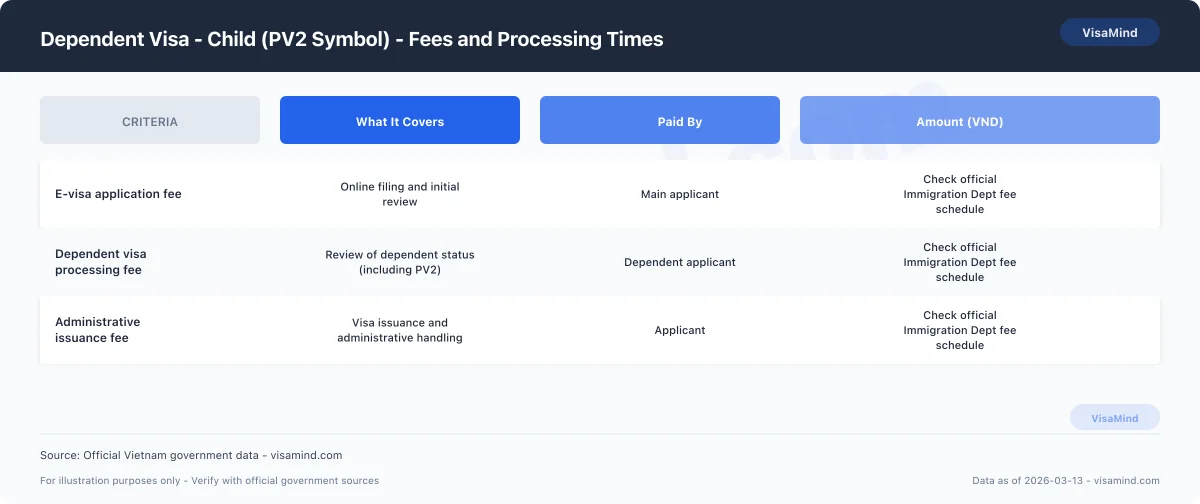
| Fee Type | Amount (₫) | Notes |
|---|---|---|
| PV2 visa application fee | ₫135 | Main filing fee (as of Feb 2026) |
| Dependent visa processing fee | ₫50 | Applies to dependent category cases |
| Administrative fee | ₫25 | Internal handling and issuance costs |
| Child dependent fee | Verify | Confirm with Immigration Dept before filing |
If you apply as a spouse under the Dependent Visa – Spouse (PV1 Symbol) or under the Family Visa (TT Symbol) category, confirm whether the dependent processing fee applies in addition to the base PV2 filing fee.
You must also submit the required entry and exit form, including Form NA1, when instructed. The Immigration Dept may refuse to process your file if you submit incorrect or incomplete payment.
Standard processing window
Under standard processing, the PV2 visa usually takes about 5 to 7 business days as of March 2026.
This timeline applies to regular applications filed with the Immigration Dept.
The processing time can shift based on:
- Your visa category
- Where you file
- Whether your application is complete
- Internal workload at the Immigration Dept
Count only business days. Public holidays and weekends aren’t included in the 5–7 day estimate.
If you submit incomplete documents, like missing NA1 forms or unpaid fees, the Immigration Dept will pause processing until you fix the issue.
When to verify current fees and times
You need to confirm current fees and processing times before applying. The Immigration Dept can change charges or timelines without prior notice.
Check directly with the Immigration Department of Vietnam (Cục Quản lý xuất nhập cảnh) for:
-
Current PV2 filing fee
-
Dependent and administrative charges
-
Processing time for your filing location
-
Special requirements for spouse (PV1 Symbol) or Family Visa (TT Symbol) cases
If you’re applying for a child dependent, confirm the correct fee category in advance. Outdated figures can cause problems.
Always review the latest Immigration Dept guidance right before submitting your application to avoid delays or rejections.
Who Can Apply
#You’re eligible to apply for a Vietnam PV2 visa if you file directly with the Immigration Department of Vietnam (Cục Quản lý xuất nhập cảnh).
Eligibility depends on your status and the visa category you’re seeking.
Applicant eligibility basics
You can apply when your case requires submission to the Immigration Department of Vietnam (Immigration Dept) instead of another authority.
The PV2 process is for applicants who must submit the right application form to this department.
You must:
- Submit your application directly to the Immigration Dept
- Use the correct application form for your visa category
- Make sure your requested visa symbol matches your purpose of stay
If your situation falls under a different visa symbol, such as PV1 Symbol or TT Symbol, select the correct category before filing.
| Requirement | What It Means for You |
|---|---|
| Filing authority | You submit to the Immigration Dept |
| Correct visa symbol | You choose PV2 or another applicable symbol |
| Proper form | You complete the required application form |
Incorrect classification can slow down processing or require you to refile.
Sponsor and dependent categories
Your eligibility may depend on whether you’re applying as a principal applicant or as a dependent.
Vietnam uses specific visa symbols to identify family and dependent relationships.
For example:
- Dependent Visa – Spouse (PV1 Symbol) applies to a spouse category
- Family Visa (TT Symbol) applies to certain family-based stays
- PV2 applies to its own designated category under Vietnam’s visa classification system
Confirm that your relationship or purpose matches the PV2 classification before filing.
If you’re applying based on a relationship to someone in Vietnam, your sponsor’s status determines the correct visa symbol.
Choosing PV2 instead of PV1 or TT without meeting the requirements may result in refusal.
| Visa Symbol | General Category Type |
|---|---|
| PV1 | Spouse-dependent category |
| TT | Family-based category |
| PV2 | Separate designated visa category |
Align your application with the correct symbol.
Where to file
You file your PV2 application with the Immigration Department of Vietnam (Cục Quản lý xuất nhập cảnh).
Submit:
- The completed application form
- All supporting documents required for your visa symbol
- The appropriate filing package to the Immigration Dept
The PV2 application form is specific to applicants submitting to this department.
Before filing, check that:
-
You selected the correct visa symbol
-
Your form is fully completed
-
You’re submitting to the Immigration Dept, not another authority
If you’re unsure about submission procedures or requirements, contact the Immigration Dept for guidance.
Why Family Visas Get Denied
#Most PV2 refusals result from preventable form errors. The Immigration Dept examines your Form NA1 and supporting details closely; even small inconsistencies can lead to rejection.
Missing or incorrect information
The most common reason for rejection of a Vietnam PV2 visa application is missing or incorrect information on Form NA1.
Enter your personal details exactly as they appear in your passport and supporting documents. This means full name, passport number, date of birth, and nationality.
Even minor discrepancies—like switched numbers or shortened names—can cause refusal.
Leaving required fields blank or failing to provide clearly identified information can get your application treated as invalid.
Be especially careful if your case involves related categories such as:
- Dependent Visa – Spouse (PV1 Symbol)
- Family Visa (TT Symbol)
If your documents reference one visa symbol but your NA1 lists another, officers may find the application incorrect.
| Common Error | Result |
|---|---|
| Blank required fields on NA1 | Immediate rejection |
| Incorrect passport number | Application invalidated |
| Mismatched visa symbol (PV1, TT, PV2) | Refusal due to incorrect classification |
The Immigration Dept reviews what you submit, not what you meant to write.
Inconsistent answers across the form
Inconsistencies across your NA1 form often lead to denial.
If your passport details differ from other sections, the Immigration Dept may question the reliability of your submission.
For instance, one spelling of your name in one section and a different version elsewhere creates doubt about identity accuracy.
Every reference to your relationship and visa category must align.
If your supporting documents indicate eligibility under a Family Visa (TT Symbol) but your form reflects different information, officers may reject for inconsistency.
Review your answers for:
- Matching spellings of names throughout
- Identical passport details in every section
- Consistent visa symbols where referenced
The Immigration Dept does not reconcile conflicting information for you. They assess the form as submitted.
How to avoid common pitfalls
You can avoid most denials by verifying every entry before submission.
Follow this process:
-
Copy all personal details directly from your passport.
-
Cross-check every field on Form NA1 against your documents.
-
Confirm that your visa symbol references (PV1, TT, or PV2) are correct and consistent.
-
Review the entire form a final time before filing.
Use this checklist before you submit:
- Name matches passport exactly
- Passport number entered without errors
- No blank required fields
- All visa category references consistent
- All information clearly identified and readable
Don’t rely on memory when completing the form. Work directly from your official documents.
When to Get Help
#Submitting a complete and accurate PV2 application increases your approval chances. Small mistakes, missing fields, or unclear information can delay review at the Immigration Department of Vietnam (Cục Quản lý xuất nhập cảnh).
Expert tips before you submit
Review every section of your application before filing, including supporting documents and personal details.
Incomplete answers or inconsistencies can cause processing delays or requests for clarification.
Focus on these checkpoints:
- Confirm all personal information matches your passport exactly.
- Ensure every required field on the Form NA1 form is fully completed.
- Check dates for accuracy and consistency across documents.
- Verify supporting documents align with your stated visa purpose.
- Re-read your answers for spelling errors or missing signatures.
If your case involves a family relationship, confirm that your category matches your situation.
For example:
| Visa Category | Typical Use |
|---|---|
| Dependent Visa - Spouse (PV1 Symbol) | Spouse of a qualifying foreign national |
| Family Visa (TT Symbol) | Family members of certain visa holders |
| PV2 Visa | Other applicable dependent category as permitted |
Selecting the wrong category can result in rejection or re-filing.
If you feel uncertain about any section, review official instructions from the Immigration Dept before submitting.
When to consult a professional
Consider professional help if you’re unsure about eligibility, documentation, or visa classification.
Misclassifying your visa type—such as confusing PV2 with the Dependent Visa - Spouse (PV1 Symbol) or Family Visa (TT Symbol)—can delay your plans.
Seek assistance if:
- You previously received a refusal from the Immigration Dept.
- Your documentation does not clearly support your relationship or status.
- You are unsure how to complete specific sections of the NA1 form.
- Your situation has changed since your last entry into Vietnam.
A professional can review your documents for consistency and spot gaps before submission. This step reduces the risk of avoidable delays.
If you need current processing times or fees in VND (₫), check the latest guidance from the Immigration Dept.
Complex or unclear cases
Get guidance if your circumstances don’t fit standard categories. Unclear relationships, mixed visa histories, or incomplete records can complicate a PV2 application.
Complex cases often include:
-
Prior visa overstays or administrative issues.
-
Changes between visa types, such as from TT Symbol to PV2.
-
Uncertainty about whether you qualify under PV2 or another dependent classification.
You must ensure your documentation clearly supports your eligibility. Even minor inconsistencies can trigger additional scrutiny.
If you can’t confidently explain your eligibility in writing, seek help before submitting. A careful review at this stage is easier than fixing problems after the Immigration Dept starts processing.
Path to Permanent Residence
#The PV2 visa does not grant permanent residence. You must qualify under a separate long-term category and apply through the Immigration Department of Vietnam (Cục Quản lý xuất nhập cảnh) (Immigration Dept).
Long-term options overview
Vietnam grants permanent residence only in limited situations under immigration law.
Holding a PV2 visa shows lawful stay, but it does not convert into permanent status automatically.
You typically need:
- A lawful and continuous stay in Vietnam
- A valid passport and visa status at the time of application
- Sponsorship or qualifying relationship, if applying through family
- A complete application file submitted to the Immigration Dept
You’ll submit the required application forms, which may include Form NA1, along with supporting documents that prove your eligibility.
| Factor | PV2 Visa | Permanent Residence |
|---|---|---|
| Purpose | Short-term or dependent stay | Indefinite residence |
| Sponsorship | Required | Often required |
| Validity | Limited | No fixed expiry |
| Separate application required | No | Yes |
Confirm current eligibility rules and document requirements with the Immigration Dept before applying.
When family routes may lead to PR
Family relationships can support a long-term immigration path. This is most common if you’re married to a Vietnamese citizen or closely related to one.
Relevant visa categories include:
- Dependent Visa – Spouse (PV1 Symbol)
- Family Visa (TT Symbol)
If you entered Vietnam under a family-based category, your relationship may form the legal basis for a permanent residence application.
You must prove the relationship with official documents such as marriage or birth certificates.
The Immigration Dept will assess:
- The authenticity of your relationship
- Your immigration history
- Your compliance with Vietnamese law
- The stability of your residence in Vietnam
You should maintain valid status at all times while preparing your permanent residence application. Overstays or violations can affect eligibility.
Next steps after eligibility
If you meet the legal criteria, you begin a formal application process with the Immigration Dept.
Follow these steps:
-
Confirm eligibility under the applicable permanent residence category.
-
Prepare required documents, including identification and proof of relationship if applicable.
-
Complete required forms, such as NA1, where instructed.
-
Submit your application to the Immigration Dept.
Fees are payable in VND (₫). For current fee amounts and processing procedures, check with the Immigration Dept.
Wait for a formal decision before assuming permanent status. Continue to maintain valid visa status, such as PV2, PV1, or TT, until approval is granted.
Fees
#| Component | Amount |
|---|---|
| Application feeExtracted from guide content — verify against official source | $135 |
| Dependent visa processing feeChild dependent — verify against Immigration Dept | $50 |
| Administrative feeProcessing — amount may vary | $25 |
Fees change; always verify on Immigration Dept..