
Overview — Vietnam PV1 visa
#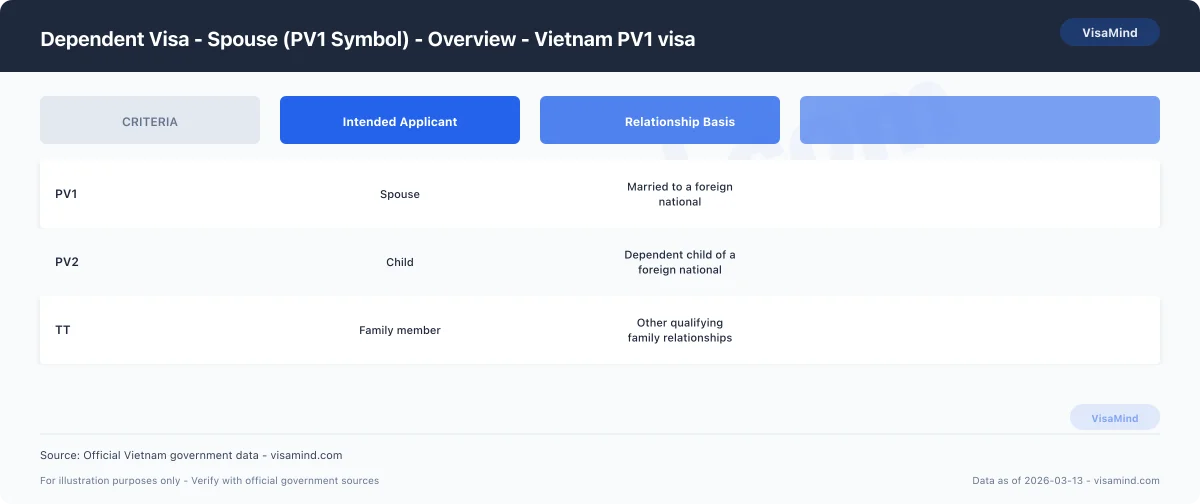
The PV1 visa allows you to join your foreign spouse who lives or plans to live in Vietnam.
You apply through the Immigration Department of Vietnam (Cục Quản lý xuất nhập cảnh) as part of the e‑visa process, and decisions typically take 5–7 business days.
Who can use it
You can use the PV1 visa if you are the lawful spouse of a foreign national who is living in Vietnam or intends to relocate there.
This visa category focuses specifically on spouses.
It does not apply to children or other relatives.
For comparison:
| Visa Symbol | Relationship Covered | Notes |
|---|---|---|
| PV1 | Spouse of a foreigner in Vietnam | Applied through the e‑visa system |
| PV2 (Dependent Visa – Child) | Child of a qualifying foreigner | Separate dependent category |
| TT (Family Visa) | Family members of certain sponsors | Different eligibility basis |
You must ensure your relationship qualifies under the PV1 category before applying.
If your child needs status, you would look at the Dependent Visa – Child (PV2 Symbol) instead.
The Immigration Dept determines eligibility and reviews your submitted information during processing.
What it allows
The PV1 visa permits you to stay in Vietnam as the spouse of a qualifying foreign national.
It supports family unity when your spouse already resides in Vietnam or plans to establish residence there.
Your status links directly to your spouse’s presence in the country.
You submit your application through the e‑visa system administered by the Immigration Dept.
In many cases, applicants use forms such as Form NA1 as part of immigration procedures, depending on instructions issued by the authority.
If you are not a spouse but another family member, you must apply under the correct symbol, such as TT (Family Visa) or PV2 for children.
Using the wrong category can delay processing.
For current fees in VND (₫) and document requirements, consult the Immigration Dept’s official guidance.
Quick processing snapshot
The Immigration Dept lists a standard processing time of:
| Stage | Timeframe |
|---|---|
| PV1 visa processing | 5–7 business days |
This timeframe applies once you properly submit your application through the e‑visa system.
processing times count in business days, not calendar days.
Delays may occur if you submit incomplete information or incorrect documents.
Plan your travel only after you receive approval.
Always verify the latest procedural updates directly with the Immigration Dept before filing.
Required Documents
#You must upload clear digital copies of your passport and a compliant photograph, then enter your biographical details exactly as they appear in your passport.
The Immigration Department of Vietnam (Cục Quản lý xuất nhập cảnh) (Immigration Dept) will not process incomplete or improperly formatted files.
Passport and identity uploads
You must upload an image of your passport data page.
This page shows your full name, passport number, date of birth, nationality, and expiration date.
Follow these technical limits:
| Document | Maximum File Size | Key Content Required |
|---|---|---|
| Passport data page | Under 200KB | Photo, personal details, passport number |
| Applicant photograph | Under 50KB | Clear face, no glasses |
Ensure the image is:
- In color
- Clear and legible
- Cropped to show the full data page
- Free of glare, blur, or cut-off edges
Your passport details must match the information you enter in the application.
Any mismatch can delay review.
If you apply for related categories such as the Dependent Visa – Child (PV2 Symbol) or the Family Visa (TT Symbol), you must upload the child’s or family member’s passport data page in the same format.
Photograph rules
You must upload a recent photograph of yourself.
The file size must be less than 50KB.
The photo must meet these basic standards:
- No glasses
- Clear view of your full face
- Neutral background
- No shadows or obstructions
Do not submit edited, filtered, or heavily compressed images.
The Immigration Dept may reject photos that distort facial features or reduce clarity.
If you submit applications for dependents under the PV2 Symbol or for family members under the TT Symbol, each person must provide a separate compliant photograph.
Do not reuse cropped passport images as standalone photos.
Form confirmations and biographical data
You must complete all required biographical fields before submission.
Enter your:
- Full name (exactly as shown in your passport)
- Date of birth
- Passport number
- Nationality
Review your entries carefully.
Even small spelling differences can cause processing issues.
Before submission, you must confirm that you have read the instructions and completed the application truthfully.
This confirmation acts as your formal declaration to the Immigration Dept.
If you are submitting paperwork that includes Form NA1, ensure the personal details in that form match the uploaded passport image and the online entries.
Inconsistent data across documents can result in a request for correction or refusal to process.
Fees and Processing Times
#You must pay government fees and plan around defined processing windows.
The Immigration Department of Vietnam (Cục Quản lý xuất nhập cảnh) sets the official amounts and timelines, which vary by visa type and filing location.
Visa and administrative fees
You pay an application fee when you submit your PV1 visa request.
The exact amount depends on whether you request single-entry or multiple-entry status.
All fees are set by the Immigration Dept and published in Vietnamese đồng (₫).
Confirm the current amount on the official Immigration Dept fee schedule before you apply, as rates can change.
In addition to the main visa fee, you may face related administrative costs if:
- You file supporting paperwork such as Form NA1
- You apply at a specific processing office
- Your dependents apply under a different category, such as:
Dependent Visa – Child (PV2 Symbol)
- Family Visa (TT Symbol)
Each applicant, including dependents, pays separate applicable fees.
| Fee Type | Who Pays | Set By |
|---|---|---|
| PV1 visa application | Primary applicant | Immigration Dept |
| PV2 (child) application | Each child applicant | Immigration Dept |
| TT (family) application | Each qualifying family member | Immigration Dept |
| Administrative forms (e.g., NA1) | As required | Immigration Dept |
Processing time windows
Under standard processing, the PV1 visa typically takes 5 to 7 days to process as of March 2026.
The processing time can vary based on:
- Your visa category
- Your place of submission
- The reviewing office within the Immigration Dept
If you submit additional documents, such as Form NA1, or apply together with dependents under PV2 or TT categories, timelines may differ by case.
Use this general reference:
| Processing Type | Estimated Time |
|---|---|
| Standard PV1 processing | 5–7 days |
processing times are not guaranteed and may change by category or workload.
Path to Permanent Residence
#After you receive a PV1 visa, you typically move to a Temporary Residence Card (TRC) to stay longer in Vietnam.
You may also arrange dependent and family status for eligible relatives through specific visa symbols handled by the Immigration Dept.
Temporary Residence Card (TRC)
A Temporary Residence Card allows you to reside in Vietnam without repeatedly extending your PV1 visa.
You apply through the Immigration Department of Vietnam (Cục Quản lý xuất nhập cảnh) (Immigration Dept).
Government fee (as of February 2026):
| Item | Fee (VND) |
|---|---|
| TRC application | ₫3,375,000* |
*Based on an application fee of $135; confirm the current VND amount with the Immigration Dept before filing.
You generally complete these steps:
-
Prepare the required application forms and supporting documents.
-
Submit your file to the Immigration Dept.
-
Pay the official fee.
-
Receive your TRC if approved.
Confirm the exact document checklist and processing details directly with the Immigration Dept before submission.
Requirements can vary based on your status under the PV1.
Common next steps after the PV1
Once you hold a PV1, you often arrange legal stay for your immediate family.
Vietnam provides specific visa symbols for dependents.
Common options:
- Dependent Visa – Child (PV2 Symbol): For your eligible child.
- Family Visa (TT Symbol): For other qualifying family members.
Your family members must submit their own applications to the Immigration Dept.
You may need to complete forms such as Form NA1, depending on the case and filing method.
Key actions you should take:
- Confirm each family member’s eligibility under the correct visa symbol.
- Prepare relationship documents as required by the Immigration Dept.
- Submit applications and pay the applicable government fees in VND.
Always verify current forms, symbols, and procedural steps with the Immigration Dept before filing.
Renewal and Extension
#You must apply for a PV1 visa extension before your current visa expires.
The Immigration Department of Vietnam (Cục Quản lý xuất nhập cảnh) reviews your eligibility, collects administrative fees, and issues the extended stay if approved.
Extension fees and charges
You pay both a visa extension fee and a separate administrative charge.
As of February 2026, the standard amounts are:
| Fee Type | Amount (₫) |
|---|---|
| PV1 Dependent visa extension | ₫145 |
| Immigration Dept administrative fee | ₫100 |
These figures apply to the Dependent Visa – Child (PV2 Symbol) and related family-based extensions connected to a PV1 holder.
If your dependent holds a Family Visa (TT Symbol), confirm the correct category with the Immigration Dept before paying.
Fees may change without notice.
You should verify the current amounts directly with the Immigration Department of Vietnam (Cục Quản lý xuất nhập cảnh) before submitting payment.
You will not receive a refund if your extension is denied.
How extensions are processed
You file your extension request with the Immigration Department of Vietnam (Cục Quản lý xuất nhập cảnh).
Most applicants submit the Form NA1 form, along with supporting documents that confirm continued eligibility under the PV1 category.
The process generally follows these steps:
-
Prepare the NA1 application form.
-
Gather documents proving your ongoing relationship to the PV1 sponsor.
-
Pay the required extension and administrative fees.
-
Submit the full application to the Immigration Dept.
-
Await notification of approval or refusal.
If you apply as a dependent, such as under the PV2 Symbol, you must show that the principal PV1 holder still maintains valid status.
For dependents under the Family Visa (TT Symbol), you must demonstrate that your family relationship remains legally valid.
processing times can vary.
Confirm current timelines directly with the Immigration Department of Vietnam before you file.
Your Rights After Approval — Vietnam PV1
#Approval gives you legal stay in Vietnam as the spouse of a work permit holder.
Your status depends directly on the main applicant’s visa and employment situation.
Residency conditions and limits
A PV1 visa allows you to reside in Vietnam with your spouse while their work authorization remains valid.
You must comply with all conditions set by the Immigration Department of Vietnam (Cục Quản lý xuất nhập cảnh) (Immigration Dept).
Your right to stay is limited by the principal applicant’s status.
If their work permit or visa ends, your PV1 status does not continue independently.
You must:
- Maintain a valid passport
- Keep your visa valid at all times
- Ensure your spouse maintains lawful work status
- Submit required forms, such as Form NA1, when instructed by the Immigration Dept
Failure to meet these conditions can lead to visa cancellation or denial of future applications.
| Condition | Impact on Your PV1 Status |
|---|---|
| Principal’s work permit valid | You may remain in Vietnam |
| Principal’s visa expires | Your PV1 becomes invalid |
| Principal’s status revoked | Your stay may be terminated |
Relationship and validity linkage
Your PV1 visa functions strictly as a spousal dependent visa. It can't be used independently.
The validity period will always match your spouse’s visa. If your spouse renews or changes status, you need to update or reapply to maintain lawful stay.
A PV1 application isn’t automatically approved, even if your spouse holds a valid work permit. Children aren’t eligible for PV1 status—they must apply under the Dependent Visa – Child (PV2 Symbol).
Some families may use the Family Visa (TT Symbol), but this depends on eligibility and sponsorship structure.
| Visa Type | Who It Covers | Linked to Principal |
|---|---|---|
| PV1 | Spouse | Yes |
| PV2 | Child | Yes |
| TT | Family member | Yes |
When to Get Help
#Most PV1 visa issues come from avoidable form mistakes and inconsistent personal details. These should be fixed before filing with the Immigration Department of Vietnam (Cục Quản lý xuất nhập cảnh).
If your case involves dependents or status changes, consider getting advice.
Common pitfalls to fix before filing
Every section of your application must be filled out accurately. Even minor errors or mismatched details can cause rejection.
Focus on high-risk areas:
- Passport information: Your name, number, and dates must match your passport perfectly.
- Form consistency: All details must be identical across your Form NA1 form and supporting documents.
- Dependent details: If a child will apply under Dependent Visa – Child (PV2 Symbol), their names and dates need to match the parent’s PV1 records.
- Status references: Don’t confuse PV1 with the Family Visa (TT Symbol) in any paperwork.
Use this checklist before you submit:
| Issue | How to Fix It |
|---|---|
| Missing answers | Complete every field; don’t leave blanks unless instructed |
| Spelling differences | Copy details directly from your passport |
| Conflicting dates | Cross-check all forms and attachments before filing |
| Incorrect visa symbol | Make sure you selected PV1, not TT or PV2 |
Review your entire file again before submitting to the Immigration Dept.
When to consult an expert
Professional advice is useful if your situation is more complex than a typical PV1 filing.
You should reach out if:
- You’re adding a child under the Dependent Visa – Child (PV2 Symbol) and documents don’t align.
- You previously applied under the Family Visa (TT Symbol) and need to adjust status.
- Your NA1 form has prior corrections or inconsistencies.
- The Immigration Dept has already rejected your application for conflicting or incomplete information.
An expert can review your forms closely, check for consistency, and help you correct errors. This lowers the risk of another rejection.
Application Process
#Apply for the Vietnam PV1 visa through the Immigration Department of Vietnam (Cục Quản lý xuất nhập cảnh). You’ll need to complete forms accurately, pay the required fee in VND (₫), and track your application using a registration code.
Filing with the Immigration Department
Start by preparing the application form required by the Immigration Dept. For online filings, fill out the electronic form and save your registration code—you’ll need this to track your case.
All personal details must be complete and accurate. Any mismatch with your passport can slow things down.
If your application covers family members, confirm you’ve selected the right category:
| Visa Category | Symbol | Who It Covers |
|---|---|---|
| PV1 Visa | PV1 | Primary applicant |
| Dependent Visa - Child | PV2 | Minor child of PV1 holder |
| Family Visa | TT | Eligible family members |
If the Form NA1 form is required, fill it out exactly as instructed. Keep information consistent across all related applications, including PV2 or TT filings.
Don’t submit until every entry is double-checked for accuracy. Mistakes can force you to start over.
Paying and submitting the form
Pay the visa fee in Vietnamese đồng (₫). The Immigration Dept sets the amount and payment method, and these can change.
Refer to current Immigration Dept guidance for:
- Fee amount in ₫
- Accepted payment methods
- Whether payment is required before or after submission
After payment, submit your application through the designated system. The system will issue or confirm your registration code—save it along with your registration email.
You’ll need the following to check results or retrieve your e-visa:
- Registration code
- Registration email
- Date of birth
Keep this information safe. Losing it can delay access to your approval.
Checking results and printing your e-visa
Check your application status through the Immigration Dept’s e-visa search. Enter:
-
Registration code
-
Registration email
-
Date of birth
The system will show your current status. Read the result carefully.
If approved, download and print your e-visa. You must carry a printed copy for travel.
If you filed related applications, such as a Dependent Visa - Child (PV2 Symbol) or Family Visa (TT Symbol), check each one separately with its own registration code.
Keep both digital and printed copies of your approved e-visa. Double-check that all details match your passport before you travel.
Eligibility Requirements
#To qualify for a Vietnam PV1 visa, you must meet relationship and status conditions. The Immigration Department of Vietnam (Cục Quản lý xuất nhập cảnh) reviews your eligibility based on your marriage and your spouse’s situation in Vietnam.
Who qualifies (relationship)
The PV1 visa is for spouses of foreign nationals who are:
- Seeking to enter Vietnam, or
- Already residing in Vietnam
You must be legally married to the foreign national. The Immigration Dept checks the accuracy and completeness of your application.
Incomplete or incorrect details will result in rejection.
You need to make sure:
- Your personal information matches official records.
- Your spouse’s information is accurate and consistent.
- All required forms, including Form NA1, are properly completed.
The PV1 category is only for spouses. Children need to apply under PV2.
| Visa Symbol | Eligible Relationship | Applies To |
|---|---|---|
| PV1 | Spouse | Foreigners entering or residing in Vietnam |
| PV2 (Dependent Visa - Child) | Child | Dependent child of eligible foreigner |
Context and linked status
Your eligibility depends on your spouse’s immigration status in Vietnam. The PV1 visa is directly tied to the foreign national’s entry or residence.
If your spouse is applying to enter Vietnam, you may apply under PV1 as their spouse. If your spouse already lives in Vietnam, you may also qualify under PV1.
PV1 is not the same as the Family Visa (TT Symbol) or the Dependent Visa - Child (PV2 Symbol), which are for other family relationships. Use the correct visa symbol when submitting documents to the Immigration Dept.
Fill out the NA1 form carefully. Missing or inconsistent information can lead to refusal.
Why Family Visas Get Denied
#Most PV1 visa denials are due to preventable filing errors. You can avoid many refusals by following document, photo, and information requirements from the Immigration Department of Vietnam (Cục Quản lý xuất nhập cảnh).
Document and photo non-compliance
Follow the Immigration Dept’s technical requirements exactly. Even small mistakes can cause refusal.
Photo errors are common. Photos that don’t meet size or format standards may result in denial without a chance to correct them.
Common issues include:
- Wrong photo dimensions
- Incorrect background or cropping
- Damaged or unclear printed photos
- Outdated photo versions
The same goes for forms like Form NA1. Leaving sections blank, signing in the wrong place, or submitting incomplete supporting documents can get your file rejected.
| Issue Type | How It Affects Your PV1 Application |
|---|---|
| Incorrect photo size | Application may be denied |
| Incomplete NA1 form | File may be rejected as invalid |
| Missing supporting documents | Processing may stop or result in refusal |
| Poor-quality printed photos | Considered non-compliant |
Check all document specifications before submission, especially for related statuses such as Dependent Visa – Child (PV2 Symbol) or Family Visa (TT Symbol).
Information inconsistencies
Inconsistent details across your application raise red flags. The Immigration Dept checks that your NA1 form matches your supporting documents.
Names, dates of birth, passport numbers, and relationship details must be identical everywhere. Even minor spelling differences can delay or derail processing.
Watch for:
- Spelling of full legal names
- Passport number accuracy
- Declared family relationship details
- Matching information across PV1, PV2, or TT applications
If information differs in related filings—such as between a PV1 applicant and a child under PV2—the authority may question the family relationship.
processing times vary by visa category and location. Confirm current timelines with the issuing authority before filing.
Fees
#| Component | Amount |
|---|---|
| Application feeExtracted from guide content — verify against official source | $200 |
| Dependent visa extension feeExtension processing — verify against Immigration Dept | $145 |
| TRC application feeTemporary Residence Card if applying — verify against official schedule | $135 |
| Administrative feeProcessing — amount may vary | $100 |
Fees change; always verify on Immigration Dept..