Overview — Vietnam visa free
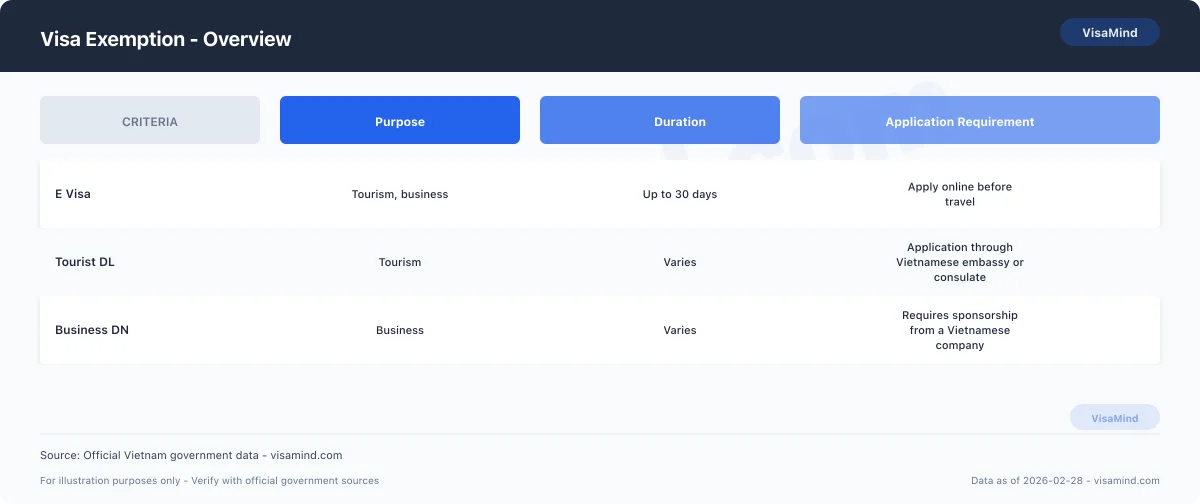
#Vietnam allows eligible travelers to enter without applying for a visa in advance. If your nationality is on the list, you can stay for a limited period without the need for an e-Visa (Electronic Visa), Tourist Visa (DL Symbol), or Visa on Arrival.
What the exemption does
The visa exemption lets you enter Vietnam without submitting a visa application before travel. The Immigration Department of Vietnam (Cục Quản lý xuất nhập cảnh) manages this program.
You get permission to stay for a fixed period based on your nationality. The allowed stay ranges from 15 to 45 days.
During this window, you can travel for tourism or business activities that fit within the exemption's rules. If you want to stay longer, you need to apply for a different visa type:
- e-Visa (Electronic Visa)
- Tourist Visa (DL Symbol)
- Visa on Arrival (where applicable)
The exemption saves you from the visa application process before departure. Still, it doesn't let you extend your stay beyond the authorized number of days. You have to comply with the time limit granted at entry.
Who it's for
Visa-free entry is available to nationals of 13 countries. Eligibility depends entirely on your passport.
You qualify only if:
- Your nationality is on the current exemption list.
- You enter for a purpose permitted under the exemption.
- You stay within the allowed 15–45 day period for your nationality.
If your country isn't on the list, you'll need a visa before traveling. The most common alternatives are the e-Visa (Electronic Visa), Tourist Visa (DL Symbol), or Visa on Arrival, depending on your situation.
If you're not sure you qualify, check directly with the Immigration Department of Vietnam before booking travel. Don't assume eligibility based on past policies.
Quick facts
| Item | Details |
|---|---|
| Managing authority | Immigration Department of Vietnam (Cục Quản lý xuất nhập cảnh) |
| Eligible countries | 13 nationalities |
| Length of stay | 15–45 days (depends on nationality) |
| Application required | No visa application if eligible |
| Alternatives if not eligible | e-Visa (Electronic Visa), Tourist Visa (DL Symbol), Visa on Arrival |
Key points:
-
Visa-free entry only applies to specific nationalities.
-
The stay period is limited and varies by passport.
-
You must switch to a proper visa type if you need a longer stay.
Eligibility Requirements
#
Visa-free entry depends on your passport type, nationality, and sometimes your family relationship to a Vietnamese citizen. The Immigration Department of Vietnam (Cục Quản lý xuất nhập cảnh) applies strict criteria.
Passport types and basic criteria
Your passport type and current nationality determine if you qualify for a visa exemption.
You may qualify if you hold:
- A diplomatic passport from a country covered by a visa exemption agreement
- An official passport from an eligible country
- An ordinary passport from a country included in a unilateral or bilateral exemption policy
The Immigration Dept reviews eligibility under formal agreements. If your passport doesn't fit an approved category, you must apply for an e-Visa (Electronic Visa), a Tourist Visa (DL Symbol), or obtain a Visa on Arrival, if eligible.
Not all passport variants qualify. For example, a British National (Overseas) passport doesn't qualify for visa-free entry.
| Passport Type | Visa-Free Eligibility | Action if Not Eligible |
|---|---|---|
| Diplomatic | If covered by agreement | Apply for visa |
| Official | If covered by agreement | Apply for visa |
| Ordinary | If nationality qualifies | Apply for visa |
| BNO Passport | Not eligible | Apply for visa |
Confirm your status with the Immigration Dept before travel.
Family and residency eligibility
You may qualify for a Certificate of Visa Exemption if you are:
- A Vietnamese national residing abroad indefinitely
- The spouse of a Vietnamese national residing abroad
- The child of a Vietnamese national residing abroad
This exemption isn't automatic. You have to apply for and receive the Certificate of Visa Exemption before travel.
The Immigration Dept looks for:
- Proof of Vietnamese nationality (for the principal applicant)
- Legal marriage certificate (for spouses)
- Birth certificate or legal proof of parent‑child relationship (for children)
Without an approved certificate, you must apply for an e-Visa (Electronic Visa), Tourist Visa (DL Symbol), or another appropriate visa.
Your documents must clearly show the family relationship. Incomplete or unclear records can result in denial of visa-free status.
Bilateral and unilateral rules
Vietnam applies visa exemption policies under two frameworks:
- Bilateral agreements between Vietnam and specific countries
- Unilateral exemptions granted by Vietnam to certain nationalities
Eligibility depends on your current nationality and passport type, not your place of birth or residence.
| Policy Type | Who Decides | Based On |
|---|---|---|
| Bilateral | Mutual agreement between countries | Nationality + passport type |
| Unilateral | Vietnam only | Nationality + passport type |
The Immigration Dept enforces these rules at the border. If you don't fall within a valid exemption category, you must secure an approved visa before arrival.
Don't assume eligibility based on past entry. Policies can differ by passport category, and exemption status only applies when all criteria are met.
Special Programs and Countries
#Vietnam grants longer visa‑free stays to certain nationalities and applies separate rules for specific programs and locations. Always check your passport country, travel purpose, and entry point before relying on any exemption.
45‑day exemptions (countries & timeframe)
Vietnam allows citizens of certain countries to stay up to 45 days without a visa. This policy runs from 15 March 2025 to 14 March 2028 for the countries below.
| Country | Maximum Stay | Validity Period |
|---|---|---|
| United Kingdom | 45 days | 15 Mar 2025 – 14 Mar 2028 |
| France | 45 days | 15 Mar 2025 – 14 Mar 2028 |
| Germany | 45 days | 15 Mar 2025 – 14 Mar 2028 |
| Italy | 45 days | 15 Mar 2025 – 14 Mar 2028 |
| Spain | 45 days | 15 Mar 2025 – 14 Mar 2028 |
| Russia | 45 days | 15 Mar 2025 – 14 Mar 2028 |
| Japan | 45 days | 15 Mar 2025 – 14 Mar 2028 |
| Korea | 45 days | 15 Mar 2025 – 14 Mar 2028 |
| Denmark | 45 days | 15 Mar 2025 – 14 Mar 2028 |
| Sweden | 45 days | 15 Mar 2025 – 14 Mar 2028 |
| Norway | 45 days | 15 Mar 2025 – 14 Mar 2028 |
| Finland | 45 days | 15 Mar 2025 – 14 Mar 2028 |
This exemption applies regardless of passport type or entry purpose during the stated period.
Countries like Belarus, Brunei, and Kazakhstan also receive visa‑free entry, but with specific maximum stay limits. Confirm the exact duration with the Immigration Dept before travel.
If you plan to stay longer than your exemption allows, you must apply for an e‑Visa (Electronic Visa), a Tourist Visa (DL Symbol), or arrange Visa on Arrival approval in advance.
Tourism Stimulus Program (2025)
In 2025, Vietnam introduced a Tourism Stimulus Program granting a 45‑day visa exemption to citizens of:
- Poland
- Czech Republic
- Switzerland
You must meet specific entry conditions and travel requirements to qualify. The Immigration Dept enforces these at the port of entry.
If you don't meet the program requirements, you can't use the exemption. In that case, apply for:
-
An e‑Visa (Electronic Visa) before departure, or
-
A Tourist Visa (DL Symbol) through proper channels, or
-
Visa on Arrival with prior approval documentation.
The 45‑day stay limit is strict. Overstaying may lead to penalties under Immigration Dept regulations.
Phu Quoc island rules
Vietnam grants a separate 30‑day visa exemption for foreign passport holders entering and exiting Phu Quoc Island.
| Location | Maximum Stay | Visa Required |
|---|---|---|
| Phu Quoc Island | Up to 30 days | No |
You must keep your stay within 30 days and comply with entry and exit requirements for the island.
This exemption applies only to Phu Quoc. If you travel beyond the island or stay longer than 30 days, you must obtain proper authorization such as an e‑Visa (Electronic Visa), Tourist Visa (DL Symbol), or approved Visa on Arrival, depending on your nationality and travel plan.
The Immigration Dept checks compliance at entry and exit. It's wise to confirm your eligibility before booking travel.
Required Documents
#You need a valid passport, clear proof of nationality or qualifying family ties, and any travel confirmations required for your entry category. The Immigration Department of Vietnam (Cục Quản lý xuất nhập cảnh) reviews these documents at entry and during any related application, including an e-Visa (Electronic Visa), Tourist Visa (DL Symbol), or Visa on Arrival.
Passport and validity
Your passport must be valid for at least six months from your date of entry into Vietnam. Immigration officers check this at the border and may deny boarding or entry if your passport doesn't meet the requirement.
Check these before you travel:
- Passport validity of 6+ months from entry date
- Passport type accepted for your entry category
- Passport in good physical condition with readable data
If you apply for an e-Visa (Electronic Visa), Tourist Visa (DL Symbol), or Visa on Arrival, use the same passport for application and travel. Any mismatch can cause delays or refusal.
| Requirement | What You Must Check |
|---|---|
| Minimum validity | 6 months from entry date |
| Passport type | Matches your visa or visa-free category |
| Document condition | Intact and readable |
Authorities measure validity from your entry date, not your planned departure.
Proof of nationality or relationship
You must provide clear proof of your nationality when entering visa-free under an eligible passport. Immigration officers rely on your passport as the main evidence.
If you claim visa-free entry as a spouse or child of a Vietnamese national, you need to show:
- Proof of Vietnamese nationality of your family member
- Proof of your relationship (such as official civil documents)
Make sure documents clearly identify names and relationships. Inconsistent or incomplete records may lead to extra questions or refusal.
When applying in advance through the Immigration Dept, submit copies as required and carry originals when traveling. Officers may verify both nationality and family status at the port of entry.
Conditional travel documents and confirmations
Some entries require supporting travel confirmations, especially for organized programs.
If you travel on a tour, you need:
- Written confirmation from a Vietnam inbound licensed tour operator
- Clear travel details matching your passport information
Carry printed or accessible confirmation documents. Immigration officers may request proof that your travel arrangements meet entry conditions.
If you later switch to a Tourist Visa (DL Symbol), e-Visa (Electronic Visa), or Visa on Arrival, make sure your documents match the category you use. The Immigration Dept bases eligibility on the documents you present at entry.
Application Process
#You need to confirm your eligibility, prepare proof of Vietnamese nationality or family relationship, and submit a complete file to the correct authority. Approval depends on accurate documents and following Immigration Dept requirements.
Before you apply
First, confirm your country and passport type qualify for visa exemption. The Immigration Department of Vietnam (Cục Quản lý xuất nhập cảnh) maintains the current rules.
Download the most recent visa-exemption form and instructions from the Immigration Dept. Make sure the version fits your eligibility category.
Gather supporting documents. You’ll need proof of:
- Vietnamese nationality
- Or a qualifying relationship to a Vietnamese national
Copies should be clear and match your passport details.
If you’re entering under a tour program, confirm arrangements with a licensed tour operator before applying. This step matters if your eligibility depends on organized travel.
Use the table below to keep track:
| Requirement | What You Must Do |
|---|---|
| Eligibility check | Verify passport type and nationality qualify |
| Application form | Download the current visa-exemption form |
| Supporting evidence | Collect proof of nationality or family relationship |
| Travel arrangement (if required) | Confirm booking with licensed tour operator |
Incomplete files often lead to refusal. Submission isn’t a guarantee of approval.
How to submit
Fill out every section of the visa exemption application form. Don’t leave any required fields blank.
Sign where indicated and attach all supporting documents listed in the instructions.
Submit your application to a Vietnamese Embassy or Consulate. Follow their specified submission method.
Here’s the order:
-
Complete the form accurately.
-
Attach required evidence.
-
Double-check for consistency with your passport.
-
Submit to the relevant diplomatic office.
If you’re considering alternatives like the e‑Visa (Electronic Visa), Tourist Visa (DL Symbol), or Visa on Arrival, review guidance from the Immigration Dept to see which category fits. Don’t file multiple applications unless specifically instructed.
After submission
The Embassy or Consulate reviews your file using Immigration Dept criteria. Officers check if your documents show eligibility under visa exemption rules.
Watch for communication from the office where you applied. Respond quickly if they ask for clarification or more documents.
- Submission does not guarantee approval.
- Decisions rest on the evidence you provide.
- You must follow the eligibility category you selected.
For current processing updates or procedural changes, contact the Immigration Department of Vietnam.
Fees and Processing Times
#Visa-free entry to Vietnam doesn’t require a visa application fee. You might still face costs if you apply for other immigration services.
processing times depend on whether you use visa exemption or apply separately with the Immigration Department of Vietnam (Cục Quản lý xuất nhập cảnh).
Fees
Under a visa-free (visa-exemption) policy, you don’t pay a visa application fee since no visa is issued in advance.
If you need a separate immigration document—like an exit visa or another status through the Immigration Dept—you’ll pay the official application fee set by the government. As of February 2026, the standard application fee equals ₫ equivalent of 25 USD, according to the published fee schedule.
Quick reference:
| Application Type | Government Fee |
|---|---|
| Visa-exemption entry | ₫0 |
| Other immigration applications (where required) | ₫ equivalent of 25 USD (as of Feb 2026) |
Confirm the current VND amount directly with the Immigration Dept before filing. Exchange rates can affect the total in local currency.
Processing time expectations
If you qualify for visa-free entry, processing time is 0 days. There’s no advance approval since no e‑Visa, Tourist Visa (DL Symbol), or Visa on Arrival is issued.
Other immigration matters inside Vietnam—like exit visas—can take longer if they need extra review. More complex cases might extend processing by one to two additional weeks.
The difference:
| Situation | Typical Processing Time |
|---|---|
| Visa-exemption entry | 0 days |
| Complex exit visa cases | 1–2 weeks longer |
If your case needs action from the Immigration Dept, submit early and watch for updates to avoid overstaying.
What You Can and Cannot Do — Vietnam visa exemption
#Vietnam’s visa exemption lets you enter without obtaining an e-Visa (Electronic Visa), Tourist Visa (DL Symbol), or Visa on Arrival in advance, but you must stick to stay limits and entry rules. If you overstay or fail to declare required items, the Immigration Dept may take action.
Length of stay and limits
Your visa exemption lets you stay in Vietnam only for the period granted at entry. You must leave before that period ends.
If you stay longer without the proper visa, you’re violating immigration rules. To remain, you’ll need to secure a visa such as:
- e-Visa (Electronic Visa)
- Tourist Visa (DL Symbol)
- Visa on Arrival
Visa-free status doesn’t allow you to extend your time indefinitely.
| Situation | What You Must Do |
|---|---|
| Staying within permitted time | Depart before your allowed stay expires |
| Need more time in Vietnam | Apply for an appropriate visa |
| Overstay without visa | You are in violation of immigration rules |
The Immigration Dept tracks entry and exit. You’re responsible for monitoring your authorized stay.
Entry rules and declarations
You must follow financial declaration rules when entering Vietnam. If you carry U.S. dollars or the equivalent in another currency exceeding the threshold, you must declare it at arrival.
Not declaring excess currency can lead to penalties or further inspection.
Steps at entry:
-
Check your cash before travel.
-
Declare amounts above the permitted limit.
-
Keep documentation for declared funds.
| Requirement | Your Obligation |
|---|---|
| Carrying excess foreign currency | Declare it upon arrival |
| Entering under visa exemption | Follow all immigration and customs rules |
You can be inspected by the Immigration Dept at the port of entry.
Tips and Common Mistakes
#Visa-free problems usually stem from incorrect documents or misunderstanding the conditions attached to your entry type. Your passport, travel purpose, and entry method must match the rules set by the Immigration Department of Vietnam (Cục Quản lý xuất nhập cảnh).
Common application errors
Delays or refusal often occur when paperwork is incomplete. This is common if you don’t provide clear proof of nationality or required relationship documents for a Visa Exemption Certificate.
Frequent mistakes include:
- Forms with missing information
- Blurry or incomplete document scans for an e-Visa (Electronic Visa)
- Expired identification documents
- Applying under the wrong category, like confusing visa exemption with a Tourist Visa (DL Symbol)
- Ignoring the conditions printed on your Visa Exemption Certificate
Switching from visa-free entry to a Visa on Arrival or e-Visa? Your application details must match your passport exactly. Even minor inconsistencies can cause refusal at entry.
If requirements are unclear, check directly with the Immigration Dept before traveling.
Passport and document pitfalls
Your passport type and validity decide if you can enter visa-free. Non-qualified passports can mean denied boarding or refusal at the border.
Check these before you go:
- Passport valid for the required period under the exemption rules
- Passport type qualifies for visa-free entry
- Passport isn’t expired or damaged
- Entry purpose matches exemption conditions
Many travelers confuse which exemptions apply to their passport. Some think visa-free entry covers all purposes of travel.
If your trip doesn’t meet exemption conditions, apply for the correct status—like an e-Visa, Tourist Visa (DL Symbol), or Visa on Arrival—through the Immigration Dept. Entry decisions depend on documents, not intentions.
What Consular Officers Evaluate
#Consular officers and the Immigration Department of Vietnam (Cục Quản lý xuất nhập cảnh) check specific facts to confirm if you qualify for visa-free entry. They focus on passport type, nationality, and travel details to determine if you need an e‑Visa (Electronic Visa), Tourist Visa (DL Symbol), or Visa on Arrival instead.
Key information they check
Officers verify your nationality and passport type. Visa exemption rules differ for ordinary, diplomatic, or official passports.
They check:
- Your country of nationality
- The type of passport you present
- Whether your nationality is covered by a current visa exemption policy
- Whether your case needs an e‑Visa (Electronic Visa) or Tourist Visa (DL Symbol) instead
They also compare your identification details to your passport. Any inconsistency can mean refusal of visa-free entry and a requirement to apply for a visa through the Immigration Dept.
| Factor Reviewed | Why It Matters |
|---|---|
| Nationality | Determines visa exemption eligibility |
| Passport type | Some exemptions apply only to specific passport categories |
| Personal details | Must match official travel documents |
| Travel purpose | Confirms whether visa-free entry is appropriate |
If you don’t meet exemption rules, officers expect you to get the right visa before travel.
Evidence of nationality and travel details
You must prove you qualify for visa-free entry based on nationality or another recognized status. Officers rely on official documentation—not verbal statements.
Bring clear evidence of:
- A valid passport showing your nationality
- Any documentation supporting exemption eligibility
- Confirmed travel details matching your entry purpose
They compare your travel info with exemption rules for your nationality. If your plans don’t fit visa-free conditions, you may need to apply for an e‑Visa (Electronic Visa), Tourist Visa (DL Symbol), or get pre-approval for Visa on Arrival through the Immigration Dept.
| Document or Detail | What Officers Confirm |
|---|---|
| Passport | Nationality and passport category |
| Identification data | Accurate personal information |
| Travel itinerary | Consistency with visa-free purpose |
Accurate documents and matching travel details decide if you enter visa-free or need a visa in advance.
Know When to Get Help
#You can enter Vietnam visa-free in many situations, but some cases require formal filings or clarification with the Immigration Department of Vietnam (Cục Quản lý xuất nhập cảnh). If your documents raise questions or your stay goes beyond basic tourism, don’t rely on assumptions.
When professional help is advisable
Seek professional guidance if your case involves civil documents, academic qualifications, or name discrepancies. For instance, a non‑Vietnamese name on a birth certificate can delay processing if it doesn’t match your passport.
You also need help if you:
- Submit civil or academic documents for a work-related visa
- Are involved in a local investigation
- File forms directly with the Immigration Dept
- Transition from visa-free entry to a Tourist Visa (DL Symbol) or another visa type
If you plan to move from visa-free status to an e‑Visa (Electronic Visa) or Visa on Arrival, check eligibility carefully. Errors in personal details or supporting records can lead to refusal or delays.
Professional assistance helps with:
| Situation | Why It Matters |
|---|---|
| Academic qualifications | Required for certain visa purposes |
| Civil status documents | Must match passport information |
| Name inconsistencies | Can trigger additional review |
| Official investigation involvement | May affect immigration status |
When your case involves more than basic travel, accuracy is key.
Where to file and authoritative sources
File official immigration forms with the Immigration Department of Vietnam (Cục Quản lý xuất nhập cảnh). This authority handles applications needing formal approval beyond visa-free entry.
Use government channels when applying for:
- e‑Visa (Electronic Visa)
- Tourist Visa (DL Symbol)
- Visa on Arrival
- Work-related visa processing with civil or academic records
If you submit documents related to a local investigation, include complete and consistent records. Incomplete filings slow review.
For current forms, procedures, and fee amounts in VND (₫), follow the Immigration Dept’s official guidance. Requirements and steps can change, and you should rely on instructions from the competent authority.
Keep copies of everything you submit. Accurate records help if questions come up during entry, extension, or status review.
Fees
#| Component | Amount |
|---|---|
| Application feeExtracted from guide content — verify against official source | $25 |
Fees change; always verify on Immigration Dept..