
Overview — Vietnam visa on arrival
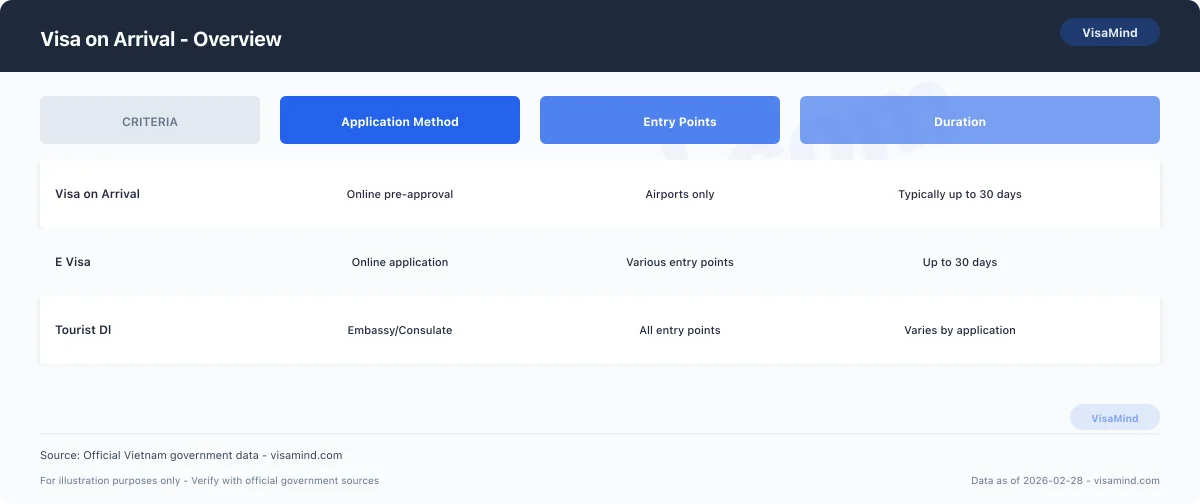
#Vietnam visa on arrival means you get your visa at the airport after securing a pre‑approved letter. You have to arrange this approval in advance and enter through an eligible international airport.
What it permits
Visa on arrival lets you pick up your visa at the airport, but only if you already have a pre‑approval letter from an authorized agency recognized by the Immigration Dept (Cục Quản lý xuất nhập cảnh).
It's an alternative to applying in advance for an e‑Visa (Electronic Visa) or getting a visa through sponsorship. You can't arrive without prior approval.
Depending on your travel purpose, the visa on arrival may be:
- Tourist Visa (DL Symbol) — tourism and short visits
- Business Visa (DN Symbol) — business activities
The maximum stay under this option is up to 30 days.
You must:
- Secure a pre‑approved visa letter before travel
- Present the required arrival form (such as Form NA6, if needed)
- Arrive through an eligible international airport
The Immigration Dept decides the visa category and length of stay based on your approved letter.
Where it's available
Visa on arrival is available only at international airports in Vietnam. It's not offered at land border crossings or seaports.
You have to enter through an airport that handles visa-on-arrival applications under the Immigration Dept’s oversight. If you try to enter at a land border without a visa, you risk being denied boarding or refused entry.
| Entry Point Type | Visa on Arrival Accepted |
|---|---|
| International airports | ✅ Yes |
| Land border crossings | ❌ No |
| Seaports | ❌ No |
If you're entering Vietnam by land or sea, you'll need to apply for an e‑Visa (Electronic Visa) instead.
Airline staff may check for your pre‑approval letter before letting you board. If you don't have it, you may not be allowed to travel.
Quick facts
You have to complete several steps before and upon arrival.
Process overview:
-
Apply through an authorized agency for a pre‑approved letter.
-
Receive the approval issued by the Immigration Dept.
-
Travel to Vietnam by air.
-
Submit your visa on arrival form (such as NA6, if needed) at the airport.
-
Receive your visa stamp.
Key limits and conditions:
| Feature | Details |
|---|---|
| Pre‑approval required | Yes |
| Maximum stay | Up to 30 days |
| Entry method | Air travel only |
| Issuing authority | Immigration Dept |
| Alternative option | e‑Visa (Electronic Visa) |
For current fees in ₫ and document requirements, refer to Immigration Dept guidance.
Application Process (VOA Vietnam)
#You handle some steps before departure and finish the rest at the airport. The essentials: get pre‑approval, prepare the right documents, and present everything properly on arrival.
Before you travel
You need a pre‑approval letter before boarding your flight. A travel agency or business in Vietnam arranges this with the Immigration Department of Vietnam (Cục Quản lý xuất nhập cảnh).
Submit:
- Full personal details
- Passport information
- Intended travel dates
- Visa type (for example,
Tourist Visa (DL Symbol)
- Business Visa (DN Symbol))
The agency submits your details to the Immigration Dept and issues an approval letter if granted. Double-check that your name, passport number, and visa category match your passport.
If you pick the e‑Visa (Electronic Visa) instead, you apply online and don't need a pre‑approval letter. Stick to one method to avoid record conflicts.
At arrival: airport steps
You'll finish the process when you land at an international airport in Vietnam. Don't leave the immigration area until your visa is issued.
Steps:
-
Show your passport.
-
Submit your pre‑approval letter.
-
Provide travel details as requested.
-
Complete required forms, which may include Form NA6 if instructed.
-
Wait for your visa stamp.
Immigration officers check your information against the approval from the Immigration Dept. They place the visa sticker in your passport, showing the DL or DN symbol.
Before leaving the counter, check your visa stamp. Make sure your name, passport number, visa type, and validity dates are correct.
Checking your approval
Before you travel, make sure your approval is valid. Errors can prevent boarding or delay entry.
For e‑Visa applicants, use the search function provided by the Immigration Dept. You'll need:
- Registration code
- Registration email
- Date of birth
For Visa on Arrival applicants, review your approval letter closely. Check all personal details against your passport and confirm the requested visa category.
| Item to Verify | What Must Match Your Passport |
|---|---|
| Full name | Exact spelling and order |
| Passport number | All characters correct |
| Date of birth | Day, month, year |
| Visa symbol | DL or DN as requested |
| Travel dates | Consistent with your plans |
Fix mistakes before you travel. The Immigration Dept uses the approved record to issue your visa at the airport.
Fees and Processing Times
#
You pay several separate fees for a Vietnam visa on arrival. processing times depend on the visa category and case complexity. The Immigration Department of Vietnam (Cục Quản lý xuất nhập cảnh) sets the official amounts and timelines. Always check current figures before you apply.
Fee breakdown
Visa on arrival has both government fees and third‑party service charges. You usually pay some fees before travel and the rest at the airport.
| Fee Type | What It Covers | When You Pay | Who Receives It |
|---|---|---|---|
| Visa approval letter fee | Pre‑approval issued before travel | Online, before arrival | Service provider (on behalf of sponsor) |
| Application fee | Government visa issuance cost | During application process | Immigration Dept |
| Stamping fee (single entry) | Visa stamp placed in your passport | At airport on arrival (cash) | Immigration Dept |
| Processing/service fee | Handling and submission support | During online request | Service provider |
If you're applying for a Tourist Visa (DL Symbol) or Business Visa (DN Symbol), confirm your sponsor or agent gets proper pre‑approval. The Immigration Dept may require form Form NA6 from the sponsoring organization.
All fees are payable in Vietnamese đồng (₫). Check with the Immigration Dept for the current VND equivalents before paying or preparing cash for the airport.
Standard processing times
In most cases, visa-on-arrival approval letters are issued in 1–2 business days. This is for straightforward cases with all documentation in order.
The processing time varies depending on:
- Visa type (DL or DN symbol)
- Accuracy of your submitted details
- Office workload
Count only business days, not weekends or public holidays. The clock starts once the authority receives a full request with sponsor documents.
If you want certainty before travel, wait for the approval letter before you board. Airlines may refuse boarding if you don't have it.
Longer or special-case timelines
Complex cases take longer. Exit visa processing, if needed, usually takes 1–2 business days, but some cases can stretch to one to two additional weeks.
Delays are common when:
- Sponsor documents need verification
- Form NA6 is incomplete
- The Immigration Dept needs extra review
The processing times can also differ by location and visa category. Business visas with corporate sponsors may require more internal review.
Confirm current timelines with the Immigration Department of Vietnam before committing to travel.
Required Documents
#You must show a valid passport, an official pre‑approval letter from the Immigration Dept, and complete the required arrival form accurately. Missing or incorrect documents can hold up your entry.
Passport and identity
Your passport must be valid for at least six months beyond your entry date into Vietnam. It also needs at least one blank visa page for the visa sticker.
If your passport doesn't meet these conditions, immigration officers may refuse entry.
Passport checklist:
- Six months’ minimum validity
- At least one blank visa page
- Good physical condition (no damaged data page)
Your visa category, such as Tourist Visa (DL Symbol) or Business Visa (DN Symbol), is issued based on the approval from the Immigration Dept. The visa type must match what's in your pre‑approval letter.
If you already have an e‑Visa (Electronic Visa), you don't use visa on arrival. You must show the approval for that specific visa type.
| Requirement | What You Need to Show |
|---|---|
| Passport validity | 6+ months remaining |
| Blank visa page | 1 page minimum |
| Visa category consistency | Matches approval letter |
Pre-approval letter
You need a pre‑approval letter from the Immigration Department of Vietnam (Cục Quản lý xuất nhập cảnh). Airlines may refuse boarding if you can't show this letter before departure.
The letter confirms that the Immigration Dept has authorized you for a visa on arrival. It lists your personal details and approved visa category, like DL (tourist) or DN (business).
Check every detail before you fly:
- Full name (exact as in your passport)
- Passport number
- Date of birth
- Approved visa symbol (DL or DN)
Any mismatch between your passport and the approval letter can cause delays at the visa counter.
The Immigration Dept issues this authorization in advance. You can't request visa on arrival at the airport without it.
What you fill in on forms
At the airport, you'll need to fill out the required arrival form before getting your visa sticker. The information must match both your passport and your pre‑approval letter.
You'll enter:
-
Full legal name
-
Passport number
-
Date of birth
-
Visa category (DL or DN)
-
Entry details
Write clearly and don't use abbreviations not in your passport.
Sometimes you'll need to reference Form NA6, which covers visa and entry procedures under the Immigration Dept’s system. Follow the instructions at the visa counter and make sure all fields are complete.
Incomplete or inconsistent forms can slow down processing at the airport.
Eligibility Requirements
#You need official approval before you travel to Vietnam for a visa on arrival. Without prior authorization, the Immigration Dept won't let you get a visa at the airport.
Pre-approval requirement
Vietnam visa on arrival isn't available unless you have advance authorization arranged through an approved channel in Vietnam. You must get a pre-approval letter from an authorized business or travel agency in Vietnam.
You can't apply on your own at the airport without this document. The approval must be secured before departure.
Key requirement:
- Pre-approval letter arranged by an authorized business or travel agency in Vietnam
The Immigration Dept (Cục Quản lý xuất nhập cảnh) relies on this approval to process visa on arrival at the port of entry.
This applies whether you're requesting:
- Tourist Visa (DL Symbol)
- Business Visa (DN Symbol)
If you don't have pre-approval, you'll need to look at alternatives such as the e-Visa (Electronic Visa).
| Requirement | Mandatory for Visa on Arrival |
|---|---|
| Pre-approval letter | Yes |
| Arranged by authorized entity in Vietnam | Yes |
| Obtained before travel | Yes |
Consequences of missing requirements
Airlines and immigration officers expect you to show a valid pre-approval letter on arrival. If you travel without it, the Immigration Dept will deny you entry under the visa on arrival process.
You can't fix this at the airport.
Common consequences:
-
Refusal to issue the visa on arrival
-
Denial of entry into Vietnam
-
Requirement to depart
The Immigration Dept doesn't waive the pre-approval requirement at the port of entry. Arriving without proper authorization makes you immediately ineligible for visa on arrival.
If you fail to get pre-approval, you'll need to obtain a valid visa through another authorized method before traveling again.
Conditions of Stay
#Your visa approval sets fixed limits on how long you can stay and what customs and financial rules apply at entry. You must follow the exact period granted and comply with declaration requirements at the airport.
Authorized length of stay
You may stay in Vietnam only for the period stated on your visa approval and entry stamp.
The permitted stay depends on your visa type, as issued by the Immigration Dept:
| Visa Type | Symbol | Purpose | Stay Period |
|---|---|---|---|
| Tourist Visa | DL | Tourism | As granted on visa approval |
| Business Visa | DN | Business activities | As granted on visa approval |
| e‑Visa (Electronic Visa) | — | Tourism or business (as approved) | As granted electronically |
Your entry date won’t extend your visa. The Immigration Dept calculates your stay from the validity period on your visa or e‑Visa approval.
If you remain past the authorized date, you risk overstay penalties. Fines apply if your stay doesn’t match the approved period.
Check your approval letter before you travel. If you spot errors, correct them before entering Vietnam.
If you entered using Form Form NA6 during your approval process, make sure the dates on your entry stamp match your granted period.
Declaring cash and other rules
Certain items and currency must be declared when entering Vietnam.
Carrying cash in U.S. dollars or equivalent in another currency? You’re required to declare it on arrival. Not declaring required amounts can lead to penalties or confiscation.
Use the customs declaration form provided at the airport. Fill in accurate figures and keep copies of your declaration documents.
You must also:
- Follow all entry conditions printed on your visa approval
- Use your visa for the correct purpose (DL for tourism, DN for business)
- Present supporting documents if requested by border officers
Border officials may check your documents against Immigration Dept records. Keep your passport, visa approval letter, and supporting paperwork handy for inspection.
Know When to Get Help
#Some Vietnam visa on arrival cases go beyond basic paperwork. Qualified guidance is needed when your filing involves formal submissions to the Immigration Department of Vietnam (Cục Quản lý xuất nhập cảnh) (Immigration Dept) or legal issues that extend past a standard entry request.
When to consult an expert
Consult an expert if your application requires official forms filed directly with the Immigration Dept, like Form Form NA6. Mistakes on government filings can delay or block approval.
Legal advice is also important if you’re involved in a local investigation. Your role during and after an investigation can affect how authorities review your immigration record.
You’ll also need guidance if your case involves victim compensation programs in the United States. These issues require separate procedures and documentation that may overlap with your immigration history.
Use professional help if:
- You must submit Form NA6 to the Immigration Dept
- You have a documented role in a local investigation
- You are pursuing or have pursued victim compensation programs in the United States
- Your prior filings contain inconsistent or incomplete information
Who handles these applications
The Immigration Department of Vietnam (Cục Quản lý xuất nhập cảnh) processes formal immigration filings, including applications for visa categories such as:
| Visa Type | Symbol | Typical Purpose |
|---|---|---|
| Tourist Visa | DL | Tourism-related entry |
| Business Visa | DN | Business-related entry |
| e-Visa (Electronic Visa) | — | Online visa application |
When you file structured forms like NA6, you submit them to the Immigration Dept. This authority reviews your documentation and decides if your application meets regulatory requirements.
Immigration professionals, including licensed immigration lawyers or accredited consultants in Vietnam, prepare and review submissions before filing. They help you avoid procedural mistakes but don’t replace the Immigration Dept’s authority.
Other legal/assistance information
If you’re identified as a victim or participant in a local investigation, clarify your legal position before filing any Vietnam visa on arrival paperwork. Authorities may review your involvement and its outcome.
If your case includes information about compensation programs in the United States, confirm how participation is documented. Keep official records of decisions, conclusions, or compensation determinations.
Before submitting documents to the Immigration Dept:
-
Review all prior statements for consistency.
-
Confirm that investigation outcomes are formally recorded.
-
Ensure your visa category (DL, DN, or e-Visa) matches your actual purpose of entry.
Professional review helps lower the risk of omissions or conflicting information in your file.
Tips and Common Mistakes
#Small errors on your visa approval or application can prevent you from boarding your flight or entering Vietnam. Every detail must match your passport and supporting documents just as the Immigration Dept will check them.
Avoid typos and data mismatches
Enter your name exactly as shown in your passport. Even a single letter off on your e-Visa (Electronic Visa) can cause refusal at the airport.
Pay close attention to:
- Full name order (including middle names)
- Passport number
- Date of birth
- Nationality
- Visa type selection, such as Tourist Visa (DL Symbol) or Business Visa (DN Symbol)
Submitting Form Form NA6 or any related document with inconsistent details may lead to rejection or denial of entry.
Review your birth certificate and passport before applying. If your birth certificate has a non-Vietnamese name that’s different from your passport, make sure all visa forms reflect your current passport details. Don’t mix spellings or alternate names.
Use this checklist before submission:
| Item to Verify | Must Match Passport Exactly |
|---|---|
| Full legal name | Yes |
| Passport number | Yes |
| Date of birth | Yes |
| Visa symbol (DL or DN) | Yes |
Fix mistakes before you travel. Errors found at the airport are tough to resolve.
Document pitfalls to watch for
Carry the correct documents that match your visa approval. An approval letter or e-Visa with incorrect data can result in denied entry.
Make sure your visa type matches your travel purpose:
- DL Symbol – Tourism only
- DN Symbol – Business activities
Applying under the wrong category may lead immigration officers to question your entry.
When submitting Form NA6 or other paperwork to the Immigration Dept, check that all attached documents show identical personal information. Discrepancies between your passport and supporting documents can cause delays or refusal.
Before departure, verify:
-
Your printed e-Visa shows accurate personal data.
-
Your passport details match every document.
-
Your visa symbol aligns with your travel purpose.
Careful document checks before your flight reduce risk.
What Consular Officers Evaluate
#Consular officers review your file to confirm your documents match the visa purpose you selected and that you meet the qualifications. They also check that your request fits the Immigration Department of Vietnam (Cục Quản lý xuất nhập cảnh) (Immigration Dept) requirements.
Documents and qualifications
You must submit documents that match your requested visa type. Officers compare your paperwork with your stated purpose, such as a Tourist Visa (DL Symbol) or Business Visa (DN Symbol).
They review whether your civil documents and academic qualifications support your planned activities in Vietnam. This is especially relevant if your visit involves work.
Officers typically check:
- Valid civil documents confirming your identity
- Academic qualifications related to your intended work or professional activity
- Consistency between your visa category and supporting documents
- Properly completed arrival paperwork, such as Form NA6, if applicable
If your documents don’t clearly support your declared purpose, the officer may question your eligibility. Incomplete or inconsistent records slow down review and increase the risk of refusal.
| Visa Type | What Officers Focus On |
|---|---|
| Tourist Visa (DL Symbol) | Documents consistent with tourism only |
| Business Visa (DN Symbol) | Civil documents and qualifications tied to business functions |
| e-Visa (Electronic Visa) | Accuracy and consistency of submitted digital records |
Approval is not guaranteed
Applying for visa on arrival doesn’t guarantee approval. Officers make an independent decision after reviewing your file.
Pre-approval steps don’t automatically lead to visa issuance. The final decision depends on whether your documents meet the Immigration Dept’s standards.
Officers may refuse your visa if:
- Your documents don’t match your stated purpose
- Your qualifications don’t support the work or activity described
- Required forms or records are incomplete
Prepare your application carefully. You must show that you qualify for the visa category you request.
When documents relate to other visa types
Officers expect your documents and visa symbol to line up. If your paperwork reflects work-related functions but you apply for a Tourist Visa (DL Symbol), that raises concerns.
Submitting academic qualifications and employment-related civil documents while requesting tourist entry may indicate you need a Business Visa (DN Symbol) instead.
Common mismatches include:
- Work credentials submitted with a tourism request
- Business documentation attached to an e-Visa (Electronic Visa) application intended for leisure
- Forms such as NA6 reflecting a purpose different from the selected visa symbol
When your documents fit another visa category, officers may decline the current request. Select the correct visa type from the start and make sure every document supports that specific purpose.
Fees
#| Component | Amount |
|---|---|
| Application feeExtracted from guide content — verify against official source | $50 |
| Visa approval letter feePre-approval letter from sponsor — verify against evisa portal | $25 |
| Stamping feePaid at airport on arrival — single entry | $20 |
| Processing feeService fee — amount may vary by provider | $10 |
Fees change; always verify on Immigration Dept..