What Vietnam Immigration Officers Check First
#Vietnam immigration officers usually start with the basics: passport validity, photo compliance, consistency across your documents, and proof that your paperwork matches the purpose of your trip. That review applies whether you are filing for an e-Visa, a Tourist Visa (DL Symbol), or a Work Visa (LD Symbol).
Documents that usually get checked first
The first pass is usually about whether the application package is complete and internally consistent:
- Passport validity that covers the minimum period required for entry
- Visa photos that match the size, background, and format rules
- Personal details that match across the passport, application, and supporting records
- Purpose-specific evidence such as employer papers, sponsor letters, or school documents when the visa route requires them
Important: A strong application is not just about having the documents. The details on those documents must line up with each other and with the visa category you selected.
Why checklists matter here
Most people searching for a Vietnam visa documents checklist are trying to avoid a preventable delay. The most common problems are expired passports, wrong photo format, missing translations, and supporting documents that do not clearly explain why you are entering Vietnam.
For example, a Student Visa (DH Symbol) may require different school and funding evidence than a Work Visa (LD Symbol), while an e-Visa application is much more dependent on identity details and photo accuracy.
How to use this checklist
Start with identity documents and photos, then move to financial proof and purpose-specific evidence. If any document was issued in another language, prepare a certified Vietnamese or English translation before you submit the application.
Proving Your Identity
#When preparing to apply for a visa to Vietnam, one of the primary steps involves proving your identity. This requires compiling specific documents to ensure compliance with the Immigration Department of Vietnam's requirements.
Passport Requirements
- Validity: Your passport must be valid for at least six months beyond your planned date of entry into Vietnam. This is a standard requirement for many visa types, including the Tourist Visa (DL Symbol) and Work Visa (LD Symbol).
- Blank Pages: Ensure your passport has at least two blank pages for visa stamps and entry/exit stamps. This is crucial for all types of visas.
Additional Identity Documents
- Passport-Sized Photos: Typically, you will need two recent passport-sized photos. These photos should adhere to specific photo specifications.
- Identification Documents: If you are applying for certain visas, such as the Student Visa (DH Symbol), you might be required to provide additional forms of identification, like a student ID or enrollment letters.
Important Considerations
- Name Consistency: Ensure that your name is consistently spelled across all documents, including your passport and any additional identification.
Important: Inconsistencies in your documentation can lead to delays or even rejection of your visa application. Always double-check your documents for accuracy before submission.
For more information on how to apply for each specific visa type, you may refer to guides such as How To Apply or Visa Refusal Reasons to better understand the process and potential pitfalls.
Ensuring that your identity documents meet these requirements will help facilitate a smoother visa application process with the Immigration Department of Vietnam.
Photo Specifications
#To apply for a visa to Vietnam, you must include a photo that adheres to specific requirements set by the Immigration Department of Vietnam (Cục Quản lý xuất nhập cảnh). This section outlines these photo specifications to ensure your application is not delayed or rejected.
Photo Specifications
Below is a table summarizing the key specifications for visa photos required by the Immigration Department of Vietnam:
| Criteria | Specification |
|---|---|
| Dimensions | 4 cm x 6 cm |
| Background Color | White |
| Format | JPEG or PNG for digital applications; paper photo for physical submissions |
| Head Position | Full face, straight ahead, eyes open, and neutral expression |
| Recentness | Taken within the last 6 months |
| Quality | High resolution, no compression artifacts, and no reflections or shadows |
Additional Photo Guidelines
- Attire: Wear regular clothing, avoiding uniforms or clothing that matches the background. Religious attire is permitted if worn daily for religious reasons.
- Accessories: Glasses are allowed but should not have tinted lenses, and there should be no glare. Avoid wearing hats or head coverings unless for religious purposes.
Important: Ensure your photo meets these criteria to avoid processing delays. For further details on visa categories, you can explore options such as Tourist Visa (DL Symbol) or Work Visa (LD Symbol).
Tips for Digital Submissions
For digital submissions, ensure your photo is in a high-resolution JPEG or PNG format. The file size should be manageable for uploading but maintain quality for clarity. If applying for an E Visa, ensure your photo file is ready to upload as part of the online application process.
By following these specifications, you can help ensure your application proceeds smoothly through the Immigration Department's review process.
Showing You Can Support Yourself
#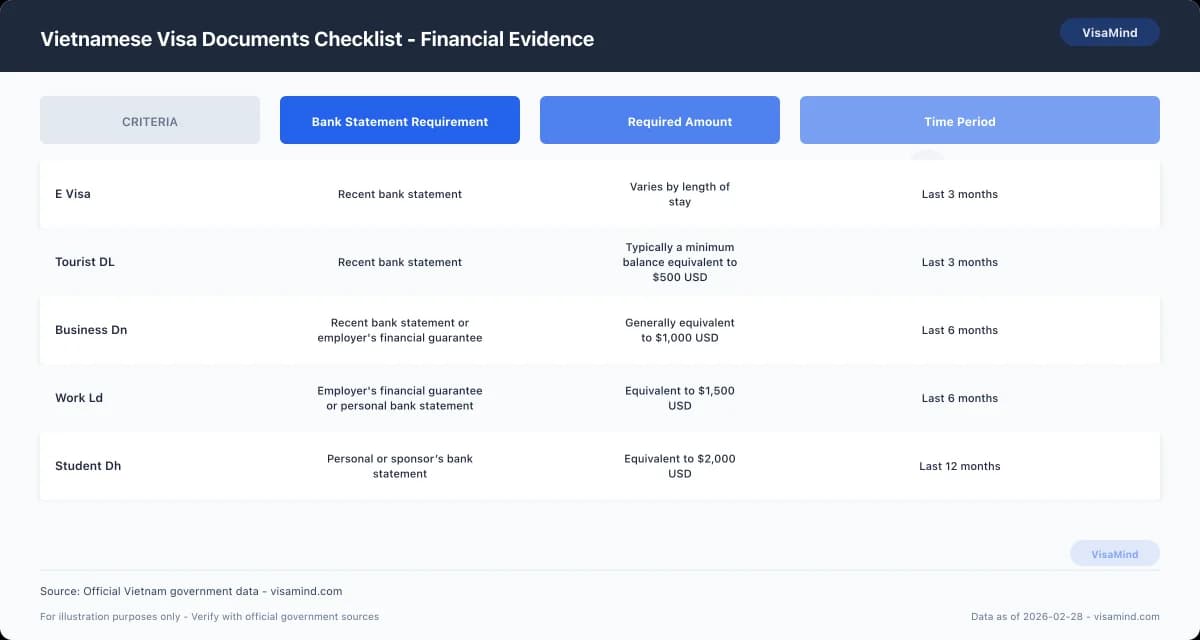
Demonstrating your financial capability is crucial. This often involves providing bank statements to show you can support yourself during your stay. Here's what you need to know about these requirements.
What Bank Statements Do You Need?
When applying for different types of Vietnamese visas, you may need to provide bank statements to show financial stability. The specific requirements can vary based on the visa type. Here’s a comparison:
| Visa Type | Financial Requirement | Time Period |
|---|---|---|
| E-Visa | Not typically required | N/A |
| Tourist Visa (DL Symbol) | Sufficient funds for duration of stay; typically USD 500-700 | Last 3 months |
| Work Visa (LD Symbol) | Proof of employment and financial capability | Last 3-6 months |
| Student Visa (DH Symbol) | Enough funds for tuition and living expenses | Last 6-12 months |
Tip: Always verify the latest requirements from the Immigration Department of Vietnam for the most accurate information.
How Much Money Should You Show?
While the specific amount can vary, it’s essential to demonstrate that you have enough funds to cover your expenses during your stay in Vietnam. Typically, for a Tourist Visa, showing a balance of around USD 500-700 is advisable, though this can vary.
For Student Visas, you should be prepared to show you can cover tuition fees and living expenses, potentially amounting to several thousand USD, depending on your course and duration. For Work Visas, demonstrating ongoing employment and a stable income might be sufficient.
How to Prepare Your Bank Statements?
- Recent Transactions: Ensure your bank statements are up-to-date, ideally covering the last 3 to 12 months, depending on the visa type.
- Balance Consistency: Show consistent balances or regular income to reassure the Immigration Department of your financial stability.
- Official Documentation: Obtain official bank statements, either electronically certified or stamped by your bank.
Important: Ensure all documents are in English or Vietnamese, or include a certified translation.
What If You Don't Have Sufficient Funds?
If you find yourself lacking the required funds, consider these options:
1. Sponsorship:
A family member or friend can provide a letter of sponsorship, along with their financial documents, to support your application. 2.
Scholarships or Grants:
For students, securing financial aid from your educational institution can supplement your bank statements. 3.
Employment Contracts:
For work visas, a signed employment contract can serve as proof of financial support.
For more details on financial requirements and how they can impact your visa application, refer to our Financial Requirements guide. Always keep your documentation accurate and up-to-date to avoid any delays or issues with your visa application.
Purpose-Specific Documents
#You will need to provide specific documents based on the purpose of your visit. Below is a checklist for purpose-specific documents required by the Immigration Department of Vietnam.
Work Visas
If your purpose of visit involves employment in Vietnam, you will need to gather the following documents for a Work Visa (LD Symbol):
- Employment Contract: A contract signed by both the employer and employee, detailing the job position, duration, and salary.
- Work Permit: Obtain this from the Immigration Department prior to applying for the visa. You can learn more about how it compares to a Work Visa.
- Business License: A copy of the employer’s business registration certificate.
- NA16 Form: This document is required when your employer is sponsoring your visa application.
Tip: Ensure your work contract reflects accurate terms to avoid complications during the visa process.
Student Visas
For those pursuing education in Vietnam, the following documents are necessary for a Student Visa (DH Symbol):
- Acceptance Letter: Official admission letter from a recognized Vietnamese educational institution.
- Course Enrollment Proof: Documents showing full-time enrollment status.
- Financial Proof: Evidence of sufficient funds to support your stay, as detailed in the Financial Requirements guide.
Family and Relationship Visas
If you're joining family members residing in Vietnam, such as with a Family TT Visa, prepare the following:
- Proof of Relationship: Marriage certificate, birth certificate, or any official document verifying your relationship with the Vietnamese resident.
- Invitation Letter: A letter from your family member or sponsor currently residing in Vietnam.
Important: Always verify the latest requirements on the official website to ensure all documents are up to date.
By assembling these purpose-specific documents, you align with the Immigration Department’s requirements, facilitating a smoother visa application process. For further details on processing times and additional guidance, you can explore the How To Apply guide.
Mistakes That Get Applications Rejected
#Mistakes in your Vietnamese visa application can lead to rejection, costing time and resources. Here are common errors to avoid:
Incorrect Photo Specifications
- Improper Size or Background: Ensure your visa photo aligns with Vietnam's specific requirements. Typically, a white background and a size of 4x6 cm are required.
- Low Quality or Alterations: Photos must be high-resolution and free from any digital alterations. Ensure that facial expressions are natural and eyes fully visible.
Tip: Refer to our Photo Specifications Guide for detailed instructions.
Expired or Invalid Documents
- Outdated Financial Statements: Provide recent bank statements, usually within the last three months, to demonstrate sufficient funds. Verify the latest requirements on the official website.
- Expired Passports: Your passport should be valid for at least six months beyond your planned entry date into Vietnam. Double-check expiry dates before submitting.
Missing or Incorrect Translations
- Official Translations Required: All documents not in Vietnamese must be accompanied by certified translations. This often includes birth certificates, marriage certificates, and educational documents.
- Mismatched Information: Ensure translation accuracy. Discrepancies between original documents and translations can lead to rejection.
Incomplete Application Details
- Omitting Required Fields: Double-check all sections of your application for completeness. Missing information leads to delays or denials.
- Inaccurate Contact Information: Provide current and correct email addresses and phone numbers for communication from the Immigration Department.
Incorrect Visa Type Selection
- Choosing the Wrong Visa: Ensure you select the visa type that matches your purpose of visit, such as Business Dn or Family Tt. This affects the required supporting documents.
For more detailed information on avoiding these pitfalls, consult our Visa Refusal Reasons Guide. By carefully checking your application, you increase your chances of a successful visa approval.
Medical Exams and Police Clearances
#For certain visa categories in Vietnam, such as the Work Visa (LD Symbol) and Student Visa (DH Symbol), you may be required to undergo a medical examination. This is to ensure you are fit to enter and stay in the country without posing a health risk. The following are common components of the medical examination:
- Health Check Certificate: Obtain this from a recognized medical institution. It typically includes a general health assessment.
- Tuberculosis (TB) Test: TB tests are often mandatory to rule out any active infections. This may involve a skin test or chest x-ray.
Important: Ensure your medical exam is completed by a clinic approved by the Vietnamese authorities to avoid delays in your visa processing.
Police Clearances
A police clearance certificate may be necessary, primarily for long-term visas such as the Temporary Residence Card or Work Visa (LD Symbol). This document confirms you have no criminal record in your home country or any other country you have resided in for a significant period.
- Police Clearance Certificate: Secure this from your local or national police department. It should be recent, usually issued within the last six months.
- Certification and Translation: If the certificate is not in Vietnamese, it must be translated and certified by an approved translator.
Tip: Start the process of obtaining your police clearance early, as it can take several weeks to receive, especially from overseas authorities.
Additional Considerations
- Document Validity: Ensure all medical and police documents are valid at the time of your visa application.
- Visa Type Requirements: Different visas have specific health and character requirements. For example, Family Visa (TT Symbol) applicants may not need as extensive checks as those applying for a work-related visa.
For more details on visa-specific requirements, refer to our How to Apply guide. Always verify the latest requirements and procedures on the official Immigration Department website before proceeding with your application.
Country-Specific Requirements
#Vietnam has specific requirements for obtaining different visa types, and understanding these is key to a successful application with the Immigration Department of Vietnam (Cục Quản lý xuất nhập cảnh). It is important to be aware of the unique documentation and procedural nuances that may apply.
Unique Documentation Requirements
Each visa category has distinct documentation requirements. For instance, when applying for a Work Visa (LD Symbol), it is essential to provide proof of employment in Vietnam, which typically includes an employment contract and a Work Permit issued by Vietnamese authorities.
For a Tourist Visa (DL Symbol), applicants usually need a passport valid for at least six months beyond the intended stay, alongside a completed visa application form. For those opting for an E-Visa, ensure your passport photo and personal information match the online application requirements.
Additional Steps for Specific Visas
Certain visa types might require extra steps. For example, a Student Visa (DH Symbol) generally necessitates a letter of acceptance from a Vietnamese educational institution. Similarly, an Investor Visa (DT Symbol) might require documentation of investment activities in Vietnam.
To apply for a Temporary Residence Card, often needed for long-term stays, you may need to provide a police clearance certificate and proof of residence in Vietnam.
Tip: Always check the latest requirements on the official website of the Immigration Department of Vietnam to ensure you are gathering the correct documents.
Important Considerations
-
Language and Translation: All documents submitted to the Immigration Department must be in Vietnamese or accompanied by a certified translation. This is crucial for any foreign-issued documents.
-
Application Process: Some applications, such as the Visa On Arrival, require pre-approval letters before you can board the flight to Vietnam.
-
Photographs: Ensure that your photographs meet the Photo Specifications as non-compliant photos may delay processing.
Important: Failing to meet specific visa requirements can result in delays or refusals. Always verify the latest guidelines and requirements directly from the Immigration Department's resources.
By understanding these country-specific requirements, you can better prepare your application and increase the likelihood of a successful visa process.