
Overview — Vietnam VR visa
#
The Vietnam VR visa is based on an online application you submit directly to the national immigration authority. You apply remotely and request either a single-entry or multiple-entry electronic visa, depending on your travel plans.
The Immigration Department of Vietnam manages the entire process.
What the electronic form is
The VR visa form is an electronic visa application you fill out and submit online to seek entry into Vietnam. There’s no paper form at the start.
You use this form to apply for:
- Single-entry electronic visa
- Multiple-entry electronic visa
The application gathers your personal details and travel information for review by the Immigration Department of Vietnam (Cục Quản lý xuất nhập cảnh). Once you’ve submitted it, the department reviews your request and decides whether to issue the visa electronically.
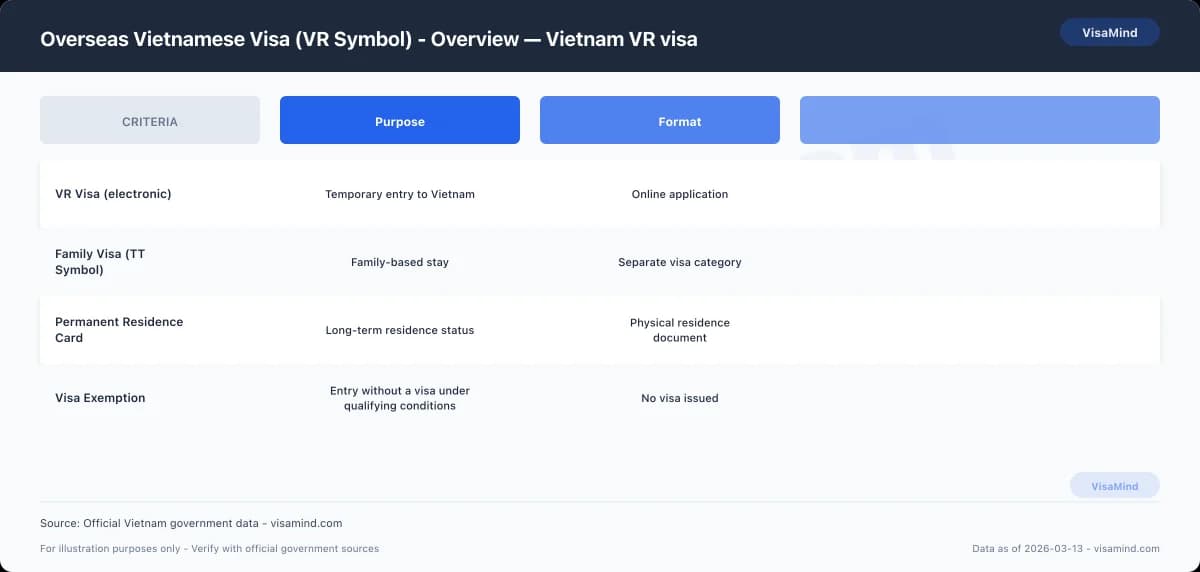
The VR visa isn’t the same as other immigration documents:
| Document | Purpose | Format |
|---|---|---|
| VR Visa (electronic) | Temporary entry to Vietnam | Online application |
| Family Visa (TT Symbol) | Family-based stay | Separate visa category |
| Permanent Residence Card | Long-term residence status | Physical residence document |
| Visa Exemption | Entry without a visa under qualifying conditions | No visa issued |
Don’t mix up the VR visa form with Form Form NA1, which is for other immigration procedures handled by the Immigration Dept.
Who manages the process
The Immigration Department of Vietnam (Cục Quản lý xuất nhập cảnh) runs the VR visa process. You submit your application directly using their electronic system.
The department:
-
Receives your electronic submission.
-
Checks your eligibility and details.
-
Issues the approved electronic visa, if granted.
No foreign embassy handles the initial electronic filing. The Immigration Dept alone reviews and issues the VR electronic visa.
Who the visa serves
The VR visa is for foreign nationals who want to enter Vietnam using an electronic visa process. You apply remotely, not by dropping off a paper file at a consulate.
This visa is for applicants who:
- Plan short-term entry into Vietnam
- Prefer an online process
- Qualify for an electronic visa instead of visa exemption
If you already qualify for Visa Exemption, you may not need a VR visa. For long-term residence or family-based status, the Family Visa (TT Symbol) or a Permanent Residence Card may fit better.
Choose the VR visa if your aim is temporary entry through the official electronic system managed by the Immigration Dept.
Eligibility Requirements
#You must meet the legal and documentation standards set by the Immigration Department of Vietnam (Cục Quản lý xuất nhập cảnh). Eligibility depends on your relationship to a Vietnamese citizen or resident and your current immigration status.
Who can apply
You can apply for a Vietnam VR visa if you’re in one of these groups:
- Foreign nationals who are spouses, children, or parents of Vietnamese citizens
- Foreign nationals who are spouses or children of foreign nationals with a valid work permit or Temporary Residence Card in Vietnam
- Individuals sponsored by a qualified host in Vietnam, as per Immigration Dept regulations
You’ll need to:
- Hold a passport valid for the period required by Immigration Dept rules
- Submit a completed Form NA1 application form
- Provide proof of your qualifying family relationship (such as marriage or birth documentation)
- Have a sponsoring individual or organization in Vietnam
If you already have Visa Exemption or a Permanent Residence Card, you don’t need a VR visa.
| Requirement | Mandatory |
|---|---|
| Valid passport | Yes |
| NA1 form | Yes |
| Proof of relationship | Yes |
| Sponsor in Vietnam | Yes |
Special categories and simplified requirements
If you apply under the Family Visa (TT Symbol) category, the Immigration Dept may process your case under family-based sponsorship rules. This mostly applies to spouses, minor children, and parents of Vietnamese citizens.
Applicants who previously entered Vietnam with a Visa Exemption based on family ties may convert their status to a VR visa if they meet documentation and sponsorship requirements. You’ll need to submit proof of your exemption status and your NA1 form.
If your sponsor holds a Temporary Residence Card, include a copy of that card. If your sponsor holds a Permanent Residence Card, provide certified proof of that status.
The Immigration Dept decides based on your documents and your sponsor’s legal status in Vietnam.
How to Apply Step by Step — visit Vietnam VR
#The entire Vietnam VR process is handled online through the Immigration Department of Vietnam (Cục Quản lý xuất nhập cảnh). The core steps are submitting the electronic application, paying the required fee in VND (₫), and checking your result using your registration details.
Fill out the e-visa application online
Access the official e‑visa portal of the Immigration Dept and fill out the electronic application form. Enter all required personal and passport details exactly as they appear in your travel document.
Prepare your information before you start. Errors can delay your case or cause refusal.
Provide:
- Full name as shown in your passport
- Date of birth
- Passport information
- Registration email address
- Other required fields displayed in the portal
If you previously held a Visa Exemption, Permanent Residence Card, or applied under another category such as the Family Visa (TT Symbol) using Form Form NA1, make sure your current application details match your records.
Submit the form after double-checking every entry. The system will give you a registration code—save it.
Pay fees and await decision
After submitting the online form, pay the e‑visa fee in Vietnamese đồng (₫) through the portal. Fee amounts can change, so check the current figure with the Immigration Dept before paying.
You can’t proceed without payment. Save proof for your records.
At this stage:
-
Submit the completed online application.
-
Pay the required fee in ₫.
-
Save your registration code and confirmation details.
The Immigration Dept will review your application. processing times aren’t fixed here, so check with the Immigration Dept for current timelines.
Check result and print approved e-visa
Check your application status using the E‑visa search function on the portal. Use the exact details from your registration.
Enter:
| Required Information | Where It Comes From |
|---|---|
| Registration code | Issued after submission |
| Registration email | Email used in application |
| Date of birth | As entered on form |
The system will display your result once a decision is made. If approved, download and print the e‑visa.
Bring the printed copy when traveling to Vietnam. Immigration officers will check it upon arrival.
Required Documents
#You must upload two digital files: your passport data page and a personal photograph. The Immigration Department of Vietnam (Cục Quản lý xuất nhập cảnh) will review these as part of your Vietnam VR visa application.
Submit clear, properly sized images to avoid delays or rejection.
Passport data page image
Upload a scanned image of your passport’s biographical (data) page. This page shows your photo, full name, date of birth, passport number, and other identifying details.
File specs:
| Requirement | Specification |
|---|---|
| Page required | Passport data (biographical) page |
| Format | Scanned image |
| Maximum file size | Under 200KB |
All text and numbers must be sharp and readable. Don’t crop out edges or cut off any information.
If you previously held a Visa Exemption, Family Visa (TT Symbol), or Permanent Residence Card, your passport details must still match the information in your VR visa application. Inconsistent data can lead to requests for clarification.
Applicant photograph and specs
Upload a recent digital photograph of yourself. Face the camera directly.
Requirements:
| Requirement | Specification |
|---|---|
| Pose | Straight, facing the camera |
| Glasses | Not allowed |
| Format | Digital image |
| Maximum file size | Under 50KB |
Your face must be fully visible. Don’t tilt your head or wear glasses.
The photo should clearly show your facial features so the Immigration Dept can match it to your passport data page. If you later submit forms such as Form NA1 for related immigration matters, keep your photo consistent with your identity documents.
Fees and Processing Times
#You must pay the correct visa fee and plan around the defined processing window. The Immigration Department of Vietnam (Cục Quản lý xuất nhập cảnh) sets the fee schedule and controls adjudication timelines.
Applicable fees
You pay an embassy visa fee when you apply for a Vietnam VR visa through a Vietnamese diplomatic mission. The embassy collects the fee in Vietnamese đồng (₫) per the rate it publishes at the time of application.
The embassy fee for this visa category is fixed by the issuing authority. Confirm the exact ₫ amount directly with the embassy or the Immigration Dept before submitting your Form NA1 application form.
The fees vary depending on:
- Where you apply (embassy vs. in-country processing through the Immigration Dept)
- The visa category (VR versus Family Visa (TT Symbol))
- Whether you qualify for Visa Exemption or hold a Permanent Residence Card
If you already have a valid Visa Exemption certificate or Permanent Residence Card, you may not need to pay a VR visa fee. Always check your status with the Immigration Dept before paying.
Standard processing window
Under standard processing, the Vietnam VR visa takes 5–7 business days to process.
This timeframe applies to routine applications under normal conditions. Business days exclude weekends and Vietnamese public holidays.
| Processing Type | Timeframe | Notes |
|---|---|---|
| Standard | 5–7 business days | Applies under normal review conditions |
Submit your NA1 form and supporting documents early to avoid travel issues. The Immigration Dept won’t backdate approvals to match your travel date.
The processing time starts only after the authority receives a complete application. Missing documents will delay review.
Variations and verification
processing times vary by visa category and processing location.
Applications lodged through an overseas embassy may move on a different schedule than those filed directly with the Immigration Dept inside Vietnam. A Family Visa (TT Symbol) may also follow a separate review track.
Confirm current timelines directly with:
- The Vietnamese embassy where you apply, or
- The Immigration Department of Vietnam (Cục Quản lý xuất nhập cảnh)
The issuing authority provides the only official timeframe, and it can change without notice.
Tips and Common Mistakes
#Accuracy and consistency are what determine whether the Immigration Dept accepts or rejects your Vietnam VR visa application. Small technical errors—especially in forms and file uploads—cause preventable delays.
Expert tips before submission
Fill out every field on your application form with exact details from your passport and supporting documents. Even minor spelling differences can create inconsistencies that trigger review or refusal.
Use the same personal information across all documents, including Form NA1 forms, supporting letters, and any paperwork tied to a Family Visa (TT Symbol), Visa Exemption, or Permanent Residence Card history. Your name, passport number, and date of birth must match exactly.
Before you submit:
- Review each answer line by line.
- Compare entries against your passport bio page.
- Confirm uploaded files meet size limits.
- Check that no required section is blank.
Save a final copy of your completed form for your records. If you’re unsure about current procedural requirements, confirm directly with the Immigration Department of Vietnam (Cục Quản lý xuất nhập cảnh).
Common documentation errors
Most rejections happen because of incomplete forms or conflicting information across documents. The Immigration Dept checks for internal consistency.
Typical issues include:
- Missing fields on the application form
- Different spellings of your name
- Incorrect passport numbers
- Mismatched dates of birth
- Oversized image uploads
File size limits matter. Applications may fail if your files exceed the allowed thresholds.
| Document Type | Maximum File Size |
|---|---|
| Photograph | 50KB |
| Passport image | 200KB |
Resize files before uploading. Exceeding these limits can cause automatic system rejection.
How to avoid rejections
Start with clear digital copies of your passport and photograph that fit the size limits. Adjust resolution or compress files as needed, but keep them readable.
Check every detail across your documents. If you’ve had a Visa Exemption, Family Visa (TT Symbol), or Permanent Residence Card, your personal data must match your current passport exactly.
Use this checklist before sending anything:
-
All fields filled out.
-
No spelling differences.
-
Passport number matches.
-
Photograph under 50KB.
-
Passport image under 200KB.
Only submit after double-checking each point. Careful review helps you avoid reapplying due to basic mistakes.
Conditions of Stay
#Your VR visa is valid only if the Immigration Department of Vietnam (Cục Quản lý xuất nhập cảnh) approves your application and you follow all entry and travel rules.
It’s important to know how a VR visa differs from Visa Exemption, Family Visa (TT Symbol), or Permanent Residence Card.
Approval is not guaranteed
Submitting a VR visa application doesn’t guarantee approval by the Immigration Dept. You need to meet every eligibility rule and submit accurate documents, including the Form NA1 form if your case calls for it.
Incomplete or inconsistent information can cause delays or outright refusal. The Immigration Dept reviews each file on its own and decides whether to accept or reject.
Before you apply, make sure:
- You fit the VR visa category.
- The NA1 form is complete and signed.
- Supporting documents match your reason for staying.
- All information is consistent everywhere.
The VR visa isn’t the same as a Permanent Residence Card, and it’s also distinct from a Family Visa (TT Symbol) or Visa Exemption.
| Status Type | Approval Required | Long-Term Residency Status |
|---|---|---|
| VR Visa | Yes | No permanent status |
| Family Visa (TT Symbol) | Yes | No permanent status |
| Visa Exemption | No visa approval required | No permanent status |
| Permanent Residence Card | Yes | Yes |
Wait for official approval before making any plans that rely on your visa.
Follow entry and travel rules
Once you have approval, follow Vietnam’s immigration and travel rules during your stay. The Immigration Dept enforces these requirements.
Enter Vietnam only under the conditions stated in your visa. Don’t engage in activities outside what your visa allows.
Keep these points in mind:
- Enter only after valid approval.
- Use the visa for its approved purpose.
- Comply with immigration controls at entry and exit.
- Keep documents that match your visa type.
If your circumstances change, address it with the Immigration Dept. Don’t assume your current visa remains valid without confirmation.
Breaking entry or travel rules can affect both your current stay and future visa applications.
Know When to Get Help
#Most Vietnam VR visa steps can be handled independently, but certain situations call for direct advice. Delays, wrong visa categories, or incomplete forms can disrupt your plans.
When to consult an immigration professional
Professional guidance is necessary if your case doesn’t fit a standard electronic visa request.
Situations include:
- Past overstays or visa violations in Vietnam
- Switching from Visa Exemption to another status
- Applying for a Family Visa (TT Symbol) instead of a VR visa
- Transitioning to a Permanent Residence Card
- Needing extra forms like Form NA1
A qualified advisor can help determine if the VR visa is right for you or if another status makes more sense.
If your case involves multiple entries or changing status after arrival, getting a professional review helps avoid mistakes.
Relevant issuing authority
The Immigration Department of Vietnam (Cục Quản lý xuất nhập cảnh), referred to here as the Immigration Dept, is responsible for VR visa processing.
You’ll interact with this office when you:
-
Submit your electronic visa request
-
Provide supporting documents
-
Specify entry type (single or multiple entry)
-
File forms like NA1 if needed
Refer to the Immigration Dept for current procedures, processing times, and fee amounts in ₫ (VND).
| Matter | Authority Responsible |
|---|---|
| VR electronic visa issuance | Immigration Dept |
| Family Visa (TT Symbol) processing | Immigration Dept |
| Permanent Residence Card decisions | Immigration Dept |
| Official forms (including NA1) | Immigration Dept |
If you’re unsure about visa category, entry validity, or document format, contact the Immigration Dept or consult a qualified professional before submitting your application.
What Consular Officers Evaluate
#Consular officers check that your information is accurate and your file is complete. Errors, inconsistencies, or missing details can result in rejection by the Immigration Dept.
Accuracy and consistency of information
Officers look for matching details across your application forms and supporting documents. Your name, passport number, dates, and purpose of stay must be exactly the same everywhere.
Applying for a Family Visa (TT Symbol)? Your relationship details need to match across all documents. The same goes if you’ve had a Visa Exemption or Permanent Residence Card.
Pay particular attention to the Form NA1 form. Incomplete fields, spelling errors, or unclear entries can cause a refusal at the intake stage.
Use this checklist before you submit:
- Full name matches your passport
- Passport number identical on all forms
- Dates (birth, entry, prior stays) are consistent
- Visa category matches your stated purpose
| Issue Identified | Likely Result |
|---|---|
| Conflicting personal details | Application not accepted |
| Unclear or unidentified information | Request for correction or refusal |
| Incorrect visa category selection | File returned or delayed |
Even minor discrepancies can stop your application before it’s reviewed.
Completeness of submitted materials
The Immigration Dept expects a complete file at submission. Missing pages, unsigned forms, or missing documents can lead to immediate rejection.
Submit all required documents for your visa category. This includes completed forms like NA1 and any materials supporting a Family Visa (TT Symbol) request, if relevant.
Before sending in your file:
-
Check that every required form is included.
-
Make sure all forms are signed where needed.
-
Leave no fields blank unless they truly don’t apply.
| Submission Problem | Impact on Application |
|---|---|
| Missing required document | File not accepted |
| Unsigned form | Processing halted |
| Incomplete form fields | Application returned |
Officers won’t fix or fill in your paperwork. Your file needs to be ready from the start.
Fees
#| Component | Amount |
|---|---|
| Embassy visa feeOverseas Vietnamese visa (VR) | $25 |
Fees change; always verify on Immigration Dept..