
Overview — Vietnam permanent residence
#Vietnam permanent residence allows you to live in Vietnam long term through a Permanent Residence Card issued by the Immigration Department of Vietnam (Cục Quản lý xuất nhập cảnh).
You apply directly with the Immigration Dept using the official permanent residence card form and current instructions published on its website.
What it covers
A Vietnam Permanent Residence Card confirms your long-term resident status in Vietnam.
You use the designated Permanent Residence Card form to request this status.
The Immigration Dept uses this form to review your eligibility and, if approved, to issue your permanent residence card.
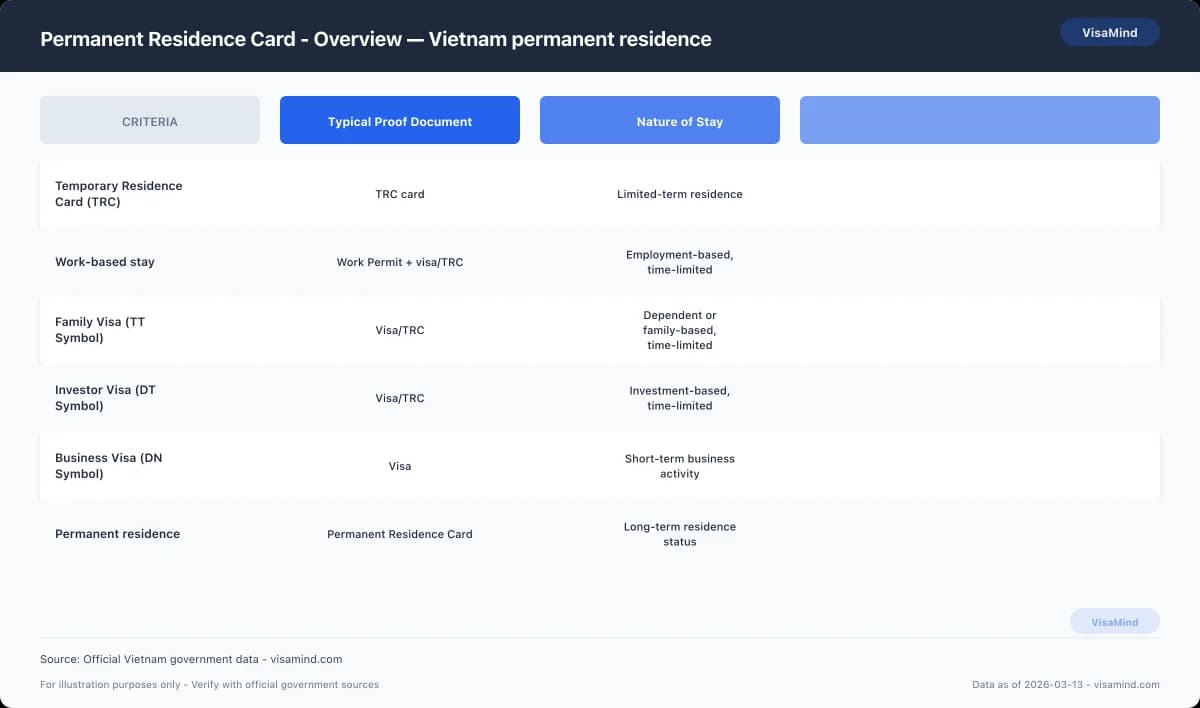
Permanent residence differs from temporary statuses such as:
- Temporary Residence Card (TRC)
- Work Permit–based stay
- Family Visa (TT Symbol)
- Investor Visa (DT Symbol)
- Business Visa (DN Symbol)
Those documents allow temporary stay.
Permanent residence authorizes long-term residence under a separate approval process handled by the Immigration Dept.
You must download the current version of the permanent residence card form and its instructions from the official Immigration Dept website before filing.
Do not rely on outdated copies.
| Item | Purpose |
|---|---|
| Permanent Residence Card form | Application for long-term resident status |
| Instructions (official website) | Filing guidance and document requirements |
| Issuing authority | Immigration Department of Vietnam |
Who issues it
The Immigration Department of Vietnam (Cục Quản lý xuất nhập cảnh) issues permanent residence cards.
You submit your application to the Immigration Dept.
The department reviews your file, determines eligibility, and issues the card if you qualify.
Only the Immigration Dept has authority to:
- Accept permanent residence applications
- Evaluate supporting documentation
- Approve or deny permanent residence status
- Issue the physical Permanent Residence Card
You should always confirm procedural details, required documents, and any applicable fees in VND (₫) through the official Immigration Dept source before submitting your application.
Program snapshot
Permanent residence in Vietnam is a formal status granted through an application filed with the Immigration Dept.
You must:
-
Obtain the official Permanent Residence Card form.
-
Complete the form according to the published instructions.
-
Submit the application to the Immigration Dept.
The Immigration Dept publishes the current form and instructions on its website.
You should verify that you are using the most recent version before filing.
| Feature | Permanent Residence |
|---|---|
| Authority | Immigration Department of Vietnam |
| Application form | Permanent Residence Card form |
| Where to get form | Official Immigration Dept website |
| Status type | Long-term residence |
Always follow the official instructions issued by the Immigration Dept to avoid rejection based on incorrect or outdated documentation.
Application Process
#You must prepare complete documentation, accurately complete the required form, and submit your file to the Immigration Department of Vietnam (Cục Quản lý xuất nhập cảnh).
Missing signatures, incomplete sections, or absent proof of status will delay review.
Preparation
Start by confirming your eligibility category and reviewing the official instructions issued by the Immigration Dept.
Each category may require different supporting evidence, so you must align your documents with your current status in Vietnam.
Prepare clear proof of identity and your current immigration status.
This may include documentation connected to your:
- Temporary Residence Card (TRC)
- Work Permit
- Family Visa (TT Symbol)
- Investor Visa (DT Symbol)
- Business Visa (DN Symbol)
If your application relates to family-based residence, investment, or employment, organize documents that show that relationship or authorization clearly and consistently.
Use the checklist below to structure your file:
| Document Category | What You Must Provide |
|---|---|
| Identity | Valid passport and identification pages |
| Immigration Status | Valid visa, TRC, or related status document |
| Supporting Basis | Work Permit, proof of investment, or family relationship documents |
| Application Form | Completed and signed form (such as Form NA5, if required for your case) |
Review every document before submission.
Incomplete files often result in processing delays or requests for additional evidence.
Filling the form
Complete all required sections of the applicable form, such as Form NA5, if your case requires it.
Do not leave mandatory fields blank.
Write your information exactly as it appears in your passport and immigration records.
Inconsistent spellings, incorrect passport numbers, or mismatched visa details create unnecessary complications.
Pay close attention to:
-
Full legal name and date of birth
-
Passport number and validity
-
Current visa type (TT, DT, DN, etc.)
-
Details of your TRC or Work Permit, if applicable
Sign the form where required.
Unsigned applications are not accepted.
Before printing or submitting, recheck all entries against your supporting documents.
Accuracy is critical.
Submitting
Submit your completed application and supporting documents to the Immigration Department of Vietnam (Cục Quản lý xuất nhập cảnh).
Organize your file in a logical order:
-
Application form
-
Identity documents
-
Proof of current immigration status
-
Supporting eligibility documents
Bring original documents if the authority requires verification.
Keep copies of everything you submit for your records.
For current submission procedures, applicable fees in ₫, and any updated requirements, consult the official guidance issued by the Immigration Dept.
Fees and Processing Times
#You will pay a government filing fee and wait several months for a decision.
Timelines depend on your category and the office handling your file at the Immigration Department of Vietnam (Cục Quản lý xuất nhập cảnh).
Fees
The permanent residence application fee is ₫ equivalent of 100 USD per applicant.
You pay in Vietnamese đồng (₫) at the rate applied by the Immigration Dept on the day of payment.
| Item | Amount | Notes |
|---|---|---|
| Permanent residence application | ₫ equivalent of 100 USD | Paid to Immigration Dept |
This fee applies to the permanent residence card itself.
It does not include costs you may already have paid for a Temporary Residence Card (TRC), Work Permit, or visas such as the Business Visa (DN Symbol), Investor Visa (DT Symbol), or Family Visa (TT Symbol).
If you submit supporting forms such as Form NA5 or request related exit visas, separate government fees may apply.
Confirm current amounts directly with the Immigration Dept before you file.
If you bring foreign currency to Vietnam to cover expenses, you must declare it in line with customs rules.
Processing windows
Under the standard process, the permanent residence card typically takes 3 to 6 months from the date the Immigration Dept accepts a complete file.
| Stage | Estimated Time |
|---|---|
| Permanent residence card (standard) | 3–6 months |
| Required exit visa (complex cases) | +1–2 weeks |
The processing time starts only after you submit a complete application.
Missing documents, incorrect forms, or inconsistencies between your TRC, Work Permit, or visa status can delay acceptance.
If you must obtain an exit visa as part of your case, expect an additional one to two weeks in more complex situations.
Always verify current timelines with the Immigration Dept office handling your case, as processing can vary by location and category.
Variations and delays
processing times vary by category and filing location.
An application tied to long-term employment under a Work Permit may move at a different pace than one based on family sponsorship under a TT visa or investment under a DT visa.
Delays commonly occur when:
- Your documents do not match your current visa status (DN, DT, or TT symbol).
- Your TRC is close to expiry.
- You submit incomplete forms, including NA5.
- The Immigration Dept requests clarification or additional documents.
Local office workload also affects timing.
Larger cities may handle higher volumes, which can extend review periods.
You reduce delays by submitting a complete, consistent file and responding quickly to any written request from the Immigration Dept.
Your Rights as a Permanent Resident
#As a permanent resident, you can secure work authorization and interact with civil authorities using your recognized status.
You rely on proper documentation, accurate personal records, and coordination with the Immigration Dept to exercise these rights effectively.
Work and civil documents
You can use your permanent resident status to support applications that require verified identity and legal stay in Vietnam.
This includes preparing documents for a Work Permit and related visas such as the Business Visa (DN Symbol) or Investor Visa (DT Symbol).
Authorities may require:
- Civil documents that confirm your identity
- Academic qualifications that support your job position
- A birth certificate that clearly reflects your legal name
If your birth certificate shows a non-Vietnamese name, ensure that all records match across your immigration file.
Inconsistent names can delay processing with the Immigration Dept.
When applying for work authorization or updating status, you may need to submit form Form NA5 along with supporting documents.
| Document Type | Why It Matters |
|---|---|
| Civil documents | Confirm identity and legal status |
| Academic qualifications | Support eligibility for a work visa |
| Birth certificate | Verifies legal name and personal details |
Keep certified copies and consistent translations to avoid rejection or requests for correction.
Access to civil functions
Your status allows you to interact with civil authorities for administrative procedures tied to residence and identity.
This includes updating records, confirming personal information, and aligning immigration status with other official documents.
If you previously held a Temporary Residence Card (TRC) or entered on a Family Visa (TT Symbol), your permanent status should align with your current civil records.
Any mismatch in name or academic background can affect future visa or work-related filings.
You remain responsible for:
-
Keeping your civil documents accurate
-
Reporting changes that affect your legal identity
-
Ensuring all immigration filings reflect consistent information
The Immigration Dept reviews documentation closely.
Clear, matching records protect your ability to work and access official procedures without interruption.
Renewing Your PR Card
#You must keep your Permanent Residence (PR) card valid and up to date with the Immigration Department of Vietnam (Cục Quản lý xuất nhập cảnh).
Renewal requires a valid passport, complete forms, and supporting documents that match your current immigration basis.
When to renew
You should renew your PR card before it expires to avoid gaps in your legal status.
Check the expiration date printed on your card and begin preparing your application in advance.
Your passport must remain valid for at least six months at the time you file.
If your passport will expire soon, renew it first.
If your immigration basis has changed—such as moving from a Temporary Residence Card (TRC) linked to a Work Permit to permanent residence, or from a Business Visa (DN Symbol), Investor Visa (DT Symbol), or Family Visa (TT Symbol)—ensure your records with the Immigration Dept are consistent before submitting a renewal.
File directly with the Immigration Dept.
For current processing times or fees in VND (₫), consult the Immigration Dept’s official guidance.
| Requirement | What You Must Check |
|---|---|
| PR card validity | Confirm expiration date |
| Passport validity | Minimum 6 months remaining |
| Immigration status history | Matches your PR approval basis |
| Application form | Fully completed and signed |
Documents for renewal
You must submit a complete application package.
Incomplete form submissions delay processing.
Prepare the following:
- Valid passport (minimum six months remaining)
- Completed Form NA5
- Current PR card
- Supporting documents that confirm your immigration basis (if requested by the Immigration Dept)
Ensure all information on Form NA5 matches your passport exactly, including your full name, passport number, and date of birth.
Even minor inconsistencies can cause delays.
If your PR status originated from employment, investment, or family sponsorship, your prior records—such as a Work Permit or visa category (DN, DT, TT)—must align with Immigration Dept records.
| Document | Key Detail |
|---|---|
| Passport | At least 6 months validity |
| NA5 | Fully completed, no blank fields |
| PR card | Copy and original if required |
| Supporting records | Must match Immigration Dept file |
Check the Immigration Dept’s official instructions for any updated document requirements before filing.
Renewal pitfalls
Most renewal problems result from incomplete forms or passport validity issues.
You avoid delays by reviewing every field in Form NA5 before submission.
Do not submit your application with a passport that has less than six months remaining.
The Immigration Dept may refuse or suspend processing.
Ensure your personal details are consistent across:
- Passport
- PR card
- Form NA5
- Prior visa or residence documents
If your immigration history includes a Temporary Residence Card (TRC), Work Permit, or visa under the DN, DT, or TT symbols, confirm that your records remain accurate and unchanged.
| Common Issue | How to Avoid It |
|---|---|
| Blank or inconsistent form fields | Review NA5 line by line |
| Expiring passport | Renew passport first |
| Mismatched personal data | Use identical details across all documents |
Always verify current procedural updates directly with the Immigration Dept before filing your renewal.
Path to Citizenship
#
Vietnamese citizenship requires a formal application with the Immigration Department of Vietnam (Cục Quản lý xuất nhập cảnh). You must prove you meet statutory residence and legal status conditions.
Your immigration history, visa category, and continuous lawful stay all factor into eligibility.
Typical pathway
You can't move straight from a short-term visa to citizenship. First, you need to establish long-term lawful residence in Vietnam.
Most applicants take these steps:
- Enter Vietnam on a valid visa:
Work Visa with Work Permit
3. Family Visa (TT Symbol)
-
Convert to or keep a Temporary Residence Card (TRC).
-
Apply for Permanent Residence through the Immigration Dept.
-
Submit a citizenship application once you meet legal requirements.
If you change visa status inside Vietnam, you may use Form NA5 to request a visa extension or status adjustment through the Immigration Dept.
Your immigration record should show:
- Continuous lawful stay
- Compliance with visa and TRC conditions
- No violations of entry, exit, or residence rules
The Immigration Dept reviews your full immigration history before approving permanent residence or forwarding a citizenship case.
| Stage | Status Required | Authority Involved |
|---|---|---|
| Entry | Valid visa (DT, DN, TT, etc.) | Immigration Dept |
| Long-term stay | Temporary Residence Card (TRC) | Immigration Dept |
| Permanent status | Permanent Residence approval | Immigration Dept |
| Final step | Citizenship application | Competent Vietnamese authorities |
Residency requirement
Citizenship requires a qualifying period of lawful residence in Vietnam. The exact duration depends on your legal basis for applying.
Your residence must be:
- Legal and uninterrupted
- Supported by valid visas or a TRC
- Properly registered with local authorities
- Compliant with Vietnamese immigration law
Time on short-term visas without long-term status typically doesn't count toward eligibility. Overstays, visa violations, or canceled residence status can damage your application.
If you previously held a Temporary Residence Card, make sure it stayed valid without gaps. Investor Visa (DT) and Work Permit-based residence often provide clearer documentation, but eligibility still depends on statutory criteria.
Before filing, check:
- Your total documented time in Vietnam
- Your current immigration status
- Whether your permanent residence status is approved
The Immigration Dept can confirm whether your residency history satisfies citizenship standards and advise on required documentation.
When to Get Help
#Legal support is necessary when your permanent residence case involves sensitive civil records or situations where you're identified as a victim in a local or cross-border matter. These issues can affect how the Immigration Dept reviews your file, especially if your Temporary Residence Card (TRC), Work Permit, or visa history connects to an ongoing investigation.
Complicated civil documents
Seek help if your civil records link to a police investigation, court process, or formal complaint.
This can impact documents you must submit with your permanent residence application, including forms like Form NA5, copies of your Work Permit, or proof of status under a Family Visa (TT Symbol), Investor Visa (DT Symbol), or Business Visa (DN Symbol).
You need to clarify:
- Your role during a local investigation
- Whether you must provide official statements or certified records
- How the conclusion of the investigation affects your file
If you're identified as a victim, authorities may require confirmation of your participation or the final outcome before approving status changes.
| Issue | Why Legal Help Matters |
|---|---|
| Ongoing investigation | Prevents inconsistent statements in immigration filings |
| Concluded case | Ensures you submit accurate outcome records |
| Missing civil documents | Helps obtain certified copies accepted by the Immigration Dept |
Mistakes in these records can delay or suspend your permanent residence review.
Victim-related or cross-border issues
Advice is also important if your case involves conduct outside Vietnam or compensation claims abroad.
If you participated in a local investigation in Vietnam and later pursue compensation programs in the United States, your statements, timelines, and official findings must remain consistent across jurisdictions.
Key points to review with counsel:
- Your documented role in the investigation
- The official conclusion of the case
- Any compensation applications filed outside Vietnam
- Whether those filings disclose immigration status or residency history
| Situation | Risk to Your PR Case |
|---|---|
| Cross-border compensation claim | Conflicting factual statements |
| Incomplete investigation records | Requests for clarification from Immigration Dept |
| Status change during investigation | Questions about TRC or visa validity |
Your immigration file must match official investigative records. Inconsistent information can trigger additional scrutiny or delay approval.
Maintaining PR Status — Vietnam PR
#Compliance with Immigration Dept requirements is mandatory after approval. Keep your records accurate, submit complete applications, and avoid gaps in lawful status linked to prior visas such as the Temporary Residence Card (TRC), Work Permit, or visa category.
Residency obligations
You remain subject to oversight by the Immigration Department of Vietnam (Cục Quản lý xuất nhập cảnh).
When you file any permanent residence card paperwork, approval isn't automatic. Officers review your file for accuracy and completeness before issuing or renewing documentation.
Use this checklist before submitting any PR-related filing:
- Complete every field on the required form (such as Form NA5, if instructed).
- Attach all supporting documents listed in the official instructions.
- Ensure details match your prior records under your Temporary Residence Card (TRC), Work Permit, or visa type (e.g., Investor Visa (DT Symbol), Business Visa (DN Symbol), or Family Visa (TT Symbol)).
- Review names, passport numbers, and dates for consistency.
| Key Area | What You Must Do |
|---|---|
| Application forms | Fill out all sections fully and accurately |
| Supporting documents | Submit every required document listed by the Immigration Dept |
| Personal data consistency | Match prior TRC, visa, and work records exactly |
| Final review | Double-check before filing |
Incomplete or inconsistent information can delay processing.
Avoiding status loss
Errors in your permanent residence card filing can lead to refusal. A rejected application can disrupt your lawful stay.
You reduce risk by controlling common failure points:
-
Review official instructions from the Immigration Dept before filing.
-
Confirm that all required documents are included.
-
Verify that information matches your immigration history.
Pay close attention if you previously held:
- Work Permit status
- Temporary Residence Card (TRC)
- Investor Visa (DT Symbol)
- Business Visa (DN Symbol)
- Family Visa (TT Symbol)
Discrepancies between prior visa records and your PR application can trigger scrutiny.
| Risk Factor | Prevention Step |
|---|---|
| Missing documents | Use a written checklist before submission |
| Incorrect data | Cross-check against passport and prior visas |
| Incomplete forms | Review every page before signing |
File carefully and accurately each time you submit documents to the Immigration Dept.
Eligibility Requirements
#Your current visa status and supporting civil records determine whether the Immigration Department of Vietnam (Cục Quản lý xuất nhập cảnh) will consider you for permanent residence. You must show lawful stay, a clear immigration history, and a documented purpose for residing in Vietnam.
Who qualifies
You need valid residency documents at the time you apply. Typically, this means you're staying in Vietnam under a recognized long‑term visa category and can prove ongoing legal residence.
Common qualifying statuses include:
- Temporary Residence Card (TRC)
- Work Permit holders with a corresponding visa
- Investor Visa (DT Symbol)
- Business Visa (DN Symbol)
- Family Visa (TT Symbol)
Eligibility depends on whether your current visa type supports long-term residence. The Immigration Dept will review your immigration record, including prior entries, exits, and extensions.
Use the table below to see how your current status affects eligibility:
| Current Status | What You Must Show |
|---|---|
| TRC holder | Valid card and lawful stay history |
| Work Permit holder | Active permit and matching visa category |
| DT, DN, or TT visa | Valid visa reflecting your actual purpose in Vietnam |
If your visa category doesn't match your activities, you risk denial.
Required background details
You must submit civil and professional documentation that supports your legal presence and purpose in Vietnam.
Expect to provide:
- Passport and current visa documentation
- Proof of current residency status
- Civil records (such as family or marital documents, if applicable)
- Academic qualifications or professional credentials for employment or investment roles
- Completed Form NA5 application form, if required by the Immigration Dept
Your documents must align with your visa type. For employment-based cases, this means academic or professional records that justify your work position.
All records should accurately reflect your current circumstances. Inconsistent information between your visa, work authorization, or civil documents can delay or prevent approval.
Why PR Applications Fail
#Most refusals result from document errors or gaps in your immigration history. The Immigration Dept reviews your file against your current visa status, prior Temporary Residence Card (TRC), and supporting records, and rejects files that do not align.
Incomplete or outdated documents
The Immigration Dept often refuses applications that include expired or outdated documents. If your Work Permit, Temporary Residence Card (TRC), or supporting civil documents are no longer valid at the time of review, your application may fail.
You must ensure that every document reflects your current legal status in Vietnam. This includes visas such as:
- Business Visa (DN Symbol)
- Investor Visa (DT Symbol)
- Family Visa (TT Symbol)
- Valid Work Permit
- Valid Temporary Residence Card (TRC)
Common document problems include:
- Submitting an expired TRC
- Using an outdated Work Permit
- Providing old civil status documents that no longer reflect your situation
- Filing Form Form NA5 with inconsistent or incomplete information
| Document Type | Common Issue | Result |
|---|---|---|
| TRC | Expired at time of review | Application refusal |
| Work Permit | Validity period ended | Ineligibility |
| Visa (DN/DT/TT) | Status does not match declared basis | File returned |
| NA5 Form | Missing or inconsistent data | Processing delay or rejection |
Review expiration dates carefully before filing. The Immigration Dept evaluates validity on the date of adjudication, not the date you submit.
Other common refusal reasons
Inconsistencies between your visa category and your stated eligibility often lead to denial. If you apply based on employment but hold a visa that does not reflect that activity, the Immigration Dept may reject the file.
You must ensure your immigration record shows a clear and lawful basis for residence. For example:
- Employment-based applicants should hold a valid Work Permit and appropriate visa status.
- Family-based applicants should hold a Family Visa (TT Symbol) matching the relationship claimed.
- Investor-based applicants should hold an Investor Visa (DT Symbol) consistent with their investment status.
Applications may also fail if:
- Your declared purpose of stay conflicts with your visa history.
- Your previous TRC category doesn't match your current claim.
- Required forms such as NA5 contain discrepancies compared to your immigration file.
The Immigration Dept checks your full immigration history. Any mismatch between your visa status, TRC classification, and application basis increases the risk of refusal.
Fees
#| Component | Amount |
|---|---|
| Application feePermanent Residence Card | $100 |
Fees change; always verify on Immigration Dept..