On this page
- Who Can You Sponsor?
- What Counts as Evidence
- The Financial Bar for Sponsors
- How to Apply for Family Sponsorship
- How Long the Process Takes
- Why Family Visas Get Denied
- Your Status During Processing
- Conditions After Approval
- From Family Visa to PR
- Real Scenarios
- Visa options for this goal
- Guides for Australia
- Other goals for Australia
Who Can You Sponsor?
#
The Partner Visa for Australia facilitates the spouse or de facto partner of an Australian citizen, permanent resident, or eligible New Zealand citizen in living in Australia. Managed by the Department of Home Affairs, this visa process begins with a temporary visa and progresses to a permanent one.
Who Can You Sponsor?
When applying for a Partner Visa, you can sponsor individuals who share a close familial or dependent relationship with you. Below is a breakdown of the eligible relationships you can sponsor:
| Relationship Type | Eligibility Criteria |
|---|---|
| Spouse | Legally married to you, an Australian citizen, permanent resident, or eligible New Zealand citizen. |
| De Facto Partner | In a genuine de facto relationship with you for at least 12 months prior to application. |
| Children | Must be dependent on you and meet specific health and character requirements. |
| Parents | Sponsorship possible under specific conditions, often involving an eligible child or relative sponsor. |
| Other Dependents | Includes individuals reliant on you for financial support and who meet the relevant criteria. |
Key Sponsorship Conditions
- Residency and Citizenship: The sponsor must be an Australian citizen, permanent resident, or eligible New Zealand citizen.
- Genuine Relationship: The relationship must be ongoing and genuine. For de facto partners, the 12-month relationship duration is typically required unless there are compelling and compassionate circumstances.
- Health and Character Requirements: All sponsored individuals must meet health and character standards as part of the application process.
Important Considerations
Important: Your sponsorship might be denied if you have previously sponsored more than two partners for migration to Australia or have sponsored another partner within the last five years.
Sponsors must also provide evidence of their relationship through documentation such as joint financial commitments and shared household responsibilities. For those looking to sponsor their parents, consider exploring options like the Parent Visa, which may offer different pathways and requirements.
For more detailed guidance, including the types of documents needed, you can refer to the Documents Checklist or consult the Partner Onshore Vs Offshore guide to understand the differences between applying within or outside of Australia.
What Counts as Evidence
#Providing comprehensive evidence of your genuine and continuing relationship is crucial. The Department of Home Affairs evaluates multiple aspects of your partnership, and the evidence you provide should reflect these areas. Below is a breakdown of what counts as evidence:
Relationship Evidence
- Marriage Certificates: If you are married, a certified copy of your marriage certificate is essential. This document serves as formal recognition of your marital status.
- De Facto Relationship Proof: For de facto partners, evidence of living together for at least 12 months is vital. This can include joint leases or mortgages, utility bills in both names, and any official correspondence addressed to both of you at the same address.
Financial Interdependence
- Joint Financial Commitments: Documents such as joint bank account statements, shared credit cards, and loan agreements can demonstrate financial interdependence.
- Shared Household Expenses: Receipts or invoices for shared household expenses, like groceries or utility bills, can further establish your shared financial responsibilities.
Social Aspects of the Relationship
- Photos Together: Photographs of you and your partner together at different events and locations can illustrate the social aspect of your relationship. Include a variety of settings and occasions to show the breadth of your social interactions.
- Social Media Interactions: Screenshots or records of social media interactions, such as messages, comments, or posts about your relationship, can provide additional context.
Communication Records
- Phone Records: Call logs and messages exchanged between you and your partner over a significant period can demonstrate ongoing communication.
- Emails and Letters: Copies of emails or letters exchanged can also serve as evidence of the continuity and depth of your relationship.
Important: Ensure all documents are certified copies and translated into English if necessary. Providing clear and organized evidence can significantly impact the success of your application.
For detailed guidance on preparing your application, consider exploring resources like the Documents Checklist or the comparison between Partner Onshore Vs Offshore options. Additionally, understanding the differences between Partner Visa 820/801 and Partner Visa 309/100 may help clarify your application path.
The Financial Bar for Sponsors
#To sponsor a partner for a Partner Visa in Australia, financial stability is a key requirement. The financial bar for sponsors is set by the Department of Home Affairs to ensure that the sponsor can adequately support their partner. This section will outline the income thresholds, savings requirements, and maintenance funds necessary for sponsorship.
Financial Requirements for Sponsorship
| Requirement | Description |
|---|---|
| Income Threshold | Sponsors need to meet a minimum income threshold to demonstrate their capability to support both themselves and their partner. The exact threshold can vary, so verify on the official website. |
| Savings Requirement | If the sponsor does not meet the income threshold, they may need to show evidence of sufficient savings. This serves as a fallback to ensure financial stability. |
| Maintenance Funds | Sponsors are expected to provide maintenance funds to cover the basic living expenses of their partner upon arrival in Australia. These funds must be accessible and sufficient. |
Understanding the Income Threshold
The income threshold is a vital element in the sponsorship process. It ensures that the sponsor can financially support their partner without relying on government assistance. The specific threshold amount may change, so it's important to check the latest figures on the Department of Home Affairs website.
Tip: Keep all financial documentation updated and readily available, as this will be crucial for demonstrating your financial capacity during the application process.
Alternative Financial Evidence
If you are unable to meet the income threshold, presenting alternative financial evidence, such as savings, can be a viable option. This includes:
- Bank statements showing substantial savings
- Documentation of investments or other financial assets
- Evidence of property ownership
Maintenance Fund Requirements
Sponsors must ensure they have enough funds to provide for their partner's basic needs upon arrival in Australia. This includes accommodation, food, and other daily expenses. The maintenance funds are a safeguard against financial hardship and are assessed on a case-by-case basis.
For more information on how to apply for the Partner Visa (onshore) (subclasses 820/801), visit our detailed guide. Additionally, understanding the Partner Onshore Vs Offshore differences can help you decide which pathway is suitable for your situation.
Important: Ensure that you maintain accurate and complete financial records. Inaccurate financial information can lead to application delays or refusals.
How to Apply for Family Sponsorship
#Determine Eligibility and Gather Required Documents
Before starting the application for family sponsorship, ensure you meet the eligibility criteria. You must be the spouse or de facto partner of an Australian citizen, permanent resident, or eligible New Zealand citizen. Make sure to gather all necessary documents, such as evidence of your relationship, valid passports, and sponsorship documents from an eligible sponsor. Ensure all documents are certified and translated into English if necessary.
Create or Log into Your Immi Account
To begin the application process, create or log into your Immi Account. This online platform will allow you to manage your visa application, attach supporting documents, and track the progress of your application. You will need to import your application using your application ID, date of birth, and identity document number.
Lodge the Application
Lodge your application for the temporary Partner visa (subclass 820) while you are in Australia. This initial step is crucial, as being outside Australia when applying can lead to delays or complications. Ensure all sections of the application are completed accurately to avoid any issues.
Pay the Application Fee
Pay the visa application fee through your Immi Account. As of 2023, fees can vary, so verify the current amount on the official website. Ensure you pay the correct fee to avoid processing delays or application refusals.
Submit Supporting Documents
Attach all supporting documents to your application in your Immi Account. These documents should include evidence of your relationship, proof of identity, health examinations, and police certificates. Ensure that all documents are certified copies, as submitting original documents can result in refusal.
Attend Biometrics Appointment
If required, attend a biometrics appointment to provide your fingerprints and photograph. You will receive notification from the Department of Home Affairs if biometrics are necessary. Make sure to attend this appointment promptly to avoid delays in processing.
Prepare for an Interview
In some cases, an interview may be required to assess the genuineness of your relationship. Review our Interview Prep guide for tips on how to prepare effectively. It is important to be honest and provide accurate information during the interview.
Tip: File online through your Immi Account to receive immediate confirmation and reduce processing time.
How Long the Process Takes
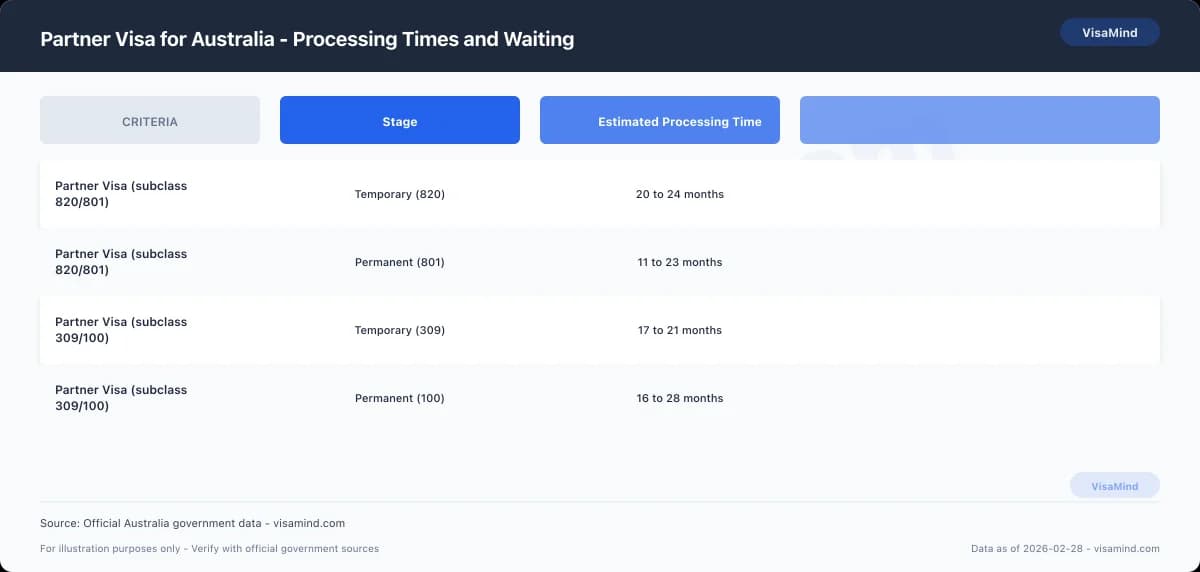
#Processing times for the Partner Visa in Australia can vary significantly based on several factors. Understanding these timelines and what can influence them is essential for planning your move to Australia.
Processing Timelines
The Partner Visa application process includes both a temporary and a permanent visa stage. Here is a breakdown of the typical processing times:
| Visa Stage | Average Processing Time |
|---|---|
| Temporary Partner Visa (subclass 820) | 21 to 28 months |
| Permanent Partner Visa (subclass 801) | 12 to 24 months after temporary visa grant |
Processing times can fluctuate, so it's advisable to verify the current timelines on the official website of the Department of Home Affairs.
What Influences Processing Time?
Several factors can impact how long it takes for your application to be processed:
-
Completeness of Application: Providing all required documents and ensuring that they are correctly certified can prevent delays. You can find a comprehensive checklist in the Documents Checklist.
-
Health and Character Requirements: Meeting health and character requirements is crucial. Delays often occur if additional information or health checks are needed.
-
Priority Categories: Some applications are prioritized, such as those with compelling or compassionate circumstances. However, most Partner Visa applications follow the standard queue.
Tip: Ensure your application is as complete and accurate as possible when submitting it online through your Immi Account to avoid unnecessary delays.
Priority for Certain Applications
The Department of Home Affairs may prioritize applications based on certain criteria, although this is generally rare for Partner Visas. For example, cases involving vulnerable applicants or those with urgent humanitarian needs may receive expedited processing. However, for the majority of applicants, the standard processing times apply.
Being mindful of these processing times and factors can help you prepare better for your journey to Australia. For more detailed insights, you can explore Processing Times and related guidance.
Why Family Visas Get Denied
#Applying for a Partner Visa for Australia can be complex, and understanding why family visas may be denied is crucial to improving your chances of success. Here are some common reasons why applications might face rejection:
Insufficient Evidence
- Lack of Relationship Documentation: Failure to provide adequate evidence of a genuine and continuing relationship is a common reason for denial. This includes lacking joint financial commitments, shared household responsibilities, or social recognition as a couple.
- Incomplete Identity Documents: Not providing all necessary identity documents, such as valid passports or certified copies of original documents, can lead to rejection.
Concerns of a Sham Marriage
- Suspicion of Non-Genuine Relationship: If Home Affairs suspects the relationship is not genuine, the application may be denied. This could be due to inconsistent information, lack of substantial proof, or a previous history of similar rejections.
Tip: To strengthen your application, ensure all relationship evidence is consistent and detailed. Consider consulting the Visa Refusal Reasons guide for more insights.
Financial Shortfalls
- Inadequate Financial Support: Not meeting the financial requirements, such as failing to secure an assurance of support when necessary, can result in refusal. This includes not providing sufficient proof of financial dependency for dependents over 18.
Medical and Character Issues
- Health Requirements: All applicants must meet health requirements. Failing to undertake necessary health examinations or submit required medical documentation can lead to a visa being denied.
- Character Concerns: Applicants over 18 must demonstrate good character, typically through police certificates. Any past criminal record or lack of police clearance can be cause for denial.
Important: Always ensure your application includes comprehensive and accurate information. Missing documents or false declarations can significantly impact the outcome.
For more details about related visa pathways, consider reviewing Partner Visa (onshore) (subclasses 820/801) and Partner Visa (offshore) (subclasses 309/100). Also, consult the Documents Checklist to make sure you have all required documentation ready.
Your Status During Processing
#During the processing of your Partner Visa application with the Department of Home Affairs, your status in Australia undergoes several significant changes. Understanding these changes is crucial to ensure you comply with all conditions and make informed decisions about your stay.
Bridging Visas and Work Rights
When you lodge your Partner Visa application, you will typically be granted a Bridging Visa A (BVA). This visa allows you to remain in Australia while your application is processed. One of the key advantages of the BVA is that it generally provides the same work rights as your previous visa. If your previous visa did not allow you to work, you may need to apply for a Bridging Visa B (BVB) or another visa that permits employment.
- Work Rights: Check the specific conditions of your BVA to verify your work entitlements.
- Apply for Bridging Visa B: If you wish to travel outside Australia temporarily, a BVB is necessary to ensure your ability to return.
Tip: Always check your Bridging Visa conditions in Immi Account to confirm your work rights and other entitlements.
Travel Restrictions
While your Partner Visa is being processed, traveling outside Australia can affect your application. With a Bridging Visa A, you aren't permitted to re-enter Australia if you leave. To travel internationally, you must apply for a Bridging Visa B, which allows temporary travel.
- Bridging Visa A (BVA): No re-entry rights if you leave Australia.
- Bridging Visa B (BVB): Allows re-entry; apply if you need to travel.
Important: Always apply for a BVB before leaving Australia to maintain your eligibility to return.
Implied Status
While your application is pending, you remain in Australia under the conditions of the bridging visa granted to you. It's essential to comply with all visa conditions, including maintaining your relationship with your sponsor and adhering to any work or study limitations.
Next Steps
If your application is approved, you will be granted a temporary Partner Visa (subclass 820), which eventually leads to a permanent visa. For more details on transitioning from a temporary to a permanent visa, refer to our Pr Pathway Guide.
For those navigating the Partner Visa process, understanding the nuances of bridging visas and keeping track of your application status through the How To Apply guide can be invaluable. Always stay informed about your visa conditions to ensure a smooth experience while your application is processed.
Conditions After Approval
#Once your Partner Visa application is approved by the Department of Home Affairs, you'll first receive a temporary visa, which allows you to reside in Australia. This initial stage is crucial as it serves as the gateway to obtaining a permanent Partner Visa. The transition from temporary to permanent status is not automatic and involves meeting specific conditions.
Temporary to Permanent Status
The Partner Visa involves a two-stage process starting with the temporary visa (subclass 820 if you are applying onshore), which can lead to a permanent visa (subclass 801). The temporary visa allows you to stay in Australia while your permanent visa application is processed. Usually, you can apply for the permanent visa two years after your initial application, provided your relationship is ongoing and you continue to meet the requirements.
Residence Requirements
To maintain your visa status, you must fulfill certain residence requirements:
- Temporary Visa Holders: You must remain in Australia to continue your eligibility for the permanent visa.
- Permanent Visa Applicants: You should ideally reside in Australia and demonstrate an ongoing commitment to the country, such as maintaining a home or employment.
Important: Ensure that your stay in Australia complies with the terms of your visa to avoid any complications in transitioning to permanent residency.
Restrictions and Rights
While holding a temporary Partner Visa, you have the right to:
- Work and study in Australia.
- Access Medicare, Australia's health care system.
However, some restrictions apply:
- You may not be eligible for certain government benefits until you obtain your permanent visa.
- Traveling outside Australia may affect your application if not managed properly. Always inform the Department of Home Affairs about any plans to travel.
General Conditions
- Health and Character: You must continue to meet health and character requirements throughout the visa process.
- Ongoing Relationship: Your relationship with your Australian partner must remain genuine and continuing.
For more detailed guidance on the transition from a temporary to a permanent visa, you can explore related resources like the Partner 309 100 visa, or for further inquiries, you may consider consulting Australia's Department of Home Affairs.
Understanding these conditions is vital to ensure a successful migration journey through the Partner Visa pathway.
From Family Visa to PR
#The journey from obtaining a temporary Partner Visa to achieving permanent residency in Australia involves a structured process managed by the Department of Home Affairs. Initially, you will apply for a temporary Partner Visa, specifically the subclass 820, if you're in Australia. This visa allows you to stay in Australia while your application for a permanent Partner Visa, known as the subclass 801, is processed.
Typically, the transition from a temporary to a permanent Partner Visa takes around two years from the date you initially lodged your application. During this period, you must continue to meet eligibility criteria, including maintaining a genuine and continuing relationship with your Australian partner.
Pathway to Australian Citizenship
Once you have obtained your permanent residency through the Partner Visa process, you may be eligible to apply for Australian citizenship. To do so, you must meet the general residence requirement:
- 4 years living in Australia on a valid visa immediately before applying
- 12 months as a permanent resident
- No more than 12 months outside Australia in those 4 years, including no more than 90 days in the last 12 months
Children under 16 are exempt from the general residence requirement but must be permanent residents.
For more details on the citizenship process, visit the Australian Citizenship page.
Important Considerations
Tip: Ensure you maintain accurate records of your time spent in and out of Australia to meet the residence requirement for citizenship.
While waiting for your permanent residency or citizenship, ensure you adhere to the conditions of your temporary Partner Visa. This includes meeting any health and character requirements set by the Department of Home Affairs.
For a comprehensive understanding of your pathway to permanent residency and citizenship, consult the PR Pathway Guide, which provides detailed insights into each step of the process.
By following these guidelines and maintaining compliance with visa conditions, you can successfully transition from a temporary visa holder to a proud Australian citizen.
Real Scenarios
#As I prepared to apply for the Partner Visa for Australia, my main concern was whether our relatively short relationship would be perceived as genuine by the Department of Home Affairs. My partner and I had been together for just over a year, and though we shared a deep connection, our collection of shared experiences was limited. To address this, we gathered all possible evidence demonstrating the authenticity of our relationship. This included joint lease agreements, shared utility bills, and photos with friends and family. We also asked two close friends to provide statutory declarations affirming our relationship. In the end, our application was successful because we demonstrated a genuine commitment to each other despite our shorter timeline.
Another worry was the character requirements, as my partner had a minor legal issue from several years ago. We were anxious about how this might impact our application. To tackle this, we proactively obtained a police certificate detailing the incident and included a personal statement explaining the circumstances and lessons learned. We also provided evidence of my partner's positive contributions to the community since then, including volunteer work and professional achievements. By addressing this concern head-on and showing growth and responsibility, we managed to satisfy the character requirements, leading to a successful visa outcome.
FAQs
What is the application fee for a Partner Visa for Australia?
Do I need to be in Australia to apply for a Partner Visa (subclass 820)?
What happens if my Partner Visa for Australia is denied?
Can I apply for permanent residency after getting a Partner Visa for Australia?
What forms are required for a Partner Visa application in Australia?
Can my dependent children be included in my Partner Visa for Australia application?
What is the balance of family test for the Partner Visa for Australia?
VisaMind provides informational guidance only and is not a government agency. This is not legal advice. Requirements can change and eligibility depends on your specific facts. If your case is complex or high-stakes, consult a licensed immigration attorney.
Next steps
Requirements vary by nationality, purpose, timeline, and case details. Use Find My Visa to get a personalized checklist for Australia with official sources and deadlines.
Find my visa