On this page
- University Admission Before Visa
- Eligibility and Requirements
- Submitting Your Student Visa
- Part-Time Work Rights
- What Comes Next
- The Study-to-PR Pipeline
- Errors That Cost Students Their Visa
- Tuition and Living Costs
- Settling In as a Student
- What Other Students Experienced
- Visa options for this goal
- Guides for Australia
- Other goals for Australia
University Admission Before Visa
#-
Secure Admission to a CRICOS-Registered Course
Before you can apply for a Student Visa (subclass 500) to study in Australia, you must first secure admission to a full-time course registered with the Commonwealth Register of Institutions and Courses for Overseas Students (CRICOS). This is a crucial step, as you will need a valid Confirmation of Enrolment (CoE) issued by your educational institution. The CoE serves as proof of your enrollment in an approved course, which is a mandatory requirement for your visa application.
-
Meet English Language Requirements
Depending on your chosen course, you may need to demonstrate proficiency in English. The specific requirements vary between institutions and courses, so it's important to check the details with your university. Commonly accepted tests include the IELTS, TOEFL, and PTE Academic. Be sure to prepare and book your test well in advance, as meeting this requirement will be necessary to obtain your CoE.
-
Arrange Overseas Student Health Cover (OSHC)
As part of the visa prerequisites, you must have health insurance for the duration of your stay in Australia. This is typically fulfilled by purchasing Overseas Student Health Cover (OSHC) from an approved provider. Your university may offer assistance in arranging this insurance, or you can choose from various providers recognized by the Australian Government. Ensure that your OSHC policy is valid from the time you arrive in Australia, as failing to maintain proper coverage can jeopardize your visa status.
-
Prepare Financial Documents
Demonstrating financial capacity is another essential step before applying for your visa. You must provide evidence that you have sufficient funds to cover tuition fees, living expenses, and travel costs. Acceptable forms of proof include bank statements, official loan documents, or scholarship letters. This financial evidence is necessary for both securing your CoE and the subsequent visa application process.
Important: Incomplete or insufficient financial documentation may result in delays or refusals of your Student Visa application. Ensure all documents are current and clearly demonstrate your financial ability to support yourself during your studies.
By securing admission, meeting English language requirements, arranging health insurance, and preparing financial evidence, you set a solid foundation for a successful Student Visa application. Once these steps are complete, you can proceed to lodge your visa application through the Department of Home Affairs. For more detailed guidance on financial requirements, visit the Financial Requirements page.
Eligibility and Requirements
#To study in Australia, you must meet specific eligibility criteria and requirements. These include financial capacity, health insurance, and language proficiency. Here's a breakdown:
Eligibility and Requirements Overview
| Requirement | Details |
|---|---|
| Age | Must be 6 years or older. If under 18, must demonstrate appropriate welfare arrangements. |
| Confirmation of Enrolment (CoE) | Required for all courses unless enrolled in a scholarship scheme approved by the Minister for Foreign Affairs and Trade. Must be registered on the Commonwealth Register of Institutions and Courses for Overseas Students (CRICOS). |
| Financial Capacity | Must provide evidence of financial capacity, such as bank statements, loan agreements, or scholarship letters. Financial Requirements provide more details. |
| Health Insurance | Must maintain Overseas Student Health Cover (OSHC) for the duration of your stay, unless falling into an exemption category. |
| English Language Proficiency | Must meet English language requirements specific to your course unless exempt. |
| Welfare Arrangements (if under 18) | Must have adequate welfare arrangements and parental consent, demonstrated through Form 1229 or a statutory declaration. |
Financial and Health Requirements
To ensure you can support yourself during your studies, you need to demonstrate financial capacity. This means showing you have enough funds to cover tuition, living expenses, and travel costs. Scholarships or financial aid can be included as part of this evidence.
For health coverage, you must have OSHC, which is mandatory unless you're exempt. OSHC helps cover medical and hospital care costs while in Australia. Ensure your coverage aligns with your entire stay to avoid any issues.
Important: Failing to maintain adequate health insurance or financial proof can jeopardize your visa application. Always verify the latest requirements on the official website.
Language and Enrollment Requirements
English proficiency is a critical component. The level required varies by course, so check the specific needs of your institution and course. Tests like IELTS or TOEFL are commonly accepted.
Moreover, a valid CoE is necessary unless you're exempt. This confirms your full-time enrollment in a CRICOS-registered course, a prerequisite for the Student Visa (subclass 500).
For comprehensive guidance on application processes, refer to the How To Apply guide. Ensure all documents are prepared and meet the criteria to avoid delays or potential refusals.
Submitting Your Student Visa
#To study in Australia, you will need to apply for a Student Visa (subclass 500) through the Department of Home Affairs. Follow these steps to ensure your application is complete and accurate.
-
Create or Log in to Your ImmiAccount
Begin by accessing the ImmiAccount portal. If you do not have an account, you will need to create one. This account will be used to manage your application and track its progress.
-
Gather Necessary Documents
Ensure you have all required documents prepared before lodging your application:
- Confirmation of Enrolment (CoE): You must have a valid CoE for each course you plan to study. If you are enrolled under a scholarship approved by the Australian Minister for Foreign Affairs and Trade, a CoE is not required.
- Financial Capacity Evidence: Provide proof of financial means, such as bank statements, loan documentation, or scholarship letters.
- Overseas Student Health Cover (OSHC): You must hold OSHC for the duration of your stay unless you fall into an exemption category.
- Proof of English Language Proficiency: Submit evidence of your English language skills unless you are exempt.
- Welfare Arrangements for Minors: If you are under 18, ensure you have adequate welfare arrangements and parental consent.
Tip: Double-check that your CoE is valid and corresponds to a course registered on the Commonwealth Register of Institutions and Courses for Overseas Students (CRICOS).
-
Complete the Online Application Form
Use your ImmiAccount to fill out the online application form. Make sure to include all required details, such as your CoE codes and evidence of financial capacity.
-
Attach Required Documents
As you complete the application form, you will need to digitally attach all relevant documents. This includes your CoE, financial evidence, proof of health insurance, and any other required paperwork. Ensure each document is clear and legible.
-
Pay the Visa Application Charge
Before submitting your application, you must pay the visa application charge. Some applicants, such as those on scholarships funded by the Commonwealth Government or secondary exchange students, may be exempt from this fee. Verify your eligibility for any exemptions.
-
Submit Your Application
Once all documents are attached and the fee is paid, submit your application through ImmiAccount. You will receive a confirmation of submission and a receipt number. Keep this for your records.
Important: Submitting incomplete or incorrect information can lead to delays or refusal of your visa application. Ensure that all details are accurate and complete.
For more detailed guidance on the application process, you may visit the How to Apply guide. Additionally, be sure to understand the financial and documentation requirements by checking the Financial Requirements guide.
By carefully following these steps and ensuring all requirements are met, you can increase your chances of a successful Student Visa application and begin your studies in Australia.
Part-Time Work Rights
#Australia offers international students the opportunity to work part-time while studying, allowing you to gain valuable work experience and support your living expenses. Understanding the rules surrounding work rights is crucial to ensure compliance with your Student visa conditions.
How Many Hours Can You Work?
As a Student visa holder in Australia, you are generally allowed to work up to 48 hours per fortnight during your study periods. This limit helps ensure that your work commitments do not interfere with your academic responsibilities. During official school holidays, there are no restrictions on the number of hours you can work.
Restrictions and Conditions
While working part-time in Australia, there are specific conditions you must adhere to:
- Course Enrolment: You must maintain a valid enrolment in a course registered on the Commonwealth Register of Institutions and Courses for Overseas Students (CRICOS).
- Academic Performance: Your part-time work should not negatively impact your academic performance.
- Valid Visa: Ensure your Student visa remains valid and compliant with Australian immigration regulations.
Important: Violating work conditions can lead to visa cancellation. Always stay informed about your rights and obligations as a Student visa holder.
Exceptions and Special Circumstances
Certain situations may allow for exceptions to the standard work conditions:
- Postgraduate Research Students: If you are a postgraduate research student, you can work unlimited hours once you have commenced your research course.
- Dependents of Students: If your partner holds a Student visa 500 for a master's or doctoral degree, they may also be eligible to work unlimited hours.
For detailed guidance on maintaining your Student visa and work rights, refer to the Student Visa (subclass 500) page.
Tip: To plan your work schedule around your studies effectively, use tools like a calendar or scheduling app to track your hours and avoid exceeding the permitted limit.
What Comes Next
#Navigating the post-study landscape in Australia offers several avenues for international students who wish to extend their stay. After successfully completing your studies, numerous visa options are available to continue living and working in Australia. These opportunities not only allow you to gain valuable work experience but also pave the way for potential permanent residency.
Post-Study Work Visa Options
One of the most popular pathways for international students is the Temporary Graduate Visa (subclass 485). This visa is designed to allow students who have recently graduated with a degree from an Australian institution to live, study, and work in Australia temporarily. The duration of the visa can range from 18 months to four years, depending on the qualifications obtained.
Key Features of the Temporary Graduate Visa (subclass 485):
-
Post-Study Work Stream: Available to international students who have recently graduated from an Australian institution with a bachelor’s degree or higher. This stream typically allows a stay of two to four years.
-
Graduate Work Stream: Suitable for international students with qualifications related to an occupation on Australia’s Skilled Occupation List. This stream usually allows an 18-month stay.
Important: Ensure that you apply for the Temporary Graduate Visa within six months of the completion of your course. Delays beyond this period may affect your eligibility.
Other Visa Options
For those seeking additional work experience or a pathway to permanent residency, other visa options include:
-
Skilled Independent Visa (subclass 189): A points-based visa for skilled workers who do not require sponsorship by an employer or a family member or state/territory government. This visa grants permanent residency.
-
Skilled Nominated Visa (subclass 190): Similar to the subclass 189 but requires nomination by an Australian state or territory government.
-
Employer-Sponsored Visas: Options such as the Temporary Skill Shortage Visa (subclass 482) allow you to work in Australia if you have a job offer from an eligible employer.
Transitioning to Permanent Residency
Many international students aspire to transition from temporary visas to permanent residency. The Skilled Migration Program is a common route, requiring students to meet specific criteria such as having an occupation on the Skilled Occupation List and achieving a certain score on the points test.
Steps to Transition:
-
Assess Your Eligibility: Review your occupation against the Skilled Occupation List and calculate your points using the Pr Pathway Guide.
-
Expression of Interest (EOI): Submit an EOI through the SkillSelect portal, indicating your intent to apply for a permanent visa.
-
Invitation to Apply: If invited, lodge an application for the relevant skilled visa.
Tip: Keep your skills assessment and English test results current, as these can affect your points score and visa eligibility.
For a comprehensive understanding of post-study work options and pathways to permanent residency, refer to the Graduate 485 visa details and explore future planning resources on the Permanent Residence page. Always verify the latest information on the official websites to ensure you meet the criteria and timelines.
The Study-to-PR Pipeline
#Studying in Australia can be a key step toward securing permanent residency (PR), thanks to the country's study-to-PR pipeline. This pathway allows international students to transition from a Student Visa (subclass 500) to a more permanent status, such as the Temporary Graduate Visa (subclass 485), and eventually to permanent residency.
Transitioning from Student to Graduate
Once you have completed your studies in Australia, you may be eligible to apply for a Temporary Graduate Visa (subclass 485). This visa provides an opportunity to gain practical work experience in Australia, which is crucial for those aiming for permanent residency. The Graduate Visa allows you to stay in the country for 18 months to up to 4 years depending on your qualifications.
- Post-Study Work Stream: For international students who have recently graduated with a degree from an Australian institution.
- Graduate Work Stream: For international students with skills and qualifications that relate to an occupation on Australia's Skilled Occupation List.
Important: To be eligible for the Temporary Graduate Visa, you must apply within six months of completing your course.
Pathway to Permanent Residency
After gaining work experience on a Temporary Graduate Visa, many students aim to apply for permanent residency through skilled migration visas. The two most common options are:
- Skilled Independent Visa (subclass 189): A points-based visa that does not require sponsorship. However, you must receive an invitation to apply.
- Skilled Nominated Visa (subclass 190): Requires nomination by an Australian state or territory government.
Both of these visas assess candidates based on a points system, which considers factors such as age, English proficiency, and work experience. Enhancing your profile through Australian work experience and further studies can significantly boost your chances.
Tips for Success
- Gain Relevant Work Experience: While on a Temporary Graduate Visa, focus on gaining experience in your field to improve your points score.
- Monitor Occupation Lists: Keep an eye on the Skilled Occupation List to ensure your profession remains in demand.
- Improve Language Skills: Higher English proficiency can increase your points, so consider taking additional language courses if needed.
For more detailed guidance on transitioning from study to permanent residency, check out our PR Pathway Guide and explore the Skilled Independent Visa (subclass 189) or the Skilled Nominated Visa (subclass 190).
Tip: Regularly update your Immi Account with any changes in your status or contact information to stay aligned with the Department of Home Affairs' requirements.
Errors That Cost Students Their Visa
#Certain pitfalls can jeopardize your application. Avoiding these errors ensures a smoother application process and increases the chances of approval.
Financial Evidence Issues
- Insufficient Financial Capacity: You must demonstrate adequate funds to cover tuition, travel, and living expenses. Not providing sufficient evidence of financial capacity, such as bank statements or scholarship letters, can lead to visa refusal. Ensure your financial documents clearly show you can support yourself during your studies in Australia.
- Inaccurate or Incomplete Documentation: Submitting financial documents that are incomplete or incorrect could result in a delay or denial of your visa application. Double-check all financial information and ensure it is up-to-date and accurately reflects your situation.
Enrolment and Health Coverage
- Missing Confirmation of Enrolment (CoE): A valid Confirmation of Enrolment (CoE) is crucial for your application. Without it, your visa application will be deemed ineligible. Ensure that you include a CoE for every course you intend to study, and that it is current.
- Health Insurance Lapses: Maintaining adequate Overseas Student Health Cover (OSHC) is mandatory. Failing to have valid health insurance for the entire duration of your stay can result in visa denial or cancellation. Make sure your OSHC is arranged before you arrive in Australia and continues without interruption.
Important: Entering Australia before your Overseas Student Health Cover (OSHC) begins can lead to complications. Verify OSHC start dates to align with your arrival.
Genuine Temporary Entrant and Intent
- Lack of Genuine Student Intent: You must satisfy the Genuine Temporary Entrant (GTE) requirement by proving your intention to stay in Australia is temporary and primarily for study. Inconsistencies in your application details, such as unclear study goals or ties to your home country, can raise red flags.
Additional Considerations
- Incomplete or Incorrect Application Information: Providing inaccurate or incomplete information on your application can lead to delays or refusals. Carefully review all sections before submission.
- Failure to Declare Family Members: If you have dependents, ensure they are declared in your Student visa application. Omitting family members can result in future complications.
For guidance on specific documentation and processes, refer to our Documents Checklist and understand common Visa Refusal Reasons to avoid.
Tuition and Living Costs
#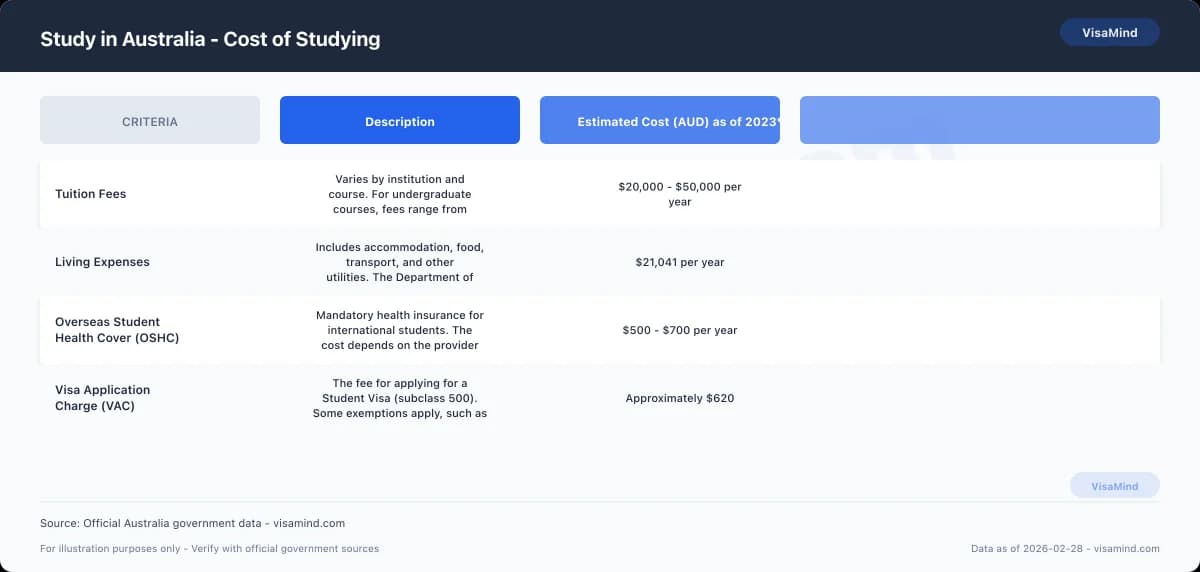
Australia is an attractive destination for international students due to its world-class education system and vibrant culture. However, understanding the financial aspects of studying here is essential. Below, we provide a detailed comparison of tuition and living costs, along with the financial requirements necessary for obtaining a Student visa.
Tuition and Living Costs
| Category | Details |
|---|---|
| Tuition Fees | Tuition fees in Australia vary by institution and course. Generally, undergraduate courses range from AUD 20,000 to AUD 45,000 per year. Postgraduate courses can be AUD 22,000 to AUD 50,000. |
| Living Costs | The Department of Home Affairs requires proof of funds to cover living costs, estimated at AUD 21,041 per year for students. This does not include tuition or travel expenses. |
| Health Insurance | Overseas Student Health Cover (OSHC) is mandatory for the entirety of your stay, unless exempt. Annual costs typically range from AUD 450 to AUD 600. |
Important: Ensure you have evidence of your financial capacity, such as bank statements or scholarship confirmation, when you lodge your application.
Financial Requirements
To lodge a successful Student visa application, you must demonstrate that you have sufficient funds to cover your tuition, living expenses, and travel costs. This can include:
- Personal bank statements
- Loan statements
- Official scholarship letters
For detailed guidance on preparing these documents, refer to our Documents Checklist.
Tips for Managing Costs
- Budget Wisely: Plan your monthly expenses and stick to a budget. This will help manage your finances effectively while studying in Australia.
- Part-Time Work: Student visa holders can work up to 48 hours per fortnight during term time, which can help cover living expenses. For more details, see our section on Part-Time Work Rights.
Understanding these financial aspects is crucial for a smooth study experience in Australia. For more information on how to apply, visit the How To Apply page or contact the Department of Home Affairs directly.
Settling In as a Student
#When studying in Australia, it's important to manage practical aspects of daily life, such as health insurance, housing, and banking. Here's what you need to know to settle in smoothly:
Health Insurance
- Overseas Student Health Cover (OSHC): As a student in Australia, you must hold OSHC for the duration of your stay. This insurance covers visits to the doctor, some hospital treatments, ambulance services, and limited pharmaceuticals.
- Choosing an OSHC Provider: Ensure your OSHC is from an approved provider. Compare options to find the coverage that best suits your needs and budget.
Important: Failing to maintain OSHC can affect your Student Visa status and lead to complications with the Student Visa (subclass 500).
Housing
- On-Campus Accommodation: Many universities offer on-campus housing options, ideal for those who want to be close to academic facilities.
- Off-Campus Housing: Renting privately or sharing accommodation are popular alternatives. Websites and student services at your institution can help you find suitable options.
- Temporary Accommodation: If you need temporary lodging upon arrival, consider booking a hostel or hotel while you search for permanent housing.
Banking
- Opening a Bank Account: It's advisable to open a local bank account to manage your finances efficiently. Major Australian banks can help you set up an account, often with student-friendly features.
- Required Documents: Typically, you'll need your passport, proof of enrolment, and proof of address to open an account.
Tip: Open your bank account within the first few weeks of arrival to avoid international transaction fees and streamline your financial activities.
For more detailed guidance on settling in as a student, including how to manage finances and housing, you can refer to the Documents Checklist to ensure you have everything you need. Additionally, understanding the Visa Refusal Reasons can help you avoid common pitfalls in your visa journey.
What Other Students Experienced
#"I'm studying a completely different field than my previous degree — will the officer question my choice?" When I decided to pursue a Master's in Environmental Science in Australia, I worried about how my history in Business Administration would be perceived. To address this, I carefully prepared a personal statement explaining my passion for sustainability and how I planned to integrate my business skills into environmental projects. I also gathered letters of recommendation from professionals familiar with my work in environmental initiatives. This proactive approach helped demonstrate my genuine interest and capability in my new field. Ultimately, my application was successful, and I believe my thorough preparation and transparency played a significant role.
"My parents' income appears low on paper — how can I prove our financial capacity?" This was a major concern for me as I prepared to apply for the Student Visa (subclass 500). To tackle this, I compiled a comprehensive financial portfolio including bank statements, property deeds, and letters from my parents' employers. Additionally, I highlighted any scholarships and part-time work plans to further assure the visa officers of my financial stability. By providing a detailed picture of our financial situation, I was able to address their concerns, and my visa was approved without any issues. This experience taught me the importance of presenting a holistic view of financial capacity, especially when traditional income sources might not tell the full story.
FAQs
What is required to switch from a Student Visa to a Temporary Graduate Visa in Australia?
How can I demonstrate financial capacity for studying in Australia?
What English language requirements must be met to study in Australia?
How does the Commonwealth Register of Institutions and Courses for Overseas Students (CRICOS) relate to studying in Australia?
What is the visa application charge for scholarship students in Australia?
What happens if I don't maintain Overseas Student Health Cover (OSHC) while studying in Australia?
Can I include family members in my student visa application to study in Australia?
Sources
Last reviewed: March 1, 2026
VisaMind provides informational guidance only and is not a government agency. This is not legal advice. Requirements can change and eligibility depends on your specific facts. If your case is complex or high-stakes, consult a licensed immigration attorney.
Next steps
Requirements vary by nationality, purpose, timeline, and case details. Use Find My Visa to get a personalized checklist for Australia with official sources and deadlines.
Find my visa