On this page
- How to Work in This Country Legally
- What Your Employer Must Provide
- Step-by-Step Work Visa Application
- Worker Rights and Restrictions
- The Long-Term Path
- Common Refusal Reasons for Work Visas
- Getting Your Qualifications Recognized
- The Financial Side of Working Abroad
- Tax Obligations for Workers
- What Other Workers Experienced
- Visa options for this goal
- Guides for Australia
- Other goals for Australia
How to Work in This Country Legally
#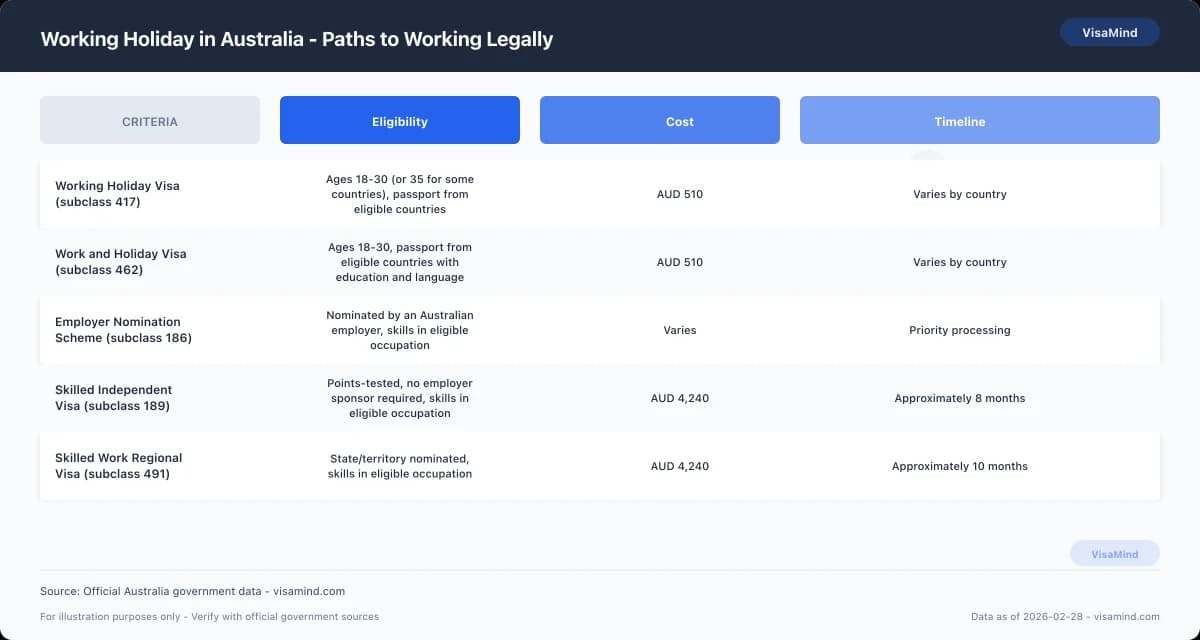
Australia offers a range of work visas for individuals looking to live and work in the country legally. These visas cater to diverse needs, from temporary work experiences to permanent residency opportunities. Below is a comparison of the primary work visa categories available.
| Visa | Eligibility | Cost | Timeline |
|---|---|---|---|
| Working Holiday Visa (subclass 417) | Must be aged 18-30 (or 35 for some countries), hold a passport from an eligible country, and not have previously entered Australia on a subclass 417 or 462 visa | Approximately AUD $510 | Processing time is typically 14 to 35 days |
| Work and Holiday Visa (subclass 462) | Similar to subclass 417, but for passport holders from a different set of countries; must meet additional educational requirements | Approximately AUD $510 | Processing time varies from 40 to 80 days |
| Temporary Skill Shortage (TSS) Visa (subclass 482) | Must be nominated by an approved employer for a skilled position | Starts from AUD $1,290 | Processing time can range from 10 to 50 days |
| Employer Nomination Scheme (ENS) Visa (subclass 186) | Requires nomination by an Australian employer, must meet skills and health requirements | From AUD $4,240 | Typically processed in 4 to 8 months |
| Skilled Independent Visa (subclass 189) | For skilled workers invited to apply, based on points-tested criteria | Approximately AUD $4,240 | Processing can take up to 12 months |
Understanding Eligibility Criteria
For most work visas, you must satisfy specific eligibility requirements, which often include:
- Age limits (for temporary work visas like the Working Holiday visas)
- Possessing the necessary skills or qualifications
- Being nominated by an Australian employer for certain visas
- Meeting health and character requirements
Tip: You can check the Working Holiday Visa (subclass 417) and Work and Holiday Visa (subclass 462) for specific eligibility details and country lists.
Visa Application Process
Applying for a work visa in Australia involves several steps:
- Assess Your Eligibility: Determine which visa category best suits your situation.
- Gather Documentation: Collect all required documents, including skills assessments and health checks.
- Submit Application: Lodge your application through the Immi Account.
- Await Decision: Processing times vary; always check the latest estimates from the Department of Home Affairs.
Important: Ensure all documentation is complete to avoid delays or rejections.
Additional Resources
Explore more about these visas through resources like the Skilled Independent Visa for permanent residency pathways or use the Documents Checklist to prepare your application. Always verify up-to-date information on the official website of the Department of Home Affairs to ensure compliance with current policies and requirements.
What Your Employer Must Provide
#When engaging with the Working Holiday visa program, Australian employers play a pivotal role in facilitating cultural exchange and providing job opportunities to young travelers. Employers must adhere to specific responsibilities to ensure a successful working holiday experience for both parties involved.
- Nominating the Applicant: Employers must nominate the applicant for a position that aligns with their skills, as required by the visa conditions.
- Providing a Safe Working Environment: Employers are accountable for ensuring that the workplace complies with Australian work safety standards.
- Fair Employment Practices: It's essential to provide fair wages and adhere to Australian employment laws to ensure that working holiday makers receive the same treatment as local employees.
Required Documentation from Employers
Employers must furnish certain documents to support the visa application process. These documents help verify the legitimacy of the employment offer and the employer's compliance with Australian regulations.
- Proof of Business Registration: Employers should provide evidence of their legal registration as a business entity in Australia.
- Job Offer Letter: A formal job offer letter detailing the role, responsibilities, and remuneration must be issued to the applicant.
- Compliance Records: Employers may need to provide records demonstrating compliance with workplace laws, including wage and hour standards.
Importance of Nomination
The nomination by an Australian employer is a critical component of the Working Holiday visa process. Here’s why it matters:
- Eligibility Confirmation: The nomination confirms that the job offered is genuine and that the applicant possesses the necessary skills to perform the role.
- Streamlined Application Process: With a valid nomination, the visa application process can proceed more smoothly, reducing potential delays.
- Priority Processing: Certain visa applications, such as those under the Employer Nomination Scheme (ENS) Employer Nomination 186, are prioritized, ensuring faster processing times.
Important: Ensure that all nomination and employment details are accurate and truthful. Misrepresentation can lead to application denial or future ineligibility for visa programs.
Australian Employment Standards
Employers must comply with Australian employment standards, which are designed to protect workers' rights and ensure fair treatment.
- Minimum Wage: Employers must pay at least the national minimum wage or the applicable award rate for the job.
- Workplace Safety: Adherence to occupational health and safety laws is mandatory, providing a safe working environment for all employees.
- Non-Discrimination: Employers must uphold Australian laws prohibiting discrimination based on race, gender, religion, or other personal characteristics.
For more detailed guidance on the Working Holiday visa and employer responsibilities, refer to the Working Holiday Guide and ensure compliance with all relevant regulations.
Step-by-Step Work Visa Application
#-
Create an ImmiAccount
To start your application for a Working Holiday visa, you must first create an ImmiAccount. This online portal is managed by the Department of Home Affairs and will serve as your primary hub for lodging your application, uploading documents, and tracking the status of your visa process.
-
Check Your Eligibility
Before you proceed with the application, ensure you meet the necessary eligibility criteria. You must be between 18 and 30 years old (inclusive) and hold a passport from an eligible country. Additionally, you'll need to fulfill health and character requirements. For a comprehensive list of eligible countries and specific requirements, verify the details on the official Home Affairs website.
-
Gather Required Documents
Compile all necessary documents ahead of time to streamline your application process. Typical documents include a valid passport, proof of sufficient funds, and any evidence of your educational or professional qualifications. You may also need to provide health assessments or police clearance certificates, depending on your circumstances.
-
Complete the Online Application
With your ImmiAccount set up and documents ready, you can begin your application. Carefully fill out all required sections in the online form. Check for accuracy to avoid delays in processing. Be honest and thorough in your responses to ensure compliance with Australian immigration regulations.
-
Pay the Application Fee
The application fee for the Working Holiday visa varies; as of 2026, it is approximately AUD 495. Ensure that you verify the current fee on the Home Affairs website before making the payment. Payment can be made directly through your ImmiAccount using a credit or debit card.
-
Submit Your Application
After completing the form and paying the fee, submit your application through the ImmiAccount portal. Upon submission, you will receive a confirmation email with a reference number. Keep this number safe as it will be essential for tracking your application status.
-
Monitor Your Application
Regularly check your ImmiAccount for updates on your application status. The processing time can vary, so patience is key. If the Department of Home Affairs requires additional information, respond promptly to avoid any delays.
Tip: Monitor the Processing Times for current estimates on how long your visa application might take. This can help you plan your travel arrangements more effectively.
By following these steps, you can efficiently navigate the application process for the Working Holiday visa in Australia. Make sure to regularly consult the official Working Holiday Guide for any updates or changes to the process.
Worker Rights and Restrictions
#If you're on a Working Holiday visa in Australia, you have the flexibility to change employers. This visa allows you to work for multiple employers during your stay, but there are some restrictions. You are permitted to work for the same employer for a maximum of six months. This is designed to encourage cultural exchange and ensure that your primary purpose remains to holiday and travel in Australia.
Tip: If you wish to extend your employment with the same employer beyond the six-month limit, you must seek permission from the Department of Home Affairs.
Can Family Join You?
Unfortunately, the Working Holiday visa does not permit you to bring family members with you as dependents. Each family member wishing to join you will need to apply for their own visa. If they're eligible, they might consider applying for visas like the Visitor visa (subclass 600) or the Student visa (subclass 500), depending on their intentions in Australia.
Can You Study?
Yes, you can undertake short-term study while on a Working Holiday visa. However, you are limited to studying or training for up to four months. This provides an excellent opportunity to enhance your skills or learn something new while enjoying your holiday.
If you're planning on longer-term studies, you might explore options like the Student visa (subclass 500), which allows more extensive educational pursuits.
Rights and Responsibilities
While the Working Holiday visa offers great flexibility, it's important to understand your rights and responsibilities:
- Work Rights: You can work in any sector, and employment is generally short-term and casual in nature.
- Tax Obligations: Like all workers in Australia, you must comply with tax laws, including obtaining a Tax File Number (TFN) and declaring your income.
- Health Insurance: It is recommended to have health insurance coverage for your stay, as you may not be covered by Australia's public health system, Medicare.
Important: Always ensure you comply with the conditions of your visa to avoid future issues, such as visa cancellation or affecting future visa applications.
The Long-Term Path
#Australia's Working Holiday visa provides an excellent opportunity for young travelers to explore the country while engaging in short-term work. However, for those considering a more permanent stay, transitioning from a temporary visa to permanent residency (PR) involves a structured pathway. Here's how you can navigate this journey and what to expect along the way.
Pathway from Working Holiday to Permanent Residency
The journey from a Working Holiday visa to obtaining PR in Australia is not direct, but several visa options can facilitate this transition. Key visas to consider include the Employer Nomination Scheme (subclass 186), Skilled Independent (subclass 189), and Skilled Work Regional (subclass 491). Each of these pathways has specific criteria and timelines.
-
Employer Nomination Scheme Visa (subclass 186): This visa allows skilled workers nominated by their employer to live and work in Australia permanently. You must be nominated by an Australian employer, meet the necessary skill requirements, and pass health and character checks.
-
Skilled Independent Visa (subclass 189): This is a points-tested visa for skilled workers who are not sponsored by an employer or family member or nominated by a state or territory government. Applicants must have skills in an occupation on the eligible skilled occupations list and pass a points test.
-
Skilled Work Regional Visa (subclass 491): This is a provisional visa that allows skilled workers to live and work in regional Australia for five years. It requires state or territory nomination or sponsorship by an eligible family member living in a designated regional area.
Timeline for Permanent Residency
The timeline for transitioning from a temporary visa to PR can vary significantly based on the visa path you choose and your circumstances. Here's a general overview of the process timeline:
| Visa Type | Processing Time (as of 2023) | PR Eligibility Timeline |
|---|---|---|
| Employer Nomination Scheme (186) | 6-12 months | Immediately upon approval |
| Skilled Independent (189) | 8-12 months | Immediately upon approval |
| Skilled Work Regional (491) | 9-13 months | 3 years living and working in regional area |
Important: Processing times are subject to change. For the most current information, verify on the official Department of Home Affairs website.
Requirements and Considerations
Applying for PR in Australia requires careful consideration of eligibility criteria and documentation. Here are some key points to ensure a smooth process:
- Skills Assessment: Ensure you have a positive skills assessment for your nominated occupation if required.
- Health and Character Checks: Passing these checks is mandatory for all applicants.
- Nomination by Employer or State/Territory: Depending on the visa, you may need to secure a nomination from an Australian employer or a state/territory government.
Tip: Utilize the Documents Checklist to ensure you have all necessary documentation ready before lodging your application.
Planning your transition from a Working Holiday visa to permanent residency requires understanding the available pathways and meeting specific criteria. By carefully considering your visa options and preparing the necessary documentation, you can pave the way for a successful application and a permanent life in Australia.
Common Refusal Reasons for Work Visas
#Understanding the common refusal reasons can help you prepare thoroughly and avoid potential pitfalls. Here are typical reasons your application might be refused and how to avoid them:
Incomplete or Incorrect Documentation
-
Lack of Skills Assessment: Failing to provide a complete and valid skills assessment for your nominated occupation can lead to refusal. Ensure you gather all required evidence and verify your skills with the relevant assessment authority.
-
Missing Nomination from Employer: If your visa subclass requires a nomination from an Australian employer, ensure this step is completed before you submit your application. This is crucial for visas like the Employer Nomination Scheme 186.
-
Unverified Qualifications: Ensure that all qualifications and documents are correctly translated and certified. Inaccurate or incomplete documentation can lead to delays or refusal.
Health and Character Requirements
-
Failure to Meet Health Standards: You must meet specific health requirements to qualify for a Working Holiday visa. It's advisable to undergo the necessary medical checks early in your application process to avoid delays.
-
Character Concerns: A background check is required to ensure you meet character requirements. Any discrepancies or omissions in your character documentation can result in a refusal.
Tip: Use the Documents Checklist to ensure you have all necessary documentation ready before lodging your application.
Eligibility Criteria
-
Age and Nationality Restrictions: The Working Holiday visa is typically available to applicants aged 18-30, although some countries allow up to 35. Verify your eligibility based on your nationality and age.
-
Financial Evidence: You may need to demonstrate you have sufficient funds for your stay. While the amount can vary, having a clear financial plan is crucial.
Important: Regularly check the Working Holiday Guide for updates on eligibility criteria and other requirements, as these can change.
By understanding and preparing for these common refusal reasons, you can increase your chances of a successful application. Always ensure that you meet the specific criteria and requirements set by the Department of Home Affairs for your visa subclass.
Getting Your Qualifications Recognized
#When you're planning a working holiday in Australia, getting your qualifications recognized is an essential step if you want to work in specific skilled occupations. This process involves skills assessments, qualification recognition, and meeting degree requirements.
Skills Assessments
- Identify Your Occupation: Check the Skilled Occupation List to see if your job is eligible for a working holiday visa like the Working Holiday Visa (subclass 417) or the Work and Holiday Visa (subclass 462).
- Designated Assessing Authorities: Each occupation has a specific authority responsible for skills assessments. Contact the appropriate authority to understand their process and fees.
- Documentation: Gather proof of your skills and qualifications. This may include certified copies of your degrees, transcripts, and employment references.
Qualification Recognition
- Australian Standards: Ensure your qualifications meet Australian standards. This might require formal evaluation by relevant authorities.
- Comparative Qualifications: If your qualifications come from a country with similar standards, they may be more easily recognized. However, it's crucial to verify with the relevant assessing body.
Tip: Early engagement with the assessing authorities can help you understand any gaps in your qualifications and address them in time.
Degree Requirements
- Relevance to Occupation: Your degree should be directly related to the occupation you wish to pursue in Australia. If additional coursework or certifications are needed, consider enrolling in local programs that might also provide pathways to longer-term visas, such as the Skilled Independent Visa (subclass 189).
- Post-Study Work Options: If you have recently completed your education, look into the Post Vocational Education Work stream, which may require a skills assessment for your nominated occupation.
Employer Nomination
- Employer Sponsorship: For certain occupations, you may need to be nominated by an Australian employer. This is crucial for visas like the Employer Nomination Scheme (subclass 186).
- Health and Character: As part of the nomination, ensure you meet health and character requirements, which is a standard for most Australian visas.
Important: Failing to complete a skills assessment or not obtaining an employer nomination can delay your application or lead to refusal.
For more detailed guidance on applying for a working holiday visa, check the How to Apply and Visa Refusal Reasons guides to ensure all your bases are covered.
The Financial Side of Working Abroad
#Important: Before applying for a Working Holiday visa, ensure you have sufficient funds to support your stay in Australia. This includes meeting specific financial requirements and understanding associated costs.
Financial Requirements for Working Holiday Makers
When planning your working holiday in Australia, it's essential to understand the financial prerequisites. These requirements are designed to ensure you can support yourself during your stay without relying solely on income from temporary employment.
Application Fees and Costs
Applying for a Working Holiday visa in Australia requires paying a visa application fee. This fee is subject to change, so it's crucial to check the current amount on the official Department of Home Affairs website before lodging your application.
| Visa Type | Application Fee (AUD) | Validity Period |
|---|---|---|
| Working Holiday Visa (subclass 417) | $510 as of 2023 | Up to 12 months |
| Work and Holiday Visa (subclass 462) | $510 as of 2023 | Up to 12 months |
Salary Expectations and Minimum Income
While on a Working Holiday visa, you are expected to supplement your travel funds through short-term employment. However, there isn't a specific salary threshold you must earn. Instead, ensure that any job you accept provides a fair wage according to Australian standards. The Fair Work Ombudsman can provide guidance on minimum wages and employment conditions in Australia.
Financial Preparedness
To be eligible for a Working Holiday visa, you must demonstrate that you have sufficient funds to support yourself initially. This requirement typically involves having around AUD 5,000. This amount is intended to cover initial expenses such as accommodation and living costs until you secure employment.
Tip: Keep a detailed budget and track your expenses to manage your funds effectively during your stay.
Additional Considerations
When working in Australia, you may need to open a local bank account and apply for a Tax File Number (TFN), which is necessary for tax purposes. For more detailed information on financial management during your stay, consult our Financial Requirements guide.
Tax Obligations for Workers
#When working in Australia under a Working Holiday visa, it's important to understand your tax obligations. This ensures you remain compliant with Australian law while enjoying your time in the country.
Income Tax Obligations
As a Working Holiday visa holder, you are considered a foreign resident for tax purposes. This means you pay tax only on income earned in Australia. The first $45,000 of your income is taxed at 15%. For income exceeding this threshold, standard foreign resident tax rates apply. It's wise to register for a Tax File Number (TFN) to avoid paying higher tax rates from your earnings.
Superannuation Contributions
While working in Australia, your employer must contribute to your superannuation (super) fund if you earn more than $450 in a calendar month. The current super guarantee rate is 11% as of 2023. You can claim these contributions back when you leave Australia through the Departing Australia Superannuation Payment (DASP). Verify on the official website for the most current rates and processes.
Double Taxation Treaties
Australia has tax treaties with several countries to prevent double taxation. This means you might not be taxed twice on the same income by your home country and Australia. It's advisable to check whether your country of residence has a double taxation agreement with Australia. For detailed information, you can consult the Australian Taxation Office website or seek advice from a tax professional.
Tip: Ensure you keep accurate records of your earnings and any tax withheld. This will help simplify the process when it comes to filing your tax return in Australia.
Filing Your Tax Return
You must file an Australian tax return at the end of the fiscal year, which runs from July 1 to June 30. You can do this online using the Australian Taxation Office’s myTax service, or consult a registered tax agent if you need assistance.
For more information on working in Australia, consider visiting the Work and Visa Extension Guide sections for additional insights.
What Other Workers Experienced
#"When I first considered applying for a Working Holiday visa, my biggest concern was whether my skills would be enough to find a job in Australia. I had some experience in hospitality, but I wasn't sure if it would meet the expectations of Australian employers. To prepare, I researched the Skilled Occupation List to understand which roles were in demand. I also updated my resume to highlight my relevant experience and completed a skills assessment to ensure I met any necessary qualifications. Once I arrived in Australia, I was able to secure a position with an employer who was willing to nominate me, which was a huge relief. This experience taught me the importance of being proactive in understanding the job market and ensuring my skills were aligned with what's needed in Australia."
Meeting Health and Character Requirements
"As I began the application process, I worried about the health and character requirements. I had heard stories of people being denied because of minor health issues or past run-ins with the law, and it made me anxious. To address this, I made sure to gather all the necessary medical records and police certificates well in advance. I scheduled a health examination with a panel physician recommended by the Department of Home Affairs. This not only provided peace of mind but also ensured there wouldn't be any last-minute surprises. Thankfully, my preparation paid off, and I was able to meet all the requirements without any issues."
Finding the Right Employer
"One of my biggest worries was finding an employer who would be willing to nominate me, as I had heard this could be a stumbling block. I knew that without a nomination, my chances of staying in Australia would be slim. I attended networking events and used online platforms to connect with potential employers even before I arrived. Once in Australia, I followed up on these contacts and was persistent in my job search. By being proactive and showcasing my enthusiasm and skills, I eventually secured a job with an employer who was willing to nominate me. This step was crucial in ensuring my ability to enjoy my working holiday and explore all that Australia has to offer."
FAQs
What is the cost of a Working Holiday Visa application in Australia?
How long does the Department of Home Affairs take to process a Working Holiday Visa?
Are there any restrictions on types of work for a Working Holiday in Australia?
Can I apply for permanent residency after a Working Holiday in Australia?
What are the common reasons for Working Holiday visa refusals in Australia?
Is it possible to combine work and study during a Working Holiday in Australia?
What financial requirements are there for a Working Holiday in Australia?
VisaMind provides informational guidance only and is not a government agency. This is not legal advice. Requirements can change and eligibility depends on your specific facts. If your case is complex or high-stakes, consult a licensed immigration attorney.
Next steps
Requirements vary by nationality, purpose, timeline, and case details. Use Find My Visa to get a personalized checklist for Australia with official sources and deadlines.
Find my visa