
Is This Guide for You?
#The Spousal Open Work Permit allows spouses of Canadian residents to work in Canada while their permanent residence application is being processed. This provides a vital opportunity for families to stay together and contribute to the Canadian economy. Applicants for this work permit are primarily the spouses of Canadian residents who are in the process of applying for permanent residence. If you are married to a Canadian resident and have submitted an application for permanent residency, this guide will be relevant for you.
- Spouses of Canadian citizens or permanent residents.
- Applicants currently in Canada with valid immigration status.
- Individuals who can provide proof of their relationship to the Canadian resident. Consider using this guide if you are seeking pathways that allow you to work legally in Canada while waiting for your permanent residence application to be processed. It is particularly useful for those who want to maintain financial independence and gain Canadian work experience.
Tip: This guide is beneficial if you want to understand the requirements and processes outlined by Immigration, Refugees and Citizenship Canada (IRCC). Permits are essential for maintaining family unity while supporting the Canadian economy. These permits are distinct from other work permits because they do not require a job offer from a Canadian employer. For more information, consider reviewing other relevant resources such as Spousal Sponsorship and Open Work Permit to explore related options.
Eligibility and Requirements
#The Spousal Open Work Permit allows spouses of Canadian residents to work in Canada while their permanent residence application is processed. This opportunity provides financial and social stability for families during this important transition period. Understanding the eligibility criteria and requirements is necessary for a successful application. This guide outlines who qualifies and what you'll need to apply for a spousal open work permit in Canada. You are the spouse of a Canadian citizen or permanent resident.
- You have submitted an application for permanent residence in Canada.
- Your Canadian resident spouse has sponsored your application for permanent residence.
Important: Ensure your permanent residence application is active and in process to maintain eligibility for the spousal open work permit. Proof of relationship to the Canadian resident, such as a marriage certificate.
-
Details about your relationship to the Canadian resident.
-
Current immigration status in Canada.
-
Personal information including telephone, email, and possibly financial or work details. Each of these documents plays a critical role in demonstrating your eligibility and supporting your application. Ensure all information is accurate and up-to-date. Valid passport or travel document.
-
Biometrics if required by IRCC.
-
No inadmissibility reasons such as criminality or security concerns.
Tip: Check if you need to provide biometrics for your application, as this can impact processing times. For more information on work permits in Canada, visit the Work Permits Overview or explore specific pathways like the Spousal Sponsorship.
Step-by-Step Process
#Each year, many individuals apply for a Spousal Open Work Permit in Canada to join their partners while waiting for permanent residency approval. This permit allows spouses of Canadian residents to work throughout the country, providing an opportunity to contribute to their household income and integrate into Canadian society. The process involves several steps, including preparing documents and tracking your application status. Understanding each step is key to application smoothly and avoiding common pitfalls. Visit the official IRCC website and create an online account if you haven't already. Log into your account and select the option to apply for a Spousal Open Work Permit. Carefully follow the instructions provided to ensure all sections of the application are completed correctly. Upload the necessary documents and submit your application through the online portal. Before starting your application, gather all necessary documents to demonstrate your eligibility and relationship to the Canadian resident. Proper documentation is critical to the application's success.
- Proof of relationship to the Canadian resident, such as a marriage certificate.
- Identification documents, like passports for both parties.
- Evidence of the Canadian resident's status, such as a citizenship certificate or permanent resident card.
- Any additional documents specified by the IRCC for your unique situation. Ensure that all documents are valid, up-to-date, and translated into English or French if originally in another language. Visit the Work Permits Overview for additional details on document requirements. After submission, applicants can monitor the status of their application through their IRCC online account. This feature helps applicants stay informed about any updates or requests for additional documents. Log into your IRCC account to check for any messages or updates about your application. Respond promptly if the IRCC requests further information to avoid delays. Regularly check the processing times on the IRCC website to manage your expectations. Keep in mind that meeting all the requirements does not automatically guarantee approval. The IRCC evaluates each case based on its merits and completeness of the application. For more information on managing expectations, refer to the Spousal Open Work Permit section.
Fees, Timeline, and What to Expect
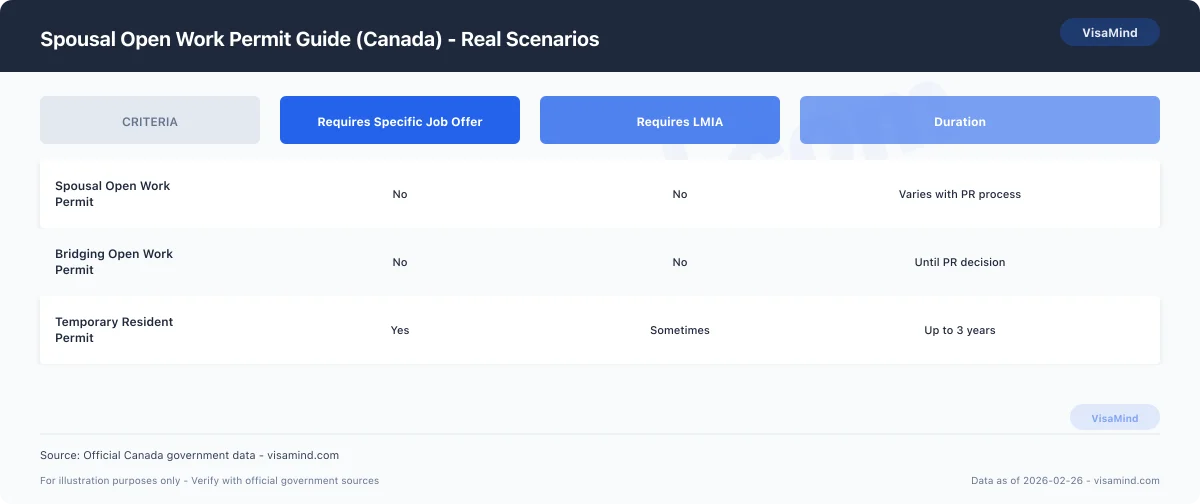
#
While exact fee amounts should be checked on the IRCC website, knowing what to expect can help you plan your application journey. The application fees for a Spousal Open Work Permit generally include the work permit fee and potentially a biometric fee. These fees are subject to change, so always verify the latest amounts on the official IRCC website.
| Fee Type | Description |
|---|---|
| Work Permit Fee | Required for processing the work permit application. |
| Biometric Fee | Applicable if biometrics are needed for your application. |
| Processing times for the Spousal Open Work Permit can vary based on several factors, including the applicant's country of origin and the completeness of the application. Typically, processing times can range from a few weeks to several months. For the most accurate processing time estimates, refer to the IRCC's processing times tool online. This will give you a more specific timeline based on your application details. | |
| After submitting your application for a Spousal Open Work Permit, you will receive a confirmation from IRCC. This indicates that your application is being processed. | |
| Receive acknowledgment from IRCC. | |
| Wait for biometrics request, if applicable. | |
| Await decision on your application. To learn more about related processes, consider exploring the Processing Times Explained and Visa Refusal Reasons guides. |
What Goes Wrong Most Often
#Each year, numerous applicants face challenges when applying for the Spousal Open Work Permit in Canada. Common mistakes can lead to delays or even rejections, affecting your ability to join your spouse in Canada. Errors in documentation are a frequent issue for applicants. Accurate and complete paperwork is key for a successful application.
-
Ensure your proof of relationship is thorough and includes documents like marriage certificates or joint financial accounts.
-
Double-check your personal information for accuracy, including contact details and immigration status.
-
Verify that all documents meet IRCC's requirements by checking the official IRCC website. Submitting incomplete applications is another common pitfall. Missing information can result in processing delays or application rejection.
-
Review your application thoroughly before submission to ensure all sections are completed.
-
Include all necessary supporting documents, such as identity proofs and any required financial information.
-
Use a checklist to confirm that nothing is overlooked. Misunderstandings about eligibility criteria often lead to unnecessary complications. It is essential to understand whether you meet the criteria before applying.
-
Ensure you are eligible to sponsor a spouse and that your spouse qualifies under the current IRCC guidelines.
-
Check that your spouse's permanent residence application is in process to qualify for the Spousal Open Work Permit.
-
Be aware that meeting all listed requirements does not guarantee approval; IRCC evaluates each application individually. For further guidance on eligibility, refer to the Spousal Sponsorship and Open Work Permit sections.
What Experienced Applicants Recommend
#Experienced applicants often share insights to help others avoid common pitfalls and streamline the application process. Effective communication with the IRCC can significantly influence the outcome of your application. Applicants often find that clear and timely interactions help in addressing any issues that might arise.
-
Use the IRCC web form for inquiries or updates about your application status.
-
Be concise and clear in your communication to avoid misunderstandings.
-
If you receive any correspondence from IRCC, respond promptly to keep the process moving. Package is required to avoid delays. Missing documents or incomplete information can lead to setbacks, which are common issues faced by applicants.
-
Gather all necessary documents such as proof of relationship and current immigration status before starting your application.
-
Double-check that each document is complete and meets the IRCC's requirements.
-
Keep copies of all submitted documents for your records in case they are needed later. Using trusted resources for guidance can make the application process smoother. Many applicants benefit from consulting reliable sources to better understand the requirements and procedures.
-
Visit the Spousal Open Work Permit page for detailed information.
-
Refer to the Work Permits Overview for a broader understanding of work permits in Canada.
-
Consult the Family Sponsorship Guide for insights on sponsoring family members to Canada.
Overview
#The Spousal Open Work Permit is an opportunity for spouses of Canadian residents to work in Canada while their permanent residence applications are underway. This permit is part of Canada's commitment to family reunification, allowing families to stay together during the immigration process. Managed by Immigration, Refugees and Citizenship Canada (IRCC), the Spousal Open Work Permit is designed to streamline the process for eligible spouses or common-law partners. This guide provides an overview of how the system functions and its benefits for applicants. Permits in Canada enable spouses of Canadian residents to work while their permanent residence applications are being processed. This initiative is part of the broader family sponsorship program, which prioritizes keeping families together during the immigration journey.
-
Eligibility requires an ongoing permanent residence application.
-
Spouses must demonstrate a genuine relationship with the Canadian resident.
-
The permit facilitates integration into the Canadian workforce. Permit offers several benefits, enhancing both personal and professional aspects of life in Canada. By allowing spouses to work, it reduces financial strain and supports economic stability during the waiting period for permanent residency.
-
Access to employment opportunities across Canada.
-
No specific job offer is required to apply for the permit.
-
Provides a pathway to gain Canadian work experience, which can be beneficial for future immigration processes. The application process for a Spousal Open Work Permit involves several key steps, each designed to ensure that applicants meet the necessary criteria. It is essential to prepare all required documentation and understand the procedures laid out by IRCC. Gather all required documents, including proof of your relationship and personal information. Consult the IRCC website for up-to-date requirements and guidelines. Submit your application, ensuring all sections are accurately completed.
Real-World Examples
#The Spousal Open Work Permit allows spouses of Canadian residents to work in Canada while their permanent residence application is being processed. This opportunity is particularly beneficial for families aiming to establish their lives in Canada and contribute to the economy. application process can be complex, and real-world examples can offer valuable insights. Here are some scenarios demonstrating the application journey and potential challenges involved. Understanding the benefits of working while waiting for her PR application, Priya applied for a spousal open work permit. She diligently gathered all necessary documents, including proof of her relationship and her current immigration status, as per the IRCC guidelines. Priya used the official IRCC portal to ensure she met all requirements and avoided common pitfalls like submitting incomplete applications. Her thorough preparation led to a successful application, allowing her to gain valuable Canadian work experience while her PR application was under review. Carlos, a software engineer, faced eligibility hurdles when applying for a spousal open work permit. Initially, he was unsure about his eligibility since his common-law partner had recently moved to Canada as a permanent resident. Carlos consulted the Family Sponsorship Guide to clarify his status and discover the pathways available for his situation. Through careful examination of the IRCC's eligibility criteria and gathering extensive documentation, he demonstrated the genuineness of his relationship. With persistence and attention to detail, Carlos successfully navigated the application process, securing his work permit and reuniting with his partner in Canada. Emily, a teacher, experienced delays in her spousal open work permit application due to missing documentation. Despite providing proof of her relationship, she realized she had not included sufficient evidence of her partner's Canadian residency status. Upon noticing the delay, Emily quickly accessed the Processing Times Explained guide and contacted IRCC for guidance. She was advised to submit the missing documents through the IRCC web form, which eventually resolved the issue.