Entry Requirements at a Glance
#
To enter Canada for business purposes, there are several pathways depending on your nationality and travel plans. Understanding these options ensures a smoother entry process.
Visa-Free Travel and Electronic Travel Authorization (eTA)
Some travelers to Canada may not require a visa. Instead, they can enter using an Electronic Travel Authorization (eTA). This option is available to visa-exempt foreign nationals traveling to Canada by air. For example, as of November 25, 2025, citizens of Qatar can apply for an eTA rather than a visitor visa. You will need a valid passport, a credit or debit card, and an email address to apply for an eTA.
Tip: Apply for an eTA well in advance of your travel to avoid any last-minute issues.
When Is a Visa Required?
Certain travelers will need to obtain a visa before entering Canada. This includes citizens of countries that are not visa-exempt. For those traveling by methods other than air, such as by car, bus, train, or boat, a visa might be required regardless of the individual's nationality.
Comparison of Entry Options
| Entry Type | Eligibility | Cost | Application Process |
|---|---|---|---|
| Visa-Free | Citizens of visa-exempt countries | Varies by airline | No formal application needed |
| eTA | Visa-exempt travelers by air, including Qatari citizens (from Nov 25, 2025) | Typically $CAN 7 | Online application required |
| Visa | Non-exempt travelers or those entering by land/sea | Starting from $CAN 100 | Application through IRCC |
How to Determine Your Eligibility
To confirm your eligibility for an eTA or if you need a visa, visit the official Visitor Visa ETA Guide. This will provide specific guidance based on your nationality and mode of travel.
Important: Ensure all required documents are prepared, such as a valid passport, and if applicable, ensure biometrics are completed if requested by IRCC.
For more information on related visas, you can explore the Temporary Resident Permit or Express Entry Guide to see if they align with your travel purposes.
Types of Visitor Visas
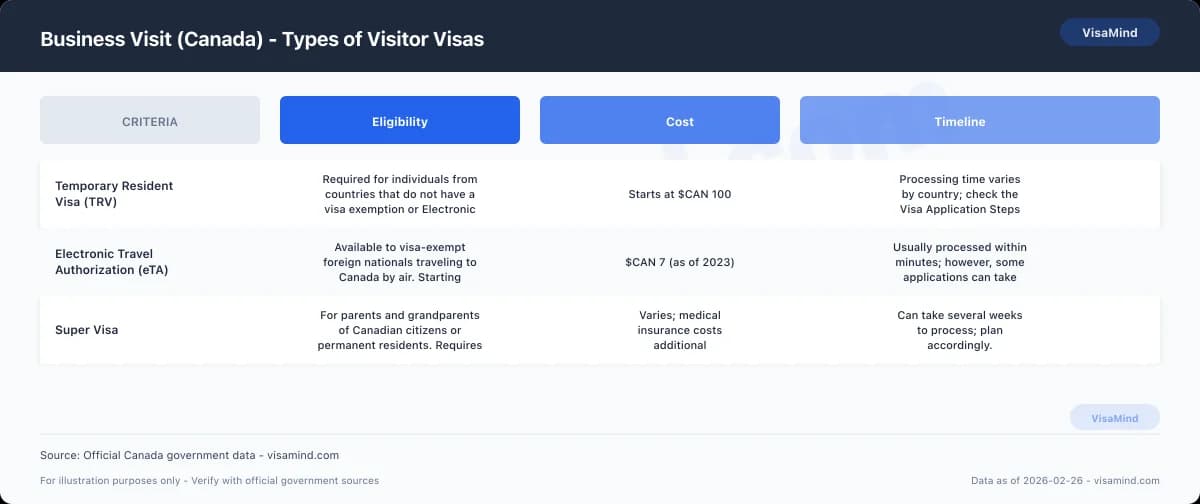
#Canada offers several types of visitor visas, each designed for different purposes and with specific eligibility criteria. These visas fall under the purview of Immigration, Refugees and Citizenship Canada (IRCC). Below is a comparative table outlining the types of visitor visas available, highlighting their key features:
| Visa Type | Eligibility | Cost (CAD) | Processing Time |
|---|---|---|---|
| Visitor Visa (TRV) | For tourists, business visitors, and family visits. Requires proof of financial support and ties to the home country. | Starting from $100 | Varies by country; check IRCC processing times for details. |
| Electronic Travel Authorization (eTA) | Available to visa-exempt travelers (e.g., citizens of Qatar starting November 25, 2025). Requires a valid passport and an email address. | $7 | Typically within minutes; may take a few days if additional documents are needed. |
| Super Visa | For parents and grandparents of Canadian citizens or permanent residents. Requires medical insurance and a letter of invitation. | Starting from $100 | Long-term visa, processing times vary; see Super Visa Guide for more information. |
What is a Visitor Visa (TRV)?
The Temporary Resident Visa (TRV) is intended for individuals who wish to visit Canada temporarily, whether for tourism, business meetings, or visiting family. Applicants must demonstrate sufficient financial resources to support themselves during their stay and prove they have ties to their home country to ensure they will return.
Who Needs an eTA?
The Electronic Travel Authorization (eTA) is a requirement for visa-exempt foreign nationals traveling to Canada by air. Notably, as of November 25, 2025, citizens of Qatar can apply for an eTA instead of a visitor visa. The eTA is linked electronically to your passport and is valid for up to five years or until your passport expires.
Important: Ensure your representative is authorized by IRCC if you choose to use one for your application. An unauthorized representative may lead to complications or delays in your application process.
What is a Super Visa?
The Super Visa is a multi-entry visa valid for up to 10 years, allowing parents and grandparents of Canadian citizens or permanent residents to visit for extended periods. Unlike regular visitor visas, the Super Visa allows for stays of up to two years at a time without the need for renewal. Applicants must have medical insurance from a Canadian insurance company and a letter of invitation from their child or grandchild in Canada.
For more detailed guidance on each visa type, including documents required and application steps, refer to the Visitor Visa eTA Guide and the Visitor Visa Vs Super Visa guide.
Tip: Applying online can expedite the process and provide immediate confirmation of submission, reducing the risk of delays associated with postal applications.
Application Checklist
#Ensuring you have all the necessary documents is crucial for a successful application. Below is a checklist to help you prepare your application for a Business Visit under the Temporary Resident Visa process.
Personal Documents
- Valid Passport: Ensure your passport is valid for the duration of your stay in Canada. It must have at least one blank page other than the last page.
- Photographs: You need two recent photographs that meet the specific IRCC photo requirements. Check the latest photo specifications on the IRCC website.
Financial Proof
- Proof of Funds: Demonstrate that you have sufficient financial resources to support yourself during your stay in Canada. This could include:
- Bank statements for the past four months
- Pay stubs
- Proof of investments
- Letter from your employer stating your salary
- Business Sponsorship Letter: If your company is covering your expenses, include a letter from your employer confirming this.
Purpose of Visit
- Invitation Letter: Obtain a letter from the Canadian company or organization you will be visiting. This letter should detail the purpose of your business trip and include contact information.
- Travel Itinerary: Prepare a detailed itinerary of your travel plans, including flight details, accommodations, and meetings.
Additional Documents
- Biometrics: Depending on your country of origin, you may be required to provide biometrics. Check IRCC’s Biometrics Guide to confirm if this applies to you.
- Representative Authorization: If you're using a representative to assist with your application, ensure they are authorized and include an "Use of a Representative" form.
Tip: Applying for an eTA is an option for eligible travelers from certain countries, such as Qatar starting November 25, 2025. If you qualify, this can be a quicker alternative to a visitor visa. Learn more about the ETA process.
Common Pitfalls
Important: Ensure all documents are complete and accurate. Omitting required documents or providing incorrect information can delay processing or lead to a refusal. For more insights on potential issues, refer to the Visa Refusal Reasons guide.
Once you have gathered all the necessary documents, review your application thoroughly before submitting it to IRCC. Proper preparation will help facilitate a smoother application process and enhance your chances of a successful business visit to Canada.
The Application Process
#Determine Your Eligibility
Before starting the application process, ensure you meet the eligibility criteria for a Business Visit to Canada. This typically includes having a valid reason for your visit, such as attending business meetings, conferences, or training. As of November 25, 2025, citizens of Qatar will have the option to apply for an Electronic Travel Authorization (eTA) instead of a visitor visa if traveling by air. Verify your eligibility based on your nationality and purpose of visit.
Choose the Application Method
You have two main options for applying for a Business Visit to Canada: online through the IRCC website or through a Canadian embassy or consulate. Online applications are generally faster and allow you to track your application status.
-
Online Application: This is the recommended method for efficiency and ease. Ensure you have a valid passport, a credit or debit card for payment, and an email address. You can start your process by visiting the Visitor Visa ETA Guide for detailed instructions.
-
Embassy or Consulate Application: If you prefer or need to apply through a Canadian embassy or consulate, you may need to arrange an appointment. Contact the nearest embassy to confirm their process and requirements.
Gather Required Documents
Prepare all necessary documentation before lodging your application. This includes:
- A valid passport
- Proof of business activities in Canada, such as conference invitations or business meeting schedules
- Financial proof to support your stay in Canada
- Any additional documents requested based on your specific situation
Tip: Having all your documents ready before you start the application will help avoid delays.
Submit Your Application and Pay Fees
After gathering your documents, proceed with submitting your application. The fee for a temporary resident visa is typically $CAN 100, but verify the current fee on the official IRCC website as it may change.
- Online Submission: Follow the prompts to upload your documents and pay the fee using your credit or debit card.
- In-Person Submission: If applying through an embassy, submit your documents and fee directly at the embassy or consulate.
Book and Attend a Biometrics Appointment
If required, you may need to provide biometrics as part of your application. You can schedule an appointment at a Visa Application Center (VAC) or a designated Service Canada location. For details on this process, consult the Biometrics Guide.
Important: Failure to provide biometrics if required can delay your application.
Track Your Application
Once your application is submitted, you can track its progress online through your IRCC account if you applied online. For embassy applications, contact the embassy directly for updates.
Receive Your Decision
After processing, you will receive a decision on your application. If approved, you will receive your visa or eTA, allowing you to travel to Canada for business purposes. In case of denial, review the reasons and consider consulting the Visa Refusal Reasons guide for further insight.
Following these steps carefully can facilitate a smooth application process for your Business Visit to Canada. Always refer to official IRCC resources for the most current information and guidelines.
Common Mistakes Visitors Make
#Important: Overstaying your visa can result in being barred from re-entering Canada for up to one year.
Overstaying Your Authorized Visit
- Misunderstanding Visa Duration: Visitors often confuse the validity of their visa with the duration of their stay. The visa's expiry date is not the same as the allowed duration of stay, which is typically determined by the Canada Border Services Agency (CBSA) upon entry.
- Failure to Extend Stay: If you wish to remain in Canada beyond your authorized period, you must apply for an extension before your current status expires. Learn more about how to Extend Your Stay.
Engaging in Unauthorized Work
- Working on a Tourist Visa: It is crucial to understand that a visitor visa does not permit you to engage in any form of employment in Canada. If you intend to work, you must apply for appropriate authorization, such as a Work Permit.
- Misinterpreting Business Visit Purpose: While attending business meetings or conferences is allowed, participating in activities that directly benefit a Canadian business, such as hands-on work, is not permitted under a business visit.
Financial Preparedness
- Insufficient Funds: Visitors must demonstrate they have adequate financial resources to support themselves during their stay in Canada. This is crucial as financial stability is a key factor in visa approval and entry decisions by CBSA.
- No Proof of Funds: Always carry documentation, such as bank statements or a letter of financial support, to show proof of funds. For more details, refer to the Visitor Visa Financial Proof guide.
Tip: If you're unsure about your eligibility or the requirements for your visit, consider consulting with a licensed immigration consultant to avoid common pitfalls. You can verify their credentials on the official IRCC website.
Arriving and Clearing Customs
#Arriving in Canada as a business visitor involves several steps that ensure compliance with Canadian immigration protocols. Understanding these steps can help you navigate the process smoothly.
Initial Entry and Immigration Process
When you arrive in Canada, you will first encounter the Canada Border Services Agency (CBSA) officials. They are responsible for assessing your admissibility to the country. Here’s what you can expect:
-
Document Verification: Be prepared to present your travel documents, such as a valid passport and any relevant visas or an eTA if you are eligible. Make sure these documents are up to date and easily accessible.
-
Purpose of Visit: Clearly explain that your visit is for business purposes. You might need to provide details of your business activities, such as meetings, conferences, or training sessions.
Biometrics and Identity Verification
Depending on your nationality and the specifics of your visit, you might be required to provide biometrics. This could include fingerprinting and a photograph.
-
Biometrics Requirement: If biometrics are required, you should have already provided these at a Visa Application Centre before traveling. However, the CBSA might still conduct additional checks.
-
E-Gates for Expedited Entry: At some Canadian airports, you may have the option to use e-Gates. These automated border control systems streamline the entry process by quickly verifying your identity against your travel documents.
Interview with a Border Officer
In some cases, a border officer may conduct a brief interview to verify the details of your visit.
- Interview Tips:
- Be honest and concise in your responses.
- Have supporting documents readily available, such as business invitations or itineraries.
- Be prepared to explain how your visit aligns with your business objectives.
Important: If you fail to provide biometrics when required, or if there are discrepancies in your documentation or responses, you could face entry delays or denial.
Additional Considerations
-
Authorized Representatives: If you are using an immigration representative, ensure they are authorized by the IRCC to represent you in dealings with Canadian immigration authorities.
-
Entry and Stay: Your entry is typically linked to the duration of your business activities. If circumstances change, you might need to extend your stay, for which you can explore options like a Temporary Resident Permit.
By understanding these steps and preparing accordingly, you can facilitate a smoother entry into Canada for your business visit. Always check the latest requirements and updates on the official IRCC website before traveling.
Extending Your Stay
#It's important to understand your options and the steps involved. Extensions are possible, but certain criteria must be met.
Can You Extend Your Business Visit?
Yes, you can apply to extend your stay in Canada as a business visitor. It's crucial to submit your application before your current status expires. This maintains your legal status while your extension is being processed by Immigration, Refugees and Citizenship Canada (IRCC).
Important: Applying for an extension before your current status expires allows you to remain in Canada under the same conditions until a decision is made.
How to Apply for an Extension
To extend your stay, you’ll need to apply for a visitor record. This document is not a visa but allows you to stay longer in Canada. Here’s how you can apply:
-
Gather Required Documents: You’ll need your current passport, proof of your initial business visit, and any other documents that support your need to stay longer.
-
Complete the Application: Follow the instructions on the IRCC website to complete your application for a visitor record.
-
Pay the Fees: As of 2023, the fee for extending your stay is $CAN 100. Verify the current fee on the official IRCC website to ensure accuracy.
-
Submit Your Application: It’s recommended to apply online to receive a receipt number immediately, which can help track your application status.
Tips for a Successful Extension Application
- Apply Early: Submit your application at least 30 days before your current status expires.
- Check for Biometrics: Depending on your nationality, you may need to provide biometrics. Visit the Biometrics Guide for more information.
- Use Authorized Representatives: If you choose to use an immigration consultant or lawyer, ensure they are licensed by checking their credentials.
By following these steps and tips, you can effectively manage the process of extending your stay in Canada for business purposes. For more information on maintaining your legal status, visit Extend Stay.
Lessons from Real Applications
#A technology consultant from Brazil planned a business visit to Canada to attend a significant industry conference in Toronto. Despite having prior travel history to Canada, the consultant was concerned about proving sufficient financial means for the trip. The consultant meticulously prepared by gathering bank statements, sponsorship letters from their employer, and proof of previous international business engagements. Using the Temporary Resident Visa (TRV) application portal, the consultant submitted these documents alongside the application. Within four weeks, the consultant received a positive response from IRCC, granting the visa and allowing them to attend the conference as planned.
Scenario: Utilizing an Authorized Representative
An Indian entrepreneur needed to travel to Canada to negotiate a potential business partnership. Aware of the complexities involved, the entrepreneur opted to employ the services of an immigration consultant. To ensure everything was in order, the entrepreneur verified the consultant's credentials through the IRCC's list of authorized representatives. With the consultant's assistance, the entrepreneur lodged a comprehensive application through the Visa Application Steps, highlighting the business purpose and the duration of the stay. The application was approved in five weeks, allowing the entrepreneur to successfully negotiate the deal in Vancouver.
Scenario: Transition to a Long-term Business Initiative
A marketing executive from Japan visited Canada for a series of business meetings with potential clients. During this visit, the executive identified an opportunity to establish a long-term business presence in Canada. Recognizing the need to extend their stay, the executive applied for an extension through the Extend Stay process. They provided additional documentation to demonstrate the potential long-term benefits of their business initiative. The extension was granted, allowing the executive to transition smoothly from a short-term visit to a more permanent business engagement in Canada.
FAQs
Can I extend my stay in Canada on a Business Visit (Canada) visa?
Can I switch from a Business Visit (Canada) visa to a work visa while in Canada?
What common mistakes should I avoid when applying for a Business Visit (Canada)?
How do I apply for a Business Visit (Canada) visa if I need an authorized representative?
What is the processing time for a Business Visit (Canada) visa application?
Can I combine a Business Visit (Canada) with a tourist visit?
What lessons can be learned from real applications for a Business Visit (Canada)?
Sources
Last reviewed: March 1, 2026
VisaMind provides informational guidance only and is not a government agency. This is not legal advice. Requirements can change and eligibility depends on your specific facts. If your case is complex or high-stakes, consult a licensed immigration attorney.
Next steps
Requirements vary by nationality, purpose, timeline, and case details. Use Find My Visa to get a personalized checklist for Canada with official sources and deadlines.
Find my visa