Is This Program for You?
#If you are currently in Canada and the date on your visitor record is approaching, you might be eligible to apply for an extension to stay longer. Important: You must apply for an extension at least 30 days before your current status expires. This ensures you maintain legal status while awaiting a decision from Immigration, Refugees and Citizenship Canada (IRCC).
Who Should Consider Extending Their Stay?
Extending your stay in Canada is particularly relevant for those who entered the country as visitors and wish to remain longer than initially planned. Whether you're visiting family, exploring Canada, or here for business reasons, you may be eligible to apply for an extension if your current conditions allow.
Eligible individuals generally include:
- Tourists or visitors on a Temporary Resident Visa (TRV) who need more time to explore or fulfill commitments.
- Family members of residents who want to extend their visit.
- Business visitors who require additional time to complete their work engagements.
What Do You Need to Apply?
Before you begin your application, ensure you have all necessary documents and information. This includes:
- Personal identification details such as your current visitor record.
- Financial proof to support your stay in Canada.
- Any medical or work-related documents that might be relevant.
Tip: Always check the latest requirements on the official IRCC website to ensure you meet all criteria.
Other Pathways to Consider
If your purpose in Canada has changed, or you wish to explore alternative options, consider applying for a different visa category. For instance:
- A Study Permit if you're planning to enroll in an educational program.
- A Work Permit if you have a job offer from a Canadian employer.
- The Bridging Open Work Permit can be an option if you are transitioning to permanent residency.
Each pathway has its own eligibility criteria and application process, so be sure to review these options carefully if your situation changes.
By understanding your eligibility and preparing thoroughly, you can make an informed decision about extending your stay in Canada. For detailed guidance on application procedures and timelines, refer to the Visa Application Steps.
Eligibility Criteria
#It's important to understand the eligibility criteria set by Immigration, Refugees and Citizenship Canada (IRCC). Here’s what you need to know about qualifying for an extension of your visitor status.
Personal Information Requirements
- Contact Information: You must provide accurate and up-to-date telephone and email details.
- Social Insurance Number (SIN): If applicable, include your SIN as part of your application.
- Financial Details: Evidence of financial stability, such as bank statements or proof of funds, may be required to demonstrate your ability to support yourself during the extended stay. For more information, you can refer to the Proof of Funds guide.
Health and Security
- Medical Examination: Depending on your country of origin or length of the requested extension, a medical exam might be necessary.
- Police Certificates: You may need to provide a police certificate to show you have no criminal record. Check the Medicals And Police Certificates guide for detailed requirements.
Important: Ensure you meet all health and security requirements to avoid delays in processing.
Existing Status and Application Timing
- Current Status: You must have a valid visitor status in Canada when applying for an extension. If you're on a work or study permit, consider options like the Bridging Open Work Permit or the Study Permit Extension.
- Application Timing: It's crucial to apply before your current status expires. IRCC recommends applying at least 30 days before your status ends to avoid any lapse.
Purpose of Extension
- Purpose of Stay: Clearly articulate the reasons for your requested extension. These can include visiting family, attending an event, or continuing studies. Supporting documents, such as invitation letters or enrollment confirmations, can strengthen your application.
- Duration of Stay: Specify the length of time you wish to remain in Canada and justify why the extension is necessary.
Language Proficiency
- Language Requirements: While not always mandatory for visitor extensions, demonstrating English or French proficiency can be beneficial, particularly if your stay involves activities requiring communication skills.
By fulfilling these eligibility criteria, you increase your chances of a successful extension application. Always verify the latest requirements on the official IRCC website and consult relevant guides such as the Visitor Visa Financial Proof for additional insights.
Step-by-Step Application
#Download and Save the Application Form
Begin by accessing the official IRCC website to locate the Extend Stay (Canada) application form. Make sure to download this form using a computer, as attempting to open it on tablets or mobile phones may lead to technical issues. Save the form in a location on your computer that you can easily remember for future access.
Prepare Your Documents
Before you start filling out the form, gather all the necessary documents and information you will need. This includes your personal details such as telephone number, email, Social Insurance Number (SIN), financial information, and any medical or work details that might be relevant to your application. Ensuring you have all the information at hand will streamline your application process.
3.Carefully review the instructions provided for your specific eligibility category to ensure you understand all requirements. Complete all required sections of the form, making sure to provide accurate and up-to-date information.
Pay the Required Fees
Once you've completed the form, you will need to pay the applicable processing fee. The fee may vary depending on the specifics of your request, so it's crucial to verify the most current fee structure on the IRCC website. Payment can typically be made online using a credit card, ensuring you follow any additional instructions provided by IRCC.
Tip: Filing online not only saves time but also provides you with a receipt number immediately, which can be useful for tracking your application status.
Submit Your Application
After completing the form and paying the fee, submit your application to IRCC. Depending on the instructions specific to your application, submission can be done online or by mail. Ensure that you include any required evidence and supporting documents, as missing information can delay processing or even result in the denial of your request.
Await Confirmation and Processing
Once your application is submitted, IRCC will review it for completeness and accuracy. Processing times can vary, so it's beneficial to check the Processing Times Explained guide for the most current estimates. During this period, keep an eye on any correspondence from IRCC for additional requests or updates regarding your application status.
Important: Always ensure that you lodge your application well before your current status expires to avoid any complications with your stay in Canada.
By following these steps and using the resources provided, you can effectively navigate the process of extending your stay in Canada. If you need additional guidance on related topics, consider exploring resources like the Visitor Visa Vs Super Visa comparison or the Study Permit Guide for more comprehensive information.
Supporting Documents Checklist
#When you want to extend your stay in Canada, it's crucial to have all the necessary documents and evidence ready for your application. This ensures that your request is processed smoothly by Immigration, Refugees and Citizenship Canada (IRCC). Below is a comprehensive checklist of supporting documents you may need to prepare.
Personal Identification Documents
- Passport: A clear copy of your passport, including the page with your personal details and any pages with stamps or visas.
- Current Status Document: If applicable, include a copy of your current Canadian visa or permit.
Important: Ensure your passport is valid for the duration of the extended stay you are requesting.
Financial Evidence
- Proof of Funds: Recent bank statements, pay stubs, or a letter from your financial institution showing you can support yourself during your extended stay. For more on financial proof, see Visitor Visa Financial Proof.
- Employment Details: If you're working in Canada, submit a letter from your employer confirming your employment status, salary, and duration of employment.
Health and Medical Documents
- Medical Examination Report: If required, provide documentation of a recent medical examination by a panel physician recognized by IRCC. For more details, refer to Medicals and Police Certificates.
Other Supporting Evidence
- Invitation Letter: If visiting family or friends, include an invitation letter from your host in Canada.
- Travel Itinerary: A detailed plan of your activities and accommodation for your extended stay.
- Purpose of Visit Documentation: If applicable, include documents that explain the purpose of your extended stay, such as conference invitations or enrollment in short-term courses.
Translation and Certification
- Translations: Any documents not in English or French must be accompanied by a certified translation.
- Notarized Copies: For certain documents, you may need notarized copies. Check the IRCC guidelines for specifics.
Tip: It's advisable to submit your application online through the IRCC portal to receive immediate confirmation and a receipt number, which can be helpful for tracking your application status.
When preparing your application, remember that each case is unique, and additional documents may be requested by IRCC based on your specific situation. Always consult the latest guidelines on the official IRCC website to ensure you have the most up-to-date information.
Timeline and Processing
#When you apply to extend your stay in Canada, the processing time can vary based on several factors. As of 2023, the average processing time for a visitor record extension is typically around 90 days. However, it's important to verify the most current processing times on the IRCC website as they are subject to change.
Factors Affecting Processing Speed
Several elements can influence how quickly your application is processed:
- Completeness of Application: Ensuring that all sections are filled out correctly and all required documents are included can prevent delays.
- Volume of Applications: Processing times might be longer during peak periods or if there is an unexpected increase in applications.
- Application Method: Applying online can be faster than paper applications due to immediate submission and receipt.
Important: Attempting to open the application form on mobile devices can lead to errors. Use a computer and Adobe Acrobat Reader to avoid issues.
Can You Expedite Your Application?
Currently, there are no formal expedited processing options specifically for extending a stay in Canada. However, if you are experiencing an urgent situation, you may contact IRCC through their Client Support Centre to discuss your circumstances. Keep in mind that such requests are assessed on a case-by-case basis and are not guaranteed.
Tips to Ensure Timely Processing
To help ensure your application is processed as quickly as possible, consider the following tips:
- File Online: Online submissions are generally faster and provide immediate confirmation of receipt.
- Accuracy is Key: Double-check your application for accuracy and ensure all documents are included.
- Monitor Your Email: IRCC may request additional information or clarification, so respond promptly to any communication.
For more information on timelines and how they apply to different visas, you can refer to the Processing Times Explained guide. Additionally, if you are considering transitioning from a study permit to permanent residence, the Study to PR situation guide may provide valuable insights.
Where Applicants Go Wrong
#- Lack of Required Evidence: One of the most common mistakes applicants make is not providing sufficient evidence to support their application for extending their stay in Canada. Ensure you submit all necessary documents, such as proof of financial support, a valid passport, and any required medical examinations.
- Incomplete Personal Information: Be diligent in providing complete personal information, including your telephone number, email address, and Social Insurance Number (SIN) if applicable. Missing details can cause delays or refusals.
Technical Errors and Missteps
- Wrong Software Usage: Applicants often try to open and complete the application using tablets or mobile phones, which can lead to technical issues. Always use a computer with Adobe Acrobat Reader version 10 or higher to avoid these problems.
- Saving Errors: It’s important to save your application form on your computer in a location you can easily remember. This will help prevent issues when you need to access the form later for revisions or submission.
Misunderstanding Eligibility and Timelines
- Incorrect Eligibility Category: Before starting your application, review the instructions for your specific eligibility category. This helps ensure you meet the criteria necessary for an extension (Visitor Record Vs Visa).
- Timing Mistakes: Apply for an extension at least 30 days before your current status expires. Failing to do so might lead to overstaying your visa, which can affect future applications.
Tip: File online through the Visa Application Steps to receive a confirmation receipt immediately, which can be helpful if any discrepancies arise.
Financial Misunderstandings
- Inadequate Financial Proof: Ensure you have adequate proof of funds to support your stay in Canada. This might include bank statements or pay stubs. You can refer to the Visitor Visa Financial Proof guide for more details.
- Failure to Update Financial Information: If your financial situation changes after you submit your application, inform IRCC promptly to avoid any misunderstandings or suspicion of misrepresentation.
By being aware of these common pitfalls and taking steps to avoid them, you can increase your chances of successfully extending your stay in Canada. Always verify the latest requirements and guidelines on the official IRCC website to ensure your application meets current standards.
How It Compares to Alternatives
#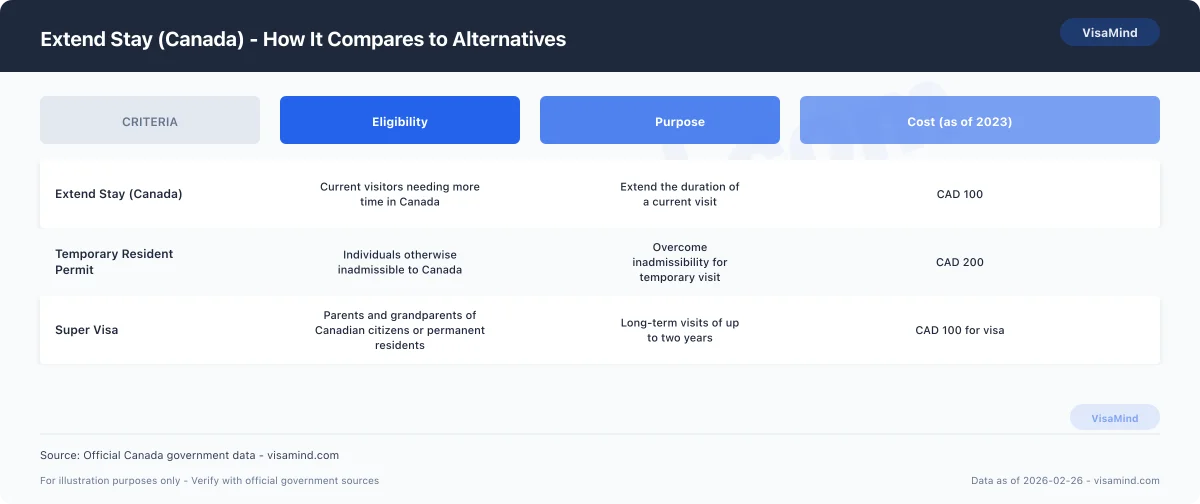
It's important to understand how this process stands in relation to other similar visas or programs. Here's a side-by-side comparison to help you identify the key differences.
| Program/Permit | Purpose | Eligibility | Cost (CAD) | Processing Time (as of 2023) |
|---|---|---|---|---|
| Extend Stay (Canada) | Extend temporary visitor status | Current visa holders needing more time | Varies, verify on the official website | Typically 120 days |
| Temporary Resident Visa (TRV) | Enter Canada temporarily as a visitor | Visitors from visa-required countries | $100 | 12 to 14 days |
| Super Visa | Long-term visit for parents and grandparents | Parents and grandparents of Canadian citizens or PRs | $100 | 8 weeks |
| ETA (Electronic Travel Authorization) | Travel to Canada by air for short stays | Visa-exempt travelers | $7 | Minutes to a few hours |
| Temporary Resident Permit | Temporary entry for inadmissible persons | Individuals otherwise inadmissible to Canada | $200 | Varies, verify on the official website |
Key Differences
Eligibility
The Extend Stay (Canada) option is specifically for individuals who are already in Canada and wish to prolong their stay beyond the original end date of their current visitor status. This contrasts with the Temporary Resident Visa (TRV), which is for those outside Canada looking to enter, and the Super Visa, which is designed for parents and grandparents of Canadian citizens or permanent residents.
Cost and Processing Time
The costs and processing times for extending a stay can vary based on individual circumstances and should be verified on the official IRCC website. Typically, the process can take up to 120 days. In comparison, an ETA (Electronic Travel Authorization) is much quicker and cheaper, but it only applies to visa-exempt travelers entering Canada by air for short stays. The Super Visa offers a longer stay but requires more specific eligibility.
Tip: If your current status is about to expire, apply for an extension at least 30 days before the expiration date to avoid status issues.
Purpose
The purpose of extending your stay is to gain more time in Canada on your current visitor status without having to leave the country. This is distinct from the Temporary Resident Permit, which allows entry into Canada for individuals who are otherwise inadmissible, addressing a specific issue of inadmissibility rather than merely extending time within the country.
For more details on applying for different types of visas in Canada, consider reviewing the Visa Application Steps or the Visitor Visa ETA Guide.
Fees and Financial Requirements
#When seeking to extend your stay in Canada, it's important to understand the fees and financial requirements associated with the process. The Immigration, Refugees and Citizenship Canada (IRCC) handles applications for extensions, ensuring that all necessary criteria are met.
Fee Structure
The fees for extending your stay in Canada can vary based on your specific situation. Here's a comparison of common scenarios:
| Application Type | Cost (CAD) | Notes |
|---|---|---|
| Visitor Record | $100 | For those who wish to extend their visitor status. |
| Study Permit Extension | $150 | To continue studying in Canada beyond the original permit validity. |
| Work Permit Extension | $155 | Applicable for individuals extending their work authorization. |
Important: Fees are subject to change. Always verify the latest fee on the IRCC official website.
Financial Proof Requirements
Applicants must demonstrate they have sufficient funds to support themselves during their extended stay. This is particularly crucial for those on a Study Permit or a Work Permit. Financial proof can include:
- Bank statements showing consistent income and savings.
- Employment letters verifying ongoing work and income.
- Scholarship letters for students receiving financial aid.
For more details on demonstrating financial capability, you can refer to the Visitor Visa Financial Proof guide.
Investment and Salary Thresholds
While extending a stay as a visitor generally does not require meeting specific salary or investment thresholds, work-related extensions might. For example, those seeking to extend a Work Permit may need to meet certain employment conditions or salary levels, depending on their specific permit category.
Tips for a Successful Application
- Prepare Thoroughly: Make sure you gather all necessary documentation well in advance of your current status expiration.
- Online Applications: Consider applying online to avoid mail delays and to receive a confirmation receipt immediately.
For further guidance on extending your study or work permits, explore the Study Permit Extension and Work Permit Extension resources.
What You Can and Cannot Do
#When you apply to extend your stay in Canada, it is important to understand what activities you can and cannot engage in during your extended stay. This can depend on your visa type and the specifics of your situation.
Work Rights
Extending your stay does not automatically grant you the right to work in Canada. If you wish to work, you may need a separate work permit. Specific permits, like the Open Work Permit or Bridging Open Work Permit, can allow employment while waiting for longer-term decisions. Always check your current status and whether it gives you the right to work before starting any employment.
Important: Working without proper authorization can jeopardize your current and future status in Canada.
Travel Restrictions
While your application to extend your stay is being processed, your ability to travel outside and return to Canada can be limited. Leaving Canada before a decision is made could result in being denied re-entry, unless you have a multiple-entry visa or other authorization. Ensure your travel plans align with your visa conditions and the processes set by IRCC.
Family Members
Family members accompanying you may also need to extend their stay. Each individual must apply separately for their extension. Depending on their intended activities, such as work or study, they might require additional permits like a Study Permit or a Work Permit. Make sure to assess each family member's needs individually.
Restrictions and Limitations
- Study: If you wish to study, you may need to apply for a Study Permit.
- Healthcare: Access to healthcare services may be limited depending on your province of stay and the type of visa you hold.
- Permanent Residence Applications: While extending your stay, you might consider pathways to permanent residence. Learn more in our Permanent Residence Guide.
Tip: Always keep a copy of your submission receipt and any communication from IRCC, as these can be crucial if any issues arise.
Understanding these aspects will help you make informed decisions about your stay in Canada and ensure compliance with Canadian immigration laws.
Real-World Examples
#An IT consultant visiting Canada on a Temporary Resident Visa (TRV) for a family reunion found himself needing to stay longer to support his sister, who was undergoing medical treatment. To extend his stay, he needed to apply through Immigration, Refugees and Citizenship Canada (IRCC). He downloaded the necessary form from the IRCC website using a computer, carefully saving the form in a memorable location. After completing the personal information sections, he provided the required documentation, including medical reports and financial statements demonstrating his ability to support himself during the extended stay. By submitting his application well before his visa's expiry, he was able to continue supporting his sister without leaving Canada. The process took approximately four weeks, and he received a confirmation of the extension.
Scenario: Extending Stay for Study Transition
A graduate student nearing the end of her Study Permit realized she needed more time in Canada to transition to a Post-Graduation Work Permit (PGWP). She decided to extend her stay to bridge the gap between completing her studies and receiving her PGWP. She applied for an extension through IRCC, ensuring that she used the Visitor Record option. She gathered the necessary documents, including proof of graduation and financial support. After submitting her application, she received confirmation within five weeks, allowing her to remain in Canada legally while she awaited her PGWP. This ensured she could smoothly transition from student to professional without interruptions.
Tip: Remember to apply for an extension at least 30 days before your current status expires to avoid any gaps in your legal stay in Canada.
FAQs
What processing time should I expect when applying for Extend Stay (Canada)?
How much is the application fee for Extend Stay (Canada) through IRCC?
Can I apply for permanent residency while on Extend Stay (Canada)?
What are common mistakes when submitting an Extend Stay (Canada) application?
What happens if my Extend Stay (Canada) application is denied?
Is medical information required for an Extend Stay (Canada) application?
Can I combine Extend Stay (Canada) with a study permit application?
Sources
Last reviewed: March 1, 2026
VisaMind provides informational guidance only and is not a government agency. This is not legal advice. Requirements can change and eligibility depends on your specific facts. If your case is complex or high-stakes, consult a licensed immigration attorney.
Next steps
Requirements vary by nationality, purpose, timeline, and case details. Use Find My Visa to get a personalized checklist for Canada with official sources and deadlines.
Find my visa