
Is Extension Possible?
#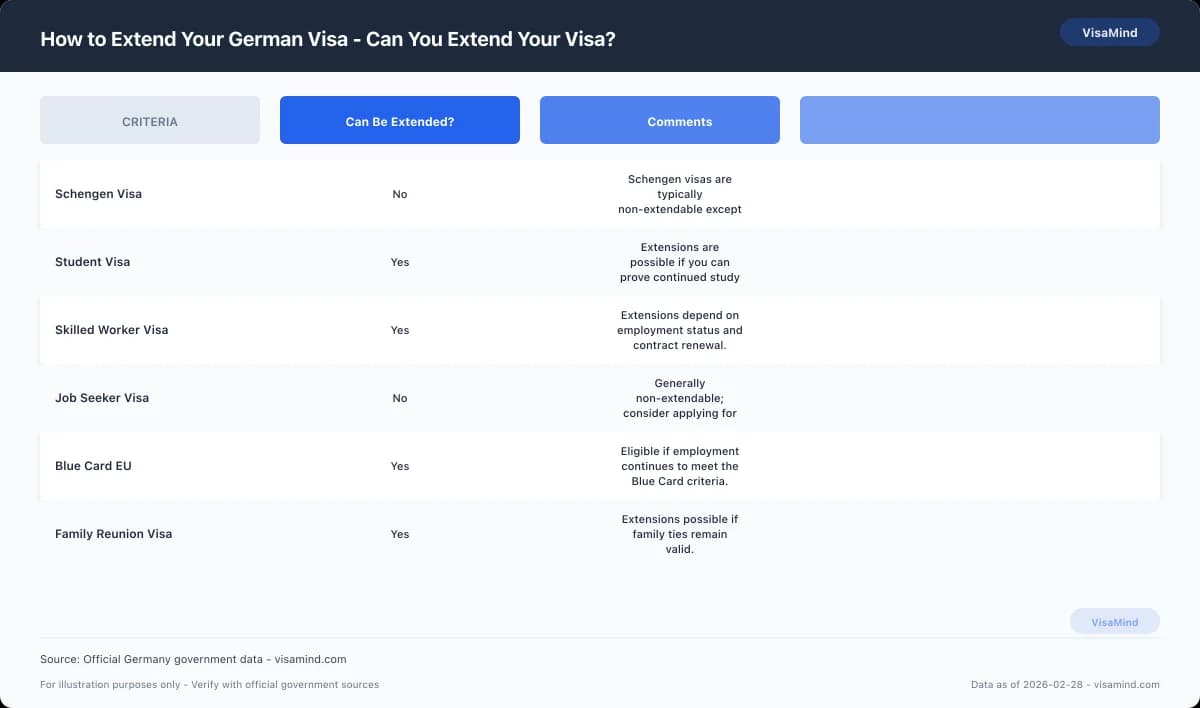
In Germany, many residence permits can be extended through the local Ausländerbehörde, provided you meet the specific criteria and timelines. Understanding whether your visa type is extendable is key as many have specific rules and conditions. The extension process allows you to stay in Germany beyond your initial visa duration, but not all visas are eligible. Knowing which visas can be extended and which cannot helps you plan accordingly.
Visa Types Eligible for Extension
Germany offers the possibility to extend several types of visas, provided that the conditions of your stay remain the same. These extensions are typically managed by the local Ausländerbehörde.
| Visa Type | Eligibility for Extension |
|---|---|
| EU Blue Card | Yes |
| Skilled Worker Visa | Yes |
| Family Reunion Visa | Yes |
| Student Visa | Yes |
Tip: For more details on specific visa requirements, check the Skilled Worker Visa and Student Visa pages.
Non-Extendable Visas in Germany
Some visas in Germany are strictly non-extendable, and individuals holding these visas must leave the country upon expiry.
| Visa Type | Eligibility for Extension |
|---|---|
| Schengen Visa | No |
| Job Seeker Visa | No |
| Working Holiday Visa | No |
Warning: Holders of non-extendable visas should plan their departure promptly to avoid overstay penalties.
Special Cases and Exceptions
In certain situations, exceptions may apply to non-extendable visas. For instance, if there are unforeseen circumstances like illness or family emergencies, you might be able to apply for a short-term extension. - Medical emergencies
- Family emergencies
- Unforeseen events
Important: Always consult the Ausländerbehörde if you believe your situation qualifies for an exception.
Extension Costs and Timeline
#The cost of extending a German visa varies based on the type of visa and your individual circumstances. For most visa categories, the extension fee is generally around €100. You should always verify the latest fee structure on the Federal Office for Migration and Refugees (BAMF) website to ensure you have the most current information.
Standard Extension Fees in Germany
| Visa Type | Standard Extension Fee (EUR) |
|---|---|
| Student Visa | €100 |
| Skilled Worker Visa | €100 |
| Family Reunion Visa | €100 |
Tip: Check with your local Ausländerbehörde for any additional fees that might apply to your specific situation.
Typical Processing Times for Extensions
The processing times for visa extensions in Germany can vary. Typically, you can expect to wait between 4 to 8 weeks after submitting your application. However, this can be longer during peak periods or if additional documentation is required.
Important: Start your extension process early to avoid overstaying your current visa. You can begin the process three months before your current visa expires.
Options for Expedited Processing
Germany generally does not provide a formal expedited processing service for visa extensions. However, you can contact your local Ausländerbehörde to inquire if faster processing is available for urgent cases.
Tip: In urgent situations, provide documentation that explains the necessity for expedited processing when contacting the authorities. - Contact Ausländerbehörde for urgent requests
- Provide supporting documents for urgency
- Follow-up regularly to check the status
Extension Eligibility by Visa Type
#In Germany, extending your visa requires understanding specific eligibility criteria based on the type of visa you hold. Each category has its own set of requirements, managed by the Federal Office for Migration and Refugees (BAMF).
Tourist Visa Extension Criteria
The possibility of extending a tourist visa in Germany is generally limited. Extensions are typically only granted in exceptional cases, such as a medical emergency or unforeseen travel disruptions. - Proof of exceptional circumstances (e.g., medical certificate)
- Sufficient financial resources for the extended stay
- Travel insurance covering the extended period
Important: The maximum duration for a tourist visa, including any extension, is 90 days within a 180-day period. Check with the local Ausländerbehörde for specific requirements.
Student Visa Extension Requirements
For students, extending your stay is often necessary to complete your studies. Extensions depend on maintaining enrollment and making satisfactory academic progress. - Proof of current enrollment at a recognized institution
- Academic records showing progress
- Proof of financial means for the extended period
| Requirement | Details |
|---|---|
| Enrollment | Confirmation from your university |
| Academic Progress | Transcripts or progress report |
| Financial Means | Bank statements or scholarship confirmation |
Tip: Consider applying for a Settlement Permit if you plan to stay long-term after your studies.
Work Visa Extension Guidelines
Extending a work visa in Germany depends on your employment status and contract length. You must demonstrate continued employment with a valid contract. - Valid employment contract
- Confirmation from employer
- Proof of financial stability For skilled workers, consider transitioning to a Blue Card EU, which offers more benefits and a pathway to permanent residency.
Family Visa Extension Conditions
Family reunification visas can be extended if you continue to meet the initial visa requirements. This often involves proving the continued relationship and financial support. - Proof of relationship (e.g., marriage certificate)
- Financial support
- Health insurance coverage
Important: Ensure all documents are current and translated if necessary. The Family Reunion Visa page provides more detailed information.
Documents Needed
#In Germany, extending your visa requires careful preparation and submission of specific documents to the local Ausländerbehörde. Ensuring you have the correct documents is a critical step in the application process.
Essential Documents for Visa Extension
To apply for a visa extension in Germany, certain documents are universally required regardless of your current visa type. These documents help establish your identity, purpose of stay, and compliance with German regulations. - A valid passport with at least two blank pages. - Your current residence permit or visa. - Recent biometric passport photos. - Proof of residence registration (Meldebescheinigung). - Evidence of your continued purpose of stay (e.g., employment contract, enrollment certificate).
Tip: Ensure your passport is valid for the entire period you are applying for an extension, as this is a common requirement across various visa types.
Proof of Financial Means
The German authorities require proof that you can financially support yourself during your extended stay. This is to ensure you will not become a financial burden on the state. - Recent bank statements showing sufficient funds. - Proof of income, such as salary slips or employment contract. - Scholarship or financial support documents if applicable.
Important: Different visa types, such as the Skilled Worker Visa or Student Visa, may have varying financial requirements. Verify the specific amount needed for your visa type on the BAMF website.
Health Insurance Verification
Having valid health insurance is mandatory for all visa extensions in Germany. You must provide proof of enrollment in a recognized health insurance plan. - Certificate of health insurance coverage from a German provider. - For private insurance: Proof of comparable coverage and payment of premiums.
Tip: Public health insurance is often preferred for ease of proof, but ensure your private insurance meets the criteria set by the German authorities.
How to Apply for an Extension
#In Germany, extending your visa involves coordinating with the local foreigners' office, known as the Ausländerbehörde. It's important to start the process early, as processing times can vary significantly depending on the type of visa and your location. The Federal Office for Migration and Refugees (BAMF) oversees the broader immigration system, but the actual extension of a residence permit is managed locally. Before proceeding, ensure you have all necessary documents ready to avoid delays.
Submitting Application Online vs In-Person
In Germany, how you submit your visa extension application largely depends on the local Ausländerbehörde. Some offices offer online submissions, while others require in-person visits. It's necessary to check the specific requirements of your local office.
-
Visit the website of your local Ausländerbehörde to determine if online applications are accepted.
-
If online submissions are available, follow the provided instructions to complete your application.
-
For in-person applications, prepare to visit the office with the necessary documents.
Tip: Always confirm the application method and any specific requirements with your local Ausländerbehörde, as processes can vary.
Completed
Forms and Where to Submit Completing the correct forms is essential for your visa extension application. The forms needed can vary based on your visa type. Ensure you have the updated forms by checking the official BAMF website or the local Ausländerbehörde. - Residence permit application form
- Proof of financial means
- Health insurance coverage
- Proof of accommodation Submit your completed forms either online or in-person based on your local office's requirements. Make sure to keep copies for your records.
Important: Incorrect or incomplete forms can lead to delays or rejections. Verify all information before submission.
Scheduling an Appointment at Ausländerbehörde
Scheduling an appointment with the Ausländerbehörde is often necessary for in-person submissions or consultations. Delays in appointment availability can affect your application timeline, so plan ahead.
-
Visit the Ausländerbehörde website to access the appointment scheduling system.
-
Select an available date and time for your appointment.
-
Ensure all required documents are ready for your appointment to avoid rescheduling.
Warning: Appointment slots can fill up quickly, especially in larger cities. Book your appointment as soon as possible to secure a suitable date.
Consequences of Overstaying
#Overstaying your visa in Germany can result in significant consequences. Fines, legal penalties, and the potential for future entry bans are serious considerations for anyone finding themselves in this situation. Understanding the potential impact on future visa applications is key. This section explores the consequences of overstaying your visa in Germany, including fines, legal penalties, and how it might affect your future interactions with the immigration system.
Fines and Legal Penalties
Overstaying your visa in Germany can result in fines that vary based on the duration of the overstay. The longer you stay beyond your visa's validity, the higher the potential fines. - Fines typically range from €300 to €3,000.
- Additional legal actions may be taken if the overstay is prolonged or deliberate. - In extreme cases, you could face deportation.
Warning: The Ausländerbehörde (local foreigners' authority) is responsible for enforcing these penalties. Ensure you adhere to your visa terms to avoid complications.
Impact on Future Visa Applications
A history of overstaying can significantly impact your ability to obtain future visas for Germany. Immigration authorities will likely consider any prior violations when assessing new applications. - Your application for future visas, such as the Blue Card EU or Skilled Worker Visa may be scrutinized more closely. - You may be required to provide additional documentation or explanations for past overstays. - There is a risk of application denial based on past immigration violations.
Important: Ensure all future applications are complete and truthful to mitigate potential negative impacts.
Possible Entry Bans and Restrictions
Overstaying your visa can lead to entry bans, preventing you from returning to Germany for a specified period. The length of the ban often correlates with the severity of the overstay.
| Overstay Duration | Typical Consequence |
|---|---|
| Less than 90 days | Warning or short-term entry restriction |
| 90 to 180 days | Possible entry ban of 1 to 3 years |
| More than 180 days | Entry ban of 5 years or more |
Tip: If you face an entry ban, consider consulting with a legal expert specializing in German immigration law for advice on potential appeals or resolutions.
Other Options If You Can't Extend
#If extending your visa in Germany is not possible, there are several other options to consider. Each alternative has its own process and requirements, managed by relevant German authorities such as the Federal Office for Migration and Refugees (BAMF) and local Ausländerbehörde offices.
Changing Visa Status in Germany
If extending your current visa is not feasible, one option is to change your visa status while remaining in Germany. This process is typically handled by the local Ausländerbehörde and involves applying for a different type of residence permit. - Determine the new visa type you qualify for, such as a Family Reunion Visa or Skilled Worker Visa. - Gather necessary documents, including proof of eligibility for the new visa type. - Schedule an appointment with the Ausländerbehörde to discuss your status change application.
Tip: Always check for the latest requirements on the BAMF website as they can vary by location and visa type.
Re-entering Germany with New Visa
If you're unable to change your status within Germany, consider leaving the country and applying for a new visa from your home country. This can often be a quicker way to secure a new visa.
-
Leave Germany before your current visa expires to avoid overstaying.
-
Submit a new visa application at the German consulate or embassy in your home country.
-
Return to Germany with the new visa once it is granted.
Warning: Ensure you have all required documents and meet the criteria for the new visa to avoid application delays or rejections.
Switching to Different Visa Type
Switching to a different visa type can be a viable option if your circumstances have changed. For example, you might qualify for a Blue Card EU if you have secured a job offer that meets the salary threshold.
| Visa Type | Eligibility | Key Requirements |
|---|---|---|
| Blue Card EU | Highly skilled professionals | Job offer, salary threshold |
| Settlement Permit | Long-term residents | Integration, financial stability |
| Student Visa | Prospective students | University acceptance letter |
Important: Switching visa types often requires a new application and fees, so budget accordingly and verify the latest costs on the BAMF website.