When to Read This
#The Foreigners Regional Registration Office (FRRO) is pivotal in processing visas for foreign nationals working in India. Both the Employment Visa and Project Visa are managed by the Bureau of Immigration, catering to different professional needs.
Ideal for Foreign Professionals
The Employment Visa is designed for foreign professionals taking up employment in India. It is suitable for those employed by an Indian entity, offering an avenue to legally work in India for extended periods. This visa typically requires proof of employment and offers the flexibility needed for various job roles.
Tip: Ensure your employment contract aligns with Indian immigration regulations to avoid application hurdles.
Guidance for HR
Managers overseeing foreign employees should understand the nuances between these visas. The Project Visa is project-specific and time-bound, often used for foreign nationals working on large-scale projects in India. Unlike the Employment Visa, it is not linked to long-term employment with an Indian company.
Important: Select the visa type that aligns with the project duration and requirements to ensure compliance with Indian immigration laws.
Visa Choices for Indian Projects
For foreign nationals involved in specific projects in India, the Project Visa is ideal. This visa is tailored for those participating in Indian projects, particularly in sectors like power and steel. It allows the holder to stay in India for the duration of the project, which is typically shorter than the Employment Visa. - Project-specific documentation required. - Duration linked to project timeline. - Mandatory registration with the FRRO upon arrival.
When to Pick the First Option
#In 2026, India issued over 58,000 employment visas, highlighting the demand for skilled professionals in the country. The Employment Visa is a necessary option for those looking to work in India for extended periods, providing opportunities for long-term employment and stability.
Scenarios Favoring Employment Visa
An employment visa is ideal for professionals seeking stable, long-term opportunities in India. It is particularly suited to individuals who have secured a permanent job offer from a recognized organization.
| Scenario | Description | Outcome |
|---|---|---|
| IT Specialist in Bangalore | A software engineer receives an offer from a top IT firm. | Secures an employment visa to work on projects and contribute to the team long-term. |
| University Lecturer in Delhi | An academic is offered a full-time teaching position at a university. | Obtains an employment visa to teach and conduct research. |
| Healthcare Professional in Mumbai | A doctor is invited to join a hospital staff permanently. | Acquires an employment visa to practice medicine and serve the community. |
Important: Ensure the employer in India is a recognized entity by the relevant Indian authorities for a successful employment visa application.
Employment Visa for Long-term Stays
For professionals planning to stay in India for over a year, the employment visa offers the stability and legal footing necessary to build a career. This visa type allows multiple entries, making it convenient for those who need to travel internationally for work. - Allows for multiple entries into India during the visa period. - Facilitates long-term residency and work without frequent renewals. - Provides a pathway to extend the visa as needed, subject to Indian regulations.
Tip: Visit the Employment Visa page for detailed information on eligibility and application procedures.
Optimal for Permanent Job Roles
The employment visa is the preferred choice for individuals with permanent job roles in India. It is tailored for those who have secured a salaried position, offering a stable foundation for career development. Unlike project visas, which are often limited to specific assignments, employment visas provide the flexibility to change roles within the same company, thus supporting career growth in India. - Suitable for full-time salaried positions. - Allows job mobility within the same organization. - Supports professional growth and long-term career planning.
Choose Option B If...
#In India, a Project Visa is specifically designed for foreign nationals coming into the country to execute projects in sectors like power, steel, and infrastructure. Unlike an Employment Visa, which is more general, a Project Visa is tailored for short-term assignments tied to a specific project. Choosing the right visa type is necessary when your purpose in India is well-defined by a project. This section explores scenarios where opting for a Project Visa is the ideal choice.
Project Visa for Short-Term Assignments A Project
Visa is ideal for professionals who need to work in India for a fixed duration on a specific project. This visa is typically granted for a period of one year or the duration of the project, whichever is less. - Engineers and managers in sectors like steel, power, and construction. - IT professionals working on software implementation projects. - Consultants involved in setting up new facilities or plants.
Tip: For a seamless experience, gather all necessary project details and sponsorship documents before initiating your application process with the Bureau of Immigration.
When Projects Define Your Stay
If your stay in India is determined by project timelines, a Project Visa ensures your visa duration aligns with project requirements. This specificity helps avoid overstays and aligns legal presence with professional commitments.
-
Identify the project's exact duration and scope.
-
Ensure your role is critical to the project's execution.
-
Coordinate with the Indian entity to secure necessary invitations and project documentation.
Important: The Project Visa requires a clear demonstration of the project's importance and your unique role. Ensure your documentation clearly reflects this necessity.
Best for Specific Project Work
When a job is tied to a specific project, a Project Visa is the most appropriate. This visa is tailored for assignments where the work scope is clearly defined, and the duration is limited. - Technical specialists brought in for system installations. - Project managers overseeing construction phases. - Consultants executing time-bound advisory roles.
Warning: Ensure the project duration does not exceed the visa validity. Extensions are not common for Project Visas, so plan your project timelines accordingly.
Key Differences Explained
#In India, the Employment Visa and Project Visa cater to distinct work-related purposes, each with specific stipulations managed by the Bureau of Immigration. Understanding which visa suits your employment type is necessary for compliance with Indian regulations. While both visas facilitate work in India, they differ significantly in terms of duration, nature of work permitted, and application process complexity. It's essential to choose the right visa type to ensure a smooth experience during your stay.
Duration and Limitations
The Employment Visa typically allows a stay of up to five years, depending on the terms of employment and contract. This visa can be renewed within India, providing flexibility for long-term employment. Conversely, the Project Visa is more restrictive, generally issued for a period of one year or the duration of the project, whichever is less. It is specifically tailored for foreign nationals coming to India for executing projects in the power and steel sectors.
Important: Ensure that your project timeline aligns with the validity of your Project Visa, as extensions may not always be granted.
Nature of Work Permitted
The Employment Visa permits a broader range of professional activities across various sectors. It's designed for individuals employed by companies, organizations, or industries that require specialized skills. In contrast, the Project Visa is narrowly focused, catering to specific projects in the power and steel sectors. This restriction means that holders of a Project Visa are limited to working on the designated project alone, without the possibility of engaging in other professional activities.
Tip: If your work involves multiple sectors or projects, an Employment Visa might offer more flexibility.
Application Process Complexity
Applying for an Employment Visa involves a detailed process, often requiring proof of specialized skills, employment contracts, and company documentation. The process can be intricate due to the need for various approvals and verifications.
-
Gather necessary documents, including employment contracts and company details.
-
Submit your visa application through the Indian mission abroad.
-
Undergo verification and approval by Indian authorities. For a Project Visa, the application process is streamlined but requires specific project-related documentation, like project contracts and endorsements from the relevant ministry in India.
Important: For both visa types, check the Bureau of Immigration website for the most current requirements and ensure all documents are prepared in advance.
Can You Switch Later?
#In India, converting from an Employment Visa to a Project Visa or vice versa is a process that requires careful consideration of your current visa status and future plans. The Bureau of Immigration manages the transition, ensuring compliance with Indian immigration policies.
Conversion Processes Explained
Switching from an Employment Visa to a Project Visa or vice versa involves different processes. Each visa type is designed for specific purposes: Employment Visas are typically for foreign nationals employed with Indian companies, while Project Visas are for foreign nationals working on specific projects in India. To initiate a conversion, you must approach the Foreigners Regional Registration Office (FRRO) in India. The FRRO will evaluate your application based on the guidelines set by the Bureau of Immigration. The process involves submitting relevant documentation to support the change in your visa type.
Limitations on Switching
Switching between these visa types is subject to certain limitations. Primarily, you need to justify the necessity for the switch based on your employment status or project requirements. - You cannot switch if your current visa validity is insufficient to complete the necessary formalities. - The switch is not permitted if it contradicts the original terms of your visa issuance.
Important: Ensure that the reason for switching aligns with the visa regulations to avoid refusal.
Steps to Change Visa Type
-
Visit the FRRO office or use their online platform to begin the application process.
-
Gather and submit all required documents, such as employment contracts or project details.
-
Pay the applicable visa conversion fee, which can vary depending on the specifics of your request.
-
Attend an interview or provide additional information if requested by the FRRO.
Tip: Check Project Visa and Employment Visa pages to understand the specific requirements before applying for a switch.
Side-by-Side Comparison
#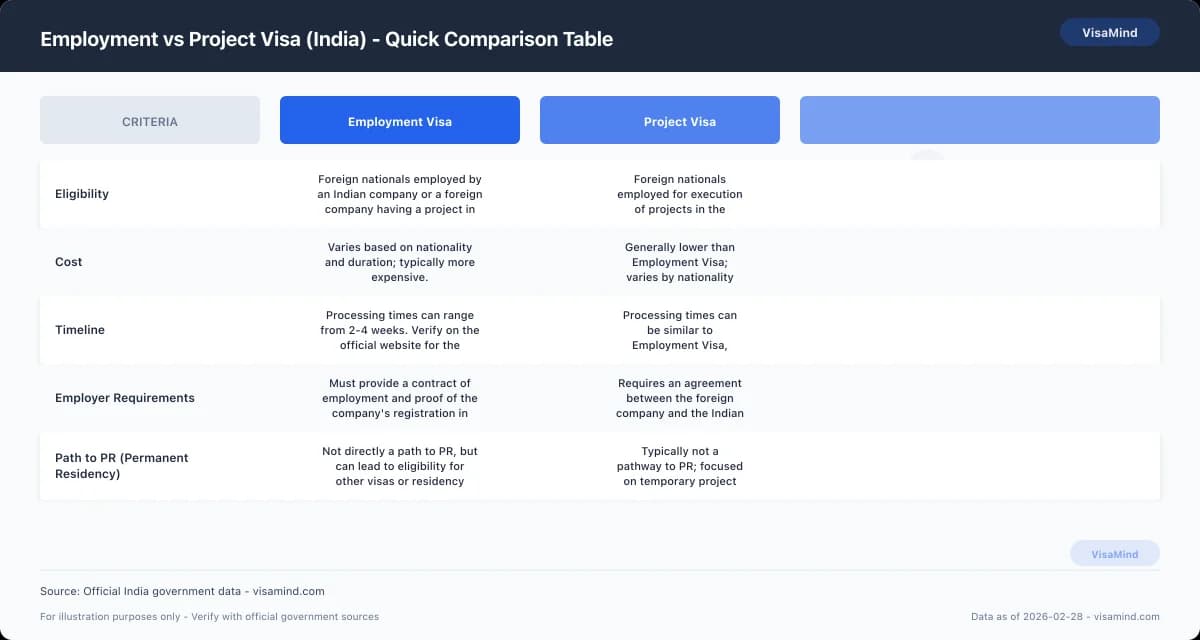
India offers two primary work-related visas for foreign nationals: the Employment Visa and the Project Visa. Each visa type caters to specific employment circumstances, governed by the Bureau of Immigration and processed by the Foreigners Regional Registration Office (FRRO) within India.
Eligibility Criteria Differences
The Employment Visa is designed for individuals who have been offered a regular job in India with a remuneration exceeding $25,000 per annum. It is typically aimed at skilled workers employed by Indian companies or multinationals operating in India. In contrast, the Project Visa is specifically for foreign nationals coming to India to execute projects in the power and steel sectors. This visa is project-specific and linked to the duration of the project, making it unsuitable for permanent or long-term employment in India.
Cost Implications
Visa fees for both Employment and Project Visas vary based on the applicant's nationality and the duration of the stay. As of 2026, fees can range from ₹8,000 to ₹15,000. It's advisable to check the latest fee structure on the official Bureau of Immigration website.
Important: Visa fees are non-refundable, even if the application is rejected. Ensure all documentation is accurate before submission.
Processing Time Variations
The processing time for an Employment Visa is generally longer due to the need for verification of employment credentials and the salary threshold. Typically, it takes about 2 to 4 weeks. A Project Visa might be processed faster, often within 2 weeks, as it is tied to specific projects with predefined terms. However, delays can occur if additional documentation is required.
Tip: Applying well in advance is recommended to accommodate any unforeseen delays, especially during peak travel seasons.
Employer Sponsorship Needs
| Visa Type | Employer Sponsorship | Additional Requirements |
|---|---|---|
| Employment Visa | Mandatory | Employment contract, salary details |
| Project Visa | Project-specific approval | Project contract, project duration |
What People Get Wrong
#In India, the Employment Visa and Project Visa are tailored for different work situations. While both allow foreigners to work in India, the specific requirements and purposes often lead to confusion.
Misunderstandings About Duration
One common misconception is that both visas offer the same duration of stay. An Employment Visa is typically granted for the duration of the employment contract, up to a maximum of five years. In contrast, a Project Visa is specific to the project duration and is usually granted for a shorter period, often not exceeding one year.
Important: Verify the visa duration for your specific project or employment contract on the official Bureau of Immigration website.
Confusion Over Work Scope -
An Employment Visa allows individuals to work in a variety of sectors, provided they have a valid employment contract with an Indian company. - A Project Visa is specifically for the execution of projects in the power and steel sectors, and does not allow for work outside the scope of the project.
Warning: Engaging in activities outside the specified scope of the Project Visa can lead to visa violations and potential penalties.
Assumptions About Flexibility
Many assume that both visas offer similar flexibility in terms of changing employers or roles. However, the Employment Visa allows for more flexibility within the same employer, while a Project Visa is tied strictly to the project and employer that it was issued for.
Tip: If you anticipate needing to change employers, consider applying for an Employment Visa for greater flexibility.
Who Chose What and Why
#In India, professionals such as IT consultants and manufacturing experts often face a choice between Employment Visas and Project Visas. The decision depends on the nature of their work and the duration of their stay in the country.
Case Study: IT Consultant in India
An IT consultant from Germany was tasked with overseeing a software development project for a multinational company based in Bengaluru. With a project duration of six months, the consultant needed a visa that would allow him to work legally in India for the entire period. After consulting the Bureau of Immigration guidelines, he opted for the Project Visa since it was tailored for professionals involved in specific projects in India. This visa aligned perfectly with his assignment timeline and project specifications. The application was lodged through the Indian mission in Berlin, and the visa was granted within a few weeks, allowing the consultant to start his assignment on schedule. The Project Visa facilitated seamless entry and ensured compliance with India's immigration policies.
Manufacturing Expert's Visa Choice
A manufacturing expert from Japan was invited to India to provide technical expertise for a new automotive assembly line in Pune. The project was set to last for 18 months, requiring a long-term stay. Given the duration and nature of the work, the expert decided to pursue an Employment Visa. This visa type is ideal for long-term assignments and was processed through the Foreigners Regional Registration Office (FRRO) to ensure compliance with local employment regulations. The Employment Visa was approved, enabling him to stay in India for the entire duration of the project. The choice of visa supported his long-term engagement with the Indian company and provided necessary legal backing for his work.
Why Engineers Prefer Project Visa
Engineers involved in infrastructure development projects in India often prefer the Project Visa. This visa type is specifically designed for those participating in government-approved projects, offering a streamlined process tailored to their needs. For instance, a civil engineer from France was engaged in a year-long road construction project in India. The Project Visa offered a simple application process through the Bureau of Immigration, accommodating his work schedule and project specifications. With the Project Visa, the engineer was able to focus on his duties without worrying about visa compliance issues, as it was specifically aligned with the nature of his work in India.