What This Family Visa Covers — Japan dependent visa
#
A dependent visa lets you live in Japan with your sponsoring family member while they hold a valid residence status. It sets out who qualifies, whether you can work, and how long you can stay under ISA rules.
Who qualifies
You’re eligible if you’re the spouse or legally recognized child of a foreign national who holds a valid mid- to long-term residence status in Japan.
ISA generally recognizes:
- A legally married spouse
- A biological or legally adopted child who is a minor and financially dependent
A genuine family relationship and financial support from the sponsor must be shown. You’ll need to provide your marriage certificate, birth certificate, and evidence your sponsor can support you in Japan.
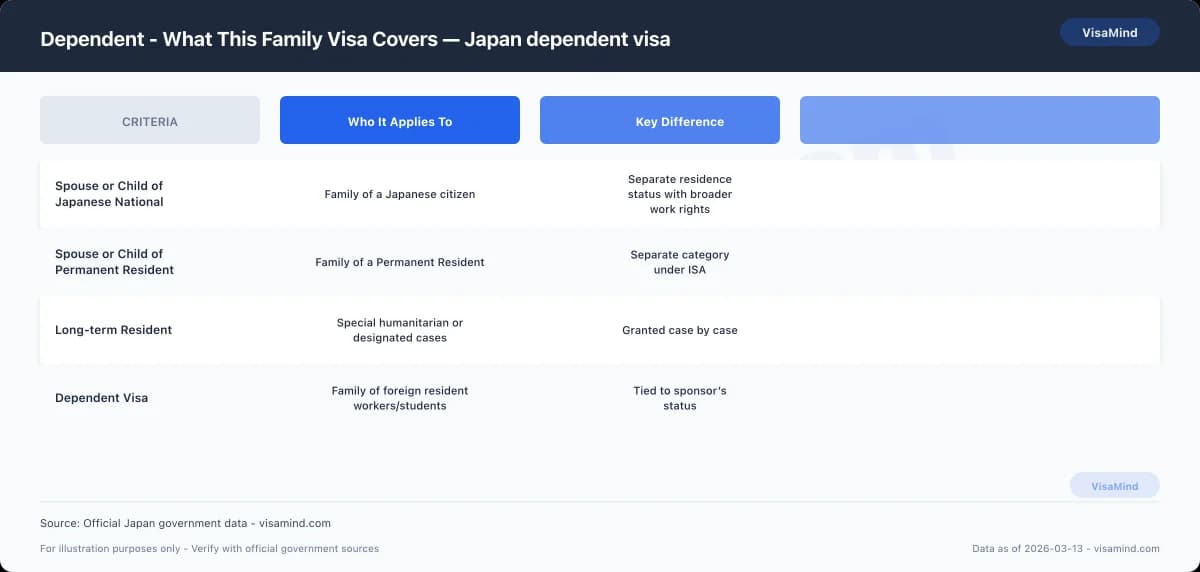
This visa is distinct from the following statuses:
| Status | Who It Applies To | Key Difference |
|---|---|---|
| Spouse or Child of Japanese National | Family of a Japanese citizen | Separate residence status with broader work rights |
| Spouse or Child of Permanent Resident | Family of a Permanent Resident | Separate category under ISA |
| Long-term Resident | Special humanitarian or designated cases | Granted case by case |
| Dependent Visa | Family of foreign resident workers/students | Tied to sponsor’s status |
If your spouse is a Japanese citizen or Permanent Resident, you must apply under the appropriate family status rather than a dependent visa.
You apply through a formal Form Visa Application process with ISA.
Work permissions
A dependent visa does not automatically allow full-time work.
You’ll have to apply separately to ISA for permission to engage in activities outside your current status if you want to work. Without this authorization, you can’t legally earn income in Japan.
Key points:
- Employment is restricted unless ISA grants permission.
- Unauthorized work can affect your current status and future applications.
- Your stay remains tied to your sponsor’s residence status.
If you need more flexible work rights, you may later consider other residence categories, including those that can lead to Permanent Residence, if you qualify independently.
Scope of stay
Your dependent visa lets you:
- Live in Japan with your sponsoring family member
- Enroll in school
- Open bank accounts and sign housing contracts, subject to standard requirements
Your period of stay matches or depends on your sponsor’s authorized stay. If your sponsor renews or changes status, you’ll also need to apply to extend or change your status through ISA.
This visa does not act as Visa Exemption (Visa-Free Entry). You must hold proper residence status to live long term in Japan.
If your family situation changes—like divorce, death, or your sponsor losing status—you must notify ISA and may need to change your residence status to remain legally in Japan.
Conditions and Rights
#A dependent visa lets you live in Japan with your sponsoring family member, but it doesn’t guarantee entry or unlimited stay. Immigration officers and the Immigration Services Agency (ISA) control admission, status, and compliance with residency rules.
Entry and port-of-entry decisions
A valid visa and a successful Form Visa Application don’t guarantee admission to Japan. An immigration inspector at the airport or seaport makes the final decision on whether you may enter.
You’ll need to show documents that confirm your purpose and ability to stay as a dependent.
Carry these items in your hand luggage:
- Your passport with the dependent visa
- Documentation showing your relationship to the sponsor
- Details of your accommodation in Japan
- A return or onward ticket, if applicable
- Proof that you have sufficient financial support
If you previously entered Japan under Visa Exemption (Visa-Free Entry), that status is different from a dependent visa. You must enter under the correct visa category that matches your approved status.
If you hold or previously held a different status, such as Spouse or Child of Japanese National, Spouse or Child of Permanent Resident, or Long-term Resident, the entry officer will review your current visa category, not your past one.
| Key Point | What It Means for You |
|---|---|
| Visa issuance | Allows you to travel to Japan |
| Port-of-entry inspection | Determines if you may enter |
| Final authority | Immigration inspector at arrival |
Residency conditions
Your stay in Japan is subject to the conditions attached to your dependent status. The Immigration Services Agency (ISA) oversees status control, extensions, and changes of status.
You must continue to qualify as a dependent of your sponsor. If your relationship changes or your sponsor loses status, your dependent status may also be affected.
Dependent status is not the same as:
- Spouse or Child of Japanese National
- Spouse or Child of Permanent Resident
- Long-term Resident
- Permanent Residence
Each category has different rights and stability of stay. If you later qualify for a more stable status, you must apply through ISA for a change of status.
Always keep your period of stay valid. If you need an extension or change, follow the procedures set by ISA and consult its official guidance for current requirements.
What to expect on arrival
At arrival, immigration officers will inspect your passport and visa. They’ll confirm that your purpose of stay matches your dependent status.
You should expect:
-
A document check
-
Questions about your sponsor and living arrangements
-
Verification of financial and travel details
Answer clearly and consistently with your application records.
If the officer determines that you do not meet entry conditions, they may deny admission despite your visa. Prepare your documents in advance and keep them accessible.
Entry approval allows you to begin your stay under the specific conditions of your dependent status. You must follow those conditions from the first day you enter Japan.
What to Submit
#You must file a complete and accurate set of documents with the Immigration Services Agency of Japan (ISA). Missing or non-compliant items often delay review.
Application form and passport
You must submit the official “Dependent” application form issued by the Immigration Services Agency of Japan (出入国在留管理庁) (ISA). Use the correct form for a Dependent status application and complete every field clearly and consistently.
Provide:
- One completed Dependent Form Visa Application form
- Your valid passport
The information in your form must match your passport exactly, including spelling, order of names, and dates. Inconsistencies can slow processing or require corrections.
If you previously held another status, such as Spouse or Child of Japanese National, Spouse or Child of Permanent Resident, Long-term Resident, or Permanent Residence, confirm that your personal details remain consistent across all records.
If you are entering Japan under Visa Exemption (Visa-Free Entry) and plan to apply for a status change, verify current procedures directly with the Immigration Services Agency (ISA) before submitting your application.
Photograph rules
You’ll need to submit one photograph that meets ISA specifications. Photo errors frequently cause delays.
Your photo must meet all of the following requirements:
| Requirement | Specification |
|---|---|
| Size | 4.5 cm x 4.5 cm |
| Age of photo | Taken within the last 6 months |
| Background | Plain white background |
| Headwear | No hats |
| Eyewear | No sunglasses |
The image must clearly show your face. Avoid shadows, filters, or altered images.
If your photo doesn’t meet these standards, ISA may reject the application or request a replacement. Using a professional photo service familiar with Japanese visa photo requirements is usually best.
Other required evidence
The core required items are limited and specific:
- One passport
- One completed Dependent application form
- One compliant photograph
Submit these documents together as part of your Visa Application to the Immigration Services Agency (ISA).
The ISA handles immigration applications and status changes in Japan. For questions about procedural details, submission methods, or additional documentation in special cases, confirm directly with the Immigration Services Agency (ISA) before filing.
Fees and Processing Times
#You must pay a government fee for visa issuance and plan for a processing period that can extend several months. Costs are fixed for single-entry visas, but timelines vary depending on where and how you apply.
Visa fees
You pay a ¥3,000 visa issuance fee for a single-entry Japan dependent visa (as of February 2026). The fee applies when the visa is issued by a Japanese Embassy or Consulate.
| Item | Amount (JPY) | Notes |
|---|---|---|
| Single-entry dependent visa | ¥3,000 | Paid upon visa issuance |
The fee amount does not change based on whether your sponsor holds statuses such as:
- Spouse or Child of Japanese National
- Spouse or Child of Permanent Resident
- Long-term Resident
- Permanent Residence
If you qualify for Visa Exemption (Visa-Free Entry), you do not pay this visa issuance fee. However, visa exemption eligibility depends on your nationality and travel purpose. Confirm current fees and exemptions with the Immigration Services Agency of Japan (ISA) or the issuing embassy or consulate before you apply.
Standard processing window
Processing for a dependent visa typically takes 1 to 3 months (as of March 2026). You’ll need to factor this timeline into your relocation plans.
| Stage | Typical Timeframe |
|---|---|
| Dependent visa processing (standard) | 1–3 months |
The processing time varies by visa category and location. The ISA handles status-related immigration matters inside Japan, while embassies and consulates issue visas abroad.
Apply at least 2–3 weeks before your intended travel date. In many cases, embassies or consulates complete visa issuance in about 5 business days, but peak seasons can extend this period.
Always verify current timelines directly with the issuing authority. Processing times can shift without notice.
Variations by location
Your processing time depends on where you submit your Form Visa Application. Applications filed at different Japanese Embassies or Consulates may move at different speeds.
If you apply in your country of residence, the local mission manages your file. High application volumes or seasonal demand can delay issuance beyond the typical 5-business-day window.
If your sponsor changes status inside Japan—such as to Permanent Residence or Long-term Resident—the ISA processes that status separately from your overseas visa issuance. Each step can affect your overall timeline.
Because timelines differ by location and workload, confirm expected processing times directly with the specific Japanese Embassy, Consulate, or the Immigration Services Agency (ISA) handling your case.

How to Apply
#You’ll need to obtain the correct application form, complete it accurately, and submit it with the required supporting evidence to the appropriate authority. Most applicants first secure a Certificate of Eligibility (COE) issued by the Immigration Services Agency of Japan (ISA), which confirms that you meet the landing conditions for a dependent status.
Where to get forms
Use only the latest version of the form.
The ISA issues different instructions depending on your eligibility category. Review the guidance that matches your situation before you begin.
| If Your Sponsor Holds | Review Category Instructions For |
|---|---|
| Japanese nationality | Spouse or Child of Japanese National |
| Permanent Residence | Spouse or Child of Permanent Resident |
| Long-term Resident status | Long-term Resident |
| Work or other mid/long-term status | Dependent status guidance under ISA rules |
If your sponsor already obtained a Certificate of Eligibility, confirm that the details on your visa application match the COE exactly. Inconsistent information can delay processing.
If you’re unsure which status applies, check the definitions provided by the Immigration Services Agency (ISA) before submitting your Visa Application.
Filling, signing and packaging
Complete every required section of the form. Don’t leave mandatory fields blank.
Follow the written instructions for your specific eligibility category. The requirements for a Spouse or Child of Japanese National differ from those for a Spouse or Child of Permanent Resident or a Long-term Resident.
Before signing, confirm that:
- Your name matches your passport exactly
- Your sponsor’s status is stated correctly
- Your information matches the Certificate of Eligibility (if issued)
- All required supporting evidence is included
Sign the form where indicated. Unsigned applications may not be accepted.
Arrange your documents in a clear order. Place the completed Visa Application form together with the required evidence as instructed by ISA. Do not staple documents unless the instructions specifically require it.
Submission options and eVisa note
Submit your application according to the instructions for your location and status category. The Immigration Services Agency (ISA) handles status-related filings within Japan, including the Certificate of Eligibility.
If you're applying from abroad, follow the procedure indicated in the dependent visa guidance. Verify the correct filing method before appearing in person.
The JAPAN eVISA system applies only to short-stay tourism for eligible nationalities. It doesn't replace the dependent visa process.
If you qualify for Visa Exemption (Visa-Free Entry) for short visits, that entry status doesn't grant dependent residence. You still need to complete the dependent Visa Application process for long-term stay.
When to Get Help
#Some dependent visa cases move without much trouble. Others involve status changes, closer scrutiny by the Immigration Services Agency of Japan (ISA), or risks at the visa stage and at entry.
Complex or borderline cases
Professional help is important if your situation doesn't fit a clear pattern under the Dependent status.
Common situations include:
- Your sponsor recently changed status (for example, from a work status to Permanent Residence).
- You may qualify instead under Spouse or Child of Japanese National, Spouse or Child of Permanent Resident, or Long-term Resident.
- You previously stayed in Japan under Visa Exemption (Visa-Free Entry) and now plan to file a Form Visa Application after receiving a Certificate of Eligibility (CoE).
Each status has different eligibility standards and document expectations. Filing under the wrong category can delay your case or result in refusal.
A professional can:
-
Compare possible statuses.
-
Confirm which status fits your family relationship.
-
Review your documents before submission to ISA.
| Situation | Why It Matters |
|---|---|
| Sponsor holds Permanent Residence | You may qualify for a different status with different conditions |
| Marriage or birth occurred recently | ISA may examine timing and documentation closely |
| Prior short-term stay in Japan | Entry history can affect visa review |
Borderline cases call for careful document strategy.
Risks even after a CoE
A Certificate of Eligibility doesn't guarantee that a visa will be issued.
After ISA issues a CoE, you still need to complete a Visa Application at a Japanese embassy or consulate. The consular officer can independently assess your case.
Get help if:
- Your personal history changed after CoE issuance.
- There are inconsistencies between your CoE application and your visa application.
- You previously had a visa refusal for Japan.
A professional can check for discrepancies in:
- Sponsor income information
- Family registration documents
- Stated purpose of stay
Even small inconsistencies can cause delays or refusal at the visa stage. The CoE details and visa application details must align exactly.
If you're unsure whether to apply as a Dependent or under Spouse or Child of Japanese National or Spouse or Child of Permanent Resident, resolve that before submitting your visa application.
Entry and inspection concerns
Visa issuance isn't the end of the process. Immigration officers at the airport or port of entry make the final decision on landing permission.
Seek advice if:
- Your circumstances changed after visa issuance.
- You plan to enter under Visa Exemption (Visa-Free Entry) while a status-related application is pending.
- You hold multiple possible residence categories, such as Long-term Resident eligibility.
At inspection, officers review:
- Your visa
- Your passport
- The stated purpose of stay
- Consistency with your approved status
If your intended activities don't match your granted status, you risk denial of landing.
A professional can help confirm that your entry plan matches the status granted by ISA and that your documents support your declared purpose.
Sponsor and Applicant Requirements — dependent visa Japan
#Your sponsor in Japan must take the lead in securing immigration approval before you apply. You must also meet document and category requirements that match your relationship and nationality.
The Immigration Services Agency of Japan (ISA) reviews both the sponsor’s status and your supporting records.
Sponsor responsibilities
Your sponsor in Japan initiates the process for long-term stays. This includes work and study statuses that allow family members to apply as dependents.
Your sponsor must obtain a Certificate of Eligibility (CoE) from the Immigration Services Agency (ISA) before you submit your Form Visa Application. CoE processing usually takes 1 to 3 months, so start early.
Sponsor responsibilities include:
- Applying for the Certificate of Eligibility through ISA
- Providing supporting documents that confirm their lawful status in Japan
- Confirming the qualifying family relationship
Without an approved CoE for long-term stays, you can't proceed with a dependent visa application at a Japanese embassy or consulate.
If your sponsor holds or is applying under categories such as:
- Spouse or Child of Japanese National
- Spouse or Child of Permanent Resident
- Long-term Resident
- Permanent Residence
ISA will review the sponsor’s status as part of the assessment.
Eligibility categories
You must qualify as a dependent under a recognized residence status category. ISA examines your relationship to the sponsor and whether it fits within an approved framework.
Common qualifying sponsor categories include:
| Sponsor Status | Dependent Eligibility Basis |
|---|---|
| Spouse or Child of Japanese National | Legal spouse or child relationship |
| Spouse or Child of Permanent Resident | Legal spouse or child relationship |
| Long-term Resident | Recognized family relationship |
| Work or Study Status (long-term) | Requires prior CoE approval |
You must submit a formal Visa Application after the Certificate of Eligibility is issued, unless you fall under a different status granted inside Japan.
Visa Exemption (Visa-Free Entry) doesn't replace the need for proper residence status if you intend to stay long term. The dependent visa process is required for stays beyond short-term entry allowances.
ISA makes the final determination on eligibility.
Nationality-specific requirements
Your nationality may determine additional document requirements. You must check the specific instructions issued by ISA or the Japanese diplomatic mission where you apply.
For example:
- Chinese nationals must submit:
A copy of the Chinese Family Register
- A Temporary Residence Permit or Residence Certificate
ISA uses these documents to verify identity, household registration, and legal residence status.
If your documents are incomplete or inconsistent, your application may face delays. Confirm document standards with the Immigration Services Agency of Japan (ISA) before submission.
Prepare nationality-specific civil documents in advance, especially when a Certificate of Eligibility is already approved and time-sensitive.
Why Family Visas Get Denied
#Most denials result from preventable filing errors. You can avoid rejection by submitting consistent information, compliant photos and documents, and applying through the correct embassy or consulate with a valid passport and required eligibility documents.
Incomplete or inconsistent information
You must complete your Form Visa Application form with details that match your passport and supporting records. Even small differences in spelling, dates, or document numbers can lead to rejection.
This issue often affects applicants for Spouse or Child of Japanese National, Spouse or Child of Permanent Resident, Long-term Resident, and dependent statuses. The Immigration Services Agency of Japan (ISA) expects full consistency across all forms and attachments.
Pay close attention to:
- Passport number and expiration date
- Name order and spelling
- Dates of birth and marriage
- Residential address history
For long-term stays, including a Japan dependent visa, you must also obtain a Certificate of Eligibility (CoE) before applying. Submitting a long-term visa application without a CoE often results in refusal.
| Common Error | Likely Outcome |
|---|---|
| Mismatched passport details | Rejection |
| Missing Certificate of Eligibility | Rejection |
| Incomplete answers | Rejection or delay |
Review every page before submission. Don't leave blanks unless the form clearly allows it.
Photo and document non-compliance
Japanese consulates strictly enforce photograph standards. If your photo doesn't meet the specifications, the office may delay or refuse your application.
Your photo must meet all of the following:
- Size: 4.5 cm x 4.5 cm
- Background: plain white
- Taken within the last 6 months
- No hats or accessories
Many applicants submit photos in the wrong size or with non-white backgrounds. That alone can delay processing.
You must also ensure your supporting documents meet requirements. For long-term status such as dependent, work, or study, you need a valid Certificate of Eligibility issued by the ISA before filing at the embassy or consulate.
Failure to provide required documents results in refusal.
Applying at the wrong office and passport issues
You must apply at the Japanese Embassy or Consulate that has jurisdiction over your place of residence. Filing at the wrong office often leads to rejection.
Jurisdiction rules are strict, even if you qualify for Visa Exemption (Visa-Free Entry) for short stays. A dependent visa requires formal processing at the correct location.
Your passport must also meet two basic conditions:
- Valid for the full duration of your intended stay
- Contains blank pages for visa attachment
If your passport lacks sufficient validity or blank pages, the consulate may refuse your application.
Check these points before booking an appointment. Small administrative errors can prevent approval, even if you otherwise qualify for Permanent Residence-related or family-based statuses.
Fees
#| Component | Amount |
|---|---|
| Visa issuance feeVisa issuance fee: ¥3,000 (approx $20 USD) (as of 2026-02). Verify the current fee on the official schedule before filing. | ¥3,000 (approx $20 USD) |
Fees change; always verify on ISA.